Tag Archives: Abbie Jury

Prole drift in New Zealand gardening

The rococo styled fountain has drifted down the road from us

The rococo styled fountain has drifted down the road from us

Prole drift. I had never heard of it until last week but I was greatly amused by it. The usual example of prole drift is the devaluing of status suffered by the Burberry plaid when it was embraced with gusto by the chavs of the UK (referred to, apparently, as a downmarket demographic). The SUV is undergoing a similar slide in status. The classic Range Rover slipped a little when Japanese manufacturers started making more reasonably priced models. But those new generation sports utility vehicles still came with a reasonably hefty price tag and appealed to the wealthy middle classes who wanted to look as if they were forever whipping up to the ski fields, whether or not it was true. “The four wheel drive is so handy – eliminates the need for chains, don’t you know.” In those early days, such vehicles were often referred to as urban tractors or Remuera shopping baskets. These days they are just as likely to be Manukau or Pakuranga Tractors. There is a certain inevitability that the status symbols of the privileged will be coveted just as much by those a little lower, or indeed much lower, on the socio economic ladder.

But as I pondered prole drift, it occurred to me that it is a remarkably good description of much of New Zealand gardening. In an earlier column, I asked whether there was such a thing as the New Zealand garden. I came to the conclusion that there are certainly some defining characteristics. At that time, I wrote:

It must be something in our egalitarian heritage which has many New Zealanders taking the ideas of the large, historic gardens – especially in Britain though sometimes from wider Europe – and attempting to re-create something similar here. We seem to be oblivious to the fact that the vast majority of the great gardens of Europe and Britain were established and maintained by the wealthy and the powerful who could afford to pay gardeners to actually do the work. So we go for high maintenance gardening styles (clipped hedges, a touch of topiary, sweeping lawns, mixed borders, buxus enclosures around statuary) – all the trappings of the gentry and the nobility which our forbears were so keen to leave behind.

Prole drift! That is what it is: prole drift. We are still at the stage of wanting the status and class (prounounced something akin to claarss) and thinking that if we embrace the status symbols of those further up the social scale, somehow the mystique of privilege will envelop us as well. It is not our egalitarian heritage after all. It is covetous envy and has resulted in scores of mini-Sissinghursts and even mini-Villandrys with barely a smidgeon of originality. Buxus hedges in abundance, tightly clipped, filled with either neat and decorative vegetables (which makes it a potager), citrus trees (which makes it Italianate), colour toned perennials or annuals in formal style (French parterres) or a froth of artfully casual blooms lifted by the mandatory white cosmos or foxgloves (which passes for English cottage style but tightly corseted by encircling low hedges) , with accents of clipped topiary balls or pyramids, even the occasional knot garden, all ornamented with obelisks, Lutyens styled garden seats, pergolas, formal avenues, laburnum arches, and… marble garden features. Diana, perhaps, something armless or a small fountain.

The funny thing is that so far so good – this heavily derivative style of prole drift gardening has indeed been accorded status and recognition in this country and, scarily, is often equated with style, superior taste and class. It remains to be seen what happens as it continues its drift sideways and downwards.

The evolution of a New Zealand style of gardening better suited to our conditions (geographic, climatic, botanic, cultural and financial) will continue. Genuinely original gardens shine and in time, we may see a decline in popularity of the current prole drift styles.

Random piece of information: just beyond Hoi An in Vietnam, on the road to Danang are the Marble Mountains. These are mined and the local craftsman can create whatever you desire and to whatever scale you wish. What is more, they will then pack it and ship it to your home. On the day we visited, the striking memory was of the carved American eagle, but the factory was full of repro classical statuary. You too can order your greatest desire – and at third world prices. They were doing a roaring trade in the classical figures. I am afraid I still subscribe to the view that if you can’t have an original (and the British museums got first dibs on a large quantity of them), then you are better off to have nothing.

Repro classical statuary to your heart's desire from the Marble Mountains near Hoi An in Vietnam

Repro classical statuary to your heart's desire from the Marble Mountains near Hoi An in Vietnam

A final few words about the rococo fountain: it belongs to Pat. I do not for one minute think that Pat believed that this recent installation in her front garden would elevate her social status. It is equally unlikely that she has looked into the rococo forbears of her fountain. No, she bought it because
a) she really liked it
b) it was cheap
and c) she has a very obliging husband who was willing to install it for her. I just think that the fountain may have drifted as far as it can – it may have reached its ultimate destination.

Plants that Delight

This article was first published in the Weekend Gardener Magazine, issue 316, June 2 – 15, 2011

Bromeliads - a vriesea

Bromeliads - a vriesea

Bromeliads
Generally speaking, I am not a fan of prickly, spiky plants (I have always felt that yuccas in particular were aptly named) but I am willing to make an exception for the bromeliad family even though it means donning protective gear when it comes to working amongst them. We use them extensively in dry woodland conditions and for much of the year they just sit around being extremely undemanding, bar the occasional clean up to remove accumulated debris.

It is when they flower, that bromeliads look exotic. The range of blooms is extraordinary and there is nothing quite like them. Some of them have strange, flattish flowers which might be cast out of thick wax, dyed in parrot colours. What is more, the flowers last for ages. I haven’t timed them but we are into months, rather than weeks. This one is a vriesea of some sort but we have never become experts on the genus, despite growing a range of different ones. Our cool, frost free, high shade conditions keep them looking particularly lush. With some of our plantings dating back to the early 1950s, we would rate them as one of the lower maintenance garden plants.

Bromeliads are readily available and many are easy to multiply for the home gardener. If you want to learn more about bromeliads, check out “Bromeliads for the Contemporary Garden” by Weekend Gardener writer, Andrew Steens.

Meconopsis

Meconopsis

Meconopsis
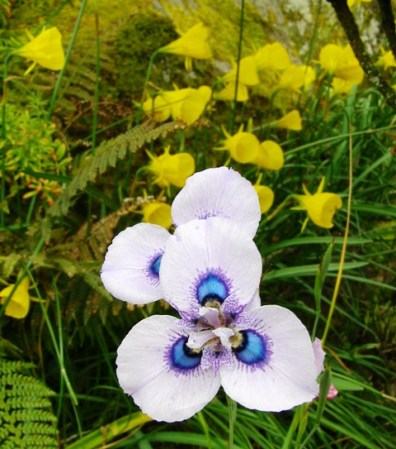
The simplest poppy form – a mere four petals surrounding a ring of golden stamens – is always charming, no matter the colour. When it comes in pure blue, it enters a league of its own.

Coming from the Himalayas, these are plants which are happier in much drier, colder conditions. We have to work at keeping them going here, where we have high rainfall, high humidity and generally mild conditions. They certainly don’t seed down and naturalise for us as they will in parts of the South Island but when they come into flower each spring, it is worth every bit of effort.

We don’t generally let them flower in the first year because if they put their effort into setting seed, the young plants tend to die. If we delay the flowering, we have more chance of some at least becoming perennial, albeit still comparatively short lived. Fresh seed is easy enough to raise but best done in seed trays and not merely broadcast to the ground with a wish and a prayer.

Meconopsis are available in New Zealand both as seed and as plants. If you have a choice, Meconopsis x sheldonii shows a little more vigour than either grandis or betonicifolia. All come in blue, though there are also white, pale yellow and red meconopsis which are nice to add in to a garden but no replacement for the beautiful and eye-catching blue.

Magnolia Felix Jury

Magnolia Felix Jury

Deciduous magnolias
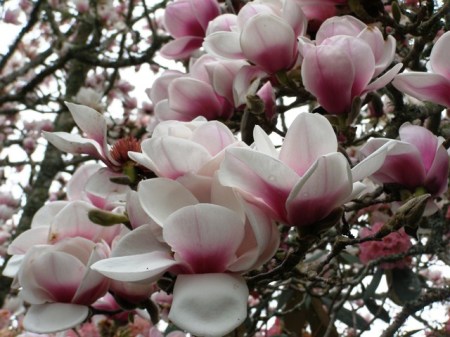
How could I be a Jury and not put deciduous magnolias in my top favourites? These trees are surely one of the most spectacular on the planet when in full flower, though it has to be said that the bigger the flower, the better in terms of impressive display.

Magnolia trees just get better with size and age which seems entirely appropriate for a genus which is ancient – so old that it does not even have proper petals. What we usually call petals are in fact tepals. They evolved before bees so originally adapted to be pollinated by beetles – hence the fact they have pollen but no nectar.

To get maximum flowering, select a variety which sets flower buds down the stem rather than just on the tips. Some varieties like the purple Lanarth can take your breath away but only for about 10 days. Others, like Iolanthe or Felix Jury, flower over many weeks, extending the display. Indeed, spring flowering on Iolanthe extends over at least eight weeks from first to last bloom and there is the bonus of random flowers over summer.

Daphne genkwa

Daphne genkwa

Daphne genkwa
A daphne with no scent? Yes, but it is so spectacular in flower that the absence of fragrance does not seem to matter. It is also deciduous, which we do not expect from a daphne and it flowers before it comes into leaf so all that is visible is a mass of graceful whips smothered in lavender blue flowers.
I think you can never have too much blue in a garden. It is a colour that complements all others and while I will admit that genkwa is not a pure toned blue, it is still blue enough for me.

D. genkwa is not easy to propagate and is generally increased from root cuttings. Neither is it easy to get established. In fact it is definitely on the touchy side. This plant was a particularly fine specimen but outgrew its allotted space so I pruned it after flowering, as you do. It promptly died, to my great disappointment. I am trying again, but this time as specimen shrubs with plenty of space to grow so they will not need to be pruned. Daphne genkwa is available in New Zealand but is not standard garden centre fare so you may need to find an obliging operator to order it in for you. It is a Chinese shrub and, being deciduous, it is generally rated as hardy.

Narcissus cyclamineus

Narcissus cyclamineus

Dwarf narcissi
In a large garden with some enormous trees, we love the tiny treasures that give detail to the bigger picture. We also have more success with the baby narcissus than with their larger cousins. They don’t seem to be quite so vulnerable to the dreaded narcissi fly, possibly because many of them flower earlier in the season.

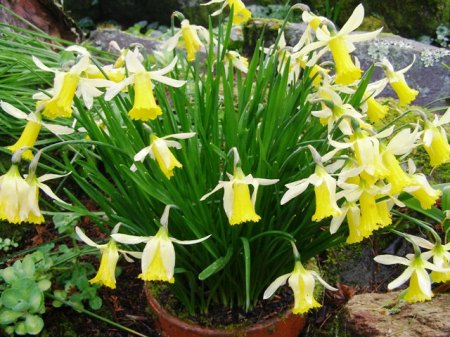
These little cyclamineus seedlings always make us smile. With the reflexed skirt of petals, they are rather reminiscent of floppy eared dogs with the heads out the car window and ears streaming behind in the wind.

We grow a whole range of different dwarf varieties – species, named hybrids and unnamed seedlings, tucked into positions around the garden. The first to bloom are the Narcissus bulbocodium citrinus or hooped petticoat types which can show colour as early as late April while others continue the display through to late September. The best known dwarf variety is probably Tete-a- Tete, but there are innumerable others which are offered for sale from time to time.

Cyclamen hederafolium

Cyclamen hederafolium

Cyclamen species
These little treasures mostly hail from southern Europe and northern Africa but some varieties are particularly suited to New Zealand gardens.

The most widely available variety is Cyclamen hederafolium (formerly known as neapolitanum) which puts its first flowers up in our garden in January and flowers through until May or even June. After that, the marbled, heart-shaped leaves are attractive in themselves. C. hederafolium comes in shades of pink and pure white. Following on from them, we have a lot of success with C. coum in winter and C. repandum in spring.

Cyclamen are particularly successful planted in drifts on woodland margins in dappled light but they are pretty adaptable in a range of conditions as long as they have good drainage. They are easy enough to raise from fresh seed if you know of anybody with plants and they grow to form tubers which are like round, flattish discs.

Rhododendron Yvonne Scott

Rhododendron Yvonne Scott

Rhododendrons
Unfortunately, the glory days of rhododendrons have been and gone in this country, but we would not be without them in our garden. Our particular favourites are the nuttalliitypes with their large, waxy trumpet flowers, most of which are scented. Combine that with big, heavily textured leaves (the technical term is bullate foliage) and the most beautiful cinnamon brown bark which peels off in long tendrils leaving a shiny trunk behind.

Add in the fact that these plants show generally healthy characteristics in warmer climates. They can get a touch of thrip but nowhere near as much as colder climate plants and they are not susceptible to the brown crisping round the edges of the leaves which disfigures so many varieties.

If I could only grow one rhododendron, R. sino nuttallii would be my first choice. Sino just means it comes from China (there is another Himalayan form). Fortunately we can grow many so we have a fair range of the nuttalliis and their hybrids, including the lovely and distinctive Yvonne Scott. Huge lime green buds open to lime flowers which fade out to white within two days, but keep the green flare in the throat. Mi Amor is probably the most widely available nuttallii hybrid on the market. While we might not rate it as the best, nuttalliis are not readily available so you might have to grab whatever you can find.

The end of an era – but another door will open

The steady flow of posts on this page has been the material I wrote for our local newspaper – the Taranaki Daily News. That all stopped in its tracks this week. After 14 years, I am no longer their garden writer.

While a little surprised at this sudden turn of events, the relief was instant. I realised that I had become bored churning out an endless flow of material to agreed formats. It is time for new challenges. In the short term, this means that there will not be the three new articles every Friday. Without the discipline of a newspaper deadline, posts will be random. But I am a compulsive writer and exploring other outlets, so something will continue, even if I am not yet sure what that will be.

In the meantime, I have had a lovely week in the garden, beavering away on a particularly troublesome border. To be free from deadlines has been liberating. I will not miss trying to come up with fresh ways of reminding people what to do in the garden week in and week out, 52 times a year. Over morning coffee (with home baking here, as a rule) I would pose the question to Mark and Lloyd every week as to what we should be doing and most weeks they would look back at me with blank looks. And I was running out of ideas for Outdoor Classroom.

I will miss doing Plant Collector and my column, particularly Collector which is fun to write so that may well continue. A number of people subscribe to this website and receive new posts direct to their email address. There is no charge to subscribe so if you have been in the habit of visiting each week, you may prefer to sign up, while posts are less predictable. Mind you, it looks better on the website than it does in email format.

Best regards,
Abbie

The Sequel – a second coming for the Tui NZ Fruit Garden

The first version to the left, the revised edition to the right.

The first version to the left, the revised edition to the right.

After due consideration, Mark's verdict was an emphatic thumbs down

After due consideration, Mark's verdict was an emphatic thumbs down

I am married to a patient and kind man but he has been looking ever more exasperated over the last two weeks. I put The Tui NZ Fruit Garden in front of him for comment because his experience with growing fruit and nuts is greater. As he dipped in and out of various chapters, he was finally moved to exclaim that he could not fathom why Tui, Tony Murrell and Rachel Vogan would put their names to this book and give it a credibility that it does not deserve.

If this seems slightly familiar to you, dear Reader, that is not a surprise. This book is the sequel – the revised edition, it tells us on the frontispiece (but not the cover). The first version was the subject of a piece I wrote this time last year, backed up by a lead story on the front page of our newspaper and picked up extensively by national media. There was a little problem with plagiarism by the author, Sally Cameron. Well, quite a big problem really – in fact an enormous one. The publishers, Penguin, pulled the book from sale immediately, mere days after it had been released. Nobody associated with the book ever commented on that withdrawal from sale so the general assumption was it had all died a natural death. No. Little did we know, they were preparing for a second coming. And here it is. It looks the same. The author is the same. The cover has been recycled. So is it the same?

I think the plagiarised sections have gone. I didn’t do an exhaustive analysis but I would guess that they have been quite thorough, given there are legal issues to be considered. But the plagiarism was only half the problem. In reviewing the original version, I was equally critical of the woeful lack of experience and knowledge by the author. And the rewrite has highlighted this even more. At least when the author was cutting and pasting information from the internet, she was generally getting it from credible sources even if they were from overseas. Now that it is in her own words, it often plumbs new depths. “A Chilean guava, pomegranate or feijoa bush can offer hedging that is just as effective as a Buxus.” Really? Shame the pomegranate is deciduous and if you clip your feijoa like you clip your buxus, you will be taking off all next year’s fruiting tips. Or, when writing about grapevines needing support: “This can be shaped or manipulated at leisure to provide a sculptured habitat for the vines to drape from.”

Even worse is the advice on protecting your grapes: “Broad pieces of netting with holes wide enough to let the sun in but keeping, bugs, diseases and birds out help let the fruit ripen nicely on the vine.” Leaving aside the description of broad pieces, since when has any netting kept out diseases and what fine grade of mesh would you need to keep out bugs? Wasps don’t even rate a mention but they are one of the biggest problems, in our experience. The sort of information that the reader needed and deserved to be told is that Albany Surprise is an excellent selection for marginal and humid conditions. Because it has a tougher skin, if you can net the birds out then the wasps can’t pierce the skin and get in to the fruit.

At least lychees, mangoes and pineapples have been consigned to a brief two page spread at the end of the book, under the title of “Fruit not commonly grown in New Zealand owing to climatic restrictions” but it is hard to understand why carambola or star fruit, which is equally marginal, remains with a four page spread of its own in the main body of the text. Maybe the author wanted to show off her recipe for pickled carambola? Proper cranberries (Vaccinium macrocarpum) should have been grouped with the lychees and mangoes too. Equally hard to understand is why tomatoes are included in a book about fruit gardens. Yes, botanically they are a fruit but every home gardener and cook regards them as a vegetable and they are grown in the veg garden, not the orchard. Doing a cut and paste of the tomato chapter from the companion volume, the Tui NZ Vegetable Garden, could be described as having a bob each way but it is unnecessary padding in a book about growing fruit. Some of the other inclusions are odd – the medlar, introduced to this country by the early settlers, is a fairly decorative tree but not worth the space in the orchard as a fruiting tree. Given that you have to wait until the small fruit are nearly rotten before you eat them, why would you bother when we can grow apples and pears so well? Peanuts are a novelty crop grown in the vegetable garden and limited to the hottest and driest parts of the country. But don’t expect too much of that sort of information in this book. In most cases, the author lacks the experience to know what is important and to sift the information accordingly.

Take kiwifruit as an example. For starters, where can you grow them? According to this book, “The kiwifruit is an appropriate crop wherever citrus fruits, peaches and almonds are successful, though the leaves and flowers are more sensitive to cold than those of orange and peach trees.” Right. So this means kiwifruit need more warmth than citrus? But refer to the entry on almonds and it says: “Almonds happily grow in areas with warm summers and cool winters.” So I guess we are talking Hawkes Bay, Marlborough and Central Otago? Refer to peaches and it says: “… a long chilling time ensures a good fruiting crop in summer.” Even we became confused about where you can grow kiwifruit successfully but at least we know that it is a warm temperate to subtropical crop.

If you are a novice and you can deduce whether your area is suitable for growing kiwifruit, what you need to know is that it is a rampant vine and if you don’t prune it thoroughly every year, it will swamp your section and choke out everything else very quickly. The book does at least tell you that kiwifruit are not self fertile so you need both male and female though it fails to mention that only the female vine produces any fruit. I will quote the section on pruning verbatim, so readers can assess for themselves whether they would understand how to prune kiwifruit from this information (including the fact that male kiwifruit vines are pruned differently to female ones). “Pruning: After fruiting has finished, the vines should be pruned in late winter, before the spring warmth. Shoots from summer pruning will not be laden with fruit until the following year after dormancy. Male plants will yield more pollen in the spring if new shoots are pinched out to leave five to seven buds during the summer. Winter pruning renews the fruiting arms, enabling plants to fruit well each year.” Got that, have you? Now you know how to prune your kiwifruit?

Another burning question about kiwifruit which most people want to know is where to buy the new yellow cultivars. The fruit is illustrated but it doesn’t tell you that you can’t buy plants. Hort Research and Zespri, who own all the research on new cultivars, keep very tight control of plants and they are not available to the home gardener. But the book does recommend Cocktail Kiwi, an unproven novelty variety – a rampant grower which is distinctly shy on setting fruit and when it does come it is about half the size of your thumb.

Ever so modest but well thumbed. I can not think that the Tui NZ Fruit Garden will still be around in 40 years time.

Ever so modest but well thumbed. I can not think that the Tui NZ Fruit Garden will still be around in 40 years time.

Kiwifruit is just one example. The book is full of chapters which are similarly inadequate. But according to Penguin, “this book contains all the essential information you need” and “it will become the reference for gardeners of all skill levels….” We wish that were true. Had this been the first release of the Tui NZ Fruit Garden, Sally Cameron and Penguin Publishers might just have got away with it, marginal though it is. To have a second shot at the same book using the same author, it needed to be very good indeed. It isn’t. We will be keeping to our old tried and true modest volume called The Home Orchard, published by the NZ Department of Agriculture in 1973. It is not glossy or trendy but at least it is by people who knew what they were writing about and it only cost us $2.25 to buy at the time.

The Tui NZ Fruit Garden, by Sally Cameron with Rachel Vogan. (Penguin; ISBN: 978 0 14 356536 9).

For the earlier story on mark one of this book, click on The Tui NZ Fruit Garden – dear oh dear.

Plant Collector: Camellia sasanqua Early Pearly

The lovely white sasanqua camellia Early Pearly

The lovely white sasanqua camellia Early Pearly

Sasanqua camellias are the autumn flowering ones in bloom now. They are cheerful and obliging plants, generally tolerant of full sun and wind and they don’t suffer from the dreaded petal blight. But in the main, they don’t have the good flower form of the main season types. Early Pearly is a stand out exception with quite the prettiest flower of any sasanqua that I know. It is a beautiful creamy white with the petals arranged formally in the layout we associate with water lilies. However, sasanquas have looser flowers and softer petals, so bloom lacks the rigidity or waxed nature of other camellia types. The foliage is a particularly good, dark forest green which gives good contrast.

The white sasanqua hedge has been used so widely that it has become a modern gardening cliché, which is a shame because it can be really lovely. But it does seem to begin and end with either Setsugekka or Mine No Yuki, particularly the former because it is so widely available, gives a quick result and is a favourite stand-by of landscapers. Personally, I would much rather be looking at the lovely Early Pearly. The one downside to EP (it is so hard to find the perfect plant) is that as a juvenile plant, it lacks the flower power of some of the other members of its family. I don’t mind that when each bloom is so pretty. As it matures, it sets many more flowers, especially when it has been trimmed, I am told. Sasanquas are native to Japan. The origin and breeding of Early Pearly has been harder to uncover although it was imported to New Zealand from Australia.