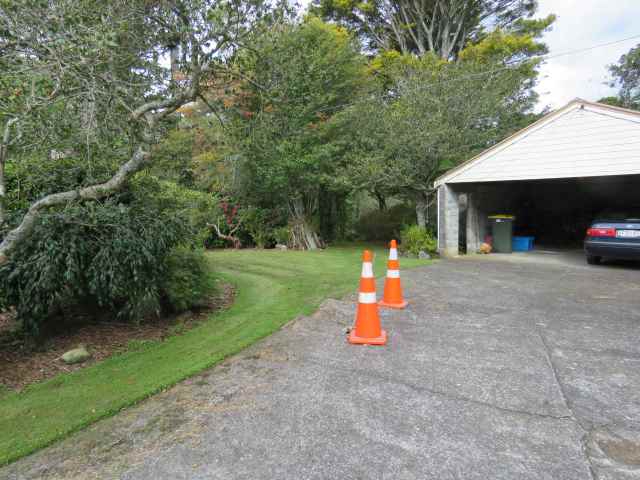
I have come to the conclusion that road cones are like rabbits. They have gone forth and multiplied. Exponentially. Everywhere. Over the years even we have acquired maybe half a dozen road cones. Lost or abandoned by their previous owners, they found what they hoped would be their forever home with us. They found a useful new purpose in life, usually reserving space for coaches during the busy garden festival season. With the garden now closed permanently, I had wondered whether rehoming them would be a betrayal of trust, maybe putting them out with their mates in any number of places where road cones choose to congregate.
But no! They have a new role to play and much closer to our house. Every time I step out the back door, I get a minor visual jolt at the sight of them. Lloyd has placed two of them on the breaking concrete. For we have developed a sink hole and he was worried that it is now deep enough to catch any visitors’ cars that might not notice the tell-tale signs of concrete slabs askew.
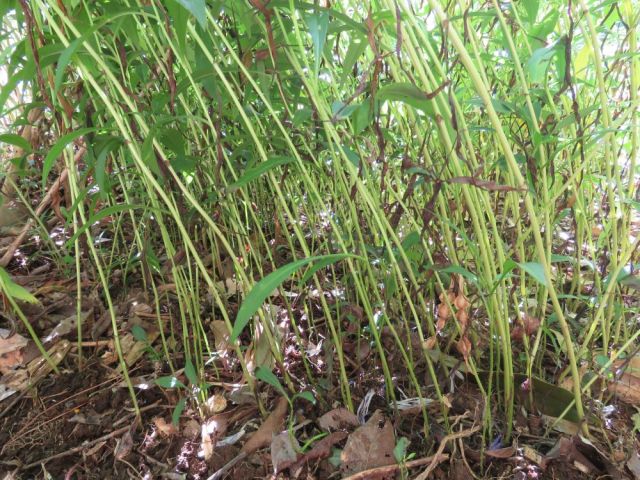
The sink hole is a mystery and one we will have to live with until Lloyd returns to work in a couple of weeks and lifts the broken pieces to fully investigate the scale of the problem. I have poked around with a bamboo stake and it goes in at least 40 or 50cm so it is not a small issue.
The concrete is the parking and turning area in front of our carport and it must date back to when the house was built around 1951. Over the years, it has developed cracks and broken in a few places but it remains perfectly functional.
So why have we developed a sink hole? The gas wells that have been deviation drilled in our area are several kilometres below ground level so it won’t be those and there is no history of mine shafts in Tikorangi. We know where our house drains go and there aren’t any in that area. There is no spring water bubbling up anywhere. So we can probably rule out both human activity and water.
This leaves tree roots. Many of us have the experience of tree roots lifting paving but maybe not so many have the experience of tree roots of sufficient magnitude to collapse paving when they rot out entirely. It is not any tree that we have felled or lost during our time here but maybe it takes many decades for tree roots to rot out and the stump disappears first? I am hoping we can solve this mystery. And if it is tree roots, I am hoping this is a one-off and not an indicator of larger problems that may surface – or indeed cave in – over time.
In the meantime, the road cones stand as sentinels.
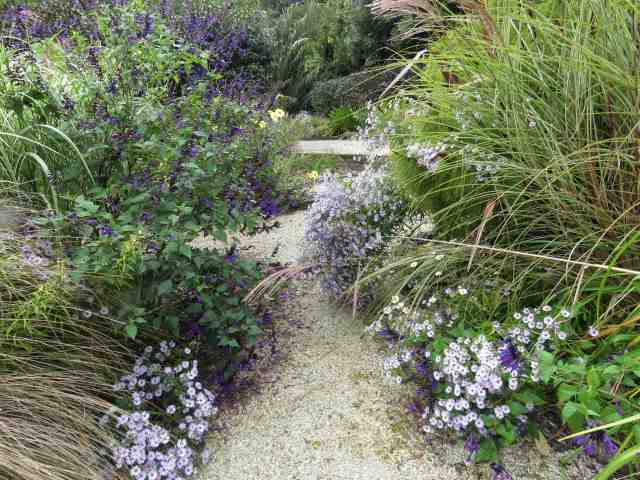
Finally, I wrote a couple of weeks ago about the species aster that I was attempting to eliminate from the twin borders. I see I relocated more than I remember to the Court Garden a few years ago and now I am having to remove most of those. I may end up resorting to total removal next year but at this stage, I am trying to restrict it to maybe three smaller areas. I took out the ones in this photograph this week even though it disturbed the very busy bees that were feeding on them. This path had become impassable because of intense bee activity once the morning sun had warmed up. Pretty, but hazardous as the bees buzzed above and the rampant root systems below were spreading in every direction.
While I like the smaller flower and the airiness of the plant, the aster must go
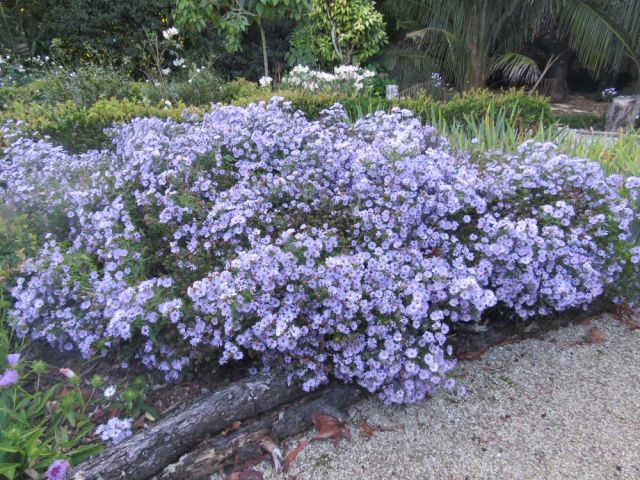
I have spent the better part of the last week digging out an invasive aster. Pretty it may be in flower but I am now aiming at total eradication from the twin borders and I am looking at in askance in the Court Garden.
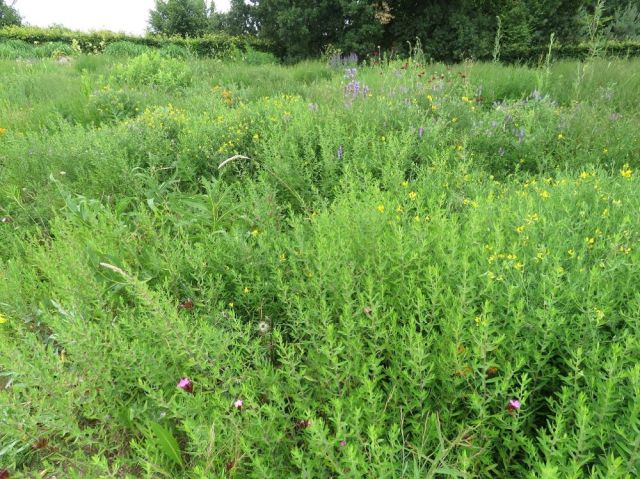
I don’t know what the species is but I am pretty sure it is a species, not a named hybrid. I see it was back in 2020 when I first decided it could be a problem. I lifted masses of it but left a few bits behind to see if it could stay with closer management. I would have started with just one small pot of it but from modest beginnings and despite some intervention along the way, I could now measure it by square metres. It has to go.
Veritable thickets of aster in the borders
The problem with this aster is not just that it needs staking in our climate because it reaches maybe 1.3 metres high in flower and flops over under its own weight, smothering everything around it. I could have coped with some seasonal staking and restricting its spread from seed by deadheading it, but it is what is happening just below the surface that is frankly alarming. It runs in every direction with huge enthusiasm. I am lifting it out of areas where I never planted, several metres away from the original clumps.
Surface rooting but it is those runners that are the real problem. They will put up shoots along the length and just keep running in every direction.
Because it is shallow rooted, I can lift the mats of roots okay and often just grab each runner in turn and carefully pull it out for most of its length – which can be 30cm of runner at a time. The problem is where it has invaded the root systems of its neighbours and the runners break off. It is going to take me years to achieve total eradication from the borders.
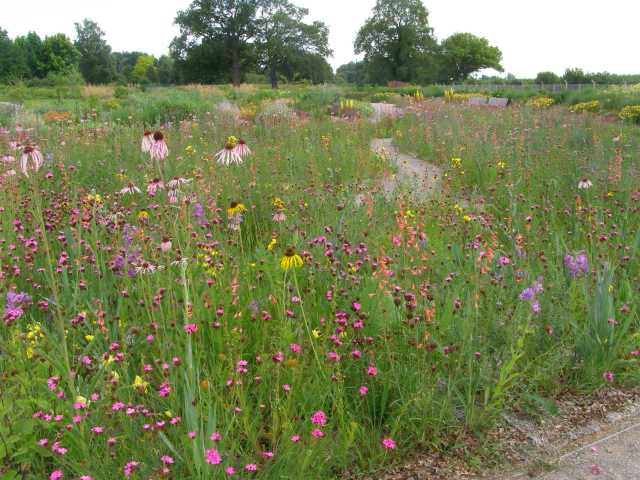
The Missouri Meadow at Wisley in 2009 – simply magical
and in 2017 – the Missouri Meadow choked by aster
That Missouri Meadow aster looks very similar to the one I am eradicating, although we were there too early to see any more than just the occasional flower
At the back of my mind is what happened to the Missouri Meadow at the RHS flagship garden Wisley, in the UK. When we first saw the meadow in 2009, it was in its second year and remains in our memory as one of the most enchanting plantings we have ever seen. By, 2017 it was a real mess because – wait for it – an invasive blue aster had taken hold and run wild. I would guess the whole garden has long gone now and been replaced by something else because getting rid of just the aster would have been impossible. I don’t know if it was the same aster but I could see that, left unchecked, my twin borders would have gone the way of the Missouri Meadow in just a few more years.
We have maybe half a dozen other named cultivars of asters in shades of blue and pink and they are fine. They are all hybrids, not species, and while they will form a fairly dense surface mat of roots, they are not invasive in the same way. And they do tend to have stronger stems so hold themselves upright, even the ones that are waist height.
Aster novi-belgii ‘Professor Anton Von Kippenberg’ is more of a compact bedding plant and I have used it in the Wave Garden. It needs digging and dividing regularly but it doesn’t keep trying to stage an escape, trampling its neighbours in the process
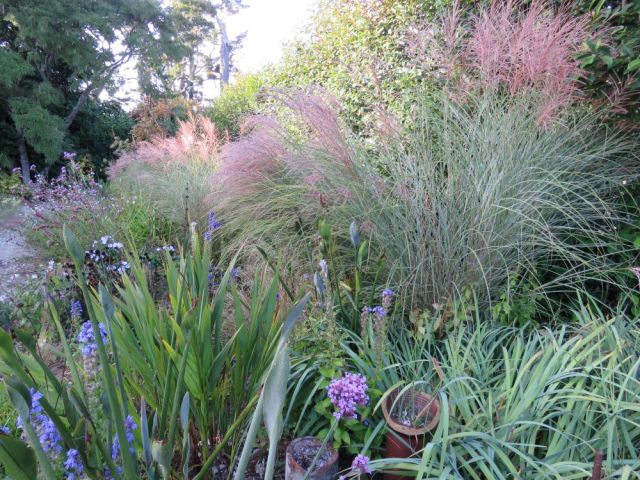
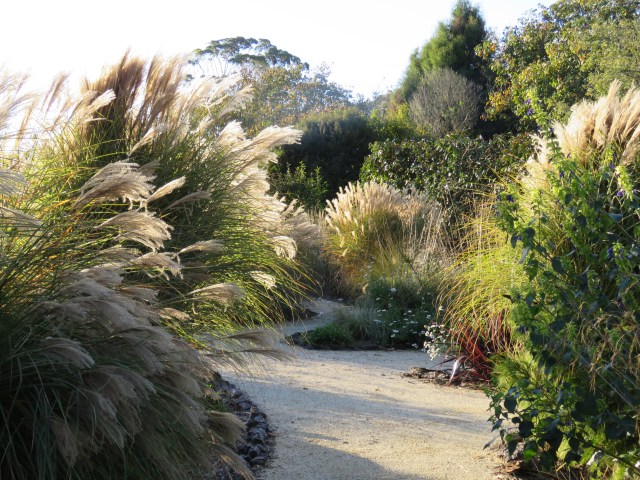
Also going from the borders are all the Miscanthus ‘Morning Light’. This is not because they are invasive, although they do seed a little more than Mark thinks they do. I know this because it is I who weeds out the seedlings. Beautiful they may be, especially in flower in late autumn as the sun drops in the sky and illuminates the plumes in the lowering light levels. But they are relatively demanding and, if not managed tightly, they grow too dense and fall apart in heavy rain and wind. Basically, they need to be lifted and divided every three years and root-pruned in the intervening years and that is a big job in densely planted borders.
Alas the Miscanthus ‘Morning Light’ must also go from the borders
I have used the same miscanthus extensively in the Court Garden and they can stay there, even though the lot need to be lifted and divided this winter. That can be done when the flowering is past its peak. But it is another lesson we learned from several visits to Wisley that led to my decision to get them out of the borders next to the Court Garden. It seemed to us that Wisley had used Stipa gigantea in almost every garden there and, while a most obliging plant with the prettiest flowers of any grass I know (golden oats, is its common name), when it is used in many garden beds, it just ends up making them all look the same. Too much of a good thing. I have generally avoided repeating plants in the different summer gardens so that each one has a different look. Miscanthus ‘Morning Light’ was one of the very few plants I repeated and, with hindsight, that was not a good decision in our growing conditions as far as the twin borders go.
So I have spaces to fill but plenty of other material to use that will be better. The thing about gardening is that it is a constant learning process but that is also what keeps it interesting. A stitch in time may indeed save nine when it comes to sewing; in the garden, removing certain plants in time may avert a takeover that will choke everything else out.
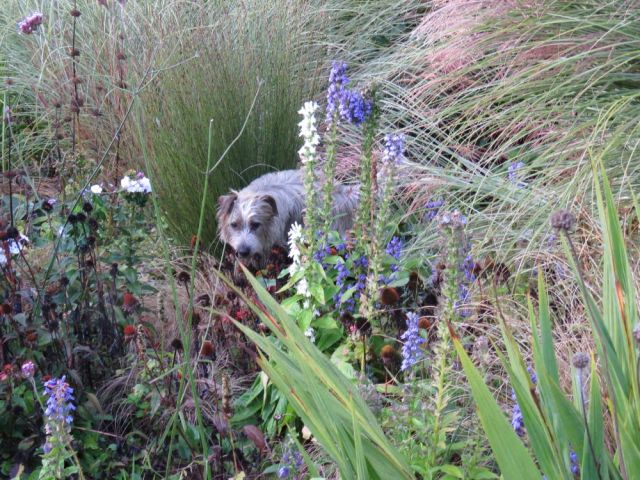
Ralph is no respecter of gardens, especially as this border is adjacent to The Rabbit Family Who Live Beneath the Swimming Pool Deck and he is on their case every day.
First written for Woman magazine and published on line only in January, on account of them ceasing publishing hard copies for distribution. A summary, really on our exploration and then creation of gardens that star in summer.
While we do exceptionally good spring gardens in Aotearoa New Zealand, the same cannot be said about our summer gardens. The best display I have seen was at Auckland Regional Botanic Gardens several years ago and that was large-scale amenity planting in a public garden. Domestic gardens are different.
We looked around our own garden in summer and it seemed very green. We get summer rainfall so we are always green but we wanted flowers, a summery feeling. Hydrangeas and woodland were not doing that for us. When we closed the plant nursery on site, an expanse of flat, sunny area was freed up. It was a blank canvas and that is a rare thing in an established garden. Here was an opportunity to do something new and create an area dedicated to summer.
We set off on our first trip to reconnoitre summer gardens in the UK in 2009, with the idea of looking at gardens comparable to ours – in other words, large, private gardens managed predominantly by the owners on a comparatively small budget. And we wanted to have a look at Gertrude Jekyll’s legacy. To be honest, the Jekyll legacy looked a little dated in the hard light of 2009 and we were equally underwhelmed by the gardens recommended to us personally by a UK guidebook writer. We abandoned that plan halfway through and instead took in some of the high-profile, historic gardens – the likes of Hidcote, Hestercomb, Great Dixter and Sissinghurst.
On our next trip, we were better prepared. Tim Richardson’s book ‘The New English Garden’ had come out and that is an excellent resource in getting to understand modern directions. We knew we wanted to see the gardens of our era and we did. It was inspirational. We also discovered some of the contemporary garden designers whose work we found particularly interesting. By the time we made our third trip, we were starting to search out gardens by those particular designers, both private commissions and public projects.
Alas Covid forced the cancellation of our most recent foray so we may never get to see the wild flowers on the Pindos Mountains in Greece and the home gardens of some of the UK designers we were tracking. But we had learned a great deal.
Firstly, summer gardens are about herbaceous perennials grown in full sun. Like so many other NZ gardeners, we had largely treated perennials as the ground level filler to layer with trees and shrubs. Most of us do mixed plantings in this country – trees, shrubs, perennials and bulbs and, of these, perennials are often the afterthought. We needed to make them the stars and to do that, we had to learn how to grow them well and which ones would thrive here without becoming thugs or weeds.
Trees, shrubs and hedges might be used with perennial plantings to give height, form and stature, but sparingly, spaced widely, playing second fiddle.
It was Tim Richardson, who gave us the concept of gardens that are immersive, not pictorial. The contemporary gardens we liked were wrap-around experiences where one is in the garden, not looking at the garden from strategically designed viewpoints. This is often achieved not only by leaving out vantage points entirely but also planting in bigger blocks, drifts or swathes to draw you through – a journey, if you like, not a static view.
Height matters. None of these modern gardens are carpeted in ankle-high to knee-high, tidy, little clumps like a modern take on Victorian bedding. Most are from waist height to towering above head-height so you really do feel immersed.
Nor did any of these gardens have neat little edging plants or clipped baby hedges at the front of the border, so favoured in this country by gardeners who feel it makes a garden look tidy and defined. What these edgers do is to create a demarcation line, a visual barrier which impedes the immersive experience.
Colour matters. Big, bright and bold, in the main, sometimes bordering on garish, certainly exuberant but always in controlled combinations of colour and texture.
Sustainability is key. The classic herbaceous twin borders have always been regarded as labour intensive with on-going staking, deadheading, weeding, digging and dividing. The New Perennials style of gardening has factored in the need to reduce labour input and much of that comes down to plant selection. Ideally, working with plants that don’t require individual staking and ongoing deadheading is one goal, as well as plants that don’t need to be lifted on a frequent basis. That said, I do a lot more deadheading now than I expected because too many plants will seed down and spread enthusiastically if I let them go to seed. Reducing weeding comes down to getting control of the weeds right from the start, allowing each plant to stand in its own space at ground level rather than intermeshing its root systems with its neighbours and keeping mulch topped up.
Dutch designer Piet Oudolf is a giant in the New Perennials movement. We loved the small private commission we saw of his at Bury Court but his recent work is more akin to grand scale amenity planting, getting – dare I say it – a bit utilitarian even. It is also very seasonal. We arrived a week too early to see his plantings at Pensthorpe Natural Park in Norfolk so all we saw was the promise of what was to come.
We found ourselves more drawn to the work of Dan Pearson, Tom Stuart-Smith, Nigel Dunnet, James Hitchmough and Christopher Bradley-Hole.
It is different in Aotearoa. We knew that. We expect our gardens to work a lot harder all year round. We also use a whole lot more evergreen plants; 99% of our natives are evergreen and most gardeners also lean more to evergreen exotics. We don’t make gardens that disappear below ground almost entirely in winter.
We also worked out that all the many plant lists put out to support these contemporary styles are of little relevance in our climate. They are tried and true performers in the northern hemisphere in places with colder winters, lower light levels and different soils. Some of their key plants just don’t like our temperate to sub-tropical climate, others become rampant thugs. We needed to work out which plants would thrive but be relatively undemanding in our conditions. Fortunately, Mark had been buying and acquiring perennials for years, planting them out and leaving them to their own devices to see how they responded, so we had some material to start with.
We created our summer gardens and goodness, concentrating on perennials gives a much faster result than working with trees and shrubs. By the second summer and autumn, they looked well furnished. And they work, to some extent, 52 weeks of the year, not just in peak summer. I admit we were working on a larger scale than most domestic gardens – around 2000 square metres of largely blank canvas – and with the advantage of a nursery background so we could raise most of the plant material ourselves.
If your lot in life is much, much smaller, it is a question of being more selective and scaling down the proportions but not the plants. Dwarf plants will never achieve the exuberance and generosity of this garden style.
What did we end up doing? A lot of looking, discussion, planning and marking out the space using tall bamboo stakes happened before any groundwork started, let along planting. You can reduce this time by employing a professional but that is not our way.
We planted five separate gardens with a sixth still under development. One key element was avoiding using the same plants in each garden; there is very little repetition beyond a few structural plants. If you keep repeating the same plants, it just ends up making the whole area look the same.
Tom Stuart Smith’s terrace at Mount St John in Yorkshire
Our curtsey to Tom Stuart Smith in our colour-themed Wave Garden
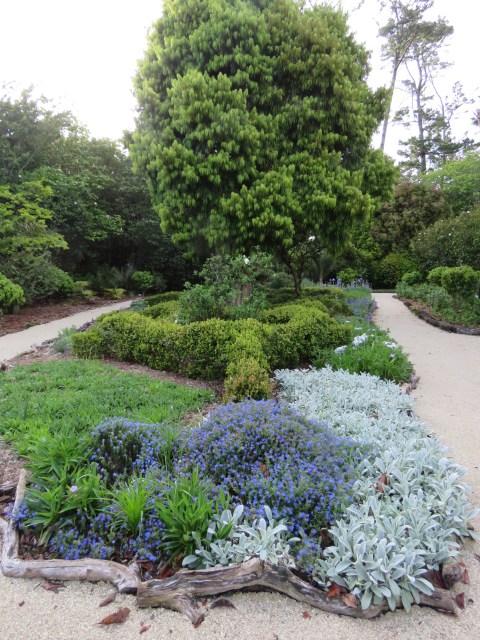
The Wave Garden drew inspiration from Tom Stuart-Smith in the definition achieved by undulating hedges giving form (we used little Camellia microphylla) with tall plants in the central enclosures and lower plants in the outside bays. It is the only colour-themed and block-planted garden we have, limited to blue and white.
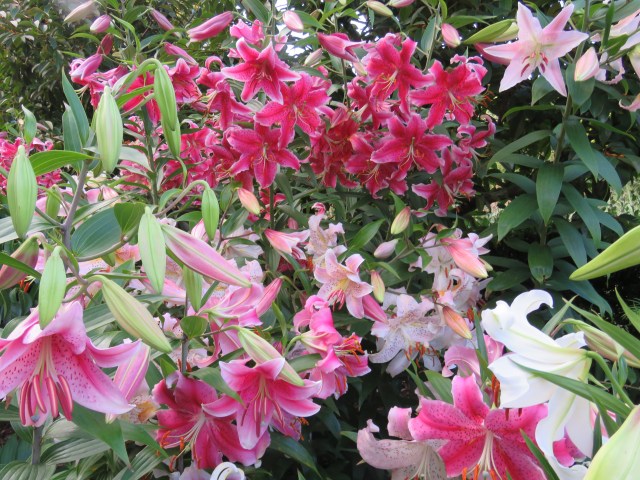
The adjacent lily border is the only part of the garden dedicated to a single plant – OTT auratum lilies that Mark raised from seed. Thirty metres of them is a pretty astounding summer experience.
Our twin borders, probably more Pearson than Oudolf in influence – or maybe neither.
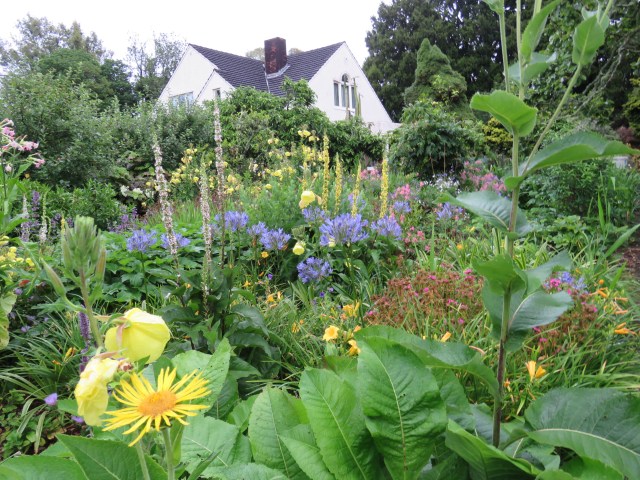
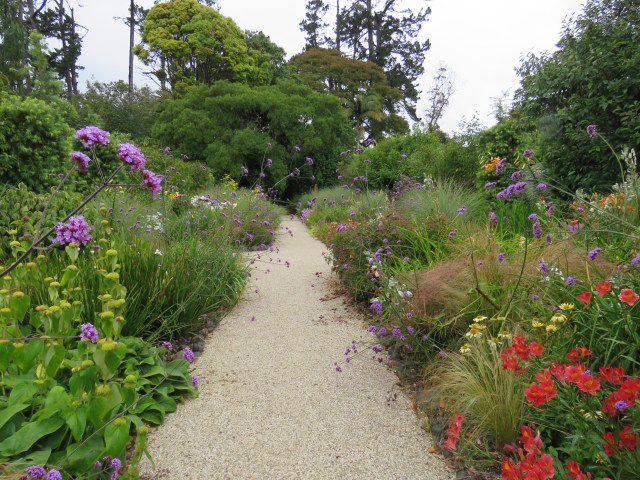
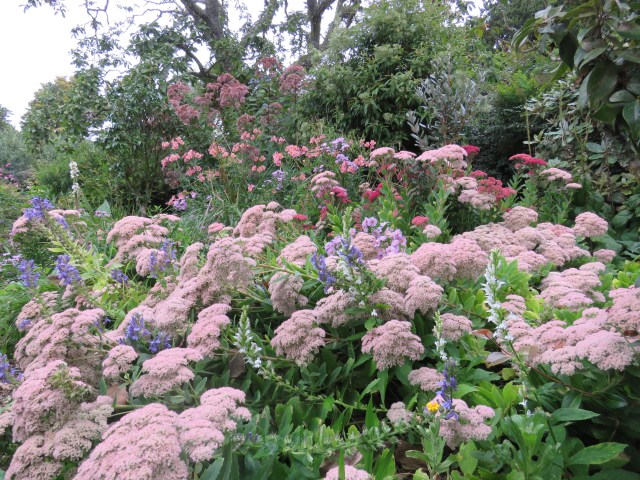
The twin borders have a distant debt to Dan Pearson. As I planted them, I kept muttering words like ‘rhythm’, ‘flow’ and ‘echo’. They are largely evergreen perennials and earn their keep visually from early spring through to very late autumn. We kept some unity by eliminating any plants that flower in pale to mid pink although cerise is fine. Red has been used sparingly.
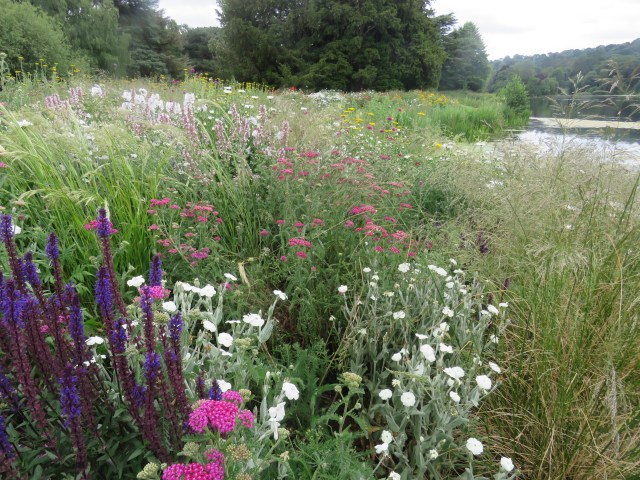
Christopher Bradley-Hole’s grass garden at Bury Court in the UK was about texture and movement, not flowers
Our Court Garden was heavily influenced by the Bradley-Hole garden but very different in both design and plant selection
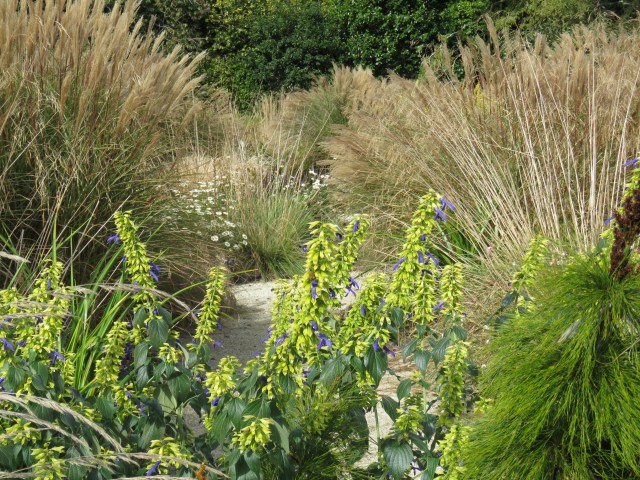
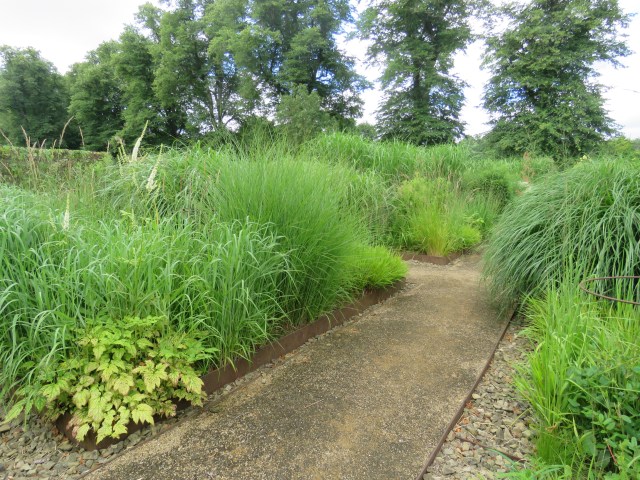
The Court Garden is the large centrepiece and was inspired by Christopher Bradley-Hole’s grass garden at Bury Court, although different in both design and plant selection. The focus is on big grasses and plants with grassy or spear-shaped foliage. By the end of summer, it is above my head in height and full of movement with just the gentlest breeze. I used a limited range of plants and over half of them are our larger native grasses, silver astelia and flaxes in burgundy and black so there is plenty to see all year round. It is a place for larger growing flowers too – apricot foxgloves, large salvias, a few single dahlias, tall helianthus, Inula magnifica and the like.
Nigel Dunnett’s perennial meadow at Trentham Gardens
Inspired by Dunnett, our bee and butterfly garden
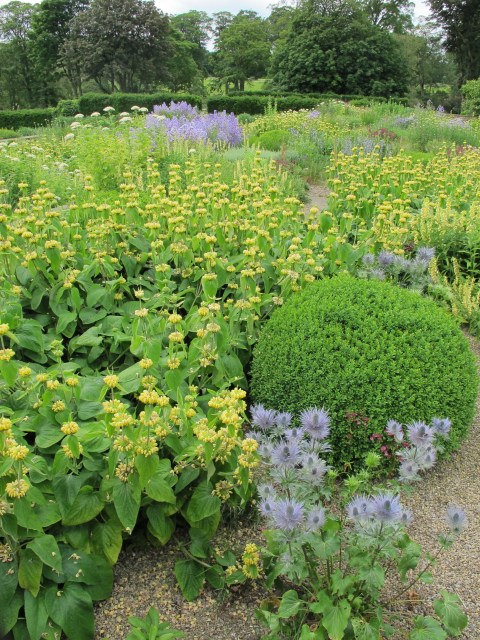
Finally the bee and butterfly garden owes a debt to Nigel Dunnett, particularly his magical perennial meadow at Trentham Gardens near Stoke-on-Trent. My mental image was of a perennial meadow but really it is halfway to a riotous cottage garden.
As yet more heavy rain falls this weekend on already saturated ground in northern and eastern areas of Aotearoa New Zealand, I make no apology for pulling out photos I have used before, showing alternatives to huge slabs of concrete or paving around homes.
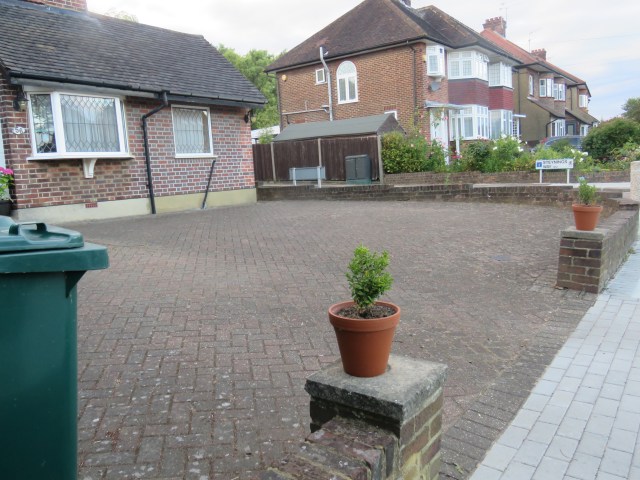
This is in London but too many of our urban areas are heading down this track
Most of us are not in a position to influence urban planning, but we can have an impact on our own property. Putting in large areas of sealing and paving, mostly to accommodate car parking or to ‘reduce maintenance’, is a significant problem contributing to urban flooding.
I have said it before, if you want a low or no maintenance section, move into an apartment – preferably one with underground carparking so the footprint of the building and housing cars remains as small as it can be. The alternative of concreting or paving your section is not only aesthetically unpleasant, it is environmental vandalism.
When accommodating cars is more important than anything else
When I took these photos, the concern was more for preserving aspects of nature, providing habitats and food sources for the natural world. This month, it is about drainage, in this country at least. All that rain falling from above has to go somewhere and if you have surrounded your home with impermeable surfaces, it has no choice but to run off and contribute to storm water systems that are overwhelmed. When an area is planted, the ground is permeable and the root systems create little channels for the water to flow down deeper into the soil. Even mown grass will do this, once it is established.
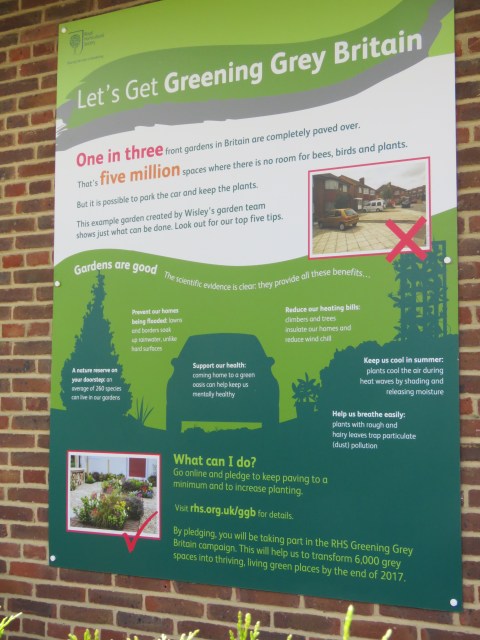
The education boards at RHS Garden Wisley in the UK claim that one in three front yards are fully paved now. Our major urban areas may not be lagging far behind in this country as sections get ever smaller and houses – almost all single storey and detached – get ever larger, leaving little space devoted to wheelie bins and car parking.
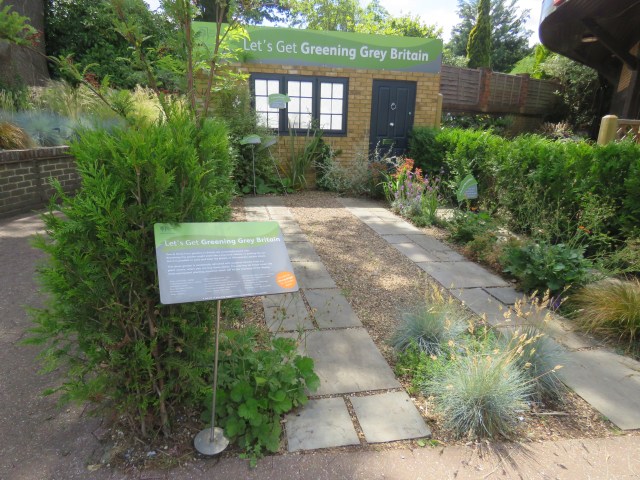
Wisley’s alternative display shows the use of spaced pavers, gravel with plants in it and recommends clipped hedging rather than solid fences on the boundaries. Just don’t lay an impermeable lining below the gravel – often recommended to ‘reduce maintenance’ but entirely defeating the drainage function of this type of driveway. Yes, it will take a bit more work to maintain than just getting the leaf blower out onto a slab of straight concrete or seal on a Saturday morning, but how much more pleasing is it visually? And it will absorb a whole lot more excess water.
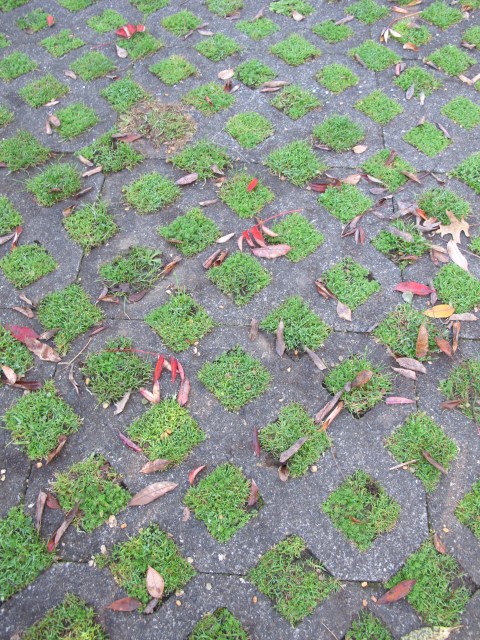
I photographed this driveway in Auckland. It is another alternative, allowing drainage while giving a hard surface on which to park the wretched motor cars that are so demanding on space. Laid properly, it should be level enough to run the lawnmower over it or to allow for sweeping, if need be.
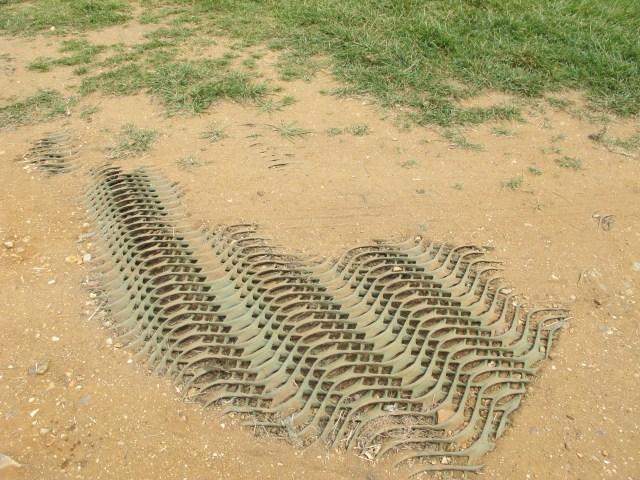
This subsurface reinforcement looks as though it may be made from recycled tyres. It was very dry at the time I spotted it exposed in a few places in a distinctly utilitarian carpark. It is another way to solve the problem of an area that would become a mud bath in wet conditions leading to a rough, rutted surface as it dries. It could be over-sown with grass to be mown in areas where there is lower vehicle traffic – like a front section.
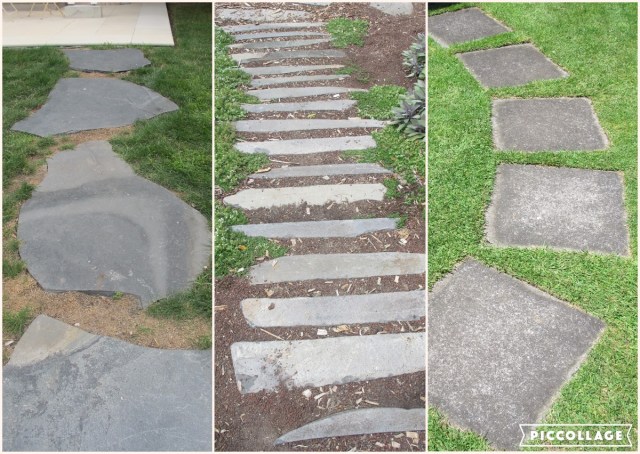
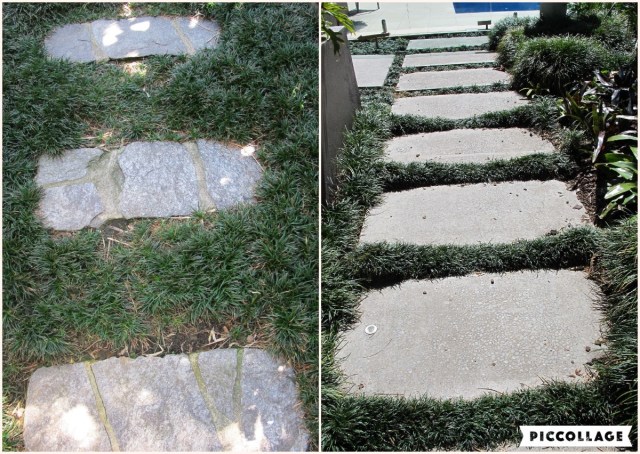
When it comes to paths, there are alternatives to a solid surface and the ones I have photographed are all using paving slabs. The one on the right would take a bit of extra maintenance to keep that sharp look because it involves using an edging tool around each paver but most of the time, the lawnmower would run straight over it. Don’t even think about spraying the edges because it would look awful with a brown, sprayed border around each paver. Again, the laying is important to get a flat surface that doesn’t become a trip hazard.
Planting around large pavers in mondo grass (Ophiopogon) gives a softer look that is really pleasing to my eyes. It is also one of the lower maintenance techniques because the mondo grass will choke out most weeds and it is extremely hardy, even to heavy foot traffic. Maintenance is just a matter of getting in and thinning it out when it starts to look too congested, which can be done with an old carving knife or a cheap flax cutter.
Wider pavers give a generous look befitting, even, to a main path to the front door.
When we last lived in a city – and I admit that was loooong time ago – we walked. A lot. It was pre-children so we probably had a lot more time on our hands. Walking in a city is a great way to get ideas, to see what is growing successfully and what is not, to influence your likes and dislikes and to look for alternative ways to accommodate modern life and vehicle dominance without damaging the environment. I don’t think many of us saw drainage as being one of the more confronting aspects of climate change.
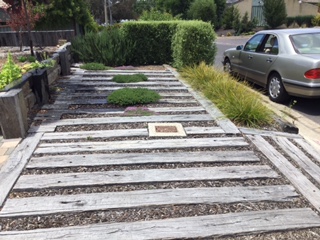
Reader Susan has kindly sent this photo of another design that combines functionality with both drainage and aesthetics. Those are railway sleepers filled with coarse woodchip. Fine woodchip runs the risk of either compacting in some conditions or simply floating away in a flood to block stormwater drains.
To say it has been a difficult week would be an understatement, at least for those of us living in Te Ika-a-Māui or the North Island, as it has long been unimaginatively named. My heart goes out to the many thousands who have had their lives turned upside down, are currently displaced or have lost everything they owned this week.
We are all overwhelmed by images of damage and loss this week so I chose to go with totally unrelated photos in yellow. This is Tecoma stans.
I just looked up the population and I see it is just shy of 4 million people living in the North Island. Given that Cyclone Gabrielle hit hard in Northland, Auckland, Coromandel, Bay of Plenty, Tairāwhiti and Hawkes Bay with lesser effects throughout much of the rest of island, it is not an exaggeration to say that the impact has been felt by at least a couple of million people, probably more. As I write this, we are still learning about the scale of damage and loss.
Rudbeckia
After taking a direct hit from Cyclone Dovi exactly a year ago, we spent Tuesday in a state of extreme anxiety as the winds hit us again. We didn’t get the rain and sea surges that have drowned the eastern coast and places north. There was some damage here but nothing on the scale of Dovi and negligible compared to the damage suffered elsewhere. I didn’t bother photographing it because it would seem trite compared to the loss and destruction in badly hit areas.
Echinacea laciniata ‘Herbstsonne’
When the earthquake hit on Wednesday night, it seemed like the universe was conspiring against us. At 6 or 6.1, it was a solid shake lasting quite a long time. It made me realise how frayed my nerves are and I don’t generally suffer from frayed nerves. I am not alone in that. I imagine the current high state of anxiety across our country is similar to that experienced across Australia during their horrendous fire season of 2019-2020. A few high profile, shrill voices blame the media; some even accused the media of over-hyping the anticipated arrival of Cyclone Gabrielle and causing unnecessary anxiety. Those voices went silent when Gabrielle turned out to be at the extreme end of the worst case scenario.
Crocosmia and blue lobelia
We live in difficult times. Those of us largely unaffected by Gabrielle may hope for a quiet breathing space, time to gather our thoughts, maybe even to experience a little boredom in normality, as we used to know it. But those who have been hit so very hard by this natural disaster don’t have the luxury of hoping for even that.
Helianthus
Stay safe. And if you or people close to you are among the badly affected, may you at least be able to see a path through this catastrophe in the weeks ahead and to find hope after despair. The sun will shine again, which is why I picked the colour yellow to accompany this post.













 Tikorangi The Jury Garden