Tag Archives: Abbie Jury

The grass report

I feel sufficiently confident to give an interim report on the grasses I have used in the new Court Garden although it will take another few years before I can give a definitive verdict. These are bigger growing grasses because we had the space and I wanted an immersive effect that wraps around when we walk through the area.

The site is the hottest area in our garden but, being lowered, it can also be frosty in winter. Cold air flows down to lower levels to settle. The ground is typical free-draining, Taranaki volcanic soils that do not become water-logged and never dry out entirely. We haven’t added any fertiliser and once planted, we never water. The area is mulched with wood chip.

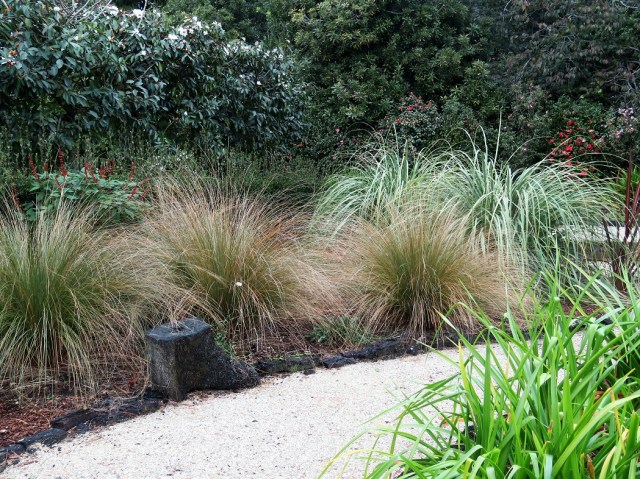
Chionochloa rubra – commonly known as red tussock but this form is only brownish red in winter

Chionochloa rubra – NZ native so evergreen. It takes first prize for graceful form because it fountains out from a narrow base and that form makes it a real star in the winter garden. Its flowering is relatively insignificant but I don’t have to groom the plants to remove dead sections. We started with just one plant and I kept dividing it, which it does easily. I have never lost a plant. It needs space to be able to appreciate the graceful form and the best plants are now 120cm high with a spread up to 2 metres.

Chionochloa flavicans, sometimes sold as ‘miniature toetoe’ though it is a different family

Chionochloa flavicans – also a native, sometimes referred to as ‘miniature toetoe’, so evergreen. At its best in spring but holds its showy flowers right through until autumn. Rabbit fodder when young. Has the reputation of ‘whiffing off’ unpredictably and it certainly doesn’t appreciate being crowded by other plants. Again, we started with a single plant and kept dividing. I have overplanted it so will lift the lot shortly and split the plants, replanting fewer and at wider spacings. I am hoping that by dividing, it will stimulate more growth and delay any inclination to ‘whiff off’. Plants are now about 75cm high and up to 140cm wide.

Anemanthele lessoniana or NZ wind grass, sometimes gossamer grass (you can see the ethereal flowers in pink tones) in the borders before I moved it over to the Court Garden
Anemanthele after moving – it turns golden under stress and it was still hot weather when I moved these plants but I expect them to recover

Anemanthele lessoniana – another native – so evergreen – with a vase shaped habit of growth and more colour variation in the foliage. Lovely in bloom with a cloud of fine flower heads. I had this in the twin borders but the plants were getting too large so I have now moved them to the Court Garden. When stressed (and my plants have often been stressed as I have lifted and divided them to increase the number from the original three), it turns an attractive gold but I will need to groom the foliage to remove dead thatch when the plants make fresh growth. It has reached about 90cm high and up to 140cm wide.

The tall plumes are the austroderia – NZ toetoe and a better choice than Argentinian pampas

Austroderia fulvida – toetoe so another evergreen native.  Very large growing and too early for me to comment on its longer term performance. I bought three small plants through Trade Me and they have already reached 1.7m high and 2.4 metres wide.

Stipa gigantea I have referenced countless times. It, too, is evergreen in our conditions and I  give it the occasional groom (by hand or with a leaf rake) to remove dead foliage. Excluding the tall flower spikes, it is about 80cm high and 160 cm wide as it matures. It divides and increases easily so just start with a single plant but you do need a certain critical mass to have sufficient to share with the sparrows. We found the pesky birds stripped the blooms in the first season and the whole reason for growing this grass is for its showy, long-lived flower spikes so that was disappointing. This year we have had plenty to share with the birds. The foliage has a glaucous tint which is a contrast.

Calamagrostis ‘Karl Foerster’ to the left with the plumes still looking good after four months

Calamagrostis ‘Karl Foerster‘ – I have written about this before. It is such a strong grower, spreading at an alarming speed, that I reduced it down to just six plants which I am hoping I can keep in check by root pruning on an annual basis. By root pruning, I mean getting a very sharp spade and cutting back the size of the clump without digging it all out. That way, I can get the spreading fresh growth off it. This works because it makes its new growths on the outside of the clump. It is evergreen in our climate but the foliage looks pretty scruffy by the end of season. I am pretty sure I cut it back hard last winter so the spring growth was all fresh and lush. It is one of the first grasses to flower in spring and those lovely plumes hold all summer and into autumn. It is all about the plumes because the foliage and form are nothing remarkable.

That is what I think is ‘Overdam’ in the front right, Stipa gigantea behind

Calamagrostis ‘Overdam‘. At least, I think it is Overdam. It was given to me. It is strong growing too, but not as threatening as Karl. It has the same lovely plumes but the bonus of clean, variegated foliage which stays looking fresh through the season, somewhat like a lower growing variegated miscanthus, though it spreads sideways rather than up. It will likely need root pruning, too.

Miscanthus is a lovely grass from spring onwards but the glow of those white plumes in the low winter sun is nothing short of amazing

Miscanthus sinensis ‘Morning Light’. Look, we started with one plant in the garden years ago that just sat, grew annually and fell apart because it needed dividing. As soon as I started dividing it (done variously with a sharp spade, an old handsaw or a small axe), it responded by growing with huge enthusiasm. I overplanted badly and need to take out at least half of the plants but as it is all about the plumes in late autumn and early winter when they glow white in the low sun angles, I will wait. The plants are around 1.7 to 1.8 metres high with flower spikes on top of that so it is very tall. If it is divided often enough, it will stay together – falling apart from the middle is a sign it needs dividing. It is fully deciduous, fine leaved and variegated. Mark is sure that the old foliage has potential for thatching but he has yet to test this theory. This is the only grass that I have spotted seeding down so far but the seedlings are easy to pull out when small.

Miscanthus ‘Morning Light’ on the right, giant miscanthus on the left

Miscanthus whatever whatever – may be just a larger growing form of sinensis with a wider leaf but it should be called Miscanthus giganteus variegatus. The leaves are wider and with a most attractive, clean variegation but the vigour and size is daunting. We ended up digging out three massive plants because I couldn’t hold them together and, as they fell apart, they blocked the path entirely. This is a triffid of a grass. Gardening friend, Susan, suggested that maybe the way forward is to do the Chelsea chop on them – cut them back to ground after the first big flush. I think she is right and I will be cutting them back to ground level about mid November. The second flush of growth should be more compact and shorter. If I can’t keep them under control this way, they will have to go. The plants are too big for me to lift alone and I don’t want to commit to plants that need lifting and dividing annually.

Just too big – they grew even larger and floppier after I took this photo

Lomandra We had a named variety in the garden but I found a better option to replace it with. I rate lomandra as one of the world’s more boring plants and I suggest you leave lomandras to supermarket carparks and roading roundabouts. We have more interesting and attractive native grasses without having to resort to this utility Aussie in NZ gardens.   

Here endeth the interim grass report. Except to say that I am moving and dividing some now because we still have at least six to eight weeks of the growing season left before temperatures drop and growth slows or stops over winter. That said, I have done this in winter and we can get away with it but it is not recommended in less benign conditions where the plants may just sit and decompose in sodden, cold soils.

The Court Garden after its second summer

August 2018

I am turning my attention back to refining the new Court Garden. How did we manage before digital cameras? They make it so easy to track change. This was where we started with a blank canvas.
August 2019

A year later and I had done most of the planting and the steps were in place. If you look carefully, you may see some little spots of yellow. I drifted many dwarf narcissi through to add early spring interest. This winter will be my last chance to locate them and remove them before they are forever swamped in the grasslands.

October 2020

This is how it looked when we opened for the garden festival last spring, when we had completed the paths. It was the first viewing by members of the public and most visitors loved it.

March 2021

This is the same view, four months later. The growth has been well in excess of what we expected. This is the result of planting into fresh ground although the soils would not have been particularly fertile after being under nursery weedmat for three decades. We have not fertilised anything. Nor did I use compost to enrich the soil. We did, however, cultivate the ground before planting and mulch afterwards. While planting, I squished a gazillion grass grubs that I unearthed as I went.

Chionochloa rubra

Despite my best effort to get the spacings right as I planted. the mistakes are now clear, mostly because I underestimated how large the plants would get. You can see from the markings on the path, how far out the grass stems are sweeping. I am fine with a bit of softening overhang but I also want to be able to walk through without getting wet legs. I need to move the right hand chionochloa back half a metre. Fine tuning, I call it.

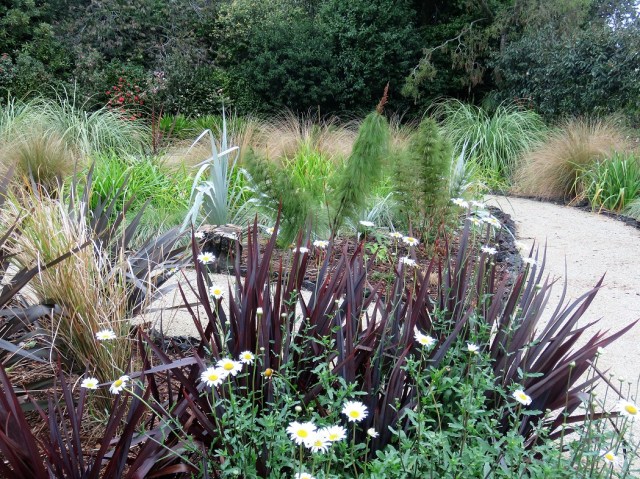
Stipa gigantea and ox-eye daisy at the beginning of November

Again, thanks to digital photography, it is easy to track plant combinations through the seasons. I have been surprised that some have held for a good four months. This is just a simple combination of Stipa gigantea (golden oat grass) and ox-eye daisies as it looked when we opened the garden at the beginning of November.

Stipa gigantea and oxeye daisies in mid December

The same view in December. Aren’t those simple daisies simply glorious? As this mass display passed over, I cut them back to the rosettes at ground level.

This is the same spot in February. The daisies are having a second flush and i think if I get my timings right, it may be possible to get a third flush each year. The stipa has also held onto its sterile flowers and I did not expect these to hold for over four months.

Stipa gigantea and Verbena bonariensis in mid December

Back in mid December, I was delighted by the chance combination of a Verbena bonariensis that chose to seed in this spot by Stipa gigantea. I even took a short video of the gentle movement which was everything I aimed for in this garden but my tech skills let me down sometimes and I can’t work out how to upload it to this platform.

Same plants in late February

This is the same scene, two and a half months later. Still pretty, albeit past its fresh flush.

NZ toetoe and Chionochloa flavicans at the start of November

Who still declares that our native plants are boring? Mark said we must have our native toetoe in what is essentially a grass garden. I bought three plants on TradeMe (our equivalent of Ebay) and from memory, I think they are Austroderia fulvida. We have five species native to this country. The smaller plants are Chionochloa flavida, often sold as ‘dwarf toetoe’ although they are a different plant family.

Four months on

Four months later, the flower plumes are still holding, albeit a little tired as we go into autumn. This is not unreasonable on their part.

I think I am ready to give an interim report card on the key plants used in this garden but that will have to wait for another post. It will take another few years before I feel confident to recommend based on longer term performance but some trends are already clear. Pretty much all the plants used are readily available in this country.

Garden styles

It is a long time since I published a piece on the folly of allowing garden openers to write their own descriptions. Even then, discretion won out and I only published it on a UK gardening site I was contributing to at the time. This explains why I couldn’t find it on my own site when I went looking for it. A not-unrelated situation arose this week when we were asked to describe the style of our garden in a single word. Apparently, this helps garden visitors.

As a seasoned garden visitor myself, I am as wary of garden owners getting to declare their own ‘style’ as I am of getting them to write their own descriptions. But just in case you need some assistance in interpreting garden style, I offer the following explanations. Some, but not all of these ‘styles’ were offered as a suggestion to help us in defining our own garden category.

Japanese – three rocks, some raked gravel and a recently planted dwarf red maple.

English style, as seen through NZ eyes

English – buxus hedging, garden rooms, a Japanese cherry tree and pretty flowers because in NZ, the English garden style begins and ends with the Arts and Crafts movement seen by so many at Sissinghurst and Hidcote.

Italianate
The real McCoy – Villa d’Este in Tivoli

Italian – more likely ‘Italianate’, similar to the connection between a ‘dinette’ and a banqueting hall, or a ‘kitchenette’ and a caterer’s kitchen. Terracotta pots, a clipped bay tree and hard landscaping carried out in concrete and ponga* logs or tanalised timber on account of a dearth of skilled Italian stonemasons here.

This really was a designer garden, designed by Dan Pearson

Designer – in theory a garden created by a name designer and executed with attention to detail and a big budget but more likely to be a recent garden designed and planted by the owner, a younger woman in her 30s or early 40s who is a magazine subscriber and who bought some graph paper, large paving slabs and black mondo grass.

Tropical – a naive gardener who does not realise that nobody has a tropical garden in Taranaki owing to us not having anything like a tropical climate. More likely to be three palms, either hardy or half hardy, and ten bromeliads. 

East Lambrook Manor set the standard for cottage gardens

Cottage – If you are expecting something like Margery Fish’s iconic cottage garden at East Lambrook Manor, you may be disappointed. More likely to be packets of wild flower seeds scattered on bare soil, struggling to germinate, let alone flower. And a clipped camellia and maybe some common purple foxgloves.

Plantsman’s – this is a difficult one. To those in the know about open gardens, it is often used as code for a garden lacking in design, prettiness or charm that may appeal to those who take a magnifying glass with them when they go garden visiting in order to view the close-up of an obscure native orchid in bloom. Occasionally, this is a descriptor adopted by an ambitious gardener with over 30 different plants in their garden who is unaware that in the rarefied atmosphere of upper-level horticulture and botany, the term ‘plantsperson’ is an honour bestowed by peers and colleagues, not self-awarded.

Courtyard – 80% paved or decked with a very expensive outdoor dining suite, sofa with all weather cushions, lighting, a very (very) small water feature and a narrow border or two on the periphery planted with clivias and a Kentia palm.

A splendid crop of broad beans

Vegetable – featuring a splendid broad bean crop in spring, some small tomato plants and a worm farm.

Sustainable vegetable – as above but mulched in cardboard or old woollen carpet.

Insect hotels are very on trend.

Potager – another vegetable garden but this time with rainbow chard and fancy lettuces corseted in clipped buxus hedging and featuring a fancy insect hotel.

Welford Park. Photo credit Chris Wood via Wiki Commons

Woodland – you may be envisaging an open scene of deciduous trees, perhaps white barked birches – with a sea of snowdrops beneath. More likely to be over-planted trees which need thinning and limbing up, underplanted with a few hostas and clivias that are struggling with root competition and too much shade.

Coastal – windy. Trees growing at a 45° angle, ice plants, gazanias, some wind burnt succulents and a defoliated copper beech.

A friend who has extensive experience in plant sales contributed the ‘Low Maintenance Garden’ – griselinia hedges, yuccas and Agave attenuata for structural focus, with Coprosma ‘Hawera’ groundcover, all surrounded by black stained bark chips.

The idea of defining our garden by a single style defeated me entirely.

*Ponga – NZ tree fern trunks which are widely available, relatively long lasting and usually inexpensive or even free.

A week of paper wasps, fasciated lilies and crocosmia

A paper wasp nest

Look at this cute honeycomb nest. A small wonder of nature but not a welcome one. It is the nest of a paper wasp. I have lived my life blissfully unconcerned about these creatures. We have both the Australian and the Asian paper wasp in New Zealand, along with the more aggressive German and common wasp. Mark wages war every summer on the nests of the latter two.

The nest is fairly hard to spot in the foliage

Alas, a wasp from this nest that I hadn’t even noticed took exception to me cutting out some of the leafy tips of an over-large osmanthus. It stung me twice just below the eye and then buzzed me aggressively as I exited hastily. I didn’t even see it. I was more worried about getting to a mirror to work out whether it was a bee (in which case I would have needed to get the sting out) or a wasp. Mark went straight out and spotted the nest at eye level – he is observant, that man. They are quite hard to spot because there is not the busy coming and going that defines a common wasp nest. We looked on line and came to the conclusion that what he saw crawling over the nest was more likely an Australian than Asian paper wasp. Whichever, they are dead wasps now.

Left to right: German wasp, common wasp, Australian paper wasp, Asian paper wasp. Photo credit: unknown. All these wasps are unwelcome intruders to this country.

While unpleasant, two paper wasp stings do not appear to be as bad those from the larger common or German wasp. I kept ice cubes wrapped in cloth on them for an hour or more as required on the first day. The puffy swelling remained for another three days and the site remained tender to touch but not exactly painful, so it could have been much worse. At least I know what to look out for now.

We are past peak auratum lily season although there are still plenty in bloom as we enter late summer.

A mass of blooms on a single stem – a sign of fasciation

Here we have the curiosity of a fasciated lily, not to be confused with a fascinating lily unless you like freaks and novelties. It is an aberration in a plant, usually a seasonal deformity but not a lasting condition and it causes a flattening of the stem (basically it is two dimensional and ribbed) and a huge increase in the number of flowers but they are correspondingly smaller. The cause is unknown and it may stem from any number of things (including hormone spray damage but not in this situation) but presumably environmental because it does not appear to be a genetic issue in the plant. It is not likely to occur again in the same plant next year.

You can see the stem is very broad and ribbed. What you can’t see is that it is also almost flat.

I picked the white stem because the weight of the flowers was too heavy for the stem to hold it up but we have another example in the lily border which stands very sturdily, showing off its freakish growth. The local paper used to publish stories every year with some breathlessly excited gardener showing off their ‘special’ plant with its unusual head of flowers and flat stem but it is not rare and fasciation occurs across a wide range of plants. It is not generally stable or lasting but broccoli, apparently, is a freak fasciation that was stabilised. Google it, if you want to know more.

You can see a much fuller head of blooms and dense foliage on the fasciated lily in the centre

The crocosmias are starting to pass over but I like to line them up and compare them. Going left to right, we start with the common roadside weed. It is usually called montbretia in this country and while pretty, it is a seriously invasive weed. It washes down our stream in every flood and it is all down our roadsides but we certainly never introduced it ourselves. It multiplies readily both from the bulbs and by seed. Botanically, it is C. crocosmia x C. crocosmiiflora.

Second from the left is ‘Severn Sunrise’ and I am working to eradicate it from the garden. It appears to be just as invasive the common one and not much different in flower, habit or growth. I wonder if it is just a selection of the same cross. It may be more highly valued in countries where it is not such an invasive weed.

Third is red ‘Lucifer’ which is now listed as Crocosmia x curtonus (I see I previously found it as C. masoniorum × C. paniculata) so it has different parentage to the orange, weedy ones. It is by far the strongest growing one we have and certainly showy but also vigorous (read: the bulbs increase very rapidly) and it sets so much seed that I try and deadhead it to control it. I also need to thin out the bulbs which are getting a bit too determined to colonise and dominate the areas where they live.

Fourth along is one of my current favourite and the purest yellow with dainty blooms. It is just a chance seedling Mark picked up from the roadside so it will be the same cross as common montbretia (C. crocosmia x C. crocosmiiflora) but we have not had an issue with it seeding down. The bulbs increase readily but without free seeding, it is not a problem to keep it restrained and it seems to have a longer flowering season.

Second from the right is my newest addition – larger flowered and a pretty yellow but richer in colour so more apricot than pure yellow without quite getting to orange. I swapped some of our yellow one with Cemetery Sue at the graveyard to get this one and it is likely to be a named form but neither of us know the name. She has not had an issue with it seeding around so I am hopeful for its future in our garden.

The large bloom may or may not be ‘Star of the East’. It is certainly dramatically larger than all the others.

The last one is by far the showiest and I think it is probably ‘Star of the East’, judging from photographs. Although it may not be, because ‘Star of the East’ is just a selection from the same cross that gives us weedy montbretia and this bears no resemblance to that cross.  It is genuinely spectacular but certainly not vigorous. We have had it in the rockery for several years where it limps on without increasing as I would like it to and it seems to be sterile. Conditions are hard in the rockery and I think I need to lift it and move it to a more hospitable location with richer soil. I say this every year but this season, I swear I will do it. It is worth the effort.

Crocosmia are wildflowers of the grasslands in southern and eastern Africa. There are currently nine different species and they should not all be judged by their wayward, roadside weed family member. They are also not as invasive in less benign climates than ours.

Our yellow crocosmia in the Iolanthe meadow garden

The karaka tree

Karaka berries in abundance on the pavement

Given the uneven nature of the pavements in my local town, my eyes were looking down when I came across this remarkable sight. The fruiting of the karaka. Even by karaka standards, this is a bountiful crop and very decorative on a sunny day, although I imagine some locals are less pleased about the amount strewn over the footpath.

It is a common coastal tree both in the wild and as a distinctive, evergreen, garden specimen. The ever-handy internet tells me that botanists think that its original habitat was the northern half of the North Island and the northerly offshore islands. The fact that it is now found all round the country and even on the Chatham Islands is because it was a valuable food source for Maori who deliberately planted it and cultivated it.

That is quite a crop of berries on the karaka tree

I think most New Zealanders know that the karaka berries are highly poisonous unless prepared correctly. It is not the fruit pulp that is the problem, it is the toxic kernel. Should you want to know how the fruit is prepared for human consumption in the indigenous diet, I can refer you to this article on The Spin Off. In the interests of research, I sampled the flesh of a ripe fruit and I can tell you it is indeed sweet and fruity although it is only a thin layer over the rather large kernel. It reminded me of the taste of loquats.

The tree in the centre is a self-sown karaka destined for the chop

Karaka pop up all around our property as self-sown seedlings along with tree ferns, nikau palms and kawakawa. This one got away on us and is destined for the chainsaw because it blocks a vista we want to keep open. Like most seedlings, we will let them grow if they are in the wilder margins or shelter belts but restrict them in cultivated garden areas. If we didn’t, we would have a forest of karaka because I swear, every fruit that falls beneath this tree germinates and I have to weed them out when small.

I kept seeing references on line to it being toxic to dogs who, allegedly, eat the whole fruit including the kernels. I asked Mark if he had ever heard of a dog being poisoned by karaka berries and he scoffed, pointing out that they are of no interest to dogs at all and he certainly had never heard of it happening. There are many things we grow in the garden that are toxic to dogs, including yew trees, but the chances of you inadvertently killing the family pet by growing a karaka tree seem very remote although it must have happened in the occasional instance to be recorded. It makes a good specimen tree with its lush foliage and quick growth without becoming a forest giant (it stops at about 15 metres naturally so you can keep it smaller in a garden situation) and the fruit will bring the kereru into your garden.

I doubt that there are many people in New Zealand, other than botanists, who know the botanical name for this tree – Corynocarpus laevigatus. There is a name I had to look up and I know that I will never remember it. We all know it by its Maori name- karaka. There may be more people who can pronounce it correctly, but not too many more. It is usually pronounced karaka to sound like cracker. I looked that up too and while there are regional variations, phonetically it can be transcribed as cah-raa-cah or kuh-raa-kuh (but with a short u sound), bearing in mind that the Maori language places equal stress on all syllables. Mark and I are practising to at least try and get it closer to the correct pronunciation.