Tag Archives: Abbie Jury

Stipa gigantea

Stipa gigantea towering against the sky

When we made our treks across the world to look at summer gardens, there were three plants that were standout performers we were keen to try here – Stipa gigantea, thalictrum and veronicastrum. Oh, and the giant blue-purple alliums but we are not going to pay the big dollars per bulb they command here. The reason they are so common in English and European gardens is because they can buy the bulbs very cheaply from Dutch growers.

We have a pink thalictrum that is doing fairly well, though it has only achieved waist-high altitude and does not look as though it is going to get much beyond that. The sole veronicastrum – the only success after three attempts with the finest seed Mark has had to deal with (he had to get the magnifying glass out to check that he wasn’t just sowing dust) – is growing slowly and seems to be a plant for the long haul rather than a quick result. But the Stipa gigantea….

A friend in Christchurch sent me a few divisions. I have no idea how long it has been in NZ or who brought it in but it is not widely available commercially. That may just be a matter of time and demand. The few divisions grew, and grew and grew until we had many. I started with them in the perennial borders but after the first two years, realised they were going to be too large there so moved them into the new Court Garden where the focus is on big grasses. I knew I was overplanting them for quick effect 18 months ago so I removed over half of them last autumn to give the remaining plants space to stand alone. Each plant needs well over a metre of area.

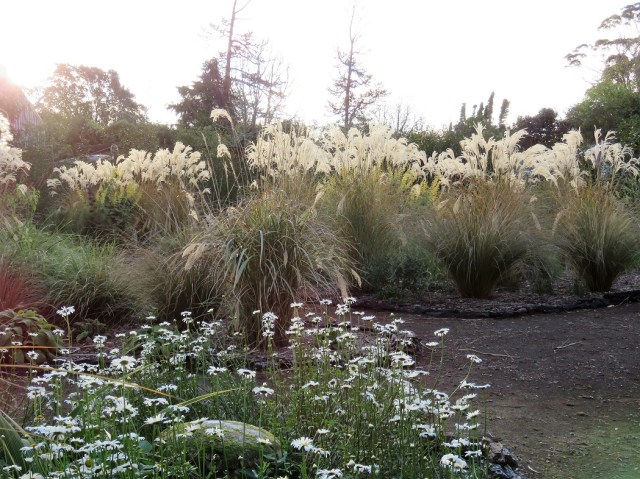
I like the combination of Stipa gigantea with the ox-eye daisy

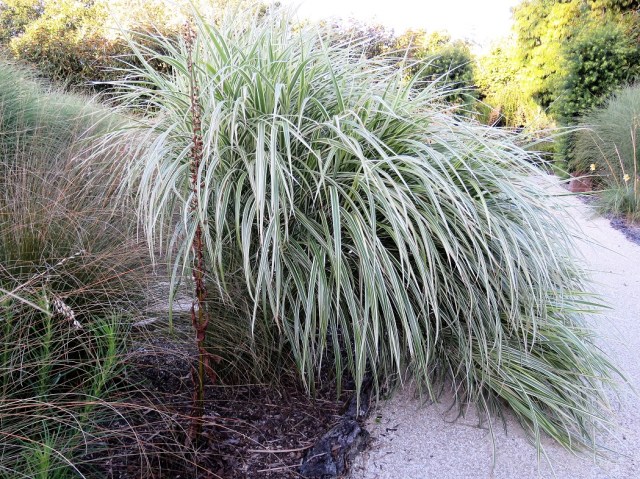
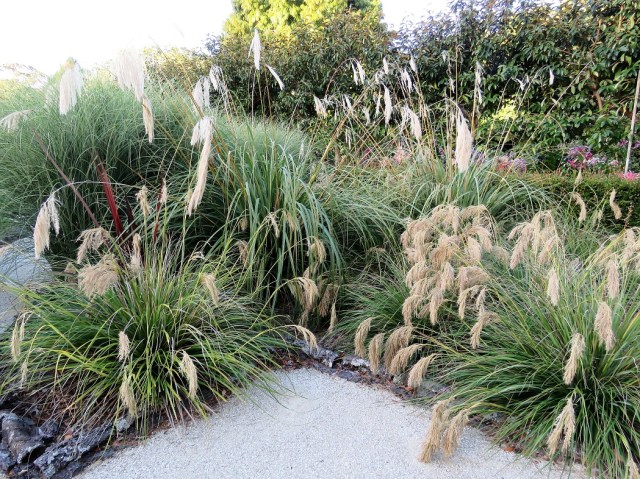
The foliage is blueish-green in colour and evergreen, forming a soft fountaining mound about knee-high. But the long-lived, towering, golden flower spikes are the reason to grow it and give it the common name of ‘golden oats’. Last year was something of a disappointment because the sparrows stripped the flowers. Apparently, we can out-sparrow the Brits who introduced that little bird to this country. If we were not going to get the flowers, I wasn’t sure I would persist with the plants.

What a difference a year makes. This season, they are magnificent – a major feature in the new Court Garden. It remains to be seen how long they hold with our bird population but I can live with that because they make a big visual statement in late spring before the miscanthus flower. The ethereal golden heads towering above are so light, they appear to dance against the sky.

I also like the stipa with the dark foliaged phormium coming into flower

As far as we can make out, Stipa gigantea (syn Celtica gigantea) is sterile here, which is helpful. We should be able to confirm this later this season. It is also evergreen. A member of the poa family of grasses, it comes from southern Europe. Given its vigorous growth, it is a good thing it is shallow rooted so easy to lift and divide, often falling apart into divisions in the process. A visitor to the garden told me she was trying to buy one but there was a waiting list and each plant was priced at $40 which made me gulp. I briefly caught myself thinking that I could have easily potted up 40 of them sold them at $20 each during our recent garden festival. But we are over selling plants; we do not want to go back there again.

If you really want to have it in your garden, you could contact Janica at Woodleigh Nursery. I see they are saying sold out at this stage but she tells me she has more which will be ready in autumn. She doesn’t price them at $40 either. You only need one plant and a bit of patience. Within two years, you will have all you need. Just give it plenty of space to star.

The other stipa we grow is Stipa tenuissima (syn Nassella tenuissima) which is very lovely and fluffy but comes with a warning. It seeds down so is on the Weedbusters list though not banned, as far as I know. Avoid it if you are anywhere near native bush or indeed farmland. We don’t need more weed pests invading pastoral land. We are keeping it because it is not a problem in a controlled garden situation and does not seed so badly that we have found it to be a pest.

Fluffy mounds of Stipa tenuissima shining in the light with yellow Phlomis russeliana and Iris sibirica ‘Blue Moon’
Plenty of stipa flowers to share with the sparrows this year. Mark says it is the pollen they are after.

A freestyle garden

WisteriaShiro-Kapitan’ with alstromeria, perennial forget-me-nots and aquilegia

A friend came out to help with a garden task this week and she gave some advice that has had me thinking ever since. To be clear, I am fine with receiving advice from friends who have experience. I may or may not follow it.

“Your perennial garden needs structures in it,” she said. ‘To encourage people to go in and view it.” My immediate response was ‘nooooo’ but it has stayed in my mind. She was referring to the Iolanthe garden, a bit of an experiment on my part and the last of our new summer garden series. I pondered the fact that I was really pleased when Mark had said the previous day how much pleasure the Iolanthe garden was giving him and I thought about why I rejected her advice as an immediate response. There are two reasons.

The first is that my friend was still thinking in terms of a garden that is open to the public. That is why people needed to be ‘encouraged’ to leave the driveway and venture into that area. She had a large garden herself that was open to the public until a few years ago when they sold up and retired to a smaller city garden. At that level she is right; structure and focal points draw one in to a space.

At last I have a place for hefty plants like foxgloves – but none of the common dark pink one. White or pastelle, please. With Chionocloa flavicans and an equally hefty, obscure lobelia.

But we live here. It is our garden. We don’t need such aids to draw us in. And I realised that at some point in the seven years since we closed, I stopped gardening for show, for public display when the garden is open. I now garden solely for our pleasure, our delight. That is probably why it has been such a shock to me over the last few months to go back to preparing the garden for opening this week. It is a very different focus. I don’t feel I have been gardening. I have been tidying, titivating, garden grooming – and I really don’t find that fulfilling.

The combination of Mark’s hybrid arisaemas with self-sown parsley, lychnis and bluebells amuses me. In this somewhat chaotic planting. There are also a few trilliums and Paris polyphylla with the rhubarb and Joe Pye weed.

Secondly, I realised that the Iolanthe garden didn’t make sense to her and that was interesting. She saw it as ‘a perennial garden’. No, I said, it is a transitional perennial meadow and she didn’t accept that the place for a meadow – transitional or not – is so close to the cultivated, defined areas near the house. Meadows, I pointed out, don’t have structure and focal points as more formal gardens do. I would never plant a straight perennial garden as I have planted this area.

I must accept that in terms of a garden that is open to the public and therefore needs to have some coherence that is easily understood by a reasonably perceptive garden visitor, the Iolanthe garden falls short. Amongst other things, if we were still open for most of the year, it falls short on design. The paths are so narrow that they are single-file and, at this stage, there is no through path for visitors so they must exit the same way they entered. Plans are underway to move the propagation houses which will allow for more flow and a wide central pathway but that will take another year or two.

This colour combination offends me greatly

But none of this matters because we are no longer open, bar the upcoming ten days. My greatest concern at the moment is the disastrous combination of this dusky pink bulb with the cheerful, if garish, calendulas. I think the bulb is a tritonia – maybe T. squalida, but feel free to correct me if I am wrong. I planted them but the calendulas are volunteers. It will be easier to discourage the calendulas from that particular location than to lift the bulbs.

I am not sure yet whether the combination is going to offend me so much that I cut the flowers off the bulbs for our opening. If you are planning on visiting us next week, you may like to step off the driveway and into the area to see.

It is the first year for this garden so it is still getting established but what I envisage is a casual sea of flowers, heavily populated with bees and butterflies, from spring to autumn.  With some grasses. Straddling the lines of a perennial garden, a cottage garden and a meadow – so a transitional meadow. That makes sense to both Mark and me, at least, even if this freestyle planting confuses others.

Our garden will be open from Friday 31 October until Sunday 8 November from 9am to 5pm daily as part of the Taranaki Garden Festival. We are not open outside these days.

A short story in four photos

Lloyd was trimming the lollipop michelias at our front entrance this week, to have us looking smart for opening the garden on Friday. We only trim them once a year.

At the end of the day I looked and was surprised to see that he hadn’t finished. The only reason I was surprised is because he is very task-oriented and likes to finish whatever he is doing. Mark and I tend to flit all over the place, multi-tasking, so his focus is a good foil in our team. There are six lollipops clipped from Fairy Magnolia Blush and one and a half umbrellas from the unnamed seedling we have by the courtyard entrance.

This morning he explained. He only just noticed Mama Blackbird in time and he didn’t want to destroy her home and kill her babies. This is exactly how both Mark and I would have responded, too. So if you are visiting our garden during the Taranaki Garden Festival, that is why one bush right at the entrance is only half-clipped.

I remembered this happening before, when I took this photo in the same plant, and in other years. Because the photo is dated back to 2012, I googled the life expectancy of a blackbird. I wondered if they lived long enough for it to be the same bird returning to her favourite position. FIFTEEN YEARS. Blackbirds can last 15 years, presumably if not predated by a cat or anything else. So it may indeed be the same Mama Blackbird raising another clutch. We can accommodate her in relative safety here.

The 2020 election in flowers. Mostly.


Red, of course for the Labour Party and Jacinda Ardern with a resounding vote of confidence that exceeded the hopes of even their own supporters. That is Rhododendron ‘Noyo Chief’.

(Red – centre left)

Green for the Green Party. I put the giant red pepper mill that our son bequeathed to us before he headed overseas (and a very good pepper mill it is, too) beside it yesterday. It was not a premonition, more serendipity but today it stands for the resurgent Māori Party who won a seat against the odds.

(Green – left wing with a strong focus on the environment and social justice. Red – but a darker shade than Labour red and with black – for the only party whose prime focus is on Māori affairs)

The yellow Doronicum orientale daisy is for the Act Party – one star and now nine additional members of parliament, some of whom must be as surprised as the rest of us to see themselves there.

(Yellow – our most right wing, libertarian party)

Bluebells, wilting, past their prime and going to seed for the National Party. But, like bluebells, they will rise again, refreshed, at some stage in the future.

(Blue – centre right but leaning more right than centre lately).

And the black ashes of defeat for the demise of New Zealand First. No matter one’s personal opinion of its leader, Winston Peters, it seems sad to witness the demise of such a characterful and long-serving MP in such an inglorious manner.

For overseas readers, we have proportional representation in NZ and a history of very stable coalition governments. This is the first time since we opted for this system that a single party has received such an overwhelming mandate that they can govern alone without needing the support of other parties. It remains to be seen whether the Labour government will choose to govern alone or whether they will opt for a cooperative approach which would see them bring the Greens and probably the Maori Party onto the government benches.


And that is a wrap from what seemed like an interminable election campaign in this year of Covid.

Golden orbs

This image has an empty alt attribute; its file name is img_7832.jpg

Every time Edgeworthia gardneri blooms and I sniff the waxy, golden orbs of fragrance, I remember a customer from our mail order days. One who put the cuss into customer, as Mark is wont to say.

New Zealand Gardener magazine carried a full-page photo of a single golden orb and the accompanying text named us as one of very few suppliers of this plant. It is not common in NZ gardens and not that easy to propagate. A full-page photo should give a hint as to the problem. It was considerably enlarged in the image.

A reader rang, desperate to order one of the few remaining plants we had. One of the staff took the call and didn’t check to make sure she knew what she was buying. I am not saying Mark or I would have checked, but we might have. The staffer instead sold her an additional random plant as well to meet our minimum order of $35 and her plants were packed and despatched.

I have no idea what the woman’s name was but I can remember she lived in Palmerston North (here’s looking at you Palmerstonians – she was yours, all yours). On receipt of the plant, she rang to express her extreme disappointment. The flower, you see. She had no idea the flower would be so small. It looked much larger in the photo. I mentally sighed and agreed to take the plants back if she returned them in good condition. She had clearly destroyed our packing because in due course, the plants arrived back in a carefully constructed cardboard cage, with windows and air vents, even. As I recall, it cost her $27.50 to send us back $35 worth of plants. I deleted her from our data base.

Edgeworthia gardneri is the tall, willowy, multi-stemmed shrub behind the orange clivia

But every year, as I enjoy the plant in bloom, I smile wryly at the thought of what she missed out on because it is lovely. It is willowy in its growth so light and graceful, adorned by many golden orbs with good scent in late winter and early spring. It is evergreen and hails from the forests in the Himalayan foothills and is, I have just discovered, just as good if not better for the making of high quality paper as its better known, deciduous, shrubby cousin, Edgeworthia papyrifera syn chrysantha (which bears the common, though inaccurate, name of the yellow daphne).

It is just that the flower heads are the size of pingpong balls, not tennis balls, or maybe even the larger ball size used in softball and baseball.