Tag Archives: Abbie Jury

Waiting for rain

The Court Garden has barely turned a hair – or lost a leaf – in our unusually dry summer

It is unusually dry here. In fact our province of Taranaki went into official drought declaration some weeks ago. I was woken yesterday morning by the sound of rain and my instant response was relief but it stopped and I see it was only about half a millimetre so that did absolutely nothing.

Continuing dry weather has affected the floral display in the borders

People who live in habitually dry areas may scoff at what we declare as drought but it is all relative. For many years, I have been cheerfully declaring that we get around 150 cm of rain a year (1500mm or about sixty inches) fairly evenly distributed across the year. We might complain about the dryness if we get several weeks without rain in summer but we are generally confident that the rains will arrive in time. Our prevailing westerly weather patterns tend to mean that we get moisture-laden air coming in from the ocean. High sunshine hours and relatively high rainfall is the norm. Currently, we are about 60% down on our normal rainfall in the first months of this year.

Fortunately, we source our water from our own, private bore so we are not in danger of running out. The water delivery businesses must be booming with urgent calls from those rural folk who rely on rain water tanks or surface water sources. Stream and river levels are uniformly low.

The autumn bulbs are not bothered. They received just enough summer rain earlier to trigger them into growth. This is dainty little Leucojum autumnale. Its teeny tiny flowers are not much larger than a finger nail but it increases well.
When it comes to gardening, because we live in a climate with consistent rainfall, we have no irrigation system and we can only reach a few, small areas with a hose. Extended dry periods are a good test for us. When the hydrangeas planted in shade start to wilt, we know we are very dry.

We are not unduly worried yet. The rains should come.  It is frustrating though, for people who garden every day. It feels as though much is on hold, waiting for rain. We can’t plant anything much or dig and divide. But at least Zach and I got onto a messy border immediately behind the house. There is a water tap close by so we could do more.

A generally unremarkable border

One might describe it as an historic but unremarkable border, most of the permanent trees and shrubs having been planted by Mark’s father, probably back in the 1950s and 1960s. Over the years, it has received little intensive care or love, confined to weeding, removing dead plants, a bit of pruning and filling bare spaces but little else. The swathe of auratum lilies were crying out for some love.

The border goes from sun to full shade. This is Zach’s orchid construction at the shady end.
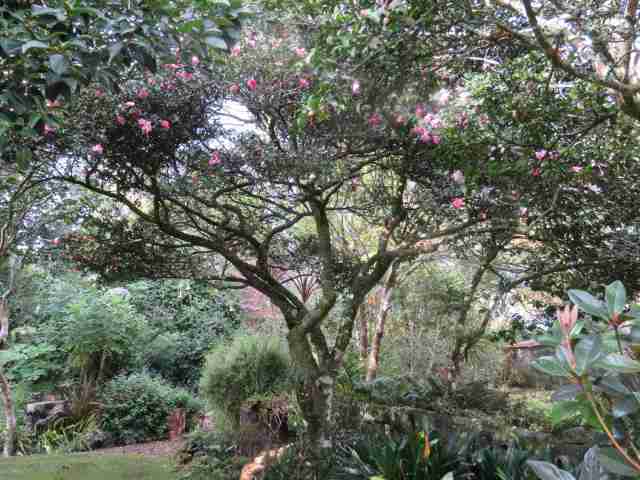
I haven’t counted the plant varieties but there must be at least 50 or 60 different ones in a curved area measuring up to three metres across and twenty five metres long. We pruned almost all the trees, shrubs, cycads and the like – a tidy-up really. The work came on the under plantings – the lower growing perennials and bulbs.
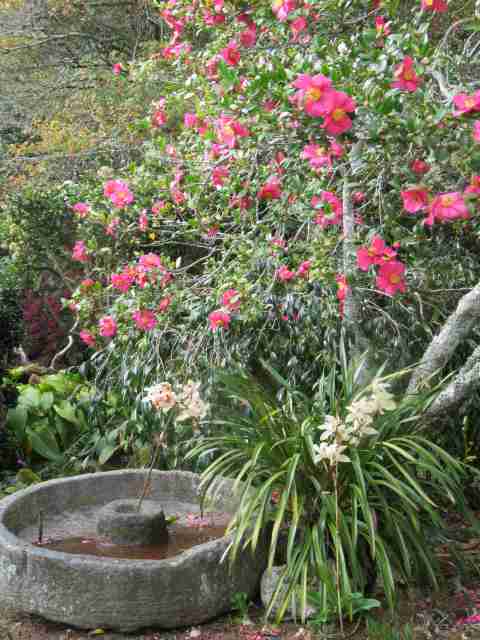
My mantra is that when there is a diverse top tier planting of trees and shrubs (like, one of each specimen), bottom tier plantings need to be simpler to give some cohesion. Our idea of simple may not be the same as many gardeners, let alone designers, but what Zach and I did was to consolidate the different ground level plantings into bigger blocks, rather than drifts or random placement. We removed some entirely (yellow tigridias and every last bit of green mondo grass), reduced some (it is very nice of Geranium madarense to seed down and naturalise but we only need four full-sized ones to make a statement next spring and a few younger ones for the year following – not 40), divided hostas and farfugiums and consolidated other plants into blocks.

Farfugium japonicum ‘Crispatum’ features strongly. I am going with the RHS name of this plant but a net search sees it listed under assorted variants including ligularia (first word), tussilagineum (second word) and Cristata or Crispata (third word) in every possible combination of those three words plus the three words of its RHS-accepted name.
Farfugium japonicum ‘Argenteum’ is showier but also much slower to increase. Fortunately, we used to sell it commercially so we had a jump start on having sufficient plants for impact in shady areas.

All plants that were lifted were plunged into buckets of water, replanted into holes enriched with compost, thoroughly watered and mulched. If we don’t get enough rain in the next week or two, we can easily reach them with the hose.

Just a reminder not to lay mulch when the ground is bone dry. It will act as a barrier to moisture entering the soil. Mulch needs to be laid to protect existing moisture levels in the ground before it dries out.

May the autumn rains arrive soon.

The rockery is so dry it is pretty much dust. There is no sign of life in the soils but the autumn bulbs are barely turning a hair at the conditions.

AI and me

I only took three photos while away, but sharp-eyed readers may work out where I went.

A family matter required some unexpected travel away this week. Mark has at least mastered answering his mobile phone at last but expecting him to link to Messenger or texts was a step too far with my speedy departure. I deputised Our Zach (our relatively young gardener, for those of you new to this site – when I say ‘relatively young’, I mean a generation younger than Mark, me and Our Lloyd)  to relay messages via Messenger. It yielded an unexpected delight.

Indeed, art does matter

As background, I do not lead a life dogged by a sense of failure but one of my nagging regrets has been that, despite 30 years of published garden writing, I have never written an entire book. I have two partially written on my computer and I had plans but they have never been completed. After feeling it weighing on my shoulders, I decided that maybe my skills lay in shorter articles in the 700 to 1200 word length range and that is okay. Maybe I don’t have an entire book in me waiting to be written and published. Or maybe I just don’t have a publisher.

No matter. It seems that I will go down in history as a published author, at least according to artificial intelligence. Zach messaged me the following:

I was searching for you on messenger and the Ai feature thought I just wanted to know about you. Anyway this is what it said:

I laughed. Zach laughed. We all laughed. Four books! Apparently.

This spurred me on to try something I had been intending to do – ask Chat GPT to write something in my writing style on a topic in which I have some expertise. It took maybe 20 seconds to come up with its reply. I am not going to list the errors; the omissions are rather more important. It doesn’t once mention Felix or Mark by name, nor does it mention their pioneering work in breeding red magnolias or the international awards that have followed. Aotearoa New Zealand does not get a mention. It takes the generic and unrelated info on pest management from other places.

Magnificent it may be, but hardly ‘deep purple’. Lilac, in the right light.

What reassured me most as a writer is that it failed entirely to capture my writing style. It reads like a generic promotional blurb. There is no danger of me resorting to using artificial intelligence on this site which I control and which is near and dear to my heart.

Being rural and of an older generation, AI may continue, in the first instance, to be the abbreviation for artificial insemination rather than artificial intelligence.

And the final image from my trip

Pushing the boundaries

I said in last week’s post that I would return to Waltham Place and Knepp Castle, along with ‘rewilding’. Both are visited in episode 4 of Monty Don’s British Gardens series.

Waltham Place first because we were fortunate to talk our way into seeing it in person in 2014. It was certainly challenging and interesting and continues to be food for thought a decade later. I have written about it here, but without photographs because one condition of entry was that we not take photographs. Did we like it? Not particularly. We prefer prettier gardens with more focus on plant interest but that was irrelevant then and remains so now.

This is my one and only photo from Waltham Place – taken when we parked the car before our pleasant host specified that the owners did not want photos taken by visitors.

In retrospect, I think it may sit as a side adjunct to the whole genre of conceptual gardens. In a pure form, conceptual gardens are where design, space and integrated art installations – the last being of a symbolic, architectural, intellectual-bordering-on-esoteric nature – take precedence over more traditional garden values. Think Little Sparta or Plaz Metaxu To some extent, I think Belgian designers Jacques and Peter Wirtz belong here too. They are landscape architects and their speciality is treating outdoor space as architecture where form and space are the most important aspects. We have never sought these gardens out because our interests take us in other directions.

Why would I put Waltham Place into this wider genre? Because the concept and philosophy that underpins the garden is arguably more important than what you see. It seemed very much an intellectual exercise.  Planted around 2000, it utilised all the existing elements of a traditional, English, Arts and Crafts garden (huge brick pergola, walled garden, gazebo on stilts, ponds, graceful manor house etc) but the plantings are on the wild side with a very light hand indeed on maintenance. The designer was Dutchman, Henk Gerritsen and it adheres closely to the philosophy of his muse from an earlier generation, Mien Ruys: “a wild planting in a strong design”. Dare I say it – the strong design element at Waltham Place means that it photographs and films rather better than the actual experience of visiting in person.

Gerritsen died at a relatively young age in 2007. Had he lived longer, I think it would have been interesting to see how his style evolved further over time because he was a philosopher with a passion for wildflowers as much as a landscape architect.  Waltham Place was certainly cutting edge at the start of the new millenium.

Neither Waltham Place nor Knepp Castle, but a wild-ish scene that charmed me on the day.

Knepp Castle, in the same episode, is very recent – just a few years old, in fact. I haven’t been there but it appears to be the new cutting edge, arousing strong opinions. I have heard it praised to the sky but also savaged as a travesty of a traditional, walled garden.

Walled gardens are not uncommon in Britain. Often encompassing areas that are measured in acres and a lasting monument to brickies of old, they were originally sheltered kitchen gardens, orchards and picking gardens so productive and utilitarian. These days, they are widely repurposed as ornamental gardens. It is quite a leap to change them from being a productive garden in times past to being purely ornamental as at Scampston Hall. Is it such a big leap to then heavily modify the contour and soil to make a naturalistic garden?

Not Knepp Castle – I have no photos of that location. This is Wildside in the rain and there seem to be strong parallels, albeit on very different budgets.

I was going to say that, to me, Knepp Castle looks like having its roots in Beth Chatto’s dry garden from the 1960s with strong elements of James Hitchmough’s Missouri meadow at Wisley from the mid 2000s, meeting Tom Stuart-Smith’s expansive perennial terraces, some modern European gardens and generous lashings of what Keith Wiley has created at Wildside – but all combined in a project started in 2020. I looked up their website and indeed the designers involved included Stuart-Smith and Hitchmough as well as Jekka McVicar and Mick Crawley whom I had not heard of but is apparently an emeritus professor of plant ecology at Imperial College in London. That is quite the team.

I am with Monty Don. I hesitate use the words rewilding, or even restorative gardening at Knepp Castle, but I love the naturalistic look and the underpinning principles of gardening in cooperation with Nature, not by iron-fisted, human control. But you have to intervene all the time, as the owner said, or it will just be taken over by weeds. My reservations – and, it seems, Monty’s – are about semantics not principles or indeed the end result which is a lovely example of modern naturalism in gardening, rich in plant interest.

To me, rewilding and restoration are more akin to what we know in this country as ‘riparian planting’***. Or maybe planting an area in eco-sourced natives or shutting up an existing area of native plants and then assiduously weeding out invading plants of exotic origin. That is not gardening.

What is being referred to as rewilding or restorative gardening in Britain is what we describe as naturalistic gardening, sometimes veering into wild gardening. Same principles, different words.

I don’t think there is a big difference between what we call our Wild North Garden here and what the Knepp Castle folk call ‘rewilding’
Naturalistic, maybe modern, here at Tikorangi but not what we would describe as rewilding.

It seems to me that the controversial aspect of Knepp Castle lies mostly in the repurposing of a walled garden to carry out this experiment in naturalism. I have only seen it in episode 4 of Monty Don’s British gardens but I have watched that segment three times. I much preferred it to the walled garden (I think in episode 3) which had been planted out in wide rows of perennials as a nod to its more traditional food producing days. That one had all the romance and panache of production nursery stock beds in our eyes (retired nursery people here) with none of the skills and delights of plant combinations, let alone any actual merit in design.

I would put Knepp Castle on my visiting list, were I planning another trip to Britain, even though I struggle with the idea of thinking like a beaver or a wild boar when it comes to garden maintenance.

***Riparian planting is being strongly promoted by our regional councils, mandatory in some situations. It is fencing off and planting the banks of waterways, generally in native plants, with the aim of preventing farmland runoff contaminating rivers and streams. In quaint rural parlance, I understand the measure of a waterway that should – or must – be fenced and planted is that it be ‘wider than a stride and deeper than a Redband’. Redband is the brand of gumboots most often worn in farming communities. That is probably what most people in this country would see as rewilding.

Our Wild North Garden again. I liked the layers from this angle.

Monty Don’s British Gardens. Part 2 – from a New Zealand perspective.

“What do you think the ingredients of a typical English or British garden are?”

“That is an interesting one. I would say hedges, borders, grass, (something inaudible to a NZ ear) and enough manicuring in some parts that it looks cared for. I think it is that mix of formality, the manicured elements and the wilder, more romantic parts that make the British garden especially British.”

Monty Don in conversation with Chris Crowder, head gardener at Levens Hall in episode two of the TV series ‘British Gardens’.

“Yesss!” I said out loud and went back and replayed it. Not just British gardens – that is a pretty accurate description of how we personally garden in Aotearoa NZ. I would qualify that we don’t do topiary here so much as some heavy clipping but it serves the same end of giving definition and form in the garden. And I would add a high level of plant interest which is another feature of British gardens (and very much so in our own garden). It is perhaps an understandable omission on Chris Crowder’s part, given that he manages a garden that dates back to 1690 (!) and is famed for its topiary.

In brief, Monty Don’s summary of the essence of British gardening seemed to come down to a few key points.

Gregarth Hall, the home and garden of Arabella Lennox-Boyd, was not featured in the TV series. To us, it is a fine example of the quintessential British garden of the late twentieth century built around some splendid architecture from earlier generations.
Gresgarth incorporated topiary.

Firstly that British gardening is deeply rooted in eighteenth century landscape design (think Capability Brown and his peers designing grand landscapes for the rich and powerful) and that, to this day, a high value is placed on that long history. Many British gardens have wonderful, historic architecture features – be they massive walls from old walled gardens, ruins, follies, pretty manor houses or even castles.

Those early funders also supported plant hunters combing the world for new plants which were welcomed with delight back in their homeland in a rarified pursuit of competition and one-upmanship. To this day, British gardening is a celebration of the ability to grow a huge range of different plants collected from around the globe and plant range is a defining feature. I remember quipping after my first trip to Italy – a magnolia conference tour – that they basically gardened with the same ten plants but that is not true of British gardens, or indeed New Zealand ones.

British botanists kept up the tradition of plant collecting. The Tetracentron sinensis in our park dates back to Frank Kingdon-Ward who financed some of his expeditions by subscription. Felix Jury paid in advance to receive seed back in the 1950s. We could have done without the rhus but the tetracentron is a fine tree.

Secondly, climate. In global terms, Britain generally enjoys a moderately temperate climate and there is no doubt that it is easier to garden in a climate without extremes. I don’t think their climate is quite as good as some of the people in the programme asserted but I would say that, as a New Zealander.

Thirdly, Monty Don talked about his homeland as a place where people ‘learn the language from an early age’. I think it is a bit more complex than that. What I see is a place where gardening has been both professionalised and institutionalised over a long period of time, which has given leadership and placed a value on it which is often lacking in other countries. Gardening, not just the broader notion of horticulture, is a respected profession. There is an established career path and high-quality training. Added to that, there is considerable support from institutions like Kew, The Royal Horticulture Society with their major gardens and in the media. BBC Gardeners’ World has been running since 1968 on primetime television, for goodness sake, and still has a loyal following. There is quite the collection of other TV garden programmes, both good and execrable, and garden celebrities who are actually celebrated, as opposed to just being recognisable. The vast majority of domestic gardening is done by amateurs but there is institutional knowledge to underpin much of that, and a strongly educative side.

In this country we haven’t had a proper TV garden programme for over two decades. That is despite census data regularly showing that gardening is one of the most popular leisure pursuits. I have long figured that nobody in the TV programme commissioning area has understood this simple fact, nor have they seen past the dated formula of instant garden makeovers.

Britain is a densely populated country with much more restricted personal space. This means that large numbers of people want to get out and about in their leisure time. With gardening so embedded in the national psyche, that often includes garden visiting and the level of visitor numbers supports both public and private gardens.

Hatfield House – again not in the Monty Don series – but an example of the style emulated by some aspirational NZ gardeners.

In Aotearoa NZ, we have taken on some of the same gardening values, although our colonial interpretation of British garden design is more Arts and Crafts (garden rooms) than 17th century pastoral landscape. With our benign climate, we certainly place a high value on growing a wide range of plants and having an attractive home garden – albeit quite a few want it to be both attractive and low maintenance. With a small population and overall low density of housing, the majority of people have private outdoor space. So yes, we do garden a lot. But overall, we lack that professional and institutional backbone of British gardening.

Great Dixter, the garden of the late Christopher Lloyd, is given credit for its significant contribution to gardening directions in recent decades in Britain.
Similarly, Beth Chatto is accorded a major place in the history of British gardening. She was pioneering sustainability long before we were even aware of climate change.

It was interesting to hear discussion on the impacts of climate change threaded throughout all the episodes. Many gardeners and Don himself referenced it as they discussed the gardens and future considerations. All I can say is that I am not seeing that sort of discussion in this country where the prevailing views seem to be either a loud ‘harrumph’ of denial or, at best, issues of climate change are pushed out to the margins as not being a relevant issue at a personal or local level. We have not normalised it as a factor in planning for the immediate – or even distant – future. We may be in for a shock as we continue to treat extreme weather events as one-offs rather than part of a larger pattern which is set to get considerably more extreme in a shorter space of time than originally thought.

Allotments – this one in suburban London. It is not from the TV programme but Mark and I often wandered allotments on our travels. These have a long history and are basically areas divided into small plots which are leased to individuals at a low annual rent, predominantly – but not exclusively – to grow food on a non-commercial basis. Their continued popularity is testament to the drive to grow gardens even in densely populated areas where people do not have personal space around their home.

Facebook showed me a post by Gardens Illustrated on one of our most favourite gardens, Wildside and I read the comments. Lovely series but it would be nice to see some ‘normal’ gardens”. Reader, what is a ‘normal garden’? The series gave considerable attention to both the wonderful British phenomenon of allotments as well as community gardens, alongside a potted history of the evolution of gardening down the past 450 years, touching on the most innovative recent developments.

I suspect a ‘normal garden’ equals ‘a garden like mine’ to that Facebook commenter.

“Rewilding” will have to wait. I will return to Knepp Castle and Waltham Place and the questions they raise in the future.

Harbingers of autumn


It may still feel like high summer where we are, but the flowers do not lie. We are on the cusp of autumn.

Colchicum autumnale

Summer here in North Taranaki has not followed its usual pattern. While we are always slower to warm up in November and December than the east coast, it didn’t really feel like summer until mid January. I don’t swim in cold water and I wasn’t tempted into the pool until well into January. Since then, we have been in and out of the water every day in an unseasonably warm and dry spell. A couple of degrees of extra heat on an ongoing basis makes quite a difference when you spend most of your days outdoors in the garden.

A stray belladonna in the raspberry cage was the first autumn bulb I noticed this season

And dry. I know when we talk about dryness, others may scoff. We all adapt to our own, local conditions and we expect rain on a regular basis all through the year. Mark, a keen weather watcher who could have happily pursued a career on meteorology, tells me we only had 40ml in January and that fell basically on one day, late in the month. We don’t ever water the garden (except for some of the vegetables) and we have no irrigation system; it isn’t necessary in our climate and nor does it seem like good practice but we are seeing some floppy looking plants and some early dropping of leaves.

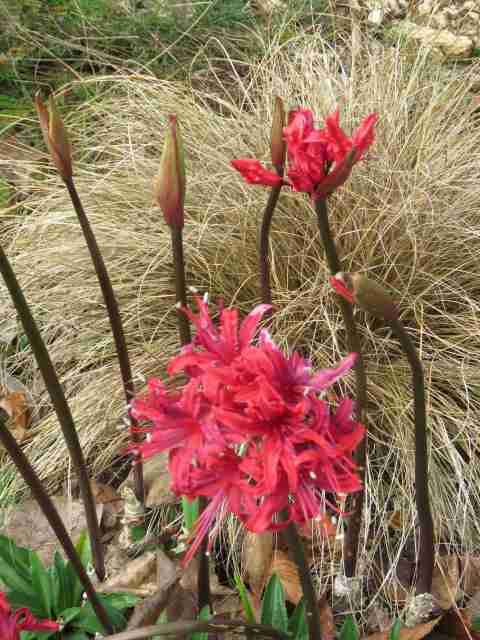
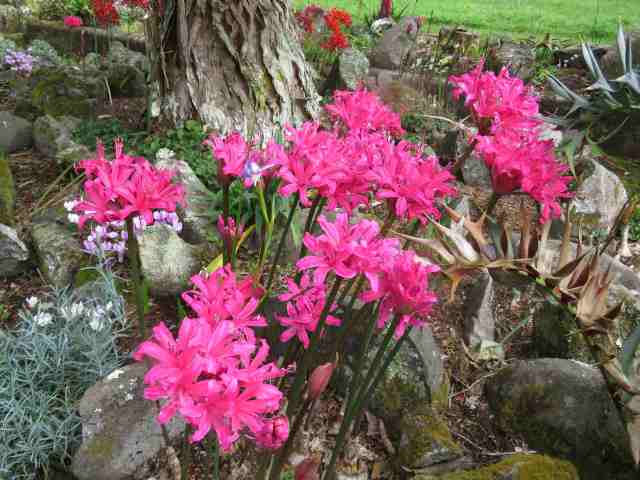
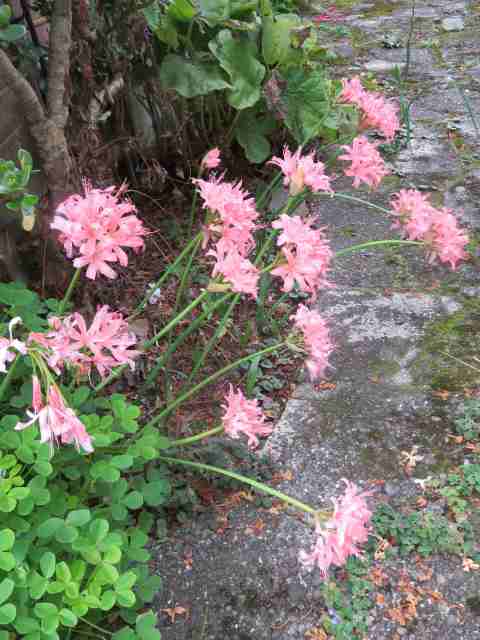
Even the first nerines are opening

When the autumn bulbs started flowering in what still feels like high summer, I assumed they were being triggered by day length, as vireya rhododendrons are. They are certainly not being triggered by change in temperature, either day or night. Mark pointed out that it may well be that one day of rain in January that triggered them into growth and that makes sense because many bulbs are identified as summer rainfall bulbs.

Lilium formasanaum is a bit controversial in this country. It is on the Pest Plants Accord so illegal to propagate or sell. We keep it because it is showy and not a problem in our garden but also, it is not in a situation where it can escape from the garden to become a problem elsewhere.

Zach and I are waiting for rain so we can move plants again. We have plans we want to get underway. At least we know that here, with a temperate, maritime climate, the rains will come. While our high summer may be of short duration, so too is the depth of winter which we measure in weeks, not months. We have exceptionally long autumn and spring seasons and that does make for a good gardening climate.

A self-seeded Moraea polystachya on the side of the drive. Of all the autumn bulbs, this moraea probably has the longest flowering season.

The autumn bulbs are one of our seasonal highlights.

The Worsleya procera is opening! This bulb is one we take some pride in because it is rare in cultivation, even rarer to see it flowering in a garden situation and it is very choice. It is generally grown as a pot plant in carefully controlled conditions. The lilac colour deepens and spreads as the flower opens.