Tag Archives: Abbie Jury

Learning from experience: gardening with bigger grasses in NZ conditions

Late March, so autumn of the first year.

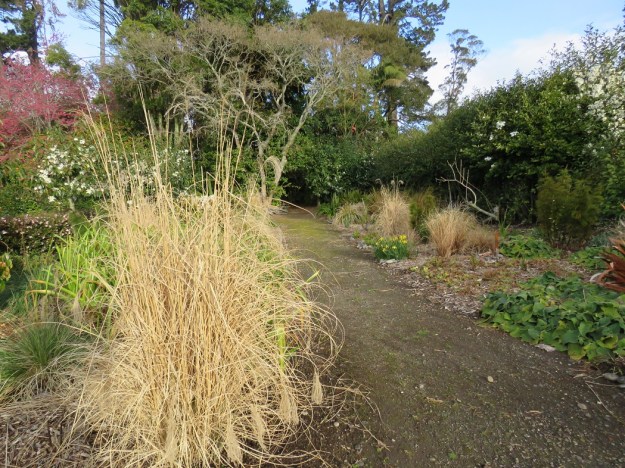
We know quite a bit about many aspects of gardening, particularly shade gardening, but gardening in full sun with big, bold perennials is a whole new ball game here and a steep learning curve. I mentioned a couple of weeks ago that I planned to lift and divide the larger growing grasses that I have used in the new borders.  Of course I am only half way through it. These jobs always take longer than I plan, even factoring in other distractions. But it is interesting to stocktake the performance of these bigger grasses one year on from planting.
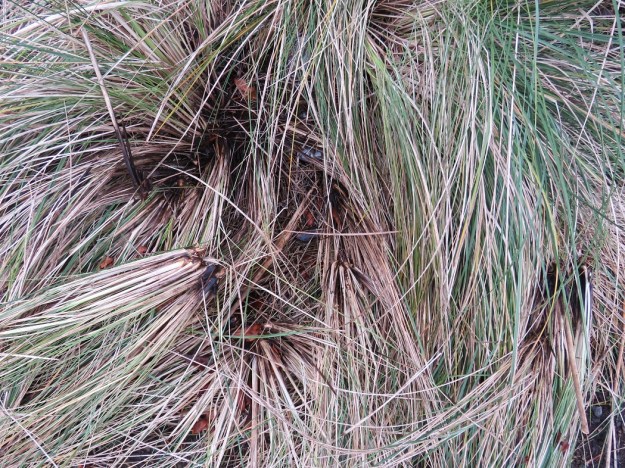
Stipa gigantea falls apart into divisions when lifted

Stipa gigantea – the giant feather grass or golden oats. Yes it grows quickly and enthusiastically but is very easy to dig out (not strong-rooted) and pretty much falls apart into divisions when lifted. So it is easy to manage. The flower heads are the feature but while ours bloomed, the sparrows laid waste to them so we did not get the full glory last summer. As far as we can make out, it is sterile so seeding and invasion are not an issue.
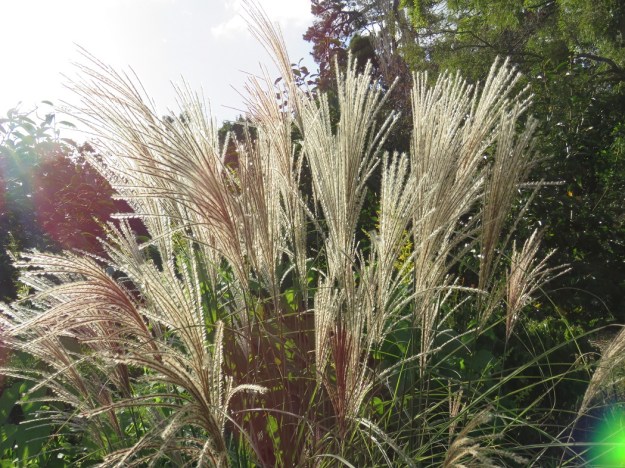
It is hard to beat the miscanthus at any time of the year

Miscanthus – I think it is ‘Morning Light’ we have. It required a little more effort to dig it out and an old handsaw and small axe to separate it into pieces but was not particularly difficult. I would not want to leave it too long though, before digging or it would get beyond my physical limits to dig and divide without assistance. It has been a standout. The clumps stand tidily like sentinels and it is brilliant at all stages – the foliage and the plumes. It is the only fully deciduous large grass I am growing and even the pillars of dried foliage have been attractive all winter. It is also close to sterile, setting almost no seed.
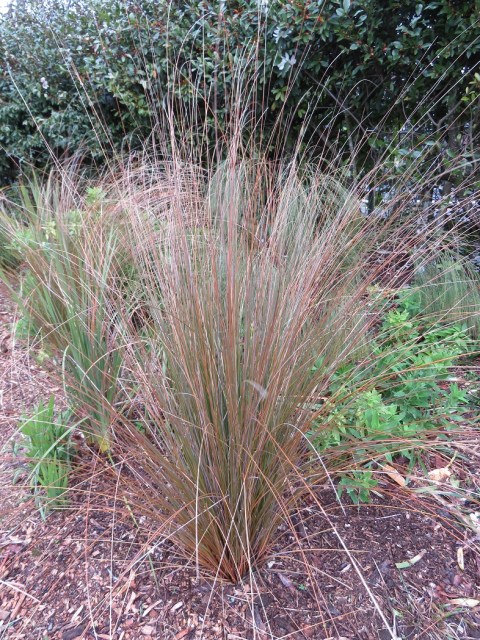
Is it Chionocloa rubra? Someone will know but it is a native tussock at least.

Chionocloa rubra – there is a bit of a question mark over the name of this one but a couple of visitors have suggested this identification. A native tussock grass that is performing brilliantly so far in attractive vase-shaped clumps. It is easy enough to dig and divide (more hacking apart with saw and small axe than dividing, to be honest) though I only divided this year to get more plants. It won’t need as much active management as most of the other grasses.

Anemanthele lessoniana is another native grass. It was a little underwhelming in its first year but I am told flowers attractively once established. I started with just three plants so I have divided them after their first year to get more.

The native toetoe (now an austroderia though formerly a cortaderia – our environmentally friendly version of the invasive Argentinian pampas grass) was one I planted a little anxiously, worried about its potential size. I need not have worried. The resident rabbits love it so much that the poor little things have failed to make any headway. I shall have to construct little cages over them if I want them to get any larger. I see we have five different austroderia species native to NZ though which one this is, I am not sure yet.
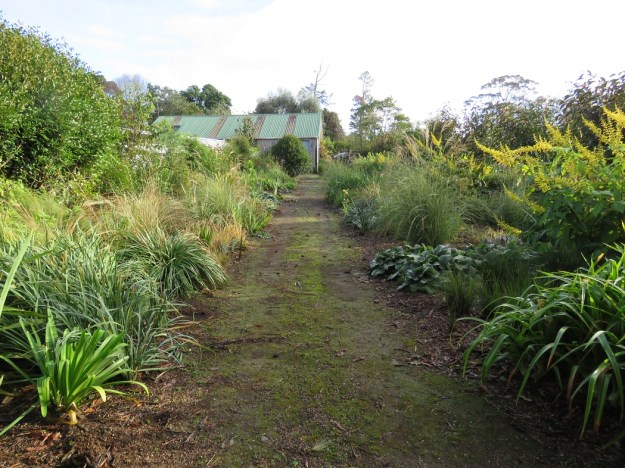
It appears I failed to photograph the calamgrostris at is peak but it is the third one up on the left in this May scene of late autumn.

Calamagrostis ‘Karl Foerster’. Yes well, this one may be on borrowed time. It is scary. I bought several – I can’t remember if it was 5 or 10 because I divided a couple of clumps mid-season when it was clearly growing strongly (about now, alarm bells should be ringing for experienced gardeners). It is a stock grass for the contemporary perennial gardens we have been looking at, mostly in the UK. Our Canberra daughter also said it was the stand-out grass in her little prairie-style patch. And it was most attractive all summer and autumn. Not so in winter where it has been a messy mix of green and brown. It is deciduous in colder climates but not so here. But that is not the main issue.

Added bucket for scale but I also measured and the root systems reached 45cm across in one year. As a quick aside, my kneeling pad of the day is a piece of rubber carpet underlay cut to size. It doesn’t last that long but it comes from waste destined for landfill anyway and while it lasts, it is good.

The plants I bought came in 2.5 litre pots so larger than a liner but not big. Under one year is all it took for each plant to e x p a n d from about 12 or 14m across to somewhere closer to 45cm across. It took every ounce of my determination and strength to dig out the clumps for they were going deep as well as wide. The root ball is solid and dense and that is when I went to find the axe to chop it apart. I raised my eyebrows and started replanting just a few smaller – much smaller – clumps and these reduced in number the further I went. Most are piled to compost. The clumps I replanted are on trial for one more year but in my bones, I know they are on borrowed time. In our conditions, it is just way too vigorous though I am guessing that in harder conditions with dry summers and cold winters, it may just be deemed a ‘strong’ grower. I don’t know if it seeds but I am not seeing seedlings pop up so far. I would say that it may be quite useful if you want to retain an eroding precipice quickly but as a garden plant, try it before getting too carried away. I think I will decide that its powerful growth outweighs the charm of its flowering plumes.

I haven’t tackled the Elegia capensis yet but it can stay untouched for another year. It is a restio so not one of the grasses, though its growth habit and bamboo-like appearance mean it fits a similar niche in the garden. I know from experience that this is one we can contain if required by cutting around with a sharp spade to reduce its spread.

The smaller grasses can wait but the standout smaller variety so far has been a very dark green form of the Australian lomandra. We have several named forms and I am hoping I will unearth the labels when I lift the clumps again (I hate looking at visible plant labels so I tend to push my labels in so deep that I can’t find them again) and the dark forest green one is by far the pick of the bunch. The rest are a bit… utility, shall I say?

The takeaway lesson from all this is we need to trial plants here. That key plants used widely overseas perform differently in our conditions. It is why we buy garden books that cover design, history, philosophy and contemporary trends but never books written by overseas authors which focus on recommended plants and planting schemes. There is no substitute for local experience.

Postscript: I have finally found a home for the Dutch irises. They always looked a bit crass and coarse in the rockery and other areas where we concentrate on species and dwarf bulbs. But they are perfect with the big grasses, Just the right scale. And they bring in colour now in early September when there is not much else happening in that area.
 

The glyphosate debate

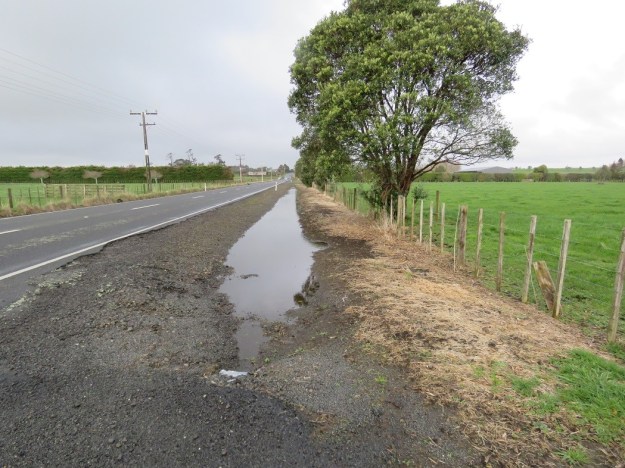
The visual and environmental scourge of the scorched earth roadside

Glyphosate has been much in the news of late and the calls to ban it are increasing in this country. I am no scientist so any opinions we have here are based on experience and observation. Because we ran a plant nursery for about three decades, our experience with sprays is greater than the average home gardener. You don’t think all those brilliant looking plants you buy from the garden centre are grown organically, do you?

Because of my lack of scientific background, I was pleased to find a post on the credible and independent Sciblogs site, written by scientist, Dr Grant Jacobs. If you have any interest in the use of glyphosate, I would urge you to read it in full here.

If you are not going to read it in full, the key points I have taken from it are:

  • The original probable (not definitive) link between glyphosate and cancer was made by IARC in 2015 (IARC being the International Agency for Research into Cancer which comes under the World Health Organisation). IARC’s role is to flag areas for further investigation and identify hazards, not to make definitive rulings. Even the term ‘probable link’ is an oversimplification of IARC’s findings.
  • The role of risk assessment on those potential hazards falls to regulatory bodies – the Environmental Protection Agency is a key body in NZ. And while IARC made the initial finding, subsequent investigations by scientists in such regulatory bodies around the world have not raised red flags. It appears that all such investigations have cleared it as safe when used according to instructions and with usual safety precautions. The difference between hazard and proven risk is important.
  • Any blanket ban on such a product comes down to a political decision and that is what we are seeing happening in Europe. A political decision is not necessarily based on science. It can often be based more in public opinion and political polling.
  • The court case in USA which triggered the recent round of debate (the school caretaker who contracted cancer) is based on a judge and jury trial in a courtroom and as such it is subject to the vagaries of a court system where the jury may or may not understand the science and where the directions given by the judge have a huge influence. This will all be tested further in the appeals process but a court case does not constitute rigorous scientific enquiry and risk assessment. While the case is certainly interesting, it is not proof of anything at this stage.

Jacobs also clarifies why we need to be talking ‘glyphosate’, not using the original brand name of Round Up. Indeed Round Up for Lawns contains no glyphosate at all. It is the chemical that is under scrutiny, not the branding. Round Up is a Monsanto product and while there are many concerns about Monsanto across a whole range of issues, the safety or otherwise of glyphosate should not be confused with a battle against Monsanto business ethics (or perceived lack thereof). Let us keep the arguments separate.

I was listening to a discussion on Radio NZ about all this and the host went on and on about the safety of glyphosate. “Is it safe? Can you guarantee it is safe?” he kept asking. Wrong question. How safe is it if used properly? Is the risk within acceptable limits? These might be better questions. Our lives are filled with hazards that we choose to manage. In the 44 years that glyphosate has been in use, it has proven itself to be safer than many other chemical sprays that are, or were, also used. Remember Paraquat? I don’t think there is any dispute that glyphosate is hugely safer than Paraquat but is it safe enough to continue using?

I worry about the nature of public debate that may see political decisions to ban what has so far been a relatively safe agrichemical, while leaving far more dangerous options on the market. Unless we have a change of heart, mind and practice on how we manage weeds and pasture, we run the risk of banning one option, only to have people substitute with another spray that could be way worse. We are a country that accepts a pretty high level of use of chemicals, toxins and sprays. While some are now controlled and you need to be an approved handler to buy them, the home gardener can still buy a fair number of products across the counter that are no longer available to their counterparts in the European Community.

The issue of the possible threat to human health underpins all this debate with IARC, cancer and banning glyphosate. It is separate to the issue of the impact on ecological systems. That is a whole different area to be considered. There are theories that environmental damage may be more to do with the surfactant (the sticking agent) rather than the glyphosate. We have also raised our eyebrows at the quick knockdown glyphosate products – the convenient aerosol or pump sprays that the home gardener can use to kill a plant more or less instantly. But again, that is a separate issue to fundamental matter of the claimed threat to human health.

It is complicated, not black and white. By all means, go organic and shun the use of non-organic sprays in your own garden. But maybe don’t cast glyphosate as the greatest villain of all the sprays and single it out for blanket bans while leaving the others on the market. I think that is called throwing the baby out with the bathwater.

Time will tell if we will face a future without glyphosate and that bears some thinking about for home gardeners, farmers and most landowners as well as the public sector which maintains the parks, reserves, road verges and playing fields. Our attitudes to weeds, to invasive plants, to long grass and to presentation standards which are widely held as desirable will have to change too. On the bright side, the scourge of the scorched earth roadside may disappear which would be hugely beneficial both environmentally and aesthetically, in my opinion at least.

Garden lore: seasonal garden advice

Herewith your annual reminder of three seasonal matters.
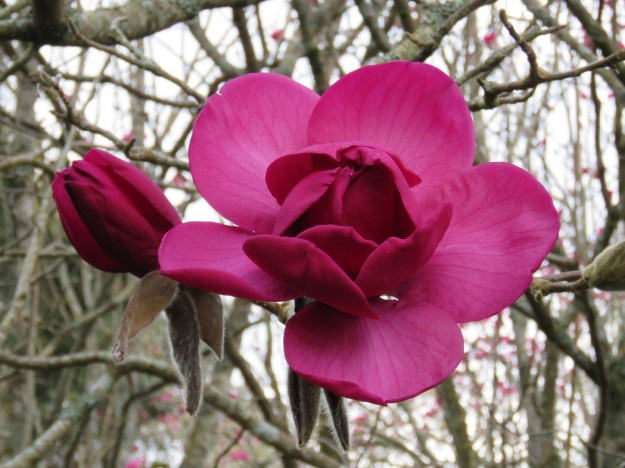
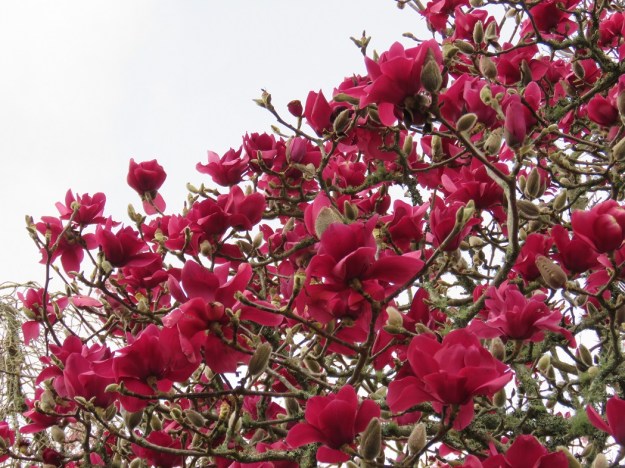
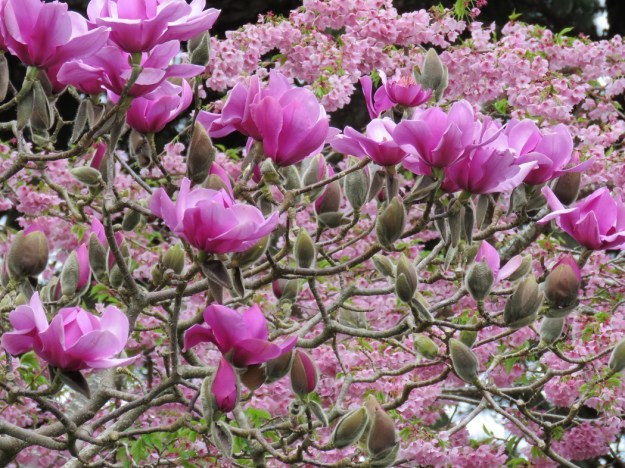
  • If your magnolia appears to have plenty of furry buds but when they go to open, all you get is a few damaged petals – or nothing – the culprit is almost certainly a possum. They can develop a taste for the buds and eat the centre out without the damage being overly obvious to the casual eye until the blooms fail to open. A single possum is quite capable of taking out most of the buds on a tree over a few nights. Mark and the dogs head out every dry night at this time of the year on a possums-in-the-magnolias round. The price of our glorious display is seasonal vigilance (and high velocity lead, which is not an option for city dwellers).

    One of the first blooms on Magnolia Felix Jury

  • If you feel you must spray your lawn, do it on the next fine day and do not delay if if you have deciduous magnolias (or indeed kiwi fruit or any other plants that are susceptible to hormone spray drift). The faintest whiff of lawn spray at the time the leaf buds are breaking dormancy is likely to damage them badly and magnolias are particularly susceptible. Most magnolias break into leaf just as flowering finishes. Every year we get enquiries from people worrying about the deformed new foliage on their trees. Invariably, the cause is lawn spray. Unfortunately, there is not a whole lot you can do about spray-happy neighbours.
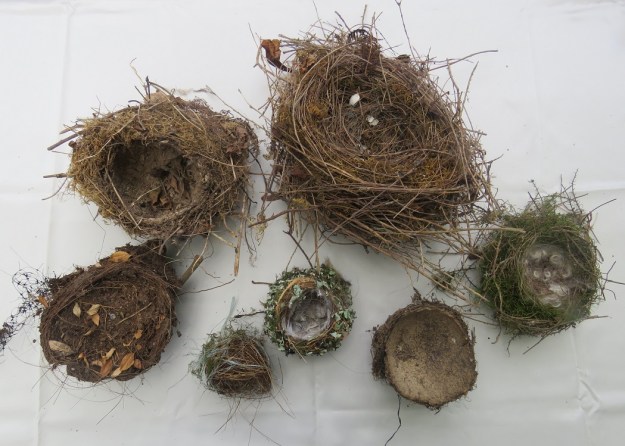
  • Get any tree or large shrub pruning done urgently. The birds will be building nests full time shortly. I am not sure what killing off birds’ eggs – or worse, later in the season, hatchlings – is called. Aviancide, perhaps? But if you have ever taken the time to watch the birds gathering materials for nests, you will realise what a huge amount of time and effort it takes. It seems very mean to destroy them, all for failing to factor that into planning for pruning.

    Vulcan in its full glory today.

Change of plan

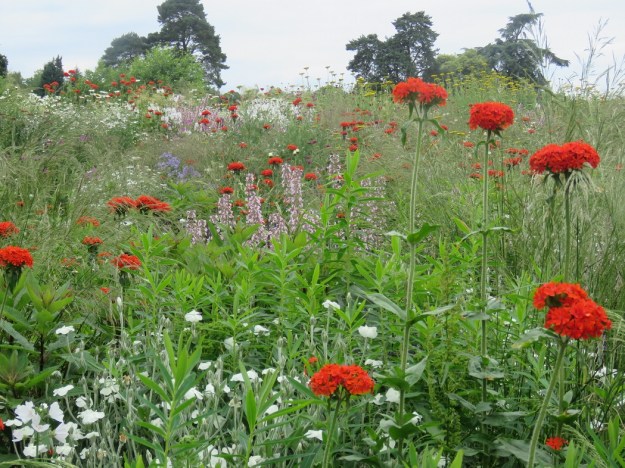
Verbascum creticum, a tall, large flowered biennial

We have spent a fair amount of time and energy examining meadow gardens and wildflower gardening over the years. It is not something we want to embark on lightly. With our growing conditions, the potential for unleashing a weedy mess is high. But crunch time is coming. What to do with the central court in our new garden? We do not want an actual tennis court. Nor do we want more lawn. We want something naturalistic, ecologically sound, relatively low maintenance and preferably wildly romantic.

Last year, I was still thinking of meadow-style and saved seeds of various large biennials and annuals that we could possibly use – Verbascum creticum, white foxgloves, nigella, even the red poppy. It takes A LOT of seed to sow an area as large as this and it was going to be expensive if we had to buy small packets to make up the chosen mix.

Flagged that plan. I may try it further out in the garden but in a smaller area. In the future. Maybe. This central court is too prominent and too large to experiment with random ‘wildflowers’ (not wild in NZ of course). It HAS to work rather than be experimental and to work in the longer term without creating a maintenance headache.

Dunnett at Trentham

While I would love to try the perennial meadow style pioneered by Nigel Dunnett and the Sheffield Movement (Pictorial Meadows) that so entranced us at Trentham last year, I also know our limits. That work is the result of years of experimentation, learning and analysis by the protagonists and the plant selections are what works in the UK. We would be starting from scratch to find what works well and how to manage it in our very different climate and growing conditions. It may also look rather flat and contrived in a tightly contained garden rather than linking to the wider landscape with natural landform.

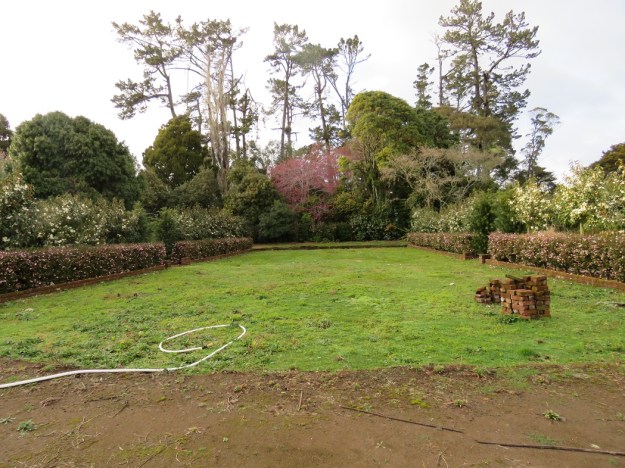
A blank canvas of about 450 square metres

This court area is about 15 metres wide and at least 30 metres long. It is a rectangular, formal shape bounded by a low brick retaining wall (still under construction) and the long sides defined by formal plantings of Fairy Magnolia White (to be pleached in due course and clipped hedges of Camellia Fairy Blush. The steps still await construction, as do the large pergolas Mark really (really, really) wants at each end. It is flanked on one side by the new grass garden and on the other by the equally new lily border and the caterpillar garden, all of which I have written about in the last year.

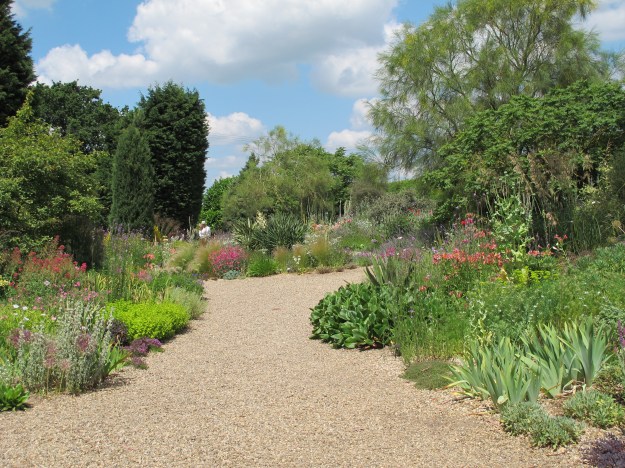
Each plant in its own space in Beth Chatto’s dry garden

The solution lay in what I have referred to as the grass garden. It isn’t really the grass garden that I envisaged at the start. It isn’t even the summer garden we initially called it, though it looks good in summer. It also looks good in spring, different but equally pleasing in autumn and has enough interest to carry it through winter. Basically, it is more an example twin herbaceous borders in a modern style, showing influences from a number of contemporary designers with some debt to Beth Chatto’s dry garden. I add Chatto, because we eventually worked out that one of the aspects that makes her dry garden so charming is that each plant stands in its own space, not jostling for room and melding into its neighbours as in classic herbaceous plantings where one aim is to have no ground space visible.  It is that individual space that not only gives a very different feel – lighter, more spacious, when done with skill –  but also makes maintenance far easier.

Miscanthus in winter in the new borders

There is a school of thought that digging and dividing perennial plants is an unnecessary activity, devised by those who like to make work. And that may be true in some climates and some styles of gardening – an extension of the no-dig garden philosophy, even. One thing I have learned from experience is that if you dig and divide often, it is not a big task to be feared. It is digging over-large plants in hard, compacted soils that is difficult and heavy work. I had to get Lloyd (who does the heavy work here) to dig out the enormous Miscanthus ‘Morning Light’ clump that I then cut up with an old hand saw to get about a dozen sizeable pieces. I wasn’t sure how they would respond to such rough treatment but they thrived and looked good all year. They are still standing, erect and pale and have not been beaten down or fallen apart in heavy rain and wind, as well-established clumps often do.

This week, I plan to dig and divide all the clumps of large grasses that I planted at this time last year. I shall report further if it turns out to be harder than I expect it to be, but the ground is still well cultivated and friable and I am not anticipating a killer task. I have promised some divisions to a colleague but there will be A LOT of miscanthus, Stipa gigantea and Calamgrostris ‘Karl Foerster’, along with our native Anemanthele lessoniana, toetoe (now an austroderia but formerly known as a cortaderia) and a large but graceful brown tussock that we have yet to find the name of. And there is the solution for the new court garden.

An immersive experience at Bury Court

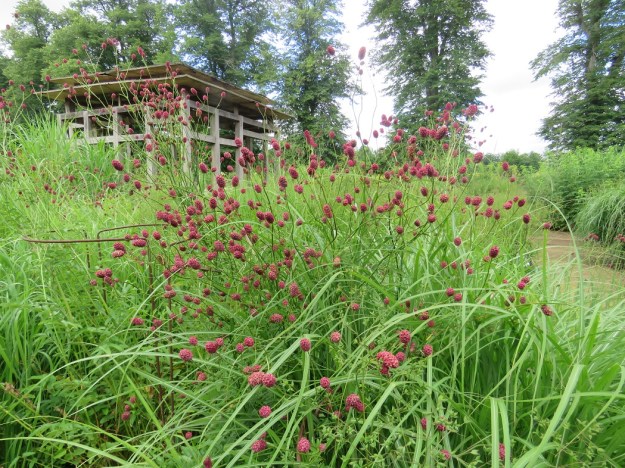
It is to be the new grass garden, drawing on lessons learned from both Piet Oudolf and Christopher Bradley-Hole. In that large, geometric area, confined by a hard-edged boundary, I envisage an immersive experience – wandering informal paths through plantings that are shoulder high (at least when in flower), predominantly grasses. Waves of grasses (the Oudolf influence) in a limited selection. With just a few tall Verbascum creticum and foxgloves in white and pale apricot (we have both a-plenty) and maybe Ammi majus and some white daisy type plant which I have yet to find.  But the big grasses will be the feature. So more ‘New Perennials’, or modern prairie on steroids than meadow.

It will take a year or two to build up enough plants to fill the area. But now that I have a plan, I am impatient to get started. The first task will be to clear the area of grass and weeds and then rotary hoe it. It will happen. It just won’t be instant.

Postscript: I have zero intention of lifting these grasses in the court garden every year. They will be planted and left,  with maybe a cut around the outside from time to time to reduce the spread.

Ammi majus


Garden lore: protecting arms

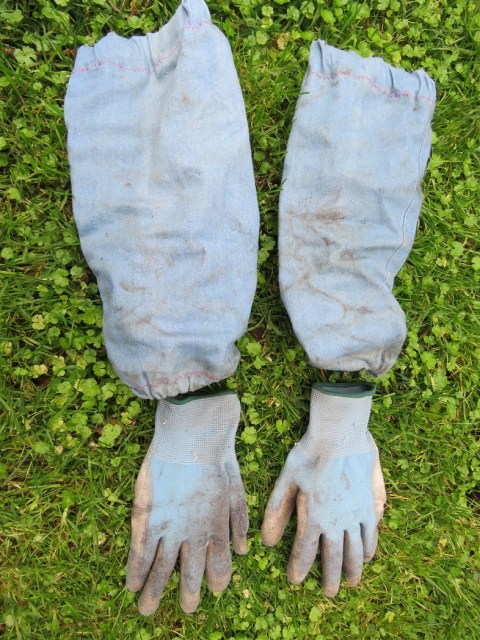
Puttees. But for lower arms. We have large swathes of bromeliads that need an occasional clean out of accumulated debris and dead foliage. Many bromeliads have finely prickled edges that can rip arms to shreds and will find the small gap between glove and long sleeves. These are my DIY solution and are equally useful for reaching into many prickly or scratchy plants.

They are just the sleeves from a denim shirt cut to size and elasticised top and bottom and I keep them to hand in my gardening basket. While I find my shredded arms heal remarkably quickly (the reddening and discomfort will disappear overnight if I coat them in that potent  liniment still made by Rawleighs and sold as antiseptic salve), I am mindful that as we age and skin thins, it may be wiser to try and avoid tempting fate. Gardens host all sorts of fungi and bacteria which may not be good on broken skin. I have heard horror stories over the years about bad infections from wounds caused by rose thorns.

The colour match between my puttees and the pair of gardening gloves was mere serendipity.

Look at all those little hooks on the margins of the bromeliad leaves