Tag Archives: Abbie Jury

Tikorangi Notes: Flowers great and small. With added lemons.

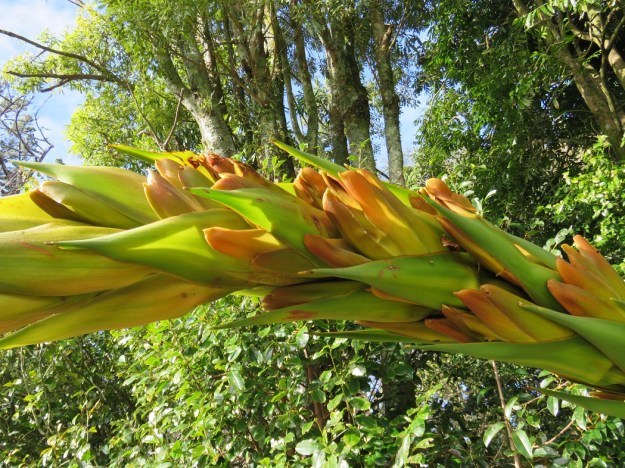
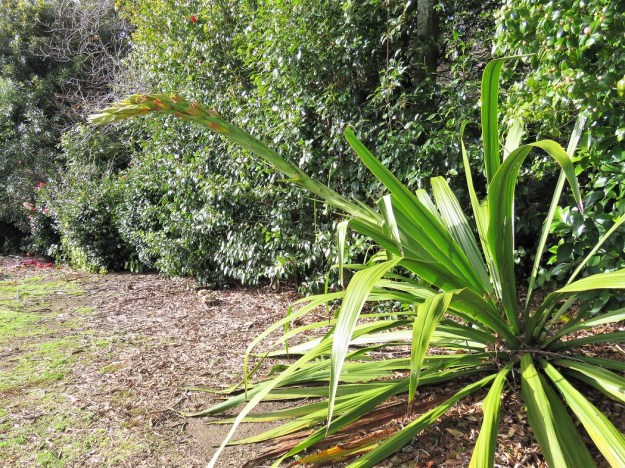
Doryanthes palmeri or giant spear lily. Certainly shaping up to be giant

Behold Doryanthes palmeri! The giant spear lily from eastern Australia. It has never flowered for us before so the three metre, sturdy flower spike is a thrill even though it has yet to open. This particular plant is a nursery relic, by which I mean that it was not planted in this position. More, cast aside from nursery crops (we once produced a few to sell) and left to its own devices. Now the grass garden is planted beside it and it looks quite at home. This is just as well; each pleated leaf is about one and a half metres long and I don’t fancy moving it. I am hoping the flowers will open in the next week or so.
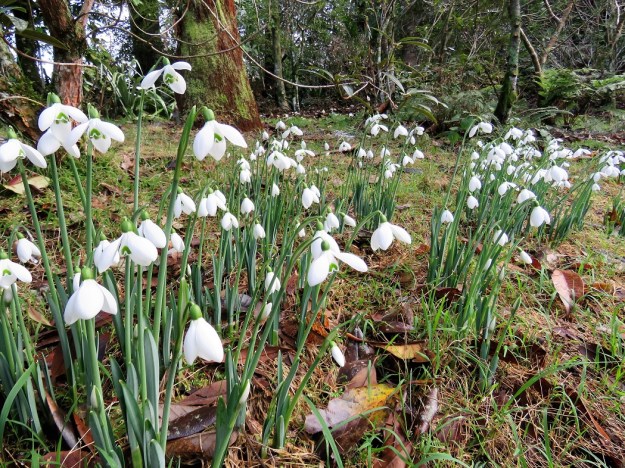
Snowdrop season! Galanthus S. Arnott

From the massive to the tiny, it is snowdrop season here. We are not really-o truly-o good snowdrop territory and Galanthus ‘S. Arnott’ and G. elwesii are the two main varieties that perform consistently well and multiply for us. Mark would dearly love some later flowering ones to extend the rather short season but while he went through a stage of gathering various different varieties, none of the later ones have thrived. Undeterred, he is trying some hybridising to see if he can get some variety but these projects, you understand, never yield instant results. It is more like a ten or twenty year plan, all to get the extended snowdrop season.
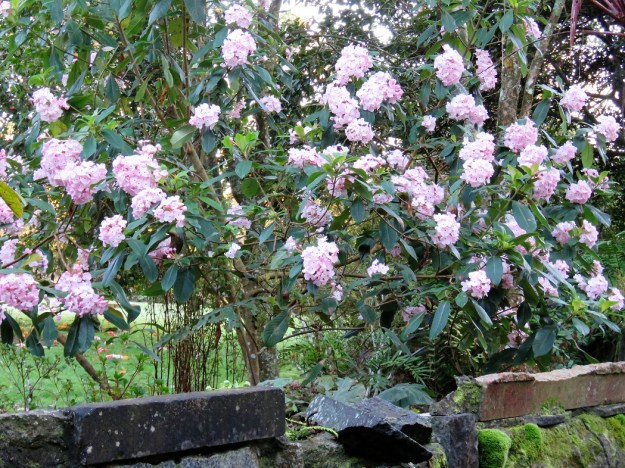
Luculia Fragrant Cloud keeps on flowering this season

It was a full month ago that I wrote about luculias. The bright pink ‘Early Dawn’ is well finished, white ‘Fragrant Pearl’ still has a few blooms but the main specimen plant needs some attention (a bit more judicious pruning and more light – it has flowered better in the past). But ‘Fragrant Cloud’ has been in full flight ever since and still looks good. This is the very best I have ever seen it and the scent is divine.
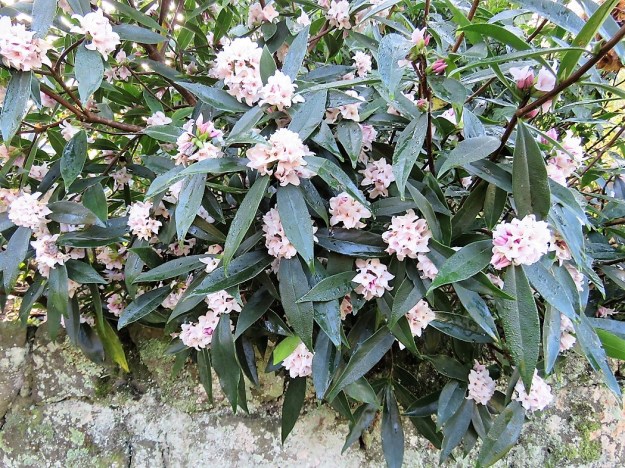
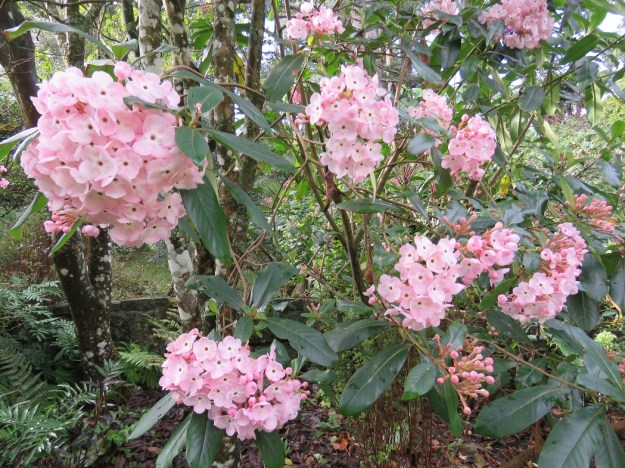
Daphne Perfume Princess

Equally fragrant are the daphnes in full bloom. We grow a number of different daphnes but a fair amount of them are our own ‘Perfume Princess’. Mark has bred other plants that are showier and more spectacular (especially the magnolias), but this obliging daphne represents a breeding breakthrough in some aspects and may well end up as the one he is best known for internationally. It is certainly the one that enabled us to retire early. Given that, we are deeply relieved as each year it proves itself again as a garden plant and a superior daphne which will stand the test of time.

I admit that as this post goes live, we are far from Tikorangi. Well, not that far. Just ‘across the ditch’, as we say, in Australia. While we need passports to travel to Australia it never feels overseas as further, oft more exotic, destinations do. It is just that all three of our children live in Australia these days and we are all joining the celebration of the second birthday of our only grandchild. So not a garden or plants-focused visit but I am sure we will find matters botanical of interest on the way. While I love the place we live, I have been missing the stimulus of travel this year. I need to find somewhere interesting and new for a trip next winter. By the time we arrive home, we should have the first colour showing on Magnolia Vulcan and M. campbellii should be in full bloom in the park. Winter will feel as though it is on the wane.
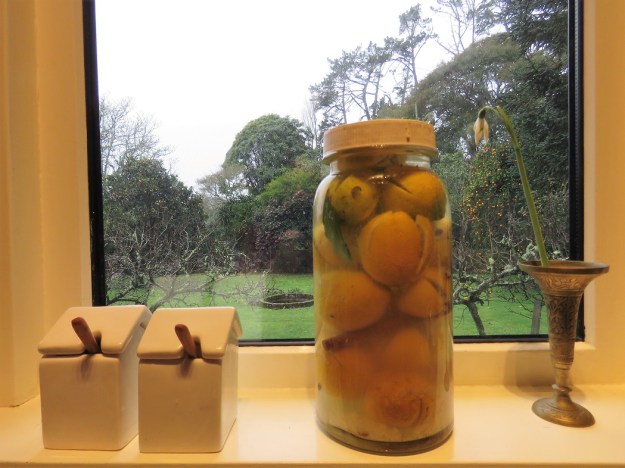
Preserved lemons – the liquid is opaque because some of the salt has yet to fully dissolve

Before we left, I made another jar of salted lemons, having noticed a heavy crop and smaller fruit on our main tree. Smaller fruit fit in the jar better. I prefer to make salted limes but the lime tree is having a year (or two) off fruiting. They are dead easy to do, store for many months in the fridge and are very tasty as a flavour addition. They can make couscous flavourful (though I have gone off couscous since I realised how highly processed this product is), add taste to rice and all manner of stuffings or savoury dishes. I resorted to buying lemons one year, in the absence of a good lemon crop at home, but if you are buying fruit, pour boiling water over them and stand them for a few minutes first. Some are, I read, coated (in wax?) to help their storage life and you need to get rid of any coating or spray residues before preserving them.

Just looking at the jar is like looking at a ray of Italian sunshine on a winter’s day in Tikorangi.
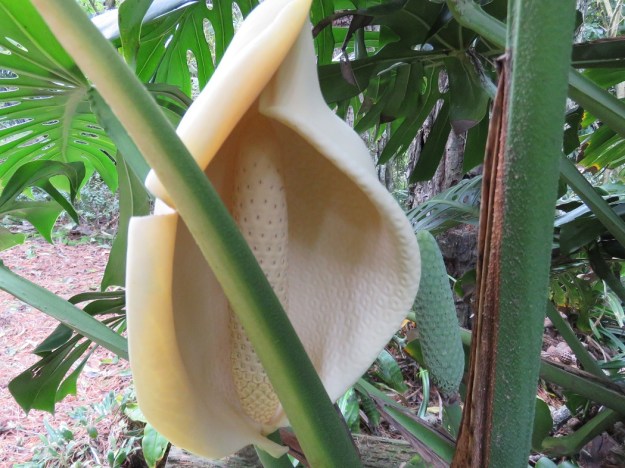
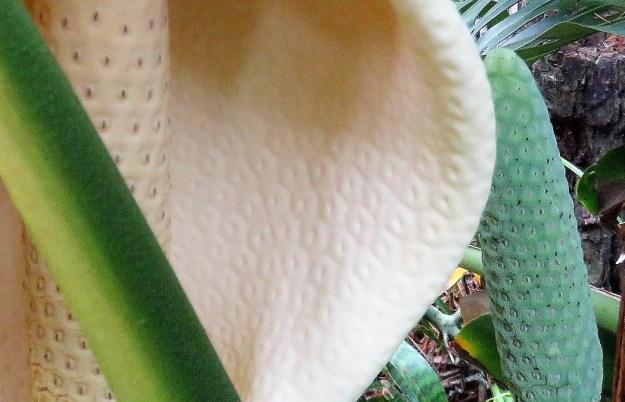


A quilted flower

The quilted spathe of Monstera deliciosa with the distinctly phallic green fruit from a previous bloom to the right

I had not noticed until yesterday that the interior of the spathe on the Monstera deliciosa is delightfully quilted. For quilting enthusiasts, they are hexagons – six-sided figures. The spathe is the curved hood on the flower – botanically a modified leaf but most of us will continue to call it a flower. Some readers will know the monstera better as the fruit salad plant – most often seen as a house plant or perhaps more as an office plant where there is greater space. I would rather doubt that it flowers, let alone fruits, when it is treated as an indoor plant.

We have it as large, shade plant, climbing our trees and furnishing some of the back areas of the woodland gardens where it never gets frosted. It is a bit rampant, a monster even, although easy enough to cut back when it roots its way along the ground. It is more difficult to contain when it romps its way up the trees because it puts out strong aerial roots all the way and our largest ones are now a good ten metres up the trees. Looking tropical, even in the depths of winter. Fortunately, this is not a plant that will smother or strangle its host tree.

Monstera deliciosa can indeed be a monster plant when liberated in the garden

Our plants set fruit but we are not hot enough to ripen them to the allegedly delicious stage. Sometimes we get them to the point where the segments are ripe enough to fall apart, as they do, but the taste, while somewhat ‘tropical fruit salad-y’ in flavour, remains too sharp to eat many. A bit like cut glass, we say, which is apparently to do with oxalic acid. Our guess is that in hotter climes, the oxalic acid is less dominant.

Coming back to the flowers, I hadn’t really noticed how lovely they are until I saw this one yesterday and noticed the matching quilting on the central spadix (which develops into the phallic shaped fruit) and the interior of the spathe which embraces it.

Arum lilies, photographed in somebody else’s garden

“Aroids”, Mark said which had us googling a few other plants with flowers of similar form which were otherwise totally different and yes, they are all members of the araceae family, though not all are members of the aroid sub family.  Arum lilies are probably the best known. Arums are a great deal more prized overseas than in New Zealand. Here, they are seen as an indicator of poor land management (our pioneer roots are as farmers in this country), invasive and widely banned from sale but not on the total eradication list, as far as I know. As a garden escape, the problem with arums is that stock don’t eat them and they are difficult to control once they have established themselves. I once wrote giving advice on how to get rid of them. The coloured calla lilies are still grown as ornamentals but I dug most of mine out this year. I found them shy flowering and they didn’t justify the garden space. Too much foliage for too few blooms.

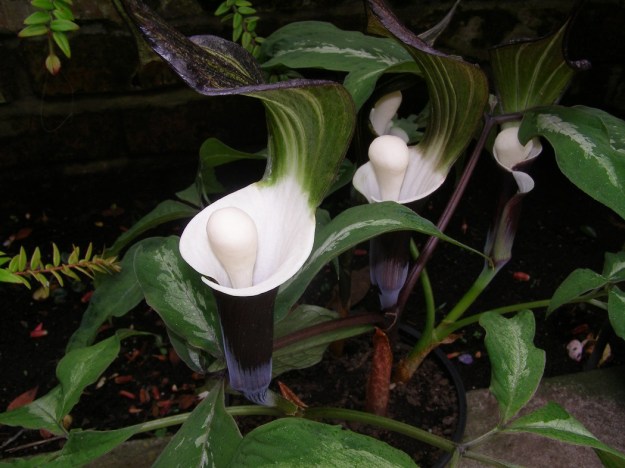
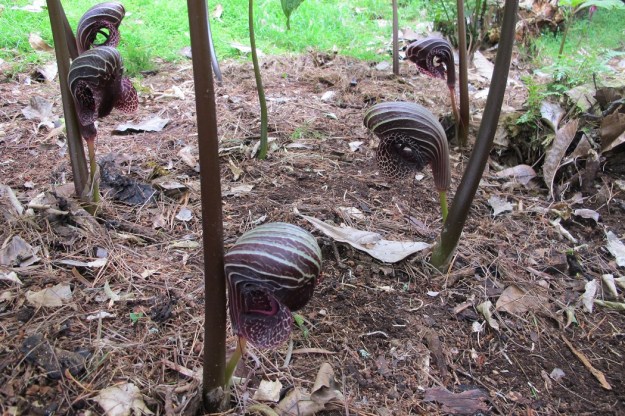
Arisaemas we grow a-plenty. Theirs is a very curious plant group, though not beautful in the usual sense. A. dahaiense

What surprised me more was to find that arisaemas and lysichiton are also members of the araceae family. They have the distinctive hooded flowers, but that is about all that looks the same as monstera or arum. I am sure I have photographed the lysichitons here (unromantically referred to in common parlance as ‘skunk cabbages’) but I can not find the photos in my files. We have both the yellow American species (americanus) and the white Asian species (camschatcensis) which we grow as bog plants.

Alocasias also belong to the same family. This includes taro, which is widely sold in New Zealand because it is a food staple for Pacific Island people, though it has never made its way into the general diet of most others and I admit I have never tried it. It has never been touted as delicious. Should you happen to be in Missouri, the botanic gardens there have the world’s largest collection of members of the araceae family. Munich Botanic Garden also has a splendid collection owing to world expert working there, the ever-handy internet tells me. I was just a bit surprised by the diversity of araceae we grow here. I was looking up the toxicity because some can cause burning of the skin and I wondered if it was connected to the aroids. But no, it appears that it is only a characteristic of some family members – chemically speaking, calcium oxalate crystals in the form of raphides. So now you know. This will explain the sensation of eating tropical flavoured glass shards when sampling the monstera fruit that are less than perfectly over-ripe.

Arisaema sikokianum – not easy to keep going as a garden plant but eye-catching

Our winner in the white camellia stakes – C. yuhsienensis

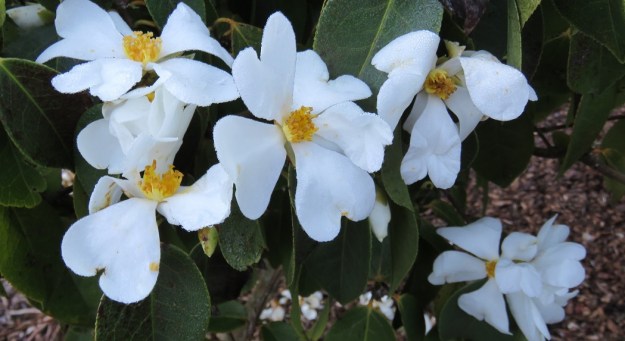
Camellia yuhsienensis

The world of white camellias is quite heavily populated, especially if you narrow it down to white species camellias. Over time, we have gathered up most of the species that have been available to us, and very lovely many of them are. But the one we have singled out as the most attractive specimen plant is Camellia yuhsienensis.

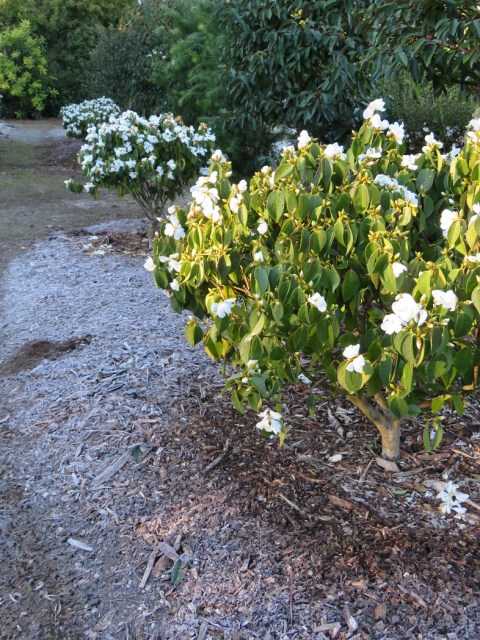
You can tell how much we love this plant by the fact that we have chosen to use it as a feature plant. I just counted and found we have no fewer than seventeen of them as specimen plants, each sitting in its own space – not hedged or jammed in with other plants. It is not usually our style to repeat a single cultivar like that. Mark threaded it through the new gardens – the grass garden and the lily border – to give winter interest.

Threaded through the lily border to give winter interest. That is visible frost this morning. And a freshly dug rabbit scrape. The rabbits are still winning here. We may yet have to get a cat again, given our dogs are pretty useless on the rabbits.

What do we love about it so much? It has handsome, bullate (textured) foliage which is not the usual shiny green associated with japonica camellias. It sets an abundance of buds in pointed clusters and opens them over a long period of time. But it is the flowers that are the real delight – pristine, white single blooms, good-sized and looking more like michelia or magnolia than classic camellia. And it holds its blooms well out from its leaves and branches. The blooms are not substantial but that can be an advantage in a camellia, especially when there is a long succession of fresh blooms waiting to take over. It is just a delight to us.

Some reports mention an overwhelming fragrance but we think that either that claim is exaggerated, the Chinese have greatly sensitised nasal capacities or the clone we grow here didn’t get much fragrance. It is really only lightly scented and that requires sticking one’s nose right up to the bloom. Nothing, alas, is perfect and we need to give the bushes an occasional shake or brush to get rid of spent blooms because they don’t always fall cleanly.

For NZ camellia purists, we grow the mounding selection chosen by Neville Haydon, back in his days at Camellia Haven

The native habitat of C. yuhsienensis is in the Hunan area of China which is, loosely speaking, southern(ish) and inland, with mountains, so it is not a tropical area. We have found it to be completely hardy in our conditions, although our winters are hardly testing. Because it is a species, plants raised from seed will show species variation. We started with two forms but always vegetatively propagated them to keep the selections stable. We had an upright columnar form but ended up cutting it out because the foliage and flowering were nowhere near as good as the mounding form we kept.

The bad news is that I doubt that it is commercially available these days in NZ so you will have to search hard to find one. I have to say that because it is disconcerting to me how many people read these posts and assume they are commercially driven and we must therefore be selling the plant and can send them one. Um, no. I write these posts because I am a writer by nature, we love gardening and it is greatly rewarding how many readers share this pleasure. I appreciate the comments. The phone calls and emails trying to order plants from us – not so much.

Superstar

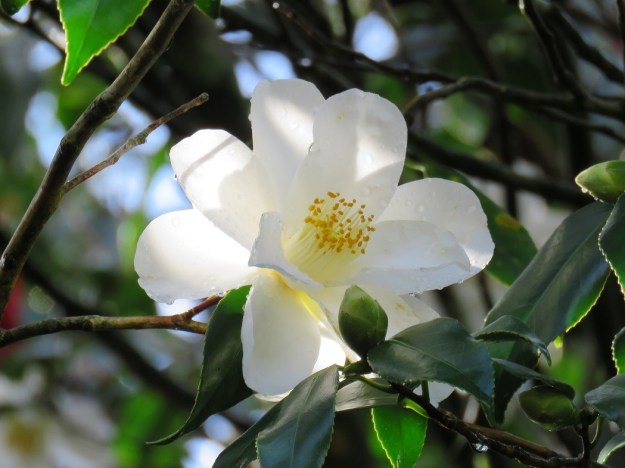
And just because I took a nice photo of it this week, I close with Superstar. It grows at least four times the size as C. yuhsienensis, probably with a quarter of the flowers, if that, but it can show a lovely bloom. It is hard to beat a beautiful white camellia on its day.

Blooms to sweeten a winter’s day – luculia

Luculia gratissima ‘Early Dawn’

Here we are, a mere three days from the winter solstice and outside my window, rain is pelting down while thunder and lightning is keeping the dogs safely in their beds by the fire. So I bring you winter sunshine, in the form of luculia, with photographs I took just yesterday when the sun shone and the daytime temperature was around 18 degrees Celsius.

I am very fond of luculia with their heady fragrance and their balls of flowers. Perhaps they are a bit like the wintersweet equivalent for mild climates. These are not particularly hardy plants even though their original homeland is declared as the Himalayas and Southern China. Think not of high, snowy peaks but more of temperate, protected, lowland forests and by the time you reach southern China, it is distinctly tropical. Luculia are okay with cooler temperatures and a degree or two of frost but that is all. The will not survive much beyond that.

There is not a huge range of luculia – there are only five different known species and, as far as I know, named cultivars are species selections, not hybrids. We grow gratissima and pinceana, grandiflora is also widely grown but I have not seen intermedia or yunnanensis except on line.

I am not a massive fan of L. gratissima ‘Early Dawn’, which is a smaller growing species. That sugar pink flower is very… sugary. Also, when grown in full sun or high light levels, the foliage can take on autumn tones which are not a great foil to sugar pink. Too often, ‘Early Dawn’ is clipped into obedient, rounded stature. Let it grow as it wishes in woodland conditions and the foliage stays bright green giving clean contrast to the pink, while the shrub becomes willowy and graceful. That is when it looks best, to my eye, although it won’t flower as prolifically in shadier conditions.

Luculia pinceana ‘Fragrant Cloud’

‘Fragrant Cloud’ is a different species, being L. pinceana. It is larger growing with considerably larger flowers in pretty almond pink, a stronger fragrance, more rangy and open in its growth and if you prune it too hard, it is highly likely to die on you. If you like tidy, contained shrubs, this may not be one for you. ‘Fragrant Pearl’ is one we named, another L. pinceana selection that came to us as a seedling from our colleague, Glyn Church. It is much more forgiving than its pink sibling and will take harder pruning. Left to its own devices, it will be just as rangy.

Luculia pinceana ‘Fragrant Pearl’

We used to grow ‘Fragrant Pearl’ commercially and it was one of the quickest turnarounds we had. Most of the trees and shrubs we grew took 3 or even 4 years from taking the cutting before becoming saleable. We could get ‘Fragrant Pearl’ through in 15 months. We would take the cuttings from nursery plants as soon as the new growth had hardened in January. They rooted really quickly and with a high percentage in the propagation beds. We would pot them from root-trainers to finished bag size in late winter or early spring, stake and shape them in January and sell them in bud in March and April. ‘Fragrant Cloud’, the pink form of the same species, was nowhere near as easy to handle as a nursery plant and the reason we don’t have L. grandiflora is because it was not that easy to propagate from the cuttings Mark tried and we don’t want it enough to go out and actually buy a plant.

I can not advise on how to make the flowers last longer when cut. Sometimes they have held reasonably well, other times they have gone limp and flaccid within hours. This probably has more to do with the time of the day they were cut than whether the stems were crushed or sealed by burning. But we heat our house to such a degree in winter that there is no point in trying to keep cut flowers in a vase.

Left to right: gratisima ‘Early Dawn’, pinceana ‘Fragrant Pearl’, pinceana ‘Fragrant Cloud

Found! Low maintenance gardening (of a sort)

The magnolia and te maunga

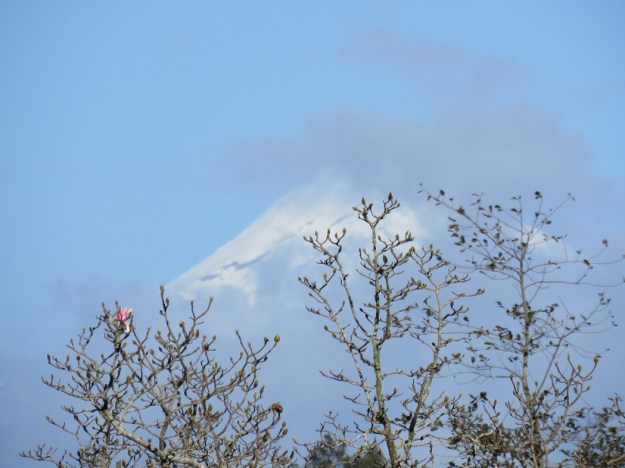
Magnolia campbellii, the Quaker Mason form

For me, the start of a new gardening year is marked by the opening of the first magnolia bloom. It is a very personal measure of time. This year, it happened this very week. Magnolia campbellii has opened her first blooms on the tree in our park. So I start a new season series of The Magnolia and Te Maunga – ‘te maunga’ being ‘the mountain’ in Maori. Our magnificent Mount Taranaki is commonly referred to simply as ‘the mountain’ by locals because it stands alone and is part of the very being of anyone who was born or now lives within sight of its presence. It is, by the way, an active volcano. With other volcanoes erupting in the world, Mark was moved to comment last week that we do at least live far enough away to get some warning if we ever need to evacuate. I have ascertained that the distance between our magnolia and the peak is 36km as the crow flies, so it is at the limits of my camera zoom.

Beneath the mighty rimu trees

Earlier in the year, we rashly agreed to open the garden for the annual conference of the NZ Camellia Society. I say rashly, only because the August date is coming closer. We closed our garden to the public coming up to five years ago now. While we maintain it to a standard that we are happy with, opening it to others requires a higher standard of presentation. I am beginning to feel the pressure. This week, I started working my way along the garden we call the rimu avenue. It is an area about 100 metres long and up to 25 metres wide, so large enough to accommodate a fair number of townhouses, were it in a major city. Fortunately, we are in the country, so instead of townhouses we have a backbone of 14 majestic rimu trees, now nearing 150 years old. Rimu are a native podocarp, botanically Dacrydium cupressinum. Mark’s great grandfather planted them back in the 1870s and photos show that they have doubled in size in Mark’s lifetime.

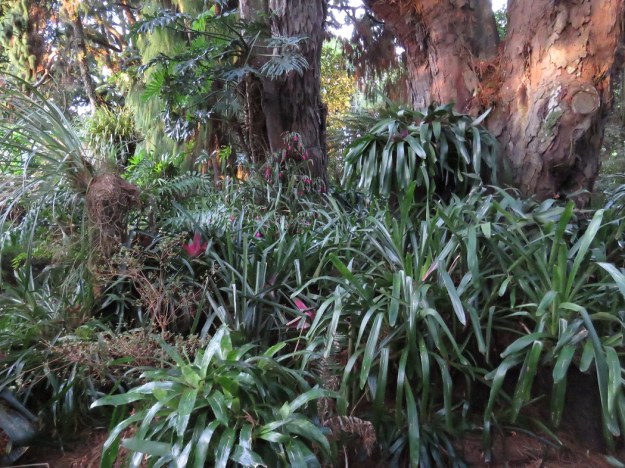
Beneath these rimu, we have what is probably the most complex planting of anywhere in our garden. Oddly, it occurred to me this week that it is the least demanding in terms of regular maintenance. This is not related to the complexity of the planting; it is to do with the fact that it is all in dry shade and also to the plant selection over time. In the last five years, we have gone through it and pulled out fallen branches and a bit of occasional debris but it has not had the loving attention to detail that I am currently giving it.

Over time, this area has become a largely self-maintaining matrix planting, an ecosystem in its own right.  There is a little bit of seeding down, but not too much. The *volunteer plants* that arrive are largely ferns, nikau palms, native collospermum and other astelias. The most common weeds are the occasional germinating Prunus campanulata and the cursed bangalow palms. Most weeds need more light. That in itself is worth knowing. If you hate weeding, go for shade gardening.

Piling the debris onto the meandering paths

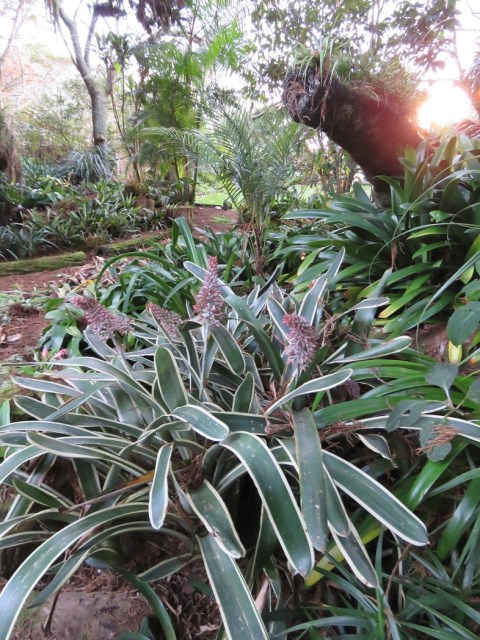
All I am doing to jazz it up is going through and removing much of the fallen rimu leaf litter and debris which builds up over time, taking out the spent heads of bromeliads, thinning clumps where necessary, a bit of cutting back of shrubby begonias, zygocactus, thinning the thuggish Monstera deliciosa and Philodendron bipinnatifidum and general tidying up. It looks a great deal better for it.

For those who are wondering what plants we have growing in the rimu avenue, I will tell you that when we first went into the enormous subtropical glasshouse at Kew Gardens in London, we felt right at home. There seemed to be a large number of plants growing under glass that we grow under the rimu, an area that is completely frost free. We have a whole range of shade palms, schefflera, vireya rhododendrons, dendrobium orchids, many clivias red, orange and yellow, species hippeastrum bulbs, Crinum moorei, bromeliads galore, ferns and a whole lot more. Everything is interplanted so it is complex and layered full, interesting year-round, as well as low maintenance.  Mark’s father first starting planting this area in the late 1950s so it has only taken 60 years of active management to reach this state of gardening nirvana.

Laying cut lengths beneath

and spreading the mulched leafy waste – yellow because it was mostly berberis

While I am working ‘up the top’, as we say, Mark and Lloyd have been down in the park doing a tidy up of fallen branches and dead shrubs and trees. Chainsaw and mulcher work, mostly. For those who read these posts looking for handy hints, I photographed their techniques for dealing with the waste on site. While they may have removed the bigger pieces for firewood, the smaller lengths of branch and trunk are chainsawed into short lengths and laid beneath large shrubs or trees. Line the lengths up in the same direction and they look neater and more purposeful than being tossed higgledy piggledy. The leafage and finer material has been mulched on site and raked out over a bed of dormant herbaceous planting. These are not techniques for formal or tightly groomed gardens but we find it an acceptable process in informal and more naturalistic areas. And we like the philosophy of keeping the cycle of growth, death and then decay nourishing further fresh growth in the same location.