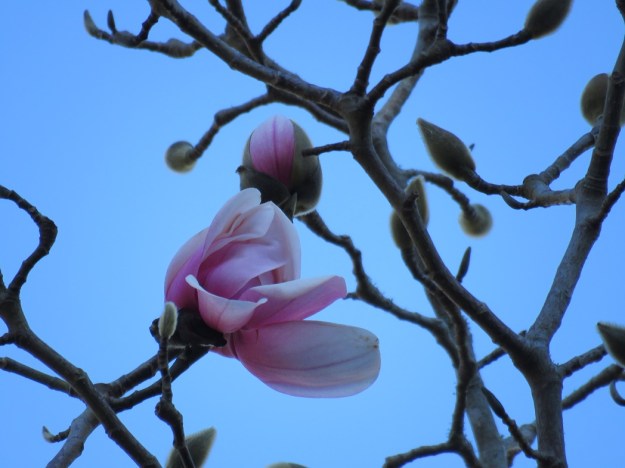
i in The very first blooms on the M.campbellii in our garden
The start of a new magnolia flowering season has come to mark the start of a new gardening year for us. No matter that this occurs in July, in the depths of winter. It coincides with the earliest of the japonica camellias, the start of snowdrop season and the blooming of Narcissus bulbocodium citrinus, but it is the heady sight of the first big pink blooms on Magnolia campbellii in our park that signals to us that spring is just around the corner.
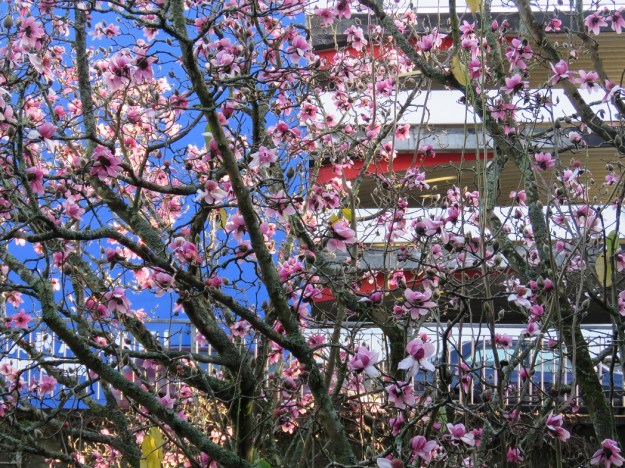
I lookn the most urban of settings in central new Plymouth
Before our plant of M. campbellii opens, we notice the row of 4 or 5 plants breaking bud on Powderham St by the Huatoki Stream in New Plymouth. These open in early to mid June, even before all the leaves have dropped but are at their peak right now. Being in the city, surrounded by concrete and tarseal, the temperatures are warmer than our country garden. We still have only the very first few flowers open.
I was interested to discover that the pink form of campbellii which is all around our district is unusual. In the wild, white forms are apparently far more common. The species has a wide distribution from eastern Nepal through the northwestern areas of Sikkim and Assam in India, southwestern China and as far down as the north of Burma. We saw it earlier this year on Mount Baotai in China but couldn’t tell whether the plant was naturally occurring there or had been relocated.
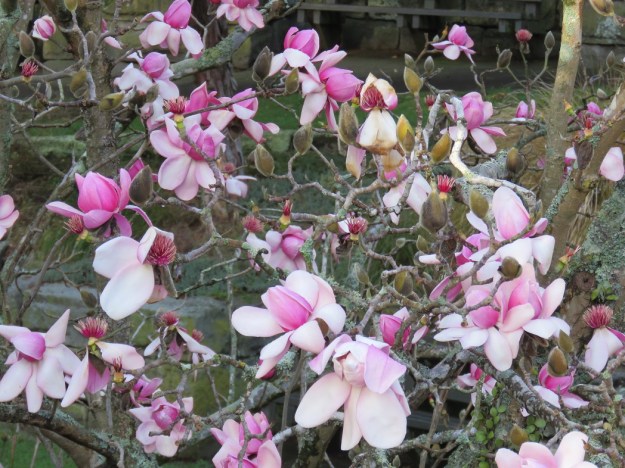
The ‘Quaker Mason’ form of M.campbellii in Taranaki
The pink form we have in Taranaki is commonly referred to as the ‘Quaker Mason’* form and originates from around Darjeeling. As early as 1915, Duncan and Davies Nursery were listing this plant despite huge difficulties in propagating it – it had to be done by layering and it was not easy to do that successfully, either. Our own specimen was one of the first trees planted here by Felix Jury and will date back to the start of the 1950s.
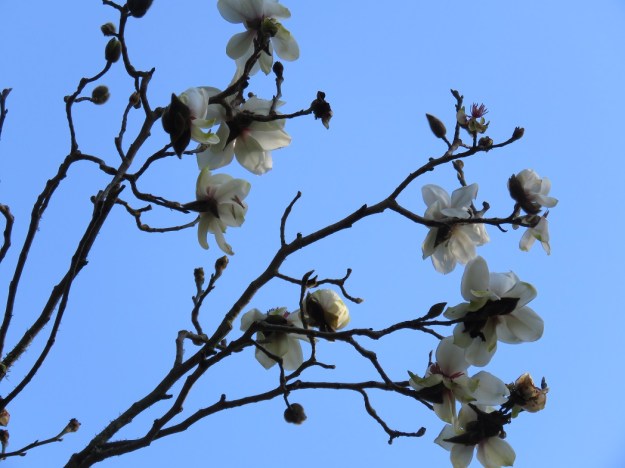
Tupare’s white form of M.campbellii this morning
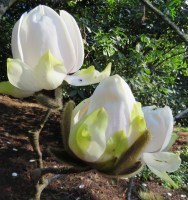 Tupare Garden in New Plymouth has one of the oldest white forms of campbellii in our area, though the tree is not a particularly strong grower. It has a different provenance which the late Jack Goodwin relayed to Mark. Alas Mark did not write it down at the time but his recollection is that Russell Matthews, who created Tupare, bought it as a seedling grown plant from a local nurseryman who had imported seed, probably in the 1940s. This may have been James or Francis Morshead. M. campbellii is renowned for taking many years before it sets flower buds and an anecdote from another source relates the huge disappointment Matthews felt when the first blooms opened white, not pink. More a collector of status plants than a plantsman, he was apparently delighted when Victor Davies – of Duncan and Davies Nurseries – assured him that the white form was most unusual and therefore a real treasure. Only history puts this into context – that the white form is unusual for Taranaki because of all our Quaker Mason pink plants, but not at all unusual in the wild.
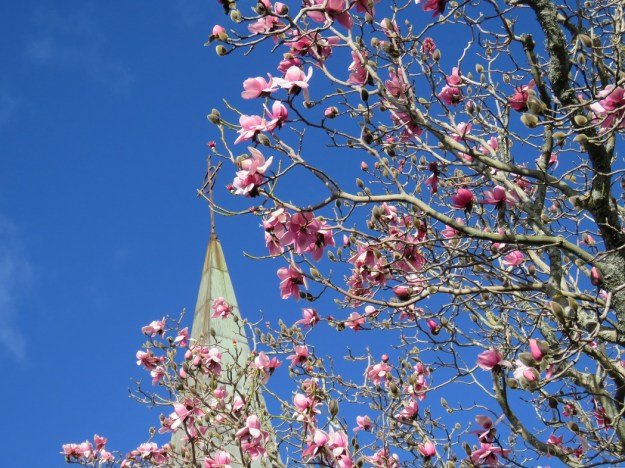
Quaker Mason by the Anglican church in our local town
On my way home from New Plymouth this morning, I detoured past the campbellii outside the church of St John the Baptist in my local town of Waitara. Sure enough, it too is in full bloom and looking glorious and is also the Quaker Mason form. Local readers may be gratified to know that one of the very finest specimens of M.campbellii – the Quaker Mason form again – is actually in Stratford, in the garden owned by Hugh Thompson.
These are all Magnolia campbellii var. campbellii. The other form of the same species, known as Magnolia campbellii var. mollicomata, originates from areas further to the east and flowers several weeks later. Our fine specimen of ‘Lanarth’ (or Magnolia campbellii var. mollicomata ‘Lanarth’, to be pedantic) will not flower until halfway into August.
Finally, in case you are wondering for whom this handsome magnolia species was named – plant collector Sir Joseph Dalton Hooker (though I don’t think he was knighted at the time he was plant hunting) named it for Archibald or Alfred (some uncertainty on his first name) Campbell, who was an enterprising and powerful representative of the British government in Darjeeling in the north of India from 1839 onwards. He is possibly better known for starting the tea industry in that area, although magnolia enthusiasts around the world continue to use his name. And we celebrate the coming of spring with the magnolia named for him.
* Quaker Mason – or Thomas Mason, to give him his correct name – was an early gardener and plantsman in Wellington. From his arrival as a new settler in 1841, he played a major role in early horticulture in the area through until the end of the century.
Postscript: while we are in the depths of winter with the shortest days and coolest temperatures, we do still get bright, clear light and very blue skies – no photo enhancement involved. This is a Tikorangi winter.
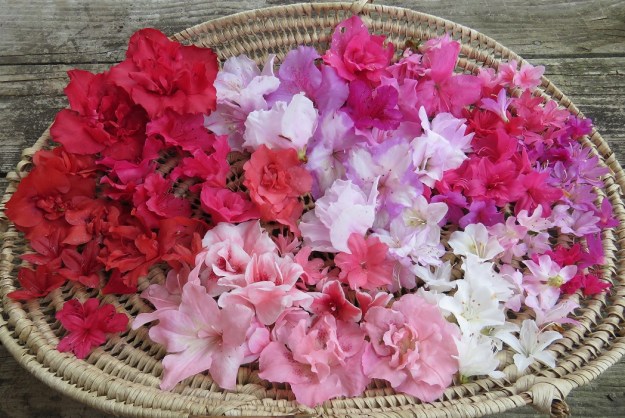
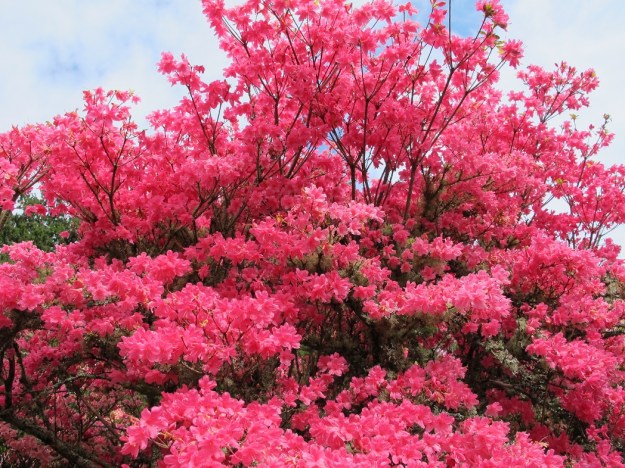 I am on the ‘Mission of 78 Azaleas’. Some years ago, Mark did a cuttings run from plants here and they had reached the point where they really, truly did need planting out. I found homes for about half of them last spring, but there are still 35 sitting out under the shade cloth, looking reproachfully at me and begging to be given permanent homes this winter.* I shall do it this very month. I swear I will. From this, you may deduce that azaleas are one of our backbone plants in the garden, threaded through quite large areas.
 I like to tell the story of a knowledgeable Japanese garden visitor. He came from Kurume and we have a fair number of very small leafed, small flowered Kurume azaleas. He had no English and we have no Japanese, but he managed to convey to us that our Kurumes were simply astounding in their stature and shape but that we needed to take better care of them. He was pointing to the grey lichen infestation in the canopy of a patch growing in full sun. While it is often recommended that you spray for this – lime sulphur or copper is the usual treatment – it is no mean feat to spray above your head height and we are consciously trying to avoid spraying. So I am on a long term campaign – year three into what may be a five year project. In late spring, I manoeuvre my way around on the ladder to take out maybe 20% of the old growth which is most heavily infested, without losing the canopy effect. They do look better for it, but I am grateful that it is only one area that needs this attention.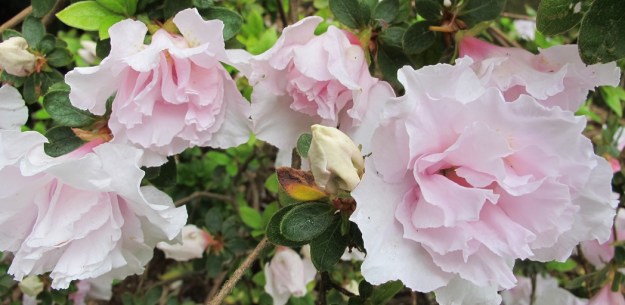

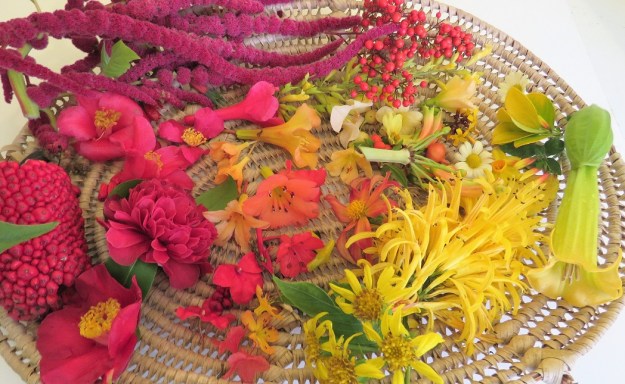 Winter can be very pink, here. Or so I have often declared. I hereby move my position. Late winter and early spring can be very pink – all those camellias and magnolias. In late autumn to mid-winter, the dominant colours are more inclined to the oranges and yellows with a smattering of reds.
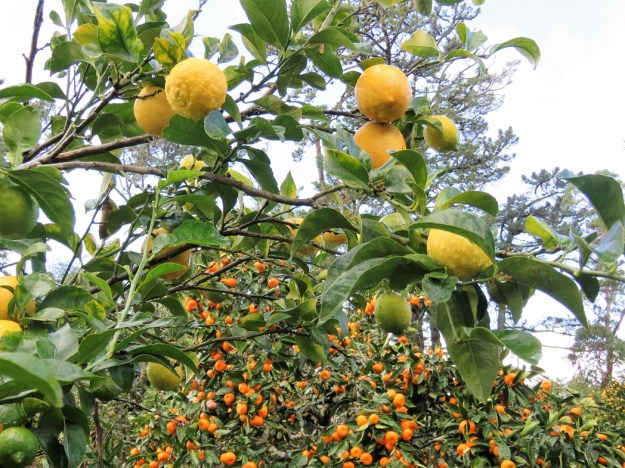 I could of course have added in fruit. The citrus trees add a glorious blaze of colour in the depths of winter – just a common old lemon and a very productive mandarin tree in this photo, but the orange trees we have scattered through the ornamental gardens are also indubitably orange and a very cheerful sight for that.
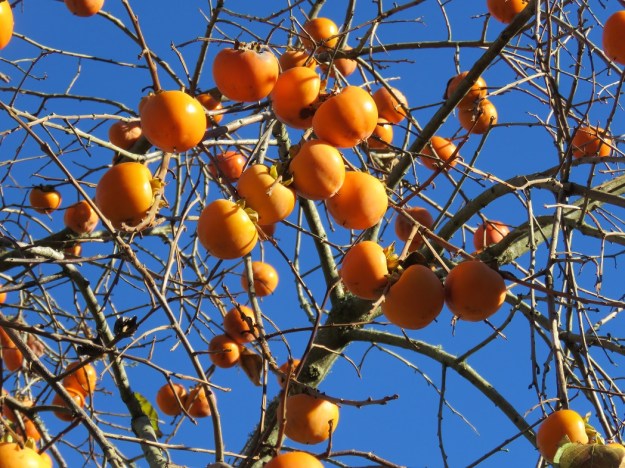 And it is hard to ignore the glory of the persimmon tree, be the sky grey or blue. It is a feature of our climate that we have high sunshine hours and bright, clear light even in mid-winter, albeit interspersed with the rain. We don’t get many days when it is irredeemably grey and gloomy, without spells of clear skies.
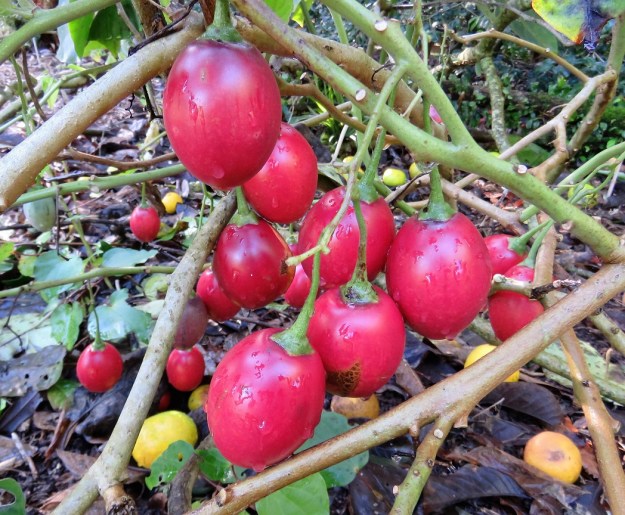 The tamarillos are also hanging decoratively. These used to be known as ‘tree tomatoes’, botanically Solanum betaceum. Apparently the ravages of the potato psyllid have hit commercial production hard, but our plants just continue on in a regime of benign neglect. The fruit is usually stewed with sugar but stewed fruit is not part of our diet. I enjoy them more as a fruit cordial. Mark’s father used to like eating them sliced on wholemeal bread with a little raw, chopped onion. The yellow fruit beneath are windfall grapefruit.
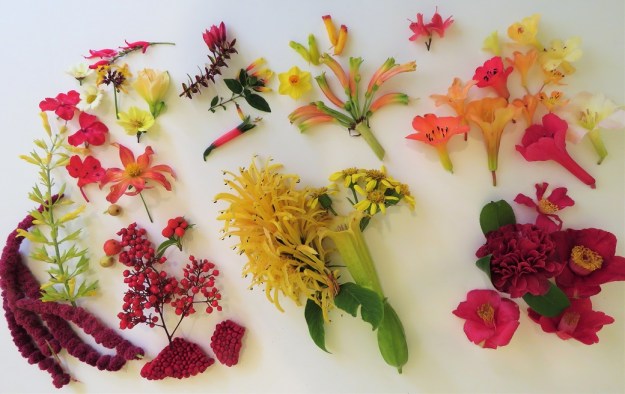 But to the flowers. On the left, we have the vestiges of autumn – salvias, impatiens, tree dahlia hybrids, daisies and Oxalis peduncularis. At the front are a few berries and seeds – baby figs from
 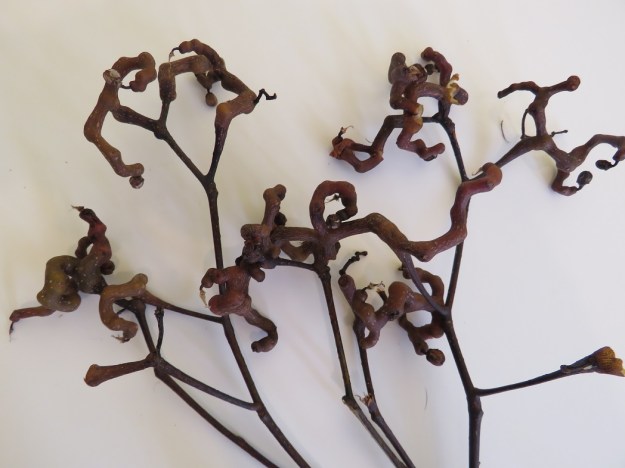 Finally I offer you… the ‘fruit’ of the Japanese raisin tree, Hovenia dulcis. I am guessing that as our plant is maybe 20 years old and planted in a somewhat out of the way position, we just haven’t noticed these before. They are actually the swollen tips of the stems and are edible. They even taste fruity, in a raisin-ish sort of way. Apparently drying them makes them even more raisin-y. It is more a curiosity than an edible essential, but we like these odd additions to our diet here.
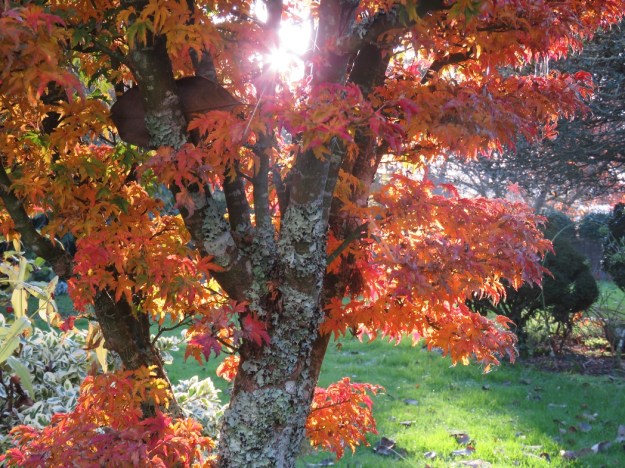 ‘tis the winter solstice today. This marks the point where the days will start to lengthen again, which is always encouraging. However, it usually marks the point where we descend into the worst of winter weather from here through July. But I tell myself that a winter so brief is not too bad, really. We are still enjoying plenty of autumn colour – which is more early winter colour here – and more camellias are opening every day. The spring bulbs are pushing through the ground.
 I had been meaning to photograph this reversion on a dwarf conifer. Many plant selections, especially amongst the conifer families, are sports or aberrations on a parent plant. Part of plant trialling is to test that sport for stability but even so, you may often see reversions to the original plant. Generally, it is going to be much stronger growing so if you don’t cut it off, over time it will dominate. A quick snip with the secateurs was all that was required on this little dwarf in the sunken garden. The major growth that Mark removed from the top of the variegated conifer in the centre of this photo required a tall ladder, some tree climbing and a pole saw.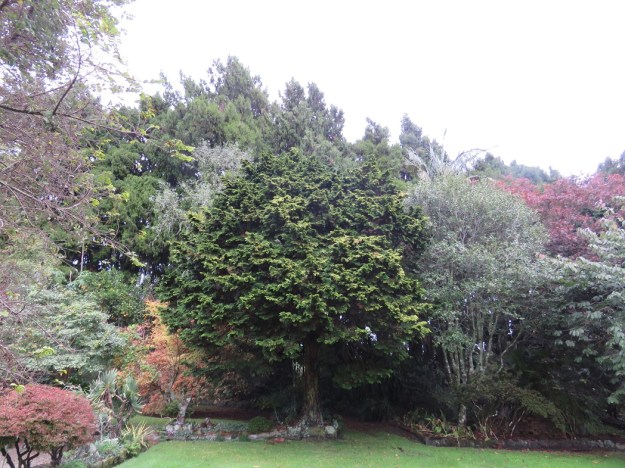
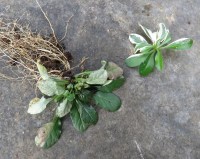 Reversions are also apparent in these perennials. The silver leafed ajuga to the left is showing reversion to plain green. While that particular ajuga is not my favourite (the silver reminds me a bit much of thrip-infested foliage on rhododendrons), it is better than the boring green which barely blooms. I weeded out an ever-growing patch of the plain green. The other little groundcover must have a name but I have no idea what it is. The clean white variegation is sharp and smart but it has a definite inclination to revert to its plain green form, which is much stronger growing. The same rules apply where variegated hostas are reverting to a plain colour. If you want to keep the variegated form, cut out the reversion or you will end up with just plain foliage.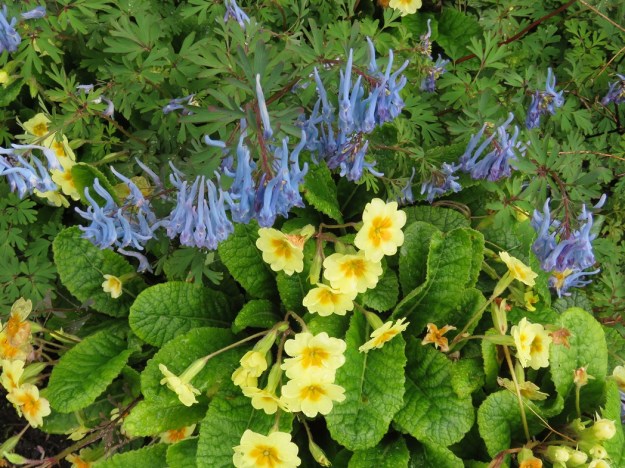

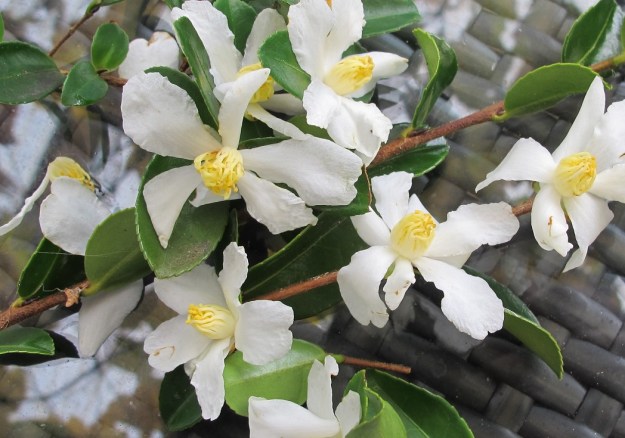

 First published in the June issue of NZ Gardener and reprinted here with their permission.