Tag Archives: Abbie’s column

Abbie’s newspaper columns

From Noxious Weeds to Garden Games via Hollandaise Sauce and Seeds

Mark groaned when he read the letter to the editor last week from a correspondent hoping that the newly formed Friends of the Te Henui Walkway would not be removing the flowering plants – such as the flowering onion weed. Dear oh dear. There is a world of difference between wildflowers and noxious weeds and onion weed falls fairly and squarely into the second category. The correspondent would be better occupied gathering up bulbs of the snowflake (leucojum) which naturalises well, has a long flowering season and is never going to invade the area rather than trying to preserve colonising thugs. Or white bluebells could be an acceptable alternative.

***

Readers who have their own asparagus patch or who enjoy this seasonal treat may like to try a recipe I saw on TV in Britain from the inimitable Hugh Fearnley Whittingstall. HFW seems to be something of a darling of mainstream TV crossing freely between lifestyle, gardening and cooking programmes while embodying much of that which is charming about British eccentrics. Pitted in some cook-off competition against a professional chef, HFW watched him fiddling about making the usual Hollandaise Sauce and then proceeded to whip up his own version. Cook the asparagus spears lightly. Soft boil a three minute egg then cut its top off, pierce the yolk, place a small knob of butter on the egg and add a squeeze of lemon juice. Dip the asparagus spears in the egg mix and eat. Voila! Instant Hollandaise Sauce without the artery hardening properties of large quantities of butter, let alone the problems of curdling.

****

Keen gardeners generally know how to grow plants from seed and if you are of this ilk, you will want to have a look at Kings Seeds catalogue. I can honestly say that Mark has had hours of wholesome fun browsing this substantial listing and will have many more hours of fun when his thirty seven packets of seed turn up. It was actually meant to be forty five packets of seed but they seemed to be out of eight that he wanted. Considering I can blow $100 easily on a trip to town, his investment of $103.30 (plus the cost of the catalogue which I think was $7.50) is likely to be of much longer duration with more rewarding outcomes.

The beauty of Kings Seeds is that they don’t just offer the mainstream flower and vegetable selections (though they are here and at prices somewhat less than you will pay buying them off the shelf), there is a large range of less common selections – annuals, perennials, herbs and vegetable – and a growing selection of heirloom varieties. There are seven different types of zucchini, for example, and I counted fifty one different types of tomatoes.

You can find Kings Seeds on line at www.kingsseeds.co.nz or if you are the more old fashioned type who prefers to hold a catalogue in your hands, Mark obtained his copy from a local garden centre. Even if you have never tried growing seeds before, you may be inspired to start. There is quite a bit of information in the catalogue but my advice to absolute beginners is not to be too ambitious to start with. Five packets of different seeds are probably enough to cope with… You will need seed trays. We still use our polystyrene mushroom trays here which used to be widely available but are harder to source now. Ours are almost vintage. We puncture many holes in the base before filling with seed raising mix. Once you have sown your seeds, it does pay to keep the trays off the ground if you can, to afford some protection from marauding slugs and snails which can demolish all the tender shoots overnight. If you resort to using your outdoor dining table to hold the seed trays, cover it with plastic first to give some protection to the table. The rest of the seed raising process you can learn by trial and error and it is a wonderful activity to do with children.

****

I don’t usually review garden books as part of this column, but a reprint of a 1936 classic has had me chuckling this week. 100 Garden Games certainly harks back to an earlier era when people were more willing to participate in organised activities. Chapter one has twenty five games for one or two players. I worried a bit about whether Slippity was a form of jelly wrestling, but apparently not. But the one which took my fancy was Toe Ball. This is an amusing little game, we are told, which involves quite considerable energy. Briefly, it involves lying flat on your back on the ground. A large ball of a fair weight has a cord tied around it, secured at the other end to your toe. You then fling your leg upwards with as much force as possible so the ball flies upwards and backwards over your head, while the loop slips off your toe. What I particularly liked was the quote at the end: “This is an excellent little stunt for the lawn when you are sun-bathing in swim suits.” The mind boggles.

Going into games for small groups and larger parties, the instructions and equipment can become somewhat more complex, along with the scoring rules. Tether Tennis did not, as I initially feared, involve tying up your playing partner so that he or she could not escape. Neither did Human Croquet use shrunken heads, although some players are required to take on the role of being hoops while others are balls. Human croquet is more a case of Blind Man’s Buff meets croquet.

But it was the Games For Children chapter which made me think that times had changed considerably. It is difficult to imagine that the modern child would be encouraged to make their own blowpipes (the instructions on how to construct a blowpipe are very detailed) complete with darts from thin splinters of bamboo. Given that bullrush has fallen into disfavour, a number of the rough and tumble games, such as Tyre Wrestling, are likely to be deemed unsafe.

However Whip Sport is certainly attention grabbing in the games for children. The section opens with: “Plenty of fun can be had from a long-thonged whip.” This is followed by instructions on how to make a long thronged whip, even something resembling a cat-o’-nine-tails if you so wish. After making your whip, this handy little reference book tells you how to master using it and suggests various targets. Maybe children in 1936 were better mannered and kinder, as well as being tougher. The prospect of lining up a group of children of the new millennium armed with long thonged whips and expecting them to play harmoniously and co-operatively might be altogether too optimistic.

If you feel you need this nostalgic little book in your collection, it is by Sidney G Hedges, published by Hamlyn (ISBN 978 0 600 61840 9). It may generate lots of wholesome fun in your garden this summer, if you avoid the games which ACC would like to make illegal.
From Oranges in Sorrento to Lemons in Hawera with Moturoa School Inbetween

In Sorrento (the south of Italy) earlier this year, Daughter and I were very taken with the use of fruiting oranges for street trees. It seemed impossibly romantic and I wondered whether it was a feasible option for Waitara, which has a climate eminently suitable to growing citrus.

As we walked along, we discussed whether it was appropriate to pick the fruit but the dilemma was solved when we ended up staying in accommodation set in an orange grove with an unlimited supply of free fruit. But even as we admired the orange trees (what a wonderful fragrance there must be at flowering time), the cynical side of me thought that such plantings were unlikely to survive long back home and the trees were more likely to either vandalised or stolen soon after planting out.

So it was saddening to read this week of the destruction wrought on the children’s gardens at Moturoa School. I am sure I was not alone in being absolutely delighted by this newspaper’s coverage of children’s gardening activities. It is just so positive and wholesome and makes one smile to see this type of initiative which enriches the life of everyone it touches. Nobody could fault the projects which teach children how to tend the soil, produce home grown fruit and vegetables and to develop a taste for fresh food – all of which will stand them in good stead for the rest of their lives. Some of us are envious that it didn’t happen when we were at school.

It just seems incomprehensible that anybody, adult or child, would want to destroy such projects – not once but twice in the same day. Even worse than ripping out the plants and snapping the trees is the message the children have been given about the unpredictable and vicious nature of some people. This was not a lesson that eight year olds needed to learn. How do you explain to young children that some people are so warped and bent that they derive satisfaction from destroying something positive and cooperative and good? Yes there will be positive outcomes. People will be kind and generous and supportive and the children will replant but they have still been taught a nasty lesson too early in life.

Good on Moturoa School for planning to replant. I am sure that the vast majority of people (and certainly every single person who reads this column) wish them every success and hope that the low-lifes have finished their fun in destroying children’s efforts.

Parents or grandparents who want to encourage young children to garden at home need to remember that successful results are the most important driver. Children need the best and most prominent spot in the garden, not to be hidden away out of sight around the back or in a waste area. They need a position in full view, in full sun and with some shelter from wind. In our experience, they like a defined area of their own with clear boundaries. It does not want to be too large and it doesn’t need expensive edgings or to be a raised bed unless you want a permanent installation. But defining the area with an edging of river stones, pieces of board or stray pavers gives a sense of containment. Being within reach of a hose or a tap is helpful. Preparing the soil in advance gives young children a head start too. Littlies can not be expected to turn over soil effectively and double dig. They will lose heart and be defeated very quickly. But if they can move straight into a well prepared bed and start incorporating compost and planting, the probability of success increases greatly. It is a simple gift to give to children.

I have also been reading about the moves by the South Taranaki District Council to use fruiting trees in public plantings and to supply apple trees to local residents this year. While I would be reluctant to see only fruit trees used (there is a place for splendid ornamental trees as well), there is something very charming about this sort of use of productive planting. I am sure that a community which feels a sense of ownership will take better care and be more vigilant in protecting plantings.

Walnut trees and chestnut trees in public locations are a splendid idea. When we were students at Massey, Mark used to harvest walnuts from an avenue at Acacia Birch and he had an annual race with the local Chinese to beat them to the chestnuts at Awapuni Racecourse. Some years ago, he collected ripe olives from in front of the New Plymouth Courthouse but it was an action tinged with feelings of guilt. At least in South Taranaki, the locals will know that it is fine to harvest nature’s bounty from their trees.

I had an all too brief chat to John Sargeant, the man driving the South Taranaki plantings. He tells me that the aim is to plant 1000 trees in the district in the next 5 years, of which about 10% will be edible. He talked about the role trees play in making memories and that in fifty years time locals should still be harvesting chestnuts, long after the planting of the trees has been forgotten. I was inspired by his passion for the project and the practical way in which he is using trees to add value to the lives of local residents. Mr Sargeant is not scared to experiment. The fig trees in Opunake have been less than successful and he has to be philosophical about thefts of feijoas and lemon trees. At least when theft occurs, the plants are still growing somewhere, whereas straight out vandalism is harder to take. Given that most people only want one lemon tree, one hopes that replanted trees may stand a better chance of remaining. The more South Taranaki residents realise that something quite special and innovative is happening in their district, the more protective they may become of their trees.

Go South Taranaki, I say, and may this set a trend for more mixed plantings in other local body areas of Taranaki. It would be a great project for community councils in the north to pick up and run with. Maybe we could yet see citrus trees, feijoas and nut trees growing throughout Waitara. In fact, Waitara could go one better than most other areas and even use bananas. How about those for defining a desirable climatic identity?

Sustainable gardening

I have been married to the same man for over 35 years now and he has spent much of that time curbing my tendency to hyperbole but I am about to open with a sweeping statement this week.

The single biggest issue that is dominating garden writing and garden theory at this time is that of sustainability. Through all the media, garden presenters, writers, planners, Uncle Tom Cobley and all are talking sustainability. Sometimes it comes in the guise of organics, but it is about a great deal more than just organics. And it has only come to the fore in the last few years but I believe that we are in a time of extremely rapid change again and the somewhat alien concept of sustainability in gardening will be accepted as the norm in a very short space of time.

Ornamental gardening doesn’t have a great history of being sustainable. Agriculture and food production is different. It is integral to human survival and even back in the days of subsistence living, it had to be able to be continued. The current strong lobby for organics in food production is really a turn of the wheel back to how things used to be done. It is only in recent history that we embraced the chemicals, pharmaceuticals, manufactured fertilisers and all the rest in a drive to lift production and to increase profits.

But ornamental gardening is rather different. Historically it was the domain of the rich and the powerful minority. You want a sweeping, gently rolling countryside view from your terrace? Get Capability Brown in and move a few untidy villages out of the way. You fancy a pleasant and cooling water garden in the middle of a dry and arid area? All such problems can be solved if you have the money and the power. Even the ancient Hanging Gardens of Babylon were testimony to man’s control over inhospitable nature (apparently in the quest to please a foreign born wife). Versailles was famous for the ability of the gardening minions to totally change the colour scheme of the bedding plants overnight so that when the French king and queen looked out of their window in the morning, instead of pink petunias and purple cineraria, they were looking instead at yellow pansies and blue forget me nots. I once used to know how many thousands of plants it took to achieve this overnight transformation.

In recent times we have become a great deal more democratic and ornamental gardens are no longer limited to those with power and deep purses. But we have tended to take on the trappings, albeit in a miniature form. A water feature is almost mandatory, even if you have to install a pump to get the water to the right place. Statues, urns, sculptures – all hark back to the rather grander gardens of yore. So too the sweeps of lawn, vistas (though many of us have to borrow them) and most of the trappings of ornamental gardening.

It is all about controlling our environment. About creating something we find pleasing and holding the unpleasant aspects of the world beyond at bay so we can have our own tranquil haven where we are in control. At its best, gardening is about working with nature. Alas, more often it is about controlling nature and bending it to our will. And that is the bit that is not sustainable.

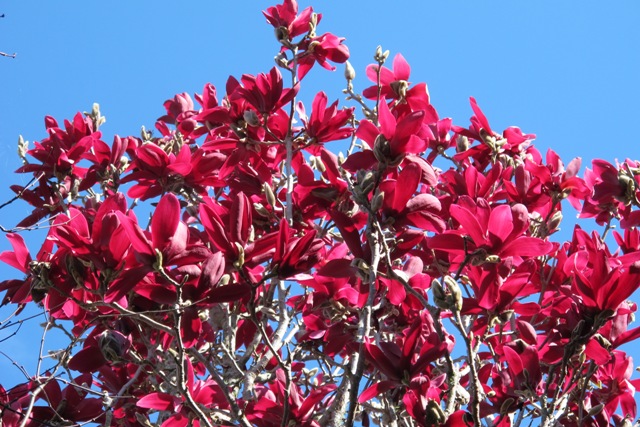
Gardening is about loving beauty as we see it individually. Save us from the utilitarian approach whereby planting ornamental trees is replaced solely by food bearing specimens. Yes, I enjoy the apples off our apple trees and the plants themselves are attractive enough, but they don’t make my heart sing like the sight of Magnolia Iolanthe in full bloom this week. I will happily harvest fresh vegetables, but I don’t want to wander around admiring them as I do the flowering cyclamen and daffodils. Growing fruit and vegetables is not a replacement for growing ornamental plants and creating a garden which feeds the soul.

But much of our talk here is focussed on how we can make our gardening practices more environmentally sound and what compromises we are willing to make in order to reduce our footprint on this planet. Truth be told, Mark is more prosaic in his interpretation of sustainable gardening. He sees it at a far more personal level of ensuring that the garden we continue to develop and extend remains manageable and able to be maintained to the standard we want in the long term. Part of that is shunning at least some of the questionable gardening practices, particularly the routine application of sprays.

I guess that adapting our gardening practices to be more sustainable and more environmentally friendly is all about individuals taking small steps rather than dramatic turnarounds. The domestic lawn is probably the worst crime. We are not willing to cast out the lawnmower (and we console ourselves that at least we don’t drive to work) but we do use a mulcher mower so the clippings are not removed. You can not keep stripping off the grass and expect the lawn to remain healthy so you either catch the clippings and feed the lawn or you mulch the clippings back in as part of the mowing process. Mark has a dislike of hormone sprays in the garden, so he has generally stopped spraying the lawn. We will take out the flat weeds by hand and have learned to live with some of the others.

Gardeners should be seriously questioning the use of plants which require routine spraying to keep them healthy. Strong, healthy plants will often withstand diseases and pests. If they won’t, maybe it is time to replace them different selections that will.

Mulching garden beds not only feeds the soil (reducing the need to fertilise), it also suppresses weeds. Being maniacal mulchers, we are now of the view that bare soil anywhere but in the vegetable garden is a black mark. Mulches also reduce or remove the need to water. Yes it rains a lot in Taranaki and water is rarely a problem in the north, but it is still hard to justify the regular use of water in an ornamental garden when it can be managed without. Delivering water to your garden tap still comes at an environmental and financial cost.

Learning how to make compost saves taking green waste to the rubbish transfer station (and buying in compost and mulch in return).

Small steps in gardening will not change our planet but it may just help to make us a little cleaner and greener. It is a myth that gardeners are environmentalists but it would be nice if we could be.

In Praise Of Plants

We have been watching Around the World in Eighty Gardens on the Living Channel. Sadly we wised up too late to the fact it was screening to catch the New Plymouth garden, Te Kainga Marire, which was featured in one of the early episodes but we have seen Monty Don (the host with an unlikely name) gallivanting around South America, the United Kingdom and Europe visiting gardens of his choice across the whole spectrum from very grand to very modest.

There is a bit of an open verdict here about our Monty as a garden host, though it did strike us in the last episode that he does not show much interest in plants. He is presenting gardens as form and vision through history across the globe and certainly has a fine grasp of the big picture and an avid interest in the social milieu which prompts the establishment of different types of garden. Big picture gardening makes good television and is undeniably impressive but can also be quite impersonal. To be fair, Monty does intersperse with some little gardens but he does not focus on the plants. Maybe our ambivalence is because we like to see the little pictures within the big frame and gardening to us is all about a passion for individual and interesting plants as much as good form and design.

We caught another programme which showed a London garden which was all green with not a flower in sight. They claimed no flowers at all but I am sure I saw a rhododendron so either the owner disbuds it or there was a slight exaggeration. It was a garden which was all about form and nothing at all to do with colour or seasonal change. Certainly it had a restful quality but it could perhaps be a little gloomy at times.

Would I ever want to garden without flowers and seasonal change? Never. If we didn’t have the flowers, we wouldn’t have the tuis. At the moment the campanulata cherries are in full bloom. The tuis don’t sit still long enough for us to take a census but there must be over a hundred of them bickering and squabbling over the bounty. Photographer friend, Fiona Clark, has been videoing our tuis for the last two seasons and I will advise the website address when the sequence goes on-line but she became a little frustrated last week when one large and aggressive tui decided an entire tree she was filming at the time was to be his and his alone, fighting off all pretenders. Tuis are territorial birds not given to living in happy harmony, but it is a delight to see trees which are alive with swarming birds and to see entire flocks flying in to the most desirable trees in the morning.

Campanulatas are the Taiwanese cherries (as opposed to the later flowering, more delicately coloured and often fluffy Japanese cherries). They can set seed a little too freely and indeed have been declared a noxious weed in Northland so if you are planting them, look for ones advertised as sterile, or that set minimal seed. While they can provide splendid food for tuis, we don’t need a jungle of wildlings in our native bush. If you already have one that seeds, stay on top of the seedlings because they are deep rooted and not that easy to eradicate if you let them get away on you. Our resident pigeons have reduced our crop of wildlings in recent years.

If we gardened without flowers, we would not have had the ephemeral delight of the English snowdrops (galanthus) or this week’s dwarf daffodils which are in full flight. Similarly, if we gardened with only the big picture in mind, we wouldn’t be enjoying these tiny treasures either.

Magnolia Burgundy Star in full glory

Magnolia Burgundy Star in full glory

Burgundy Star is just opening her flowers. Photo Abbie Jury

The flower-free zone would also mean missing out on the magnolias which are opening now. I had a very pleasant interlude at the weekend with a visit from an Auckland architect who was seeking magnolias for her new garden. Not for her the uniformity of evergreen magnolias or restricting her range to one variety only. No, she was after big, blowsy, spectacular and seasonal. I warmed to her instantly, recognising a fellow traveller. She knew and I knew that she was overplanting her small section, but she wanted to fit in as many OTT trees to cover as long a flowering season as possible. That exuberance is refreshing in an era when good taste in gardening and design is often equated to restraint bordering on the anally retentive. And it is unusual in somebody who works professionally in the design sector without a great background in plants.

A flower free, or all green, or totally evergreen garden is usually designed to be as static as possible. Ditto the low maintenance garden. The creative process happens once at the very beginning. From then on it is straight maintenance, outdoors housework. There may be a bit of a makeover or renovation every five years or so but basically it is repetitive work to maintain the status quo. As one who finds housework a dull but necessary chore, the prospect of reducing gardening to the same level of repetitive activity does not appeal at all.

What I like about gardening is the constant creative thinking and action. To achieve that, you need to be willing to change the scene by altering planting combinations, adding extra bits of interest, replacing underperforming plants, getting excited about discovering a plant you didn’t know about before, coming upon something new in flower or growth each week and responding to the changing environment. Those are the interesting parts, not doing edges and clipping and weeding.

It is the vibrancy of plants and seasonal change that give life to a garden and for us that includes flowers and vast range of different plants all of which have their time to shine. Good design gives a framework to hold it all together visually just as good architectural design can create a splendid house but does not make it a home. Good maintenance presents it well. But it is the plant selection that makes it come alive. We will stay with the flowers and the birds here and watch the tuis while rejoicing in the OTT display of tree magnolias in full flower over the next month or two.

Thinking Small in the Big Country

We had cause to travel to Australia a couple of weeks ago for a family celebration. Fortunately, given our timing, we were in Wollongong (south Sydney) and Canberra and our paths only crossed with the 125 000 Catholic pilgrims when it came to flying out of Sydney airport. We avoided the chaos of Sydney, which also meant we missed the Pope. But as I noted the austerity of St Peter’s Square and the near total absence of any vegetation in the Vatican City when I was there a month ago, I doubt that we would have been able to discuss gardening with him.

We have never been to Wollongong before and despite it being a somewhat industrial area, we were rather taken by it. Its location ensures a higher rainfall than many other parts of Australia and the climate was almost balmy. The soulangeana magnolias were at their peak (little sign of them showing colour here) and the presence of sub tropical plants, including an abundance of frangipani, indicates that the area never gets particularly cold. The beautiful blue sky and expanses of pristine beaches had us thinking that maybe Australia is indeed the lucky land. Certainly we did not hear the doom and gloom talk of home. Mind you, that may be a superficial judgement because the TV only showed wall to wall happy, smiling pilgrims.

After a tiki tour of the area which involved much bonding with her father identifying and discussing the multitude of exotic Australian birds, Elder Daughter drove us to her second home in Canberra. I have been to that city before but it was a first for Mark and he was a little shocked at the harshness of the climate. In winter it is very dry and very cold while in summer it is very dry and very hot. He whispered to me that he much preferred Wollongong. Gardening as we know it just is not possible in Canberra.

Daughter commented that none of the Aussie TV gardening gurus she has seen appears to have come to grips with practical design suggestions for front yards. The private courtyard out the back has been done to death, but there is a dearth of ideas when it comes to dealing with the waste of space out the front. Irrigation is on a semi permanent ban so the front lawn and garden does not survive. The only alternatives appear to be green nylon lawn (!) or dyed bark chip mulch (referred to as tan bark). Daughter was suggesting that if she had a front yard, she would be looking at buying a truckload of massive rocks and establishing a rock garden (more rock than garden). Or maybe try a meadow of anigozanthus (kangaroo paws) which, being native, might fare better.

Nylon lawn at up to $120 a square metre

Nylon lawn at up to $120 a square metre. Photo Abbie Jury

Post celebrations (no, neither a wedding nor a grandchild), Daughter and her partner indulged us by taking us to the somewhat remarkable Cockington Green Gardens which had possibly more than a nodding affilation to the genre of Fred and Myrtle’s paua house in Invercargill. No paua, but scaling hitherto unconquered heights of being twee to the point where it takes on a life of its own. It was started by a passionate Anglophile model maker and has recently been expanded with an international section (mostly sponsored by foreign embassies). Leaving aside the plethora of miniature scale buildings, cricket match, soccer match and all the rest of it (and there was a lot of the rest of it including fairy garden and miniature trains), the gardening was dominated primarily by dwarf conifers and clipped and topiaried buxus. Alas we can not get that excited about masses of dwarf conifers, but it was certainly clear that in a much colder climate the conifers colour up a great deal better. The silver blues and burgundies made our few at home look very subdued.

The Treaty House at Cockington Green

The Treaty House at Cockington Green. Photo Abbie Jury

New Zealand was represented by a model of the Treaty House at Waitangi. If I remember correctly, it was the only one not sponsored by the Embassy but I think by an individual instead, which may possibly be an indication that our ambassador to Australia has better taste. After our initial amusement, we were underwhelmed by the gardening at Cockington Green but envious of the evidence of large tourist numbers. Given that Canberra is hardly a tourist hotspot, it makes you realise how few we actually get in Taranaki.

Conifers and buxus and a toy train at Cockington Green

Conifers and buxus and a toy train at Cockington Green. Photo Abbie Jury

As an antidote to the OTT naff nature of Cockington Green, we headed off to the botanic gardens which are devoted entirely to native Australian plants with a purity of purpose which is not necessarily a populist position with locals, who may well prefer some bedding plants and colour. And the dry, open areas were a little arid with no underplanting at all. The hardy natural flora of Australia is nowhere near as exotic as their fauna and around Canberra is heavily dominated by hardy eucalypts. It wasn’t until we reached the bushland plantings that we went: oh yes. As New Zealanders, we take for granted our lush growth, both in the natural environment and in the contrived garden. It is a concept largely foreign to those who live in much harsher environments.

Mark was grateful for the relative absence of plant eating fauna at home. We would be less than impressed to have kangaroos peering out from the understory of the garden and effortlessly hurdling our fences. Possums here are a pest but at least we can shoot them – they are a protected species in Australia. The rosellas, vast flocks of sulphur crested cockatoos, crows and an abundance of other birdlife can wreak havoc in an environment where their main of source of food includes your garden plants. And at least we never got foxes courtesy of the British settlers. We saw tree ferns (yes, Australia has a range of tree ferns of their own) where the new growth had been stripped bare by rosellas in search of the spore.

There really is no place like home and the verdant green environment that we take for granted here is really quite rare. We would rather be here than there. They may be the lucky country economically, but we are the lucky gardening land.