Tag Archives: agapanthus

Blue sky gardening rather than feeling blue

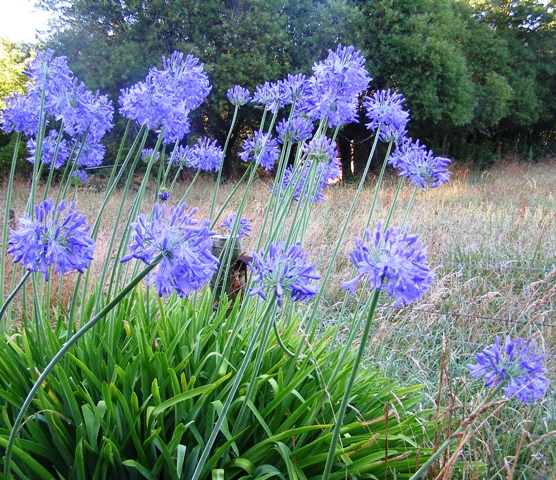
Weeds maybe, but pretty on summer roadsides - agapanthus

Weeds maybe, but pretty on summer roadsides – agapanthus

There I was, having decided to write about blue flowers this week, when I opened the latest issue of NZ Gardener and Lynda Hallinan had beaten me to it. But that’s all right. She was mainly looking at annuals with just a few perennials and one shrub.

It is the sight of the blue jacaranda in full flower which makes me fall in love with blue blooms all over again. It is the first thing I see out the window every morning and I sit and drink my early morning tea admiring it and reflecting on how much I love the colour.

Where we live, blue is the dominant colour of the roadside flowers in summer. I know agapanthus is a weed and difficult to eradicate but our verges would be the poorer for its absence. Plants have to be tough in that situation and the agapanthus is a showy survivor. Beacons of summer, here.
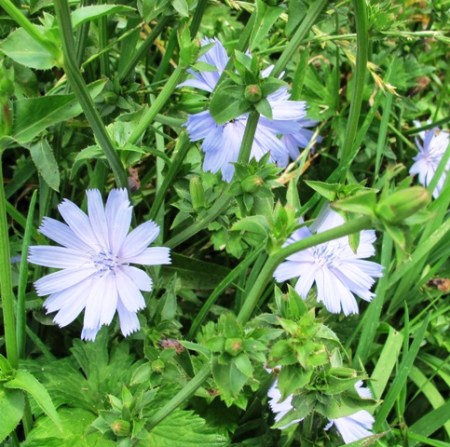
The simplicity of chicory

The simplicity of chicory

The wild chicory is pretty as a picture with its soft blue daisies. In the garden we grow blue asters with a similar flower but in long grass, the simplicity of the chicory is more fitting.

We are blue hydrangea territory, being acidic in soils. With regular summer rain and mild, humid conditions, the blocks of blue flowered hydrangeas tend to mean we take this plant for granted. Go to more alkaline territory and they turn pink as readers may have noticed in other areas, but they add to our blue palette here. As we fluff around our garden hydrangeas, pruning each year to tidy them up and promote good flowering, it is interesting to reflect that those roadside wildflowers are never touched yet bloom faithfully. As a general rule, if you don’t prune a hydrangea, you get more flowers but they are smaller.

Impressed by the garden performance of the You-Me hydrangea series

Impressed by the garden performance of the You-Me hydrangea series

When it comes to the garden, those big blue moptop hydrangeas (the macrophyllas) are okay as a backdrop but they lack refinement as garden plants. We have been most impressed with the more delicate appearance of the recent introductions from Japan in the You-Me series. We collected several from hydrangea expert Glyn Church a few years ago and have lost the names but they are all quite similar so I’m not sure that any one is better than the others. Look for them branded under the You-Me group and they carry individual names like “Forever” and “Eternity”. If you can’t find them in your local garden centre, then you can get them on line from Woodleigh Nursery. Be warned, however, that they are apparently not colour stable so if your soils are more alkaline, they won’t be the pretty blues we have here. Presumably they will be pretty pinks instead.

What is it about blue? For me, I think it is that the blue as blue skies are such a mood enhancer. It may have something to do with the dreaded holes in the ozone layer (though I hope it has more to do with our isolation and low population) but we have a clarity and intensity of light in this country that most of us take for granted until we travel overseas.

I have commented before on the fact that we treat green as colour neutral in the garden. All those monochromatic garden schemes are in fact bichromatic because they are one colour plus green.
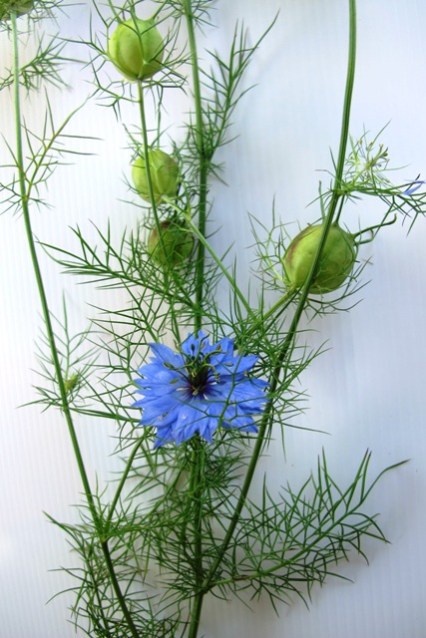
Nigella damascena - a personal favourite

Nigella damascena – a personal favourite

Blue is not colour neutral as such, but it sits happily in any colour combination. So if your garden bed is hot colours of reds, yellows and oranges, blue will sit in that mix quite happily. In you have gone instead for pretty pastel pinks and whites, blue does not shout when included. Of the primary colours, it is the easiest to blend. It can lift a tightly controlled, colour managed garden out of the blandness that sometimes afflicts them, by adding just a little zing.

I don’t understand why “feeling blue” is a reference to feeling sad. In my books, you can never have too much blue in a garden and lifting one’s eyes to the blue sky above is a celebration of life.

First published in the Waikato Times and reprinted here with their permission.
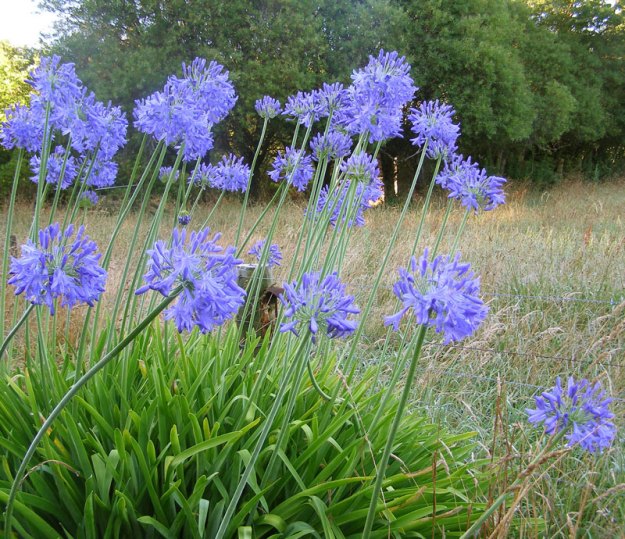
Agapanthus -the blue (and white) stars of our summer roadsides

Our summer roadsides would be the poorer without agapanthus

Our summer roadsides would be the poorer without agapanthus

We have a bit of a love-hate relationship with agapanthus here in Taranaki and in warmer areas of this country. But as you drive around the countryside at this time of the year, most would agree that our roadsides would be the poorer if they were gone. They resemble giant blue harebells growing, well, growing pretty well everywhere if we are honest.

Agapanthus all come from South Africa and from relatively limited areas of that country. Don’t be misled by the common international name, the Lily of the Nile. They are neither a member of the lily family, nor do they grow anywhere near the Nile. Nor does Agapanthus orientalis come from the Orient. That descriptor merely means eastern, so the natural habitat of A. orientalis (probably more correctly known as A. praecox ssp orientalis) should be on the eastern side of South Africa, assuming the original plant collections and recording was done accurately.

The name comes from Greek. Agape is love and anthos is flower but whether this means the flower of love or lovely flower is unclear.

So are they a weed? These matters are rarely as black and white as they appear. On the debit side:
• Most agapanthus set seed freely and the seed germinates readily.
• Agapanthus grow well in a wide range of situations including inhospitable clay banks and shaded areas. They form a dense cover which prevents other plants from germinating – particularly desirable native regeneration. They have the potential to colonise bush reserves, national parks and native bush.
• The common agapanthus are resistant to the world’s handiest weedkiller, glyphosate (formerly known by its original brand name: Round Up). While you can take them out with stronger brush killer sprays, most of these require you to hold a spray licence.
• Digging out well established clumps takes quite some physical strength and determination because the plants cling on for grim death and the clumps can be formidable. Because they have roots which are rhizomes, if you don’t get the whole plant out, what is left behind in the soil will re-grow.
• There is no way this plant would ever be permitted into the country now. Mind you, the same thing could be said about kiwifruit.

There is a credit side and a degree of resigned acceptance by the authorities in this country which sees agapanthus treated as a surveillance pest plant rather than the hard line decision to ban it outright.
• While it seeds freely, the seeds are not dispersed by birds at all so in most cases, the seedlings pop up close to the parent plants. The big problem comes with plants beside waterways because the water can do a very efficient job of spreading them much further.
• They are a significant plant for cut flower producers and there are dwarf and sterile forms available for home gardeners which pose no threat at all. There is a large international market and agapanthus occupy an established niche in our nursery industry. Many of the named hybrids have parentage which includes one or more of the species other than praecox and this reduces the weed problems.
• They make a significant contribution to our summer landscape as a flowering plant and will tolerate harsh, roadside conditions so are favoured for amenity plantings.
• They are evergreen, tidy and suitable for using to stabilise slip-prone areas.

Basically Biosecurity and most northern regional councils would love to ban it outright but pragmatism triumphs so the aggie lives on to flower another day. Auckland has banned the larger growing forms of A.praecox (the common form), still allowing the production and sale of dwarf forms as a compromise position. The sensible position for the home gardener who lives adjacent to native forest or to waterways, would be to remove them entirely. As a back-up position, being industrious and thorough about dead heading would reduce the problem. For the rest of us, it probably doesn’t matter and they make a huge contribution to our summer gardens and landscape.

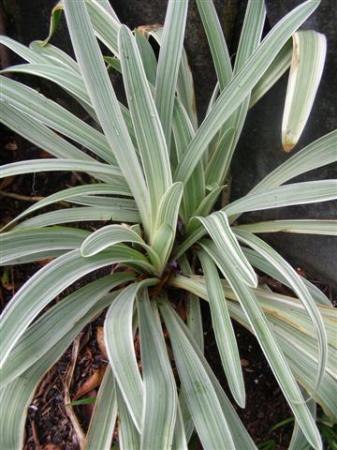
Agapanthus Tinkerbell - no weed potential here

Agapanthus Tinkerbell - no weed potential here

By no means are all agapanthus thugs. Little Tinkerbell is common in gardens though probably more noted for its very clean white and sage green variegated foliage than its flowers. It is distinctly shy on flowering, as a rule. It also has a significantly large root system for a plant without a great deal on top but it is a useful addition in the garden border. Other named hybrids are often more amenable than thuggish and have their place in the garden setting.

This is a plant family which is a great deal more highly prized overseas than here. In harsher climates, stronger growing plants are valued for their ability to survive the conditions and most of Europe and the US have much harder conditions than we have. Toughies that stay in leaf as well as put on a lovely summer flowering display are harder to come by, especially in blue. Because they don’t tolerate extremely cold conditions, additional measures are often required to get the common agapanthus through winter.

But in this country, you can’t even give away common agapanthus. Which is why we were genuinely shocked by a section in “A Green Granny’s Garden”, by Fionna Hill. I reviewed this before Christmas and I have to admit I did not read it cover to cover or that review might have been a little tougher had I come across the following paragraph referencing her attendance at a Hollard Gardens’ workshop here in Taranaki:
“Workshop participants have been invited to bring seed and other plant material to share. We pulled lots of agapanthus plants from Maggie’s New Plymouth garden that day and (we thought) cheekily we’d take the opportunity to leave a wheelbarrowful. We give the barrow to some helpful children to wheel back to the meeting shed, while we speed off down the road. I think it might not have been welcome, at that time, believing them to be a pest.” (sic). The page of self justification that follows does not mitigate the action for anybody except the author, who concludes: “I shouldn’t feel so guilty about that wheelbarrowful that Maggie and I have left as a contribution – at UK rates, the barrowful was worth about 300 pounds.” I don’t think so, dear. What you did was to furtively leave your friend’s weeds for Hollards’ staff to dispose of. You should be feeling guilty and embarrassed.

Tikorangi Notes: Friday 28 January, 2010

LATEST POSTS: Friday 28 January

1) Agapanthus – love them or hate them, they are stars of our summer roadsides. Abbie’s column.

2) An exceptionally fierce summer storm last Sunday took out many flowers in the garden but the disa orchids came through unscathed. Plant Collector.

3) Garden tasks for the week from dealing with potato blight to why you may want to think twice before planning to become self sufficient in pine nuts.

Agapanthus blue and white, and montbretia on our roadside

Agapanthus blue and white, and montbretia on our roadside

TIKORANGI NOTES:
Agapanthus or Nile lilies are considerably more highly prized overseas than in New Zealand. Here we tend to see them as indestructible, utility roadside plants or fillers but come summertime, these large clumps of strappy foliage are adorned with a mass of blue or white blooms. They become a real feature of our countryside. But such is the antipathy to these plants, that they are frequently looked down on as garden plants. I think the only one we have in a garden situation (as opposed to our road verges bounding the property) is little variegated Tinkerbell.

Variegated agapanthus - doubly damned in NZ

Variegated agapanthus - doubly damned in NZ

I will have to find a spot for the yellow variegated form shown here, but am not sure yet where it will fit. We have never done anything with this seedling of ours. There is no point in building it up for sale in this country – it is damned on account of being an agapanthus, doubly damned because it is variegated in a country where we do not favour variegated foliage much at all, though it is a good plant with stable colour. The crocosmia (commonly referred to as montbretia) is similarly a borderline weed but it lights up the roadside outside with the agapanthus.