Tag Archives: arum lilies

Three weeds in white

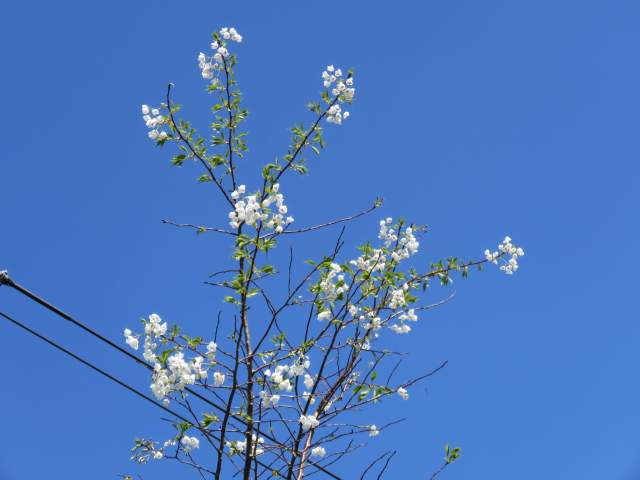
Is it Prunus serrulata? It is certainly a prunus, or flowering cherry and what we call ‘a garden escape’ in this country

Springtime is very flowery and all tends to be forgiven when plants flower. However, I couldn’t help but notice that three common roadside wildflowers in bloom right now are indubitably weeds. Not harmless weeds that qualify as ‘just plants growing in the wrong place’ but actual, invasive weeds.
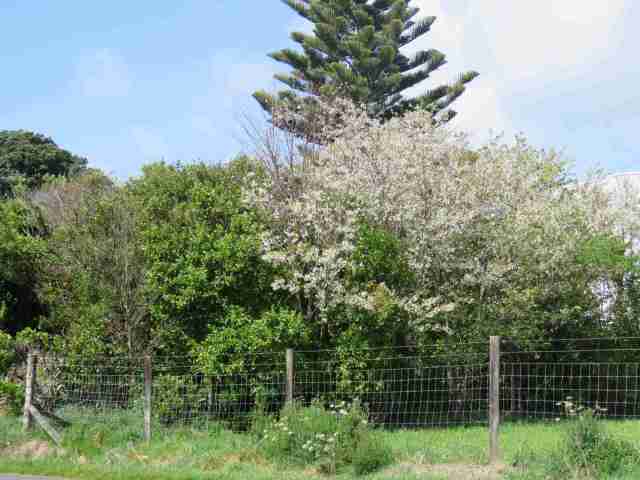
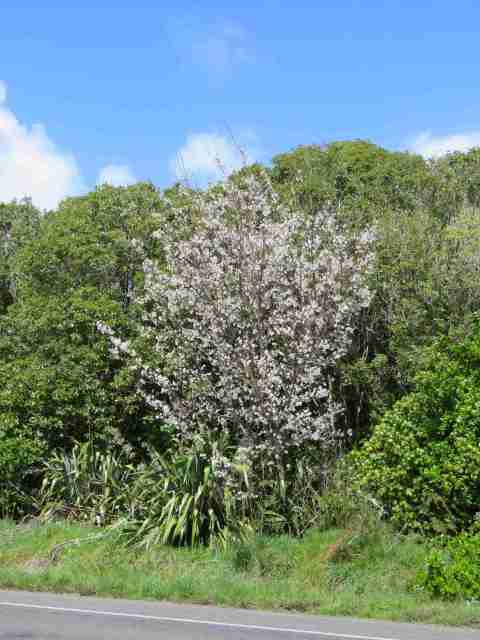
You see it here, you see it there. On the road to town and there are a large number that I could have stopped to photograph along the way that are clearly garden escapes – as in, they are not planted in gardens but must have originated from one to start with.
But wait there are more. And more and more.

I have never noticed before just how many white flowering cherries there are all around the countryside but once I started looking, they were e v e r y w h e r e. There has been a lot of talk in this country about the evils of the-early flowering, carmine-red Prunus campanulata so favoured by our native tui. Some areas have gone so far as to completely ban it – around Nelson and in Northland, I understand. They are somewhat controversial to grow and most will seed around too freely. But I can’t find the same level of concern concerns expressed about white prunus  spreading itself far and wide in this area. There is a whole lot more of it around this neighbourhood, clearly self-seeded, than P. campanulata. I am no expert on cherries but looking up the pest plant lists, I figured it is quite possibly Prunus serrulata. There is a list of 13 different prunus species on the national plant pest accord, all identified as problematic and banned from commercial production and sale. P. serrulata seems the best match to what I see in bloom right now.  
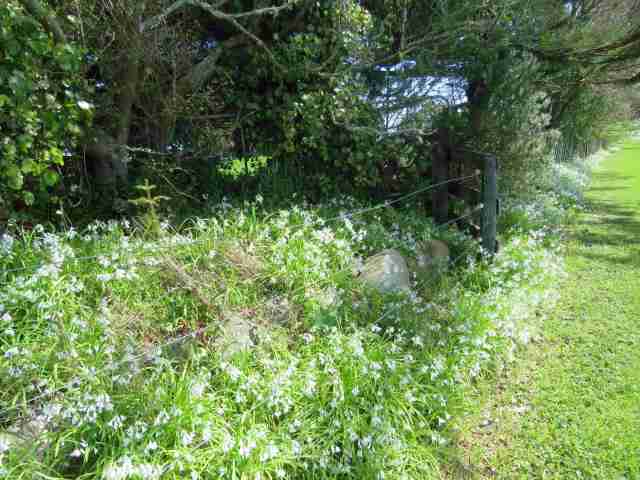
Plenty of onion weed on roadsides and along fencelines on country roads.

Onion weed is in full flower and it, too, is widespread, mostly on roadsides. It is quite pretty in bloom but spreads way too enthusiastically and is difficult to eradicate. I haven’t dug one up but I would guess it is a typical weedy allium where a single bulb is capable of producing baby bulb offshoots by the score or more. The ability of weedy alliums to reproduce is frankly alarming.
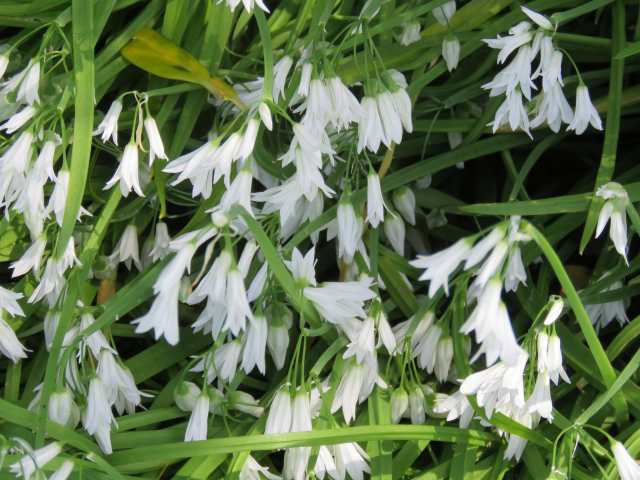
Mark was sure that onion weed is what is sometimes referred to as wild garlic but I see he is not correct on that. What we call onion weed is Allium triquetrum. What is usually referred to as wild garlic is a different species, A. ursinum. Proper garlic is yet another allium species, A. sativum. I doubt there is any reason to avoid harvesting our common onion weed, should you be keen on gathering wild foods. It certainly smells onion-y, as all the alliums do. Indeed, a quick net search came up with one enthusiast on Substack sharing his recipe for charred onion weed with cashews, curry leaves & gochujang ripple labneh. Not all of his recipes are quite so complex and the author is clearly better placed to advise on foraging than I am.
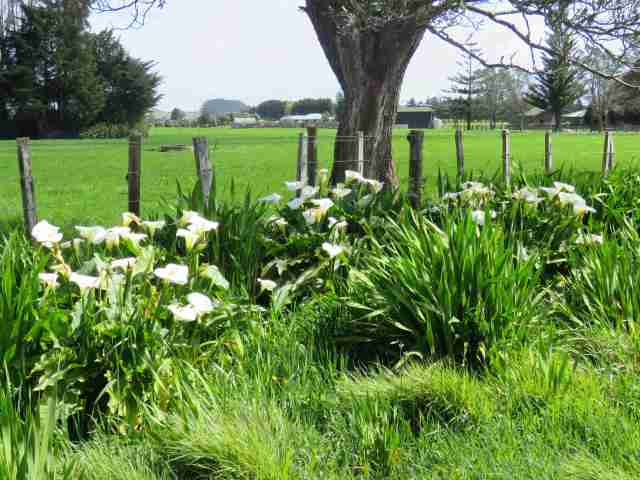
Arum lilies growing wild. There is no colour enhancement or filter on this photo. That bright green of the paddock behind is the defining colour of this area, especially in spring.

Arum lilies are a great deal more highly prized in other countries than here. I quote Bay of Plenty regional council: “Zantedeschia aethiopica Originates from South Africa. Introduced to New Zealand as an ornamental garden plant and thought to have naturalised by 1870. All parts of the plant (are) poisonous and it is one of the National Poison Centre’s top ten poisonous plants; being consistently involved in unintentional or childhood poisonings.”

Like all zantedeschia, they make a good cut flower but their reputation here is so tarnished by their invasive weed status that few people value them in that category. It is a very difficult plant to eradicate too, and I can tell you that from experience after working to eliminate the form once sold here under the name of ‘Green Goddess’.
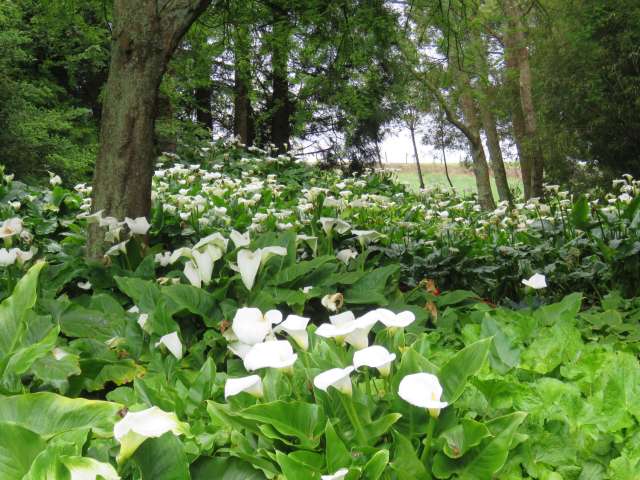
A mass of arums in a garden I visited two years ago. A brave landscaping decision, I thought.

I have only once in recent years seen it used as an ornamental garden plant. It is certainly striking and the blooms are long-lived and robust. I can’t quite get over my squeamishness about featuring plants that we know are noxious weeds. Pampas grass is striking, especially the fluffy pink form. Giant gunneras are striking but they are a really invasive problem here. Last time I looked, they were banned entirely in Taranaki – as in, illegal to have on your property – which is the highest level of control. I feel that arum lilies, like giant gunnera, are much more valued in other countries where they don’t pose the same environmental problem as here.

When all is said and done, should famine strike, we can eat onion weed and the wild cherry trees can provide good firewood but the arum lily has no such saving grace.
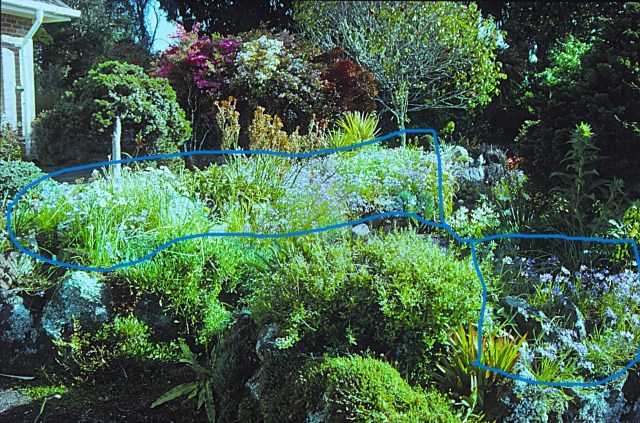
From 1993

Postscript: While thinking of weeds, I was amused to find this low-grade photo of the rockery, taken in 1993, so 32 years ago. The blue – you are looking at the blue which I tried to bring up with a filter and then highlighted. Most of that blue is the Geissorhiza – probably G. aspera, seen here at its worst. To this day, I am still digging out every tiny bulb that germinates and grows to the point where I can identify it. Mark’s father, who planted it and then deeply regretted it, took to painting it with weedkiller and an artist’s paintbrush. I have even dug out and replaced all the soil in some of the rockery pockets with the worst infestations. Continued vigilance is all that stands between a well-tended rockery and a repeat geissorhiza takeover.
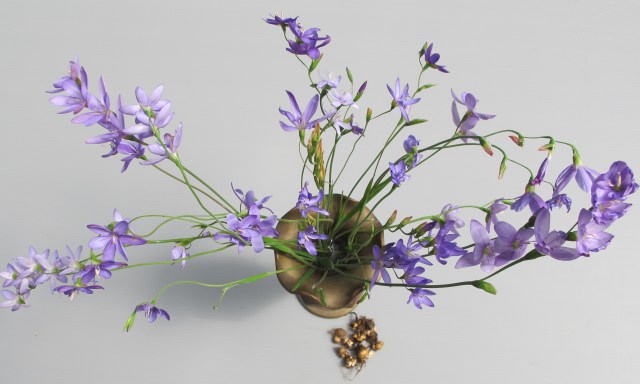
Do not be fooled by its dainty appearance. The geissorhiza is not harmless.

A quilted flower

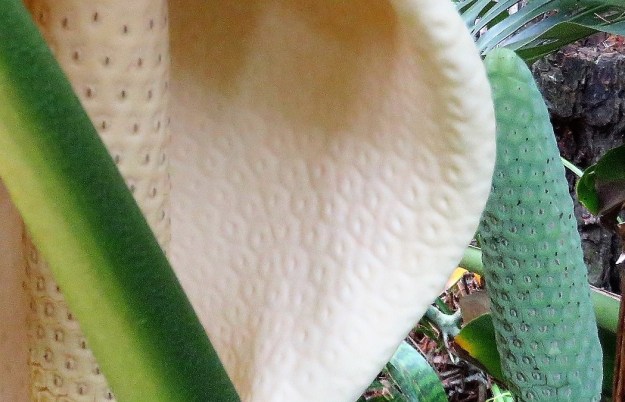
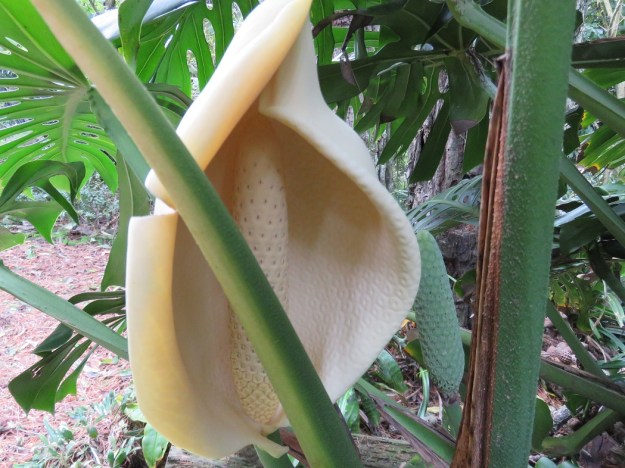
The quilted spathe of Monstera deliciosa with the distinctly phallic green fruit from a previous bloom to the right

I had not noticed until yesterday that the interior of the spathe on the Monstera deliciosa is delightfully quilted. For quilting enthusiasts, they are hexagons – six-sided figures. The spathe is the curved hood on the flower – botanically a modified leaf but most of us will continue to call it a flower. Some readers will know the monstera better as the fruit salad plant – most often seen as a house plant or perhaps more as an office plant where there is greater space. I would rather doubt that it flowers, let alone fruits, when it is treated as an indoor plant.

We have it as large, shade plant, climbing our trees and furnishing some of the back areas of the woodland gardens where it never gets frosted. It is a bit rampant, a monster even, although easy enough to cut back when it roots its way along the ground. It is more difficult to contain when it romps its way up the trees because it puts out strong aerial roots all the way and our largest ones are now a good ten metres up the trees. Looking tropical, even in the depths of winter. Fortunately, this is not a plant that will smother or strangle its host tree.

Monstera deliciosa can indeed be a monster plant when liberated in the garden

Our plants set fruit but we are not hot enough to ripen them to the allegedly delicious stage. Sometimes we get them to the point where the segments are ripe enough to fall apart, as they do, but the taste, while somewhat ‘tropical fruit salad-y’ in flavour, remains too sharp to eat many. A bit like cut glass, we say, which is apparently to do with oxalic acid. Our guess is that in hotter climes, the oxalic acid is less dominant.

Coming back to the flowers, I hadn’t really noticed how lovely they are until I saw this one yesterday and noticed the matching quilting on the central spadix (which develops into the phallic shaped fruit) and the interior of the spathe which embraces it.

Arum lilies, photographed in somebody else’s garden

“Aroids”, Mark said which had us googling a few other plants with flowers of similar form which were otherwise totally different and yes, they are all members of the araceae family, though not all are members of the aroid sub family.  Arum lilies are probably the best known. Arums are a great deal more prized overseas than in New Zealand. Here, they are seen as an indicator of poor land management (our pioneer roots are as farmers in this country), invasive and widely banned from sale but not on the total eradication list, as far as I know. As a garden escape, the problem with arums is that stock don’t eat them and they are difficult to control once they have established themselves. I once wrote giving advice on how to get rid of them. The coloured calla lilies are still grown as ornamentals but I dug most of mine out this year. I found them shy flowering and they didn’t justify the garden space. Too much foliage for too few blooms.

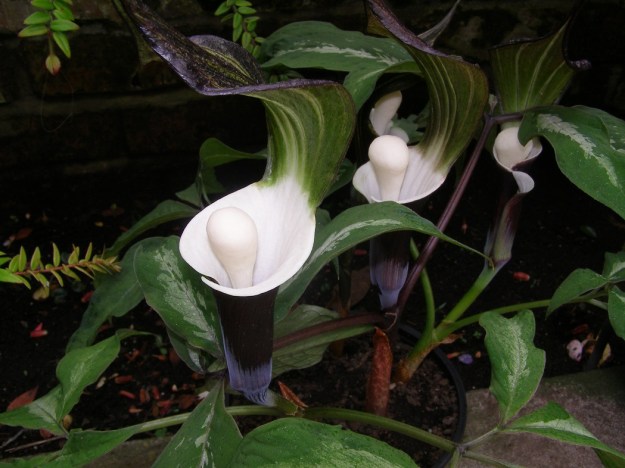
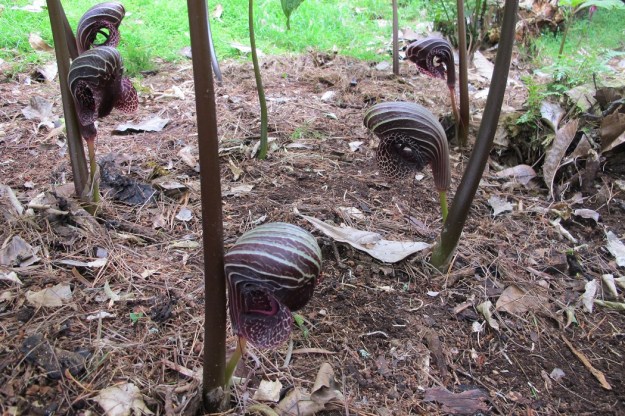
Arisaemas we grow a-plenty. Theirs is a very curious plant group, though not beautful in the usual sense. A. dahaiense

What surprised me more was to find that arisaemas and lysichiton are also members of the araceae family. They have the distinctive hooded flowers, but that is about all that looks the same as monstera or arum. I am sure I have photographed the lysichitons here (unromantically referred to in common parlance as ‘skunk cabbages’) but I can not find the photos in my files. We have both the yellow American species (americanus) and the white Asian species (camschatcensis) which we grow as bog plants.

Alocasias also belong to the same family. This includes taro, which is widely sold in New Zealand because it is a food staple for Pacific Island people, though it has never made its way into the general diet of most others and I admit I have never tried it. It has never been touted as delicious. Should you happen to be in Missouri, the botanic gardens there have the world’s largest collection of members of the araceae family. Munich Botanic Garden also has a splendid collection owing to world expert working there, the ever-handy internet tells me. I was just a bit surprised by the diversity of araceae we grow here. I was looking up the toxicity because some can cause burning of the skin and I wondered if it was connected to the aroids. But no, it appears that it is only a characteristic of some family members – chemically speaking, calcium oxalate crystals in the form of raphides. So now you know. This will explain the sensation of eating tropical flavoured glass shards when sampling the monstera fruit that are less than perfectly over-ripe.

Arisaema sikokianum – not easy to keep going as a garden plant but eye-catching

Garden Lore

“I fear I am a little impatient of the school of gardening that encourages the selection of plants merely as artistic furniture, chosen for colour only, like ribbons or embroidery silk. I feel sorry for plants that are obliged to make a struggle for life in uncongenial situations, because their owner wishes all things of those shades of pink, blue or orange to fit in next to the grey or crimson planting.”

Edward Augustus Bowles My Garden in Spring (1914)

OLYMPUS DIGITAL CAMERA

Garden Lore: arum lilies

Arum lilies are something of a scourge in this country. These are the remains of a selected white splashed-green flowered form called ‘Green Goddess’. I have just done what I hope is the final clean up in my eradication efforts. You can imagine the hollow laugh of disbelief from Mark when I informed him that ‘Green Goddess’ has an Award of Merit from Britain’s prestigious Royal Horticultural Society. It is clearly not a weed there, no sirree.

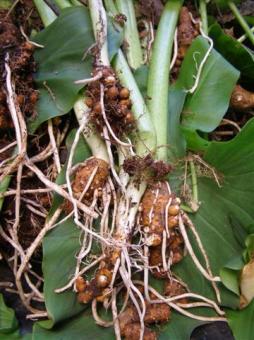
The common weedy arum here is from South Africa and is Zantedeschia aethiopica, although Z. italicum is also a problem. The issue is that these plants just do too well here. They are tolerant of a very wide range of conditions and, being toxic, stock won’t touch them so they can multiply even on grazed land. Not only do they spread by seed but you can see from the root system why they can be difficult to eradicate. The rhizome below ground has numerous offsets and every one has the potential to grow to a separate plant.

I eradicated by digging carefully and thoroughly gathering all the baby offsets. Don’t risk composting them. Either dry and then burn them or put them out in the rubbish for deep burial at landfill. Never, ever dump them on the roadside. I have just done what I hope is the final follow-up to root out the remaining stragglers after 3 years. If you want to go the chemical way, the Weedbusters website recommends metsulforon-methyl with glyphosate and penetrant (to make it stick). Or Escort is what Mark recommends – that is the metsulforon-methyl bit.

The smaller growing, coloured zantedeschias that are often known as calla lilies are generally derived from different species and do not show the same weedy inclination, being prized as cut flowers and making excellent garden plants. However, they are apparently all equally toxic so take care when handling them as their sap can burn.

First published in the Waikato Times and reprinted here with their permission.

In the Garden: January 7, 2011

• Now is the time to get straight on to dividing and replanting autumn bulbs because they will be starting to come into growth very soon. Belladonna lilies and nerines both get planted with their necks above ground level. Cyclamen hederafolium (I spotted the first flower this week), sit just nestled into the soil, like round discs. Their roots and their flowers both come from the top so it does help to get them the right way up. Ornamental oxalis and colchicums (autumn crocus) are other common autumn bulbs to divide now.

• Summer is the best cherry pruning time to avoid the dreaded silver blight getting in to the cut surfaces. If you have a flowering cherry with patches which did not flower last spring and the leaves are clustered much more densely, you have witches broom which needs to be cut out before it takes over the entire tree. Unfortunately the very popular Prunus Awanui is susceptible to witches broom, as are many other ornamental cherries of the Japanese type.

• You can cut most hybrid clematis off close to the ground if they have finished flowering or are looking mildewed (powdery white leaves). Feed them, keep them watered and they will grow again and flower in six weeks. This works for most of the large flowered types.

Arum lilies may be prized as cut flowers overseas but one look at the root system shows why they are a noxious weed on the banned list here

Arum lilies may be prized as cut flowers overseas but one look at the root system shows why they are a noxious weed on the banned list here

• If your New Year’s resolution was to start a vegetable garden, start preparing the ground now for planting winter vegetables soon. It needs to be in full sun. If you make the effort to get the soil right, it will pay dividends. If you are starting with lawn or grass, skim off the turf before you start digging and stack it to one side to rot down. Then start digging, and digging again to get the soil light and friable. Add in compost or manure and then leave it all to settle, push-hoeing off any germinating weed seeds as they appear.

• Garlic can be harvested now, but leave onions until the tops turn brown and bend down. To store garlic for the rest of the year, it will need drying – plaiting and hanging is the traditional method but you can also lay it out in a well ventilated area. Super fresh garlic is delicious to use in cooking.

• Arum lilies are a menace and on the banned list. I dug out a few remnant plants of the green and white flowered form called Green Goddess. You can see in the photograph how the roots are a rhizome with a multitude of little round babies ready to detach from the main body and to grow. These need to removed from the site too or they will continue to cause problems. We put them out in the rubbish, rather than trusting to the composting process and I will keep checking the area on the look out for babies germinating.