Tag Archives: autumn bulbs

In the garden this fortnight: April 26, 2012

A fortnightly series first published in the Weekend Gardener and reproduced here with their permission.
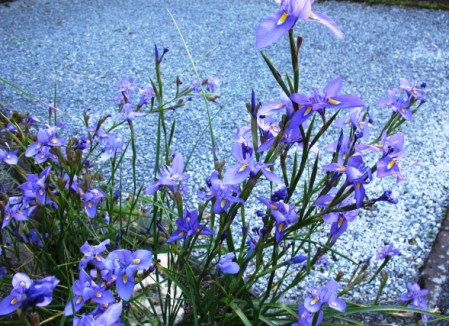
The pretty Moraea polystachya has a long flowering season

The pretty Moraea polystachya has a long flowering season

We are not noted for autumn colour here. I can’t think that anybody has ever said: “Oh but you simply must go to Taranaki to see the autumn display.” The trigger to deciduous plants to turn is temperature related and we drift so imperceptibly from summer through autumn to early winter, that even plants renowned for their capacity to blaze with colour are usually a disappointment. Besides, we are so verdant and green and our native plants are all so resolutely green that all we can do is to admire the occasional single deciduous specimen. Generally it is inland areas with drier climates and much sharper variation in seasonal temperatures which put on the big displays.

However, our autumn is marked by much smaller, pretty pictures of autumn bulbs. We garden extensively with bulbs. In a large garden with some huge trees, it is the dainty, often ephemeral pictures which give the charm and detail. Autumn flowering bulbs are harder to find for sale because most people don’t think beyond the more common spring bulbs.
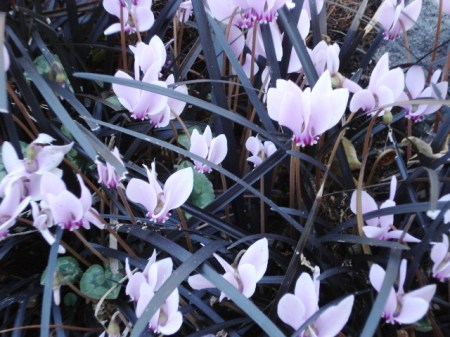
Cyclamen hederafolium - the easiest of the species in our climate

Cyclamen hederafolium - the easiest of the species in our climate

At the moment, it is the pink and white Cyclamen hederafolium, blue Moraea polystachya (autumn peacock iris), a rainbow of colours in the ornamental oxalis, bold lilac colchicums (often incorrectly referred to as autumn crocus), the real autumn crocus and the beautiful hybrid sarniensis nerines which are carrying the season in the rockery. Out on the roadside, the belladonna lilies are in bloom. Some, like the colchicums, do not flower for long but are very showy. Moraea polystachya is a gem of a bulb. It flowers down the stem so it has an exceptionally long season stretching into months rather than weeks. It can seed down but is easy enough to thin out if necessary.

Cyclamen hederafolium (formerly known as neapolitanum) is the easiest and most reliable of the species cyclamen. It too has a long flowering season, followed by attractive, heart shaped leaves with white markings. It combines very well with black mondo grass and in places we have English snowdrops (galanthus) to come through in late winter, extending the seasonal interest amongst the cyclamen foliage.

Top tasks:
1) Cut off all last season’s leaves on the Helleborus orientalis and remove them to the compost heap. We have done this for many years now, following the advice from Terry Hatch at Joy Plants. It removes any build up of aphids and it means that the flowers are highly visible as they come through with just delicate new leaf growth. As the season progresses, the new foliage takes over and fills the whole patch. Timing is important – if you leave it too late, you have to trim carefully around all the emerging flower stems.
2) After raking off the hellebore foliage, I will weed out the rash of germinating seedlings and then cover the whole bed with a mulch of compost to a depth of about 3cm. This feeds the soil and discourages weeds. Hellebores are one perennial that is best left undisturbed. It is better to raise seed than to try and divide existing clumps. They can sulk for years before recovering.
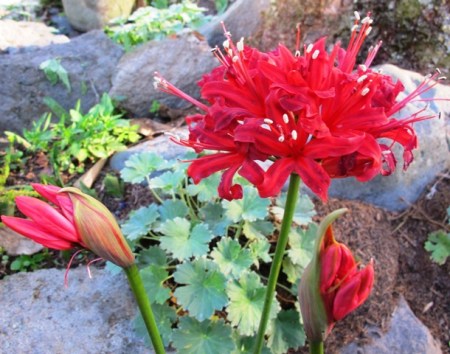
The Nerine sarniensis hybrids are a real autumn feature in the rockery

The Nerine sarniensis hybrids are a real autumn feature in the rockery
Plant Collector – Oxalis massoniana

Oxalis massoniana

Oxalis massoniana

Envy the gardener who has not had to battle invasive oxalis. Most of us know only too well how difficult it is to eradicate the weedy ones. But there are only a few villains in a very large family and unfortunately, most people shun the lot because of those few. We wouldn’t be without the decorative oxalis and O. massoniana is just one putting on a splendid display at this time.

I think we must have around 30 different oxalis in pots and in the garden here and they are just a drop in the bucket of the many hundreds of different species. Flower colour ranges from white, through the gamut of pinks, lilacs and lavenders, crimson red, yellows and oranges. The foliage is also varied from the clover type leaves to fine and feathery, trailing and even miniature palm leaves. We must have them flowering for six to eight months of the year. I should comment that some have a flowering season lasting a long time, while others are a bit of a flash in the pan.

Some oxalis are garden safe but if in doubt, keep them in pots where they are wonderfully forgiving of benign neglect. The flowers only open in the sun so the pots make a lovely seasonal feature on a sunny doorstep. I have tried massoniana in the garden but it seems to be happier and showier in a big, shallow container.

The apricot and soft yellow two-tone colouring is very pretty and the flowering season lasts a good length of time. As with most of the autumn and early winter flowering oxalis, it is native to the bulb wonderland of South Africa. If you can’t bear the thought of growing oxalis, just call it by its more romantic sounding common name overseas – wood sorrel.

First published in the Waikato Times and reprinted here with their permission.

Plant Collector- Lycoris aurea

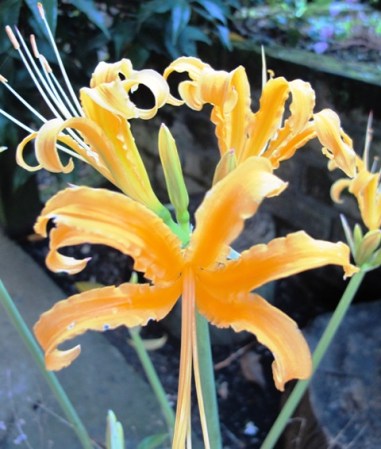
Lycoris aurea - the golden spider lily

Lycoris aurea - the golden spider lily

No, it is not a golden nerine in flower. Nerines do not come in yellow or gold and they hail from South Africa. The lycoris is a close botanical relative (both are from the amaryllidaceae family) but a distant geographic one. It comes from China through to Japan and is sometimes called the golden spider lily. Its native habitat is described as limestone country, which is interesting. Maybe it could be naturalised around Te Kuiti? It is a plant of the grasslands and forest margins in southern China and it has apparently naturalised in California.

The lycoris is not rare, it is just not widely available. But when you think about it, there are not many autumn flowering bulbs available commercially. Along with other members of the amaryllis family, it has a relatively large bulb although it prefers to be fully buried, unlike belladonnas and nerines which like to bake with their necks exposed. The lycoris does like a bit of summer heat to ripen the bulb which springs into growth in early autumn by putting up its flower spikes first. These will be followed by strappy green leaves which stay until the bulb goes dormant in late spring. It is renowned as an excellent cut flower.

It appears that lycoris was named for the Roman woman (not of noble birth) who counted various notable lovers including Mark Anthony. Aurea just means yellow.

First published in the Waikato Times and reprinted here with their permission.

In the garden this fortnight: Thursday 29 March, 2012

A fortnightly series first published in the Weekend Gardener and reproduced here with their permission.

The little known Rhodophiala bifida

The little known Rhodophiala bifida

We keep talking about sustainable gardening here. For us, sustainable garden is twofold – both managing the maintenance of a large garden with a small labour input (wouldn’t we love legions of skilled gardening staff?) but also following garden practices which are not damaging to the environment. To this end we make our own compost, mulch heavily, use a mulcher mower, eradicate or control plants that threaten to become invasive, shun chemical fertilisers and hardly use sprays at all to keep plants healthy. We have a few plants of exceptional note that warrant a touch of insecticide, but generally, if a plant can’t grow well in good conditions, we will not persist with it. A few more roses are destined for the incinerator as I cull further. We do use glyphosate for weed control and Mark lives in fear that it may one day be ruled environmentally unacceptable because we would find it very hard to maintain standards without it.

The enormously useful leaf blower

The enormously useful leaf blower

But our biggest environmental footprint here is the internal combustion engine – the lawnmower, weed eater, mulcher, chainsaw, water blaster and motor blower (leaf blower). We console ourselves with the thought that we are only a one car household and that car often has only one outing a week so maybe that compensates for CO2 emissions. The motor blower is a huge timesaver for a big garden. We started with a cheap handheld one but progressed to a backpack model. It is possible to sweep and groom one’s way right around the garden at walking speed. That is an awful lot faster than doing it with a leaf rake, broom and barrow. As we hurtle at alarming speed from deeply disappointing summer into premature autumn, the blower comes into its own. Fine debris gets dispersed (it does generate dust) while larger leaves can be hustled into discreet areas to break down and rot.

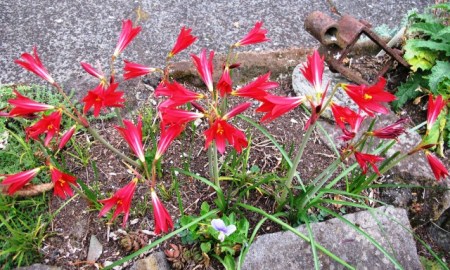
The autumn bulbs are starting. At the moment the little known Rhodophiala bifida is looking terrific as are the red paintbrush blooms of Haemanthus coccineus (the plant many readers may know better as elephant ears). The lovely blue Moraea polystachya is coming into bloom, along with Cyclamen hederafolium and the early nerines are open. These seasonal delights offer some compensation for a summer which never really got going.

Top tasks:

1) As perennials pass over and many fall over, we need to do a tidy up round of the garden borders. Because our temperatures are mild here and we have soils which never stay waterlogged, we can and do lift and divide perennials most of the year. There is still time for plants to re-establish before winter temperatures stop growth.

2) Where repeated use of the blower has led to too much of a build up of debris (mostly in our hellebore border), I need to get through and rake off the surplus for the compost heap before we add this season’s leaf drop.

Tikorangi Notes: Friday March 2, 2012

Latest posts Friday March 2, 2012
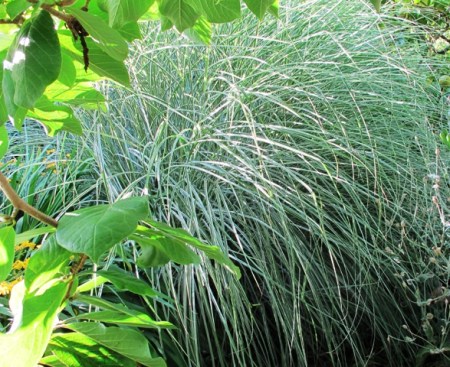
1) Space limitations in the Waikato Times this week means there is only one new post from there at this time – Gardening with grasses. Shun the contrived use of dwarf grasses forced into an unnatural role as an edger but use them instead in mixed plantings with perennials with a debt to the prairie style of gardening.

2) Judging by the visitor statistics to my website this week, it seems unlikely that anyone has missed the piece on what looks mighty like plagiarism + Penguin + Sally Cameron + Tui garden guides Round Two – More bad Penguin. It resulted in an immediate recall of a second book in the series (Tui NZ Vegetable Garden). There seems to be a bit of debate about whether it is entirely the author’s fault or whether the publisher must also bear some of the blame. Frankly, I think Penguin has to take some of responsibility – at the very least for choosing such an ill equipped author in the first place. Too many corners cut in trying to get that series of books onto the market.

3) In the absence of other original posts all I can do is to recommend a YouTube clip which was the source of great delight to me this week. A lawnmower who learns to dream big. And in case you think that was computer generated trickery, we have the rather more mundane clip which shows it is … real. Remote controlled flying lawnmower.
We are not optimistic that our Walker mower has the capacity to fly.

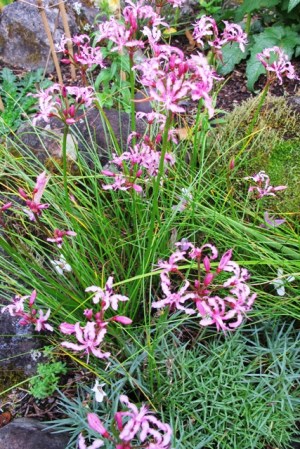
Nerine filifolia

Nerine filifolia

Looking out the window this morning at the swimming pool, Mark commented that clearly the swimming season was over for the summer and at least I had had a swimming season whereas he had not even been in this year! The only consolation about the most disappointing summer we can ever recall is that we were not alone. Most of the country has been similarly afflicted and indeed, our daughters in Sydney and Canberra tell us the same thing! Shared disappointments are so much easier to cope with. And gardeners move on. Autumn is here. The autumn bulbs are starting – Haemanthus coccineus with its red paintbrush blooms, the lovely blue Moraea polystachya, cyclamen, Rhodophiala bifida and the first of the nerines. Nerine filifolia is evergreen with us and is simply the daintiest, most charming little rockery nerine you are likely to see. I potted some to sell a couple of years ago and not a soul wanted to buy them so these days we just keep them to delight ourselves.