Tag Archives: Camellia Waterlily

The end of an era

We don’t open the garden to many groups these days but agreed when we were approached to host a visit from “the last Camellia Nationals in their current format”. That is the national conference of the NZ Camellia Society. Competitive show blooms have long been a hallmark of the camellia world, the major focus of the annual conference but a range of garden visits are also included.
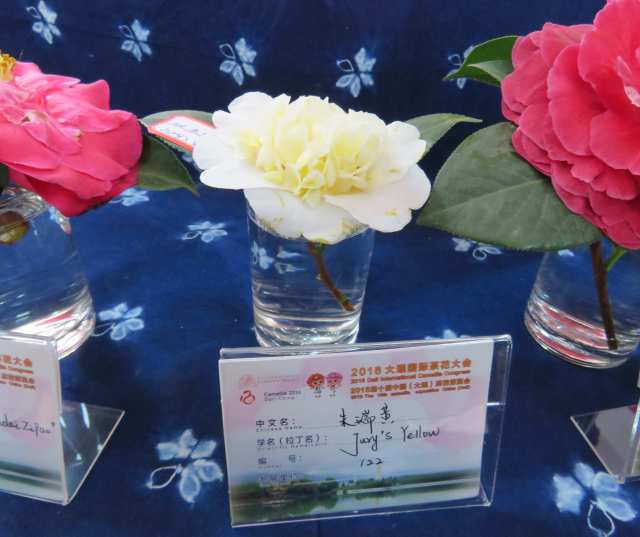
A little bit of Taranaki Jury on the honours table of the International Camellia Convention in Dali, China 2016

Mark’s father Felix and his Uncle Les Jury were giants in the camellia scene back in the 1960s and 1970s, earning international reputations and breeding camellias that have become known throughout the world. To this day, Les’s Camellia ‘Jury’s Yellow’ remains a market standard and Felix is probably best remembered for his camellias ‘Dreamboat’ and ‘Waterlily’.
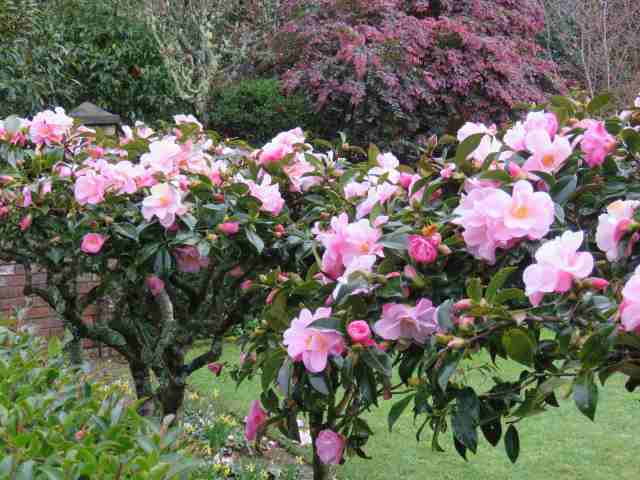
Camellia ‘Waterlily’
Camellia ‘Dreamboat’

When Mark and I returned to Taranaki at the end of 1979, Les was elderly. But before he died in the early 1980s, he was particularly encouraging and generous with advice to Mark, who was taking his own first steps in plant breeding, starting with camellias. Felix didn’t die until 1997 so the camellia influence was strong.

Conferences past. I recently found some homemade posters – I am guessing Mimosa’s work – for a conference that was likely in the 1960s. The flowers have been cut out from magazines and glued on and, unless I am mistaken, the lettering is from Letraset and only oldies will remember the days before accessible printing, let alone photocopy machines!

It was to respect that family connection to camellias that we agreed to the visit last weekend. Times are changing and many horticultural groups are struggling to continue as members die off – literally – and younger generations are not signing up to replace them. That is why this was to be last national camellia show and conference in the current format. I have no idea what new format is planned.
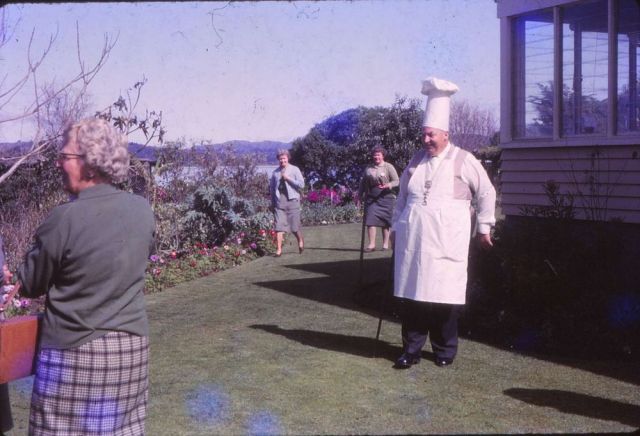
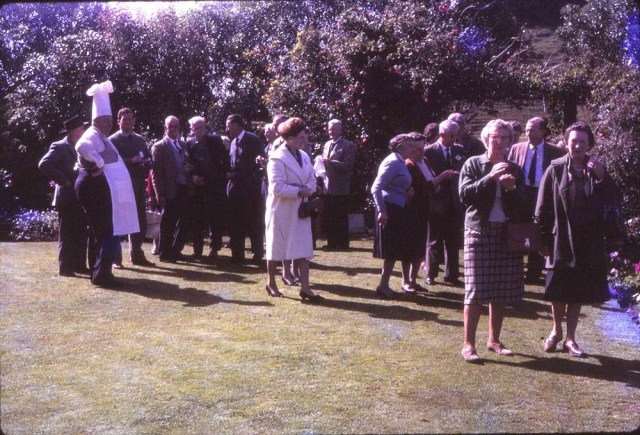
Camellia conferences in days of yore were a little larger and a little different. If the labelling on Mark’s parents’ slides was correct, this seems to be Whakatane 1964.

In times past, the camellia conference was huge. In the heady boom times through until the early 1990s, my recollection is that the conference tours around gardens involved six coaches and countless cars – several hundred people. It was bigger than the rhododendron conference which only required four coaches plus cars. Mark attended several conferences as his parents’ driver and was in awe at the scale of the event and the depth of expertise in the attendees. I went to one – I think it was Whakatane ‘82 and I can date it because I had our first-born with us and she was small. Even back then, Mark and I were a good decade or three younger than most of those who went. We continued to host conference visits here in the times since so last Sunday felt something like the end of an era. Conference attendance was down to 63, so one coach, a minibus and a couple of cars.

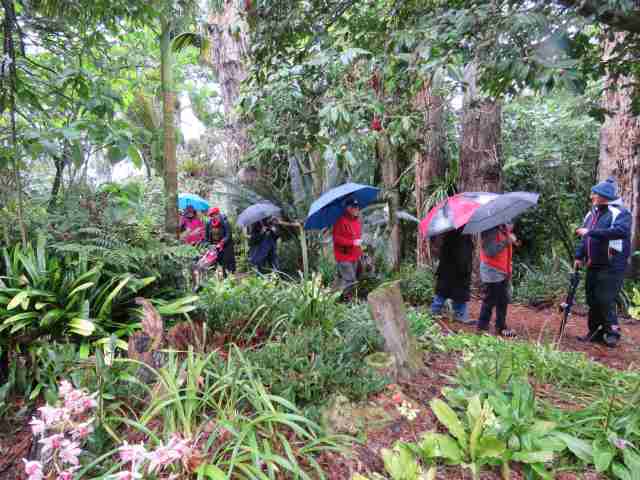
The group arrives last Sunday afternoon.
It rained but the camellia enthusiasts were very enthusiastic and appreciative
In earlier times, pretty much every camellia we grew put on a mass display of blooms. These days it is a rarer sight which makes this little row of Mark’s ‘Pearly Cascade’ more special. But even this would have had many more blooms in the days before petal blight.

Of course, camellias have changed over that time, too. Back in those days, camellias were ranked the second largest-selling product line. Roses were top. And the vast majority of camellias being produced were japonicas and hybrids. Camellia petal blight changed everything. The mass display of flowers all over the bush, the efforts Felix and Les both went to in creating varieties that were self-grooming (dropping spent blooms to avoid the need to pick over the plant), the perfection of formal blooms like ‘Dreamboat’, ‘Mimosa Jury’ or ‘Desire’, the purity of bushes with perfect white blooms, the quest for ever larger blooms – these are but distant memories. Petal blight has largely destroyed the displays that made camellias so loved. It made the Camellia Society shows problematic because the blooms no longer stood up to travel and display over several days. Picked as perfect, they too often became blotched with brown by the next morning and sludge the day after.

Camellia Mimosa Jury’

We still have hundreds of camellias here in our garden and right across our property. I set out to pick one off each bush where I could reach a flower and gave up after covering just a fraction of the garden. A few are named varieties but many are just seedlings from the breeding programme.

I think of camellias like the cast of a stage-show musical. In times gone by, the entire front row of the chorus and some significant soloists were camellias. Nowadays, they play a valuable but less acclaimed role, filling out the back rows of the chorus with a few of them getting to step forward to sing a few solo lines from time to time. They used to be grown primarily for their flowers. Now we value them more for their potential form – we clip and shape key specimens – as well as their obligingly resilient and healthy nature and their adaptability.
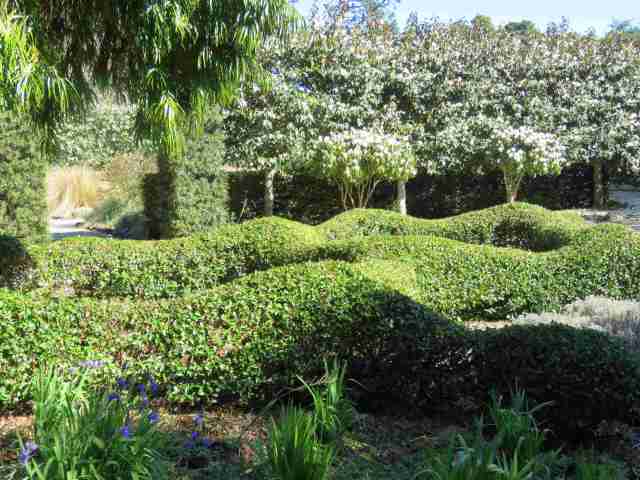
We use camellias differently now. The undulating hedge in the foreground is Camellia microphylla. The clipped hedge running across the middle of the photograph is Mark’s Camellia ‘Fairy Blush’. The two white topped lower plants in front of it are Camellia yuhsienensis.
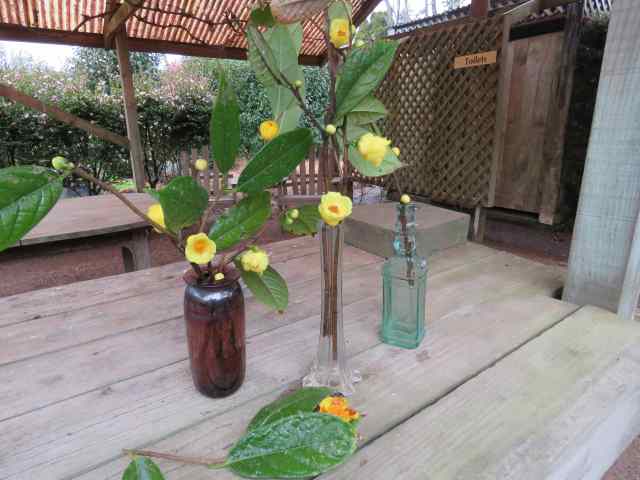
I set up a few sprays of Camellia nitidissima on the table by the visitor loos because I thought the visitors might not be accustomed to seeing them growing outdoors as garden plants – but nobody commented on them, to me at least. At the time when Les and Felix were breeding camellias, nobody in the west even knew about the yellow camellias in China and Vietnam. Les created ‘Jury’s Yellow’ from white camellias.

Out and about, in a very limited, local way

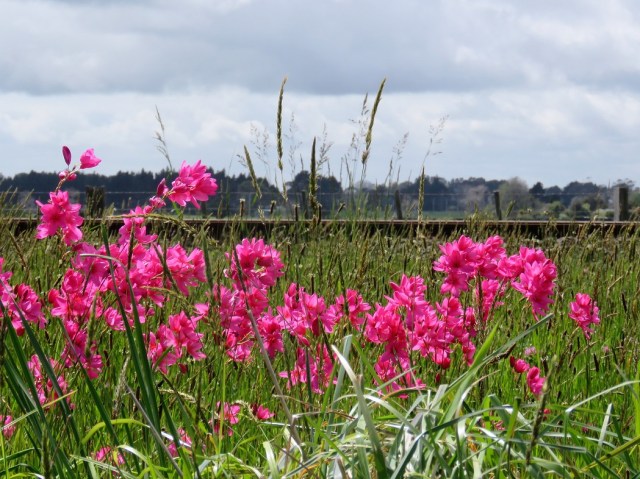
Ixias by the railway track near Lepperton

I flashed past these eye-catching ixias (corn lilies) at speed and promptly thought that I should have stopped and photographed them. I then thought I couldn’t be bothered until a couple of kilometres down the road when I turned and went back. Are they not pretty? They are growing on wasteland beside the railway in Lepperton and the sight of them stopped me being grumpy about something else that had happened.

There is nothing choice or rare about ixias. We have them in the twin borders in several colours and they show up each year on one of the mass bulb suppliers’ catalogues. But as a wildflower, their charm seems greater to me. I was glad I had dug some to put down in the Wild North Garden where they may recreate the simple charm of the railway siding.

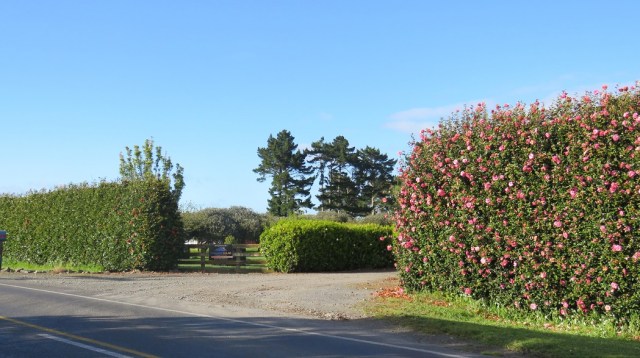
The rare sight of a camellia hedge in full bloom, though now past its peak

I also stopped to photograph a camellia hedge because a mass flowering camellia hedge is a rare sight for us in these days of the cursed camellia petal blight. This one is down the road from us (in a rural sense – maybe 5km down a different road entirely to the one we live on but still ‘down the road’). We used to have mass displays of larger flowered camellias in informal hedges but they are a thing of the past here. The plants haven’t gone; it is the flowering that is a memory. This particular hedge is in an extremely open situation, exposed to both full sun and wind from every direction. It confirmed for me that the extremely sheltered microclimate we have in our own garden has exacerbated camellia petal blight to be some of the worst in the world. Fungi thrive in a protected situation. It is a trade-off. That microclimate enables us to grow many other plants that would not otherwise thrive but at the expense of the japonica and hybrid camellia flowers.

Camellia ‘Waterlily’
Camellia ‘Les Jury’ to the left and Felix’s ‘Waterlily to the right. Something that had finished flowering but appears to be white at right angles in the centre.

It was Mark who drew my attention to the fact that it is Camellia ‘Waterlily’, one of his father’s early cultivars. We have the original plant in the garden here. Next to it, to the left, is a clipped hedge – now at the end of its flowering season – of Camellia ‘Les Jury’. It is the best red his Uncle Les bred so they have the Jury camellia brothers right and left of the gateway.

Each spike is a cluster of a huge number of individual flowers with long stamens on the xeronema

We don’t have a whole lot of native plants that carry gardeners’ bragging rights with them but the Poor Knights’ lily – Xeronema callistemon – is one. It grows on the rocky cliff faces on the Poor Knights islands, often washed by sea water and never drying out but never getting waterlogged. According to Wikipedia, those offshore islands of New Zealand which few people ever get to visit but are a treasure trove of unique flora, were so-named because their shape reminded the early Europeans of a bread pudding popular at the time, the Poor Knights Pudding.  There is a random piece of information for you.

Xeronema callistemon in the central row on a bank in Waitara, thriving in a regime of benign neglect

Their natural habitat is not easy to re-create in a garden situation which is why they carry some bragging rights. I am pretty sure they are also frost-tender and it takes a long time for them to reach flowering size. Despite all that, there is fine display of huge plants on a shady bank in my local town of Waitara. Prostrate rosemary festoons down the bank below them and they are flanked by some pretty scruffy trachycarpus palms but eat your heart out, gardeners who have failed with the xeronema at home. Finding a suitable spot and then allowing benign neglect seems to work better.

Poor Knights lily and Marlborough rock daisy in our swimming pool garden. Maybe they feel at home because we have a salt water filter on the pool and they can smell the salt? Or maybe not.

Our best plants are just coming in to flower. I admit we groom the plants a bit – removing spent leaves. I like the combination with the Marlborough rock daisy (Pachystegia insignis) – another cliff dweller but this time from a location which must be close to 1000km south of the Poor Knights Islands.

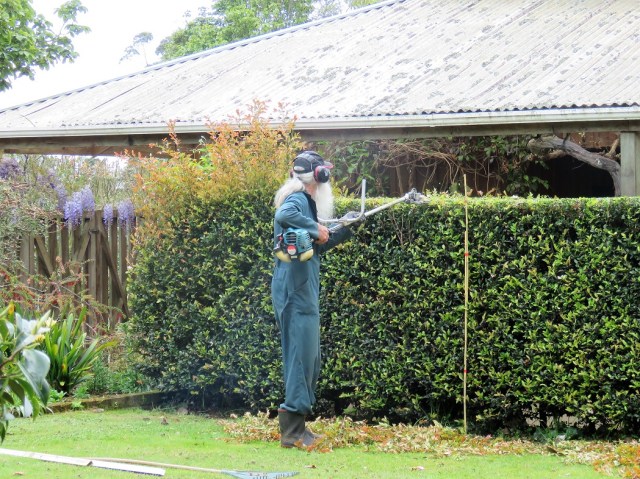
Trimming the hedges here is largely done by Lloyd. If you look carefully, there is tape on the bamboo to mark the desired heights and he also checks with a string line.

Meantime, it is all go on preparing the garden for the Taranaki Garden Festival, opening on October 29. We have our fingers crossed that we stay at level two which enables it to go ahead. We will be awfully miffed if we get Covid Delta in Taranaki with a last-minute cancellation after all this work.

Kia kaha. Stay sane and stay safe in these trying times.  We are living through an event that will become a significant point of history for future generations to study. It is not a comfortable position for anyone.

Camellia Diary number 3: July 3, 2010

Click to see all Camellia diary entries

Click on the Camellia diary logo above to see all diary entries

July may see days getting a little longer but it also tends to herald the worst of our winter weather. However as chill, grey days can be interspersed, as today and indeed, last weekend, with positively mild days when it is possible to garden comfortably and shed layers of clothing, the camellias flower on undeterred.

The sasanquas are drawing to the end of their season but Elfin Rose, who opened her first blooms at the very end of March, is still a significant patch of lolly pink and dark forest green. Three months of flowering is better than most of the other sasanquas manage. Silver Dollar also just gets better every year and is excelling with an extended flowering season. We think Silver Dollar, being lower and slower growing, would make a good hedge. Alas were it not for the wonderful shape and maturity of Mine No Yuki, it would have had the chop by now. It does not justify its place here as a flowering plant where the pristine white blooms turn to brown mush in our rains.

The ever faithful Camellia Waterlily

The japonicas are just starting – the first flowers came on good old Waterlily, one of the first camellias named here by Felix. The original plant is pretty sizeable now – maybe six metres – but the early flowers are as lovely as ever. Half sister, Softly (another saluenensis hybrid) is also showing plenty of open bloom. In the class of pale formals, Softly shows good weather resistance. We went on a magnolia tour in northern Italy a few years ago and the timing coincided with the peak of their japonica display, and what a display. We soon worked out that camellias in that climate mass flower over a much shorter period of time. Here, ours flower for much longer but without that oomph all at once.

The lovely species yuhsienensis

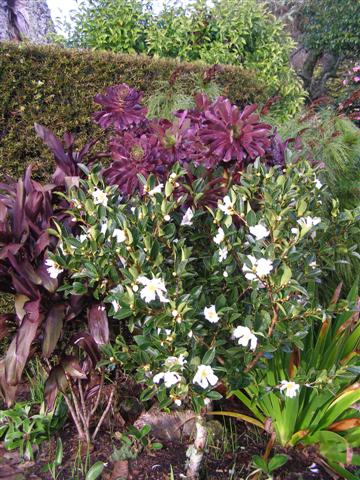
Compact C. drupifera, planted here with burgundy aeonium and cordyline

In the species, C.gauchowensis is looking lovely but the star this week is the compact C.drupifera. Or maybe C.yuhsienensis. It is hard to decide – all look lovely with pristine white blooms. Yuhsienensis takes a bit of grooming to stay looking its best but it is such a lovely camellia. We have a row of about 50 plants in our open ground area which we are still debating about using as a hedge. Puniceiflora continues flowering – puny flowers but still with a simple, small charm.

Alas I found the disconcerting sight of the first instance of the dreaded camellia petal blight at the very beginning of June (about June 2, from memory). It just seems to get earlier every year but it is not yet showing up badly on garden plants so I will return to the topic later when it is no longer possible to ignore it.