
Garden Lore: May 23, 2014
“Momordica – Cucurbitaceae – The Squirting Cucumber. An annual gourd-like plant, with woolly leaves, and yellow flowers, the fruit of which resemble a small cucumber; and which, when ripe, bursts the moment it is touched, scattering its seeds, and the half liquid, pulpy matter in which they are contained, a considerable distance. This quality made it a favourite, in gardens, a century ago, when some people were yet in a state of sufficient barbarism to find amusements in the annoyance of others; but it has now deservedly fallen into disrepute, and is seldom grown.”
Jane Webb Loudon “The Ladies’ Companion to the Flower Garden” (1840)
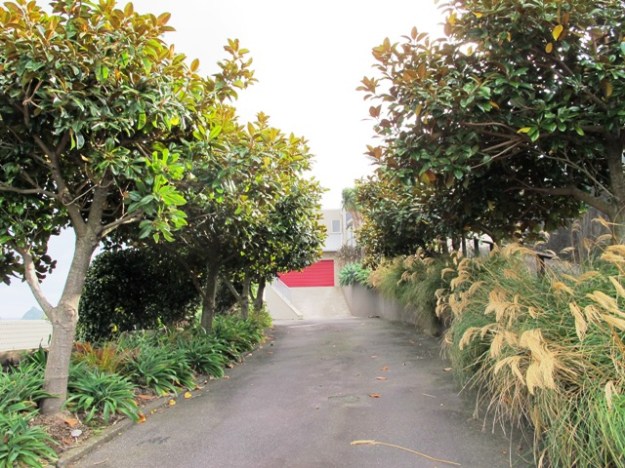
Vegetable time bombs, we call them
Garden Lore: Magnolia Little Gem
I stopped to photograph this driveway in town because it is like a vegetable time bomb waiting to give its owners no end of problems. What you are looking at is a narrow driveway flanked on either side by avenues of Magnolia Little Gem. At this stage, it still looks quite attractive. Little Gem is a good looking plant with glossy, dark green leaves and brown felted indumentum beneath. In summer, it will sporadically produce attractive white flowers. The mistake often made is in thinking that the descriptor “little” in its name, means it will stay small. While it will not get as large as some of the other grandiflora magnolias, it is still going to be an 8 metre tree and have a spreading canopy. You can already see it spreading.
In narrow spaces, you need narrow, columnar trees (technically ‘fastigiate’) which can give height and structure, without width. If you are going to choose a plant which forms a canopy, you need to keep the branching above the height of vans and small trucks – probably 3 metres up. Clip and shape from the very start so that you don’t have to undertake radical work when the trees become a problem.
It takes a lot more effort and expense to remove established trees which have outgrown their allotted space than it takes to plant them in the first place. It is better to get the selection right at the start.
First published in the Waikato Times and reprinted here with their permission.

 Tikorangi The Jury Garden