
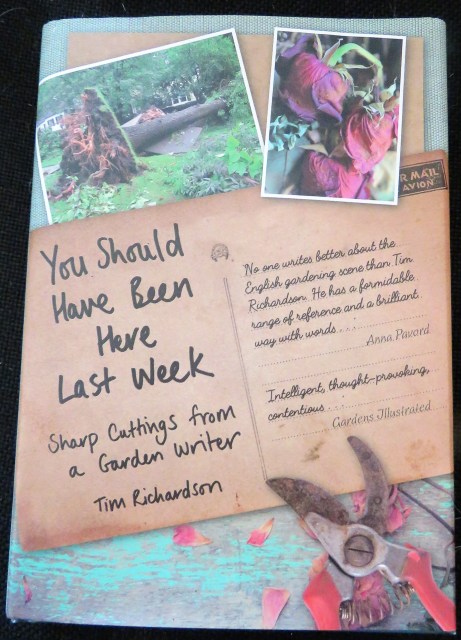
The subtitle is “Sharp cuttings from a garden writer” but eagle-eyed readers may notice that the secateurs on the front cover look as if they have been through the compost heap and are anything but sharp
Tim Richardson first came to our notice with his lavish book “The New English Garden”. We used it as a guidebook for our last garden visiting trip in that country because we wanted to see more contemporary work. “You Should Have Been Here Last Week” is a much more modest publication and as a result, a great deal more convenient for reading. It is a collection of writings for various publications – Country Life, Daily Telegraph, Gardens Illustrated and half a dozen others. And what an interesting collection these are.
Topics range widely and the writer does not hesitate to put forward a measured opinion, at times well apart from the Establishment. People, places, trends, theories – he will analyse the lot. His critique of the New Perennials movement, the Sheffield School and modern directions in planting struck a particular chord with us and conveyed with clarity where he considers it has developed beyond the Northern European/Piet Oudolf movement (‘Immersive not pictorial’ was particularly succinct). But if that is not your interest, maybe the politics of self-sufficiency, gay gardening, the efforts to “Re-Vita-lize” Sissinghurst and the perils of public ownership of formerly private gardens will catch your interest. Those who are aware of my opinions on the matter may laugh when I say I feel totally vindicated by his critique of the stranglehold the Arts and Crafts garden style has held over gardens for too long. Modern design does not escape his scrutiny either – his views on Suburban Modernism (Sub Mod) gives some very good advice to those who live on smaller, town sections.
There is lots of meat (or maybe high quality protein, if you prefer) in these short pieces – plenty to think about, discuss, and to challenge your thinking about gardening. And he is a good writer rich in quotable passages, sometimes cutting, controversial even.
It is worth buying, this book and it is not even expensive. I wish there was more garden writing of this quality. I did a brief search on the author and came up with this gem:
“Tim Richardson, author of Sweets: The History of Temptation, is the world’s first international confectionery historian. He also writes about gardens, landscape and theatre and contributes to the Daily Telegraph, Country Life, The Idler, House & Garden, Garden Design Journal and Wallpaper. He lives in North London.”
It is an unverified Wikipedia entry and I understand he no longer writes for the Garden Design Journal – sacked, or “let go” as they say, over a satirical paragraph in a column that was too hot to handle for that publication. If you want to read the previously unpublished column, it is in this new book. Being a bit of a flibbertigibbet, I was entranced to think of him doubling as the first international confectionery historian. He is clearly a man of many talents.
You Should Have Been Here Last Week by Tim Richardson. Pimpernel Press 2016
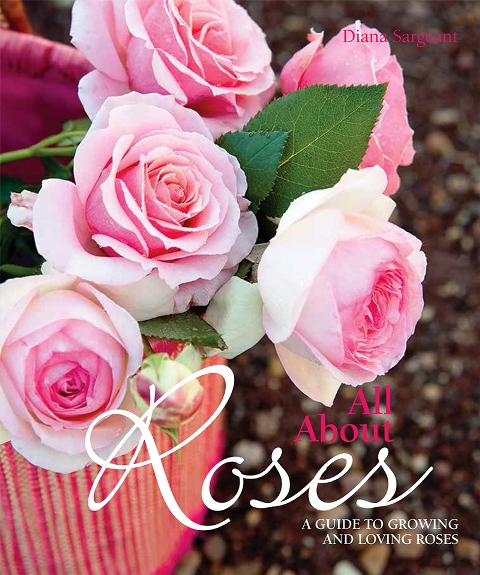 I approached this book with a little trepidation because it seemed to be part of the trend to release Australian publications in this country, assuming that they will be equally relevant here with no significant difference in conditions and plant varieties. In this case it works. This is a charming and helpful book written by somebody who combines vast experience with a genuine love for the topic. The author ran a rose nursery for 25 years where they chose to go to organic production well before many others came to realise that our growing of roses had become bad practice environmentally. There is no doubt it would be easier in Australia to grow good roses without chemical intervention because of their dry climate, but her experience is invaluable. I am not sure how readily available some of her alternatives are in this country yet – but they are stocked even by Bunnings in Australia so if the demand is here, I am sure we will see them soon. That is eco-fungicide, eco-oil, eco-neem and eco-amingro.
 Despite the subtitle, An Illustrated History, this handsome book is more for the coffee table than a library reference. The selection of trees – and there are about 100 different tree species, each given at least a double page spread, sometimes more – is a little too random and eclectic to make this useful as a reference book. It is more testimony to a love affair than a work of scholarship.
 The subtitle of this book is “ Seasonal, sustainable Australian gardening” and therein lies a problem which I do not think the distributors, Allen and Unwin, understand. While only three hours away by jet, Australian gardening might as well be a world away. It is different in so many ways that it is difficult to understand how a publisher might think that it is appropriate to claim this book as “the definitive gardening manual for the modern gardener” in New Zealand. It isn’t.
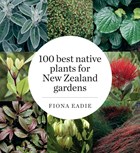 If this book looks a little familiar, it is because it is a new edition of one first published in 2001, updated in 2008 and again for 2014. It is a handy book, not comprehensive because it only covers 100, but many are varieties of native plants that you may want to know about. Credit to both author and book designer for having a flexible approach where the sections on each plant can vary in length rather than dumbing the content down to fit a formulaic lay-out of the style seen in recipe books.
 Tikorangi The Jury Garden