Tag Archives: garden maintenance

Garden maintenance, sustainability or just garden grooming?

Judge not a garden upon the daisies in its lawn

Judge not a garden upon the daisies in its lawn

There is nothing like preparing a presentation to focus the thinking. So most of our discussions here recently have been clarifying thoughts on what makes a good garden. The ever-so-brief outline is that good gardening is a combination of good design, good plants and plantsmanship over time, maintenance and sustainability all served up with more than a dash of panache, style or flair. If you want the full details along with all the accompanying examples, you will just have to come to the Waikato Home and Garden Show today at 12.30 or tomorrow at 2.30 (find the Weekend Gardener Stage).

Because we garden on a large scale here and The Significant Other had a deeply disturbing Significant Milestone Birthday recently (“It is all downhill from here,” he keeps reminding me), sustainability is a gardening principle we are spending a lot of time thinking about. But it wasn’t until I was working through my presentation that I came up with the hypothesis:
“We spend far too much time worrying about garden maintenance in this country and not enough time worrying about sustainability. In fact, so-called maintenance is in danger of being accorded a status way beyond its importance. What compounds this is that what is frequently seen as garden maintenance is in fact garden grooming – edges, hedges and lawns.”

Garden grooming is what presents a garden well and it is just as important as housekeeping indoors. But while the initial design and fit out of a house is a highly skilled exercise, often employing the services of an architect and an interior designer, the routine cleaning is a low skilled task at best and can be carried out perfectly adequately by someone with little thought and no understanding of the skill level that went into creating the interior. So too in the garden. When we still employed staff in the nursery, we would despatch them into the garden with leaf rakes and edging tools when we had to spruce up in a hurry. Generally they weren’t gardeners and they needed clear boundaries set lest they do real damage, but they were fantastic garden groomers. They could whip through and titivate in next to no time, partly because they didn’t get distracted by plants. At the end of it, the garden looked fantastic. It was a bit of a revelation to us that if the underpinning garden is in good shape, it doesn’t take particular skill to add the icing to the cake. Yet it is that sharp finish that is often judged as garden maintenance.

People who open their garden to the public will know all about this final grooming round and just how smart it makes the garden look. Most garden visitors now expect that high level of finish, especially for festivals and events. It is a great deal easier to manage if your patch is a small town garden and I have seen some splendid examples of immaculate presentation. Alas, as many have come to consider that this elevated level of garden grooming is the measure by which a good garden is judged, large gardens encompassing several acres have come under pressure to achieve the same, immaculate, sharp appearance. We do it here once a year for our annual garden festival and I love how smart the garden looks and vow every year to maintain it at that level. But it is completely unsustainable across seven acres. Without an army of gardeners (about one to an acre, perhaps), it just is not possible to keep it that spic and span for 52 weeks of the year. Besides, battling nature takes all the fun out of gardening.
Immaculate garden grooming is not the same as maintenance (photo: Jane Dove Juneau)

Immaculate garden grooming is not the same as maintenance (photo: Jane Dove Juneau)

I call that finish garden grooming. Garden maintenance should be considerably more extensive and require much greater skills. It is, or should be, all about managing your garden in sustainable ways so that it is a source of pleasure and not a burden. It is about keeping control of weeds so they never get beyond you, about keeping plants and soils healthy and about eliminating gardening practices which are all round bad for the environment. It is about adapting to changing environments within the garden over time. As trees and shrubs grow, they start to cast shade and their roots spread further. The gardener needs to change some plantings and practices as the growing environment changes. Maintenance is about keeping trees a good shape, avoiding forked trunks, lifting and limbing, and about knowing how and when to prune. It is about lifting and dividing choked perennials, deciding which plants are precious and which are expendable, restricting or eliminating plant thugs, rescuing bulbs which have become so overcrowded they no longer flower.

That is what garden maintenance should be about. To me, it is not about whether there is the odd flat weed in the lawn. Goodness knows, we have a park full of pretty white daisies though we do try and keep flat weeds out of the house lawns. At least our lawn clippings are not toxic and can safely be put on the compost heap or indeed used in the vegetable garden except that we never gather the clippings. We mulch them back in and that means we never have to add fertiliser to the lawn.

I appreciate the immaculate presentation of a garden but only when it is the final touch to one which is actively and positively gardened, not when it substitutes for an underlying lack of quality management. Look beyond edges, hedges and lawns.

The myth of the mixed border

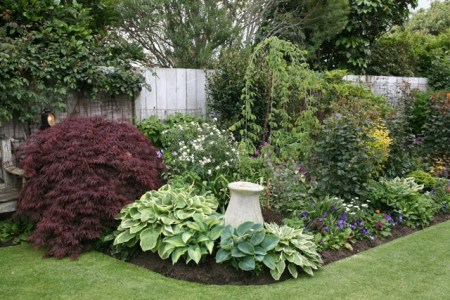
A typical type of mixed border with boundary hedge behind

A typical type of mixed border with boundary hedge behind

Just at the moment I am somewhat fed up with mixed borders, or mixed beds for that matter. I am of the opinion that it is a myth that the mixed border is easier to maintain than the herbaceous border. It is easier to leave alone, but not to maintain.

The mixed border is a term coined to describe plantings which are typically a blend of small shrubs, perennials and annuals all frothing together to create a picture of flowers and foliage. It is pretty much how most people garden, certainly in freshly planted situations. The woody shrubs give year round structure often with the bonus of seasonal flowering while the clumping perennials and showy annuals fill in the spaces between and give a well furnished look, usually with the attribute of prolonged flowering. The calibre of the plant combinations speaks volumes about the skill and experience of the gardener.

This is also the face of the modern rose garden. Gone are the designated rose beds where there were only roses planted in well cultivated but bare soil with plenty of air movement – utility, lacking in aesthetics but a practical approach to growing these thorny, disease prone plants with fantastic flowers. Nowadays we generally integrate roses into mixed plantings which have a fair debt in history to the chocolate box English cottage garden. Most rose plants are not attractive in their own right so the mixed plantings mask the ugly bushes and, commonly, the diseased foliage while allowing the flowers to star.

So you plant a mixed border or bed and it looks perhaps a little new and bare in its first year, good in its second year, possibly even fantastic in its third year and then, imperceptibly, season by season, it changes over the subsequent years to the point it all becomes a little blah. The woody plants grow and start to dominate while at the lower level, it is survival of the fittest amongst the perennials. Anything rare or choice is by definition not a plant thug so will give up the fight and disappear quickly. Besides, the establishment of the woody plants is likely to have changed the micro climate and that will be compounded exponentially if you also enclosed your bed or border in a nice little hedge. Soon the well cultivated, freshly dug soil and open, airy, sunny conditions that your perennials loved has become compacted and congested with competing root masses from the woody plants, not to mention growing areas of shade.

This is the voice of experience here. I have been micro gardening the area we loosely refer to as the rose garden. By micro gardening, I mean taking apart as much as I can of the whole area and reassessing the role of every single plant. Because we also garden extensively with bulbs, there are limited times of the year when we can take apart a garden to recultivate and replant in this manner. As well as the roses, I had planted dwarf camellias for winter interest and all year round form and the site demanded a carpet of low growing perennials and annuals below. Said carpet had been looking a little moth eaten for some time – too many holes I had attempted to plug (or darn). In fact it all looked rather tired and messy. Successive applications of mulch had raised the soil levels above the surrounding edgings, compounded by the escalating invasion of masses of fine roots from an avenue of huge trees some distance away.

I am so over roses. Every time I turn around or move, I seem to get snagged on their thorns. There are times this week when I have contemplated pulling out and burning all but the standard roses. It is only the memory of their stunning November display that has given them a stay of execution. That, and the feeling that a complete garden includes at least some roses. I certainly will not be wanting to use roses extensively in any future mixed plantings.

Painful irritant though the roses are, they are not the major problem of the mixed border. It is what goes on below the ground that is the inherent structural weakness of the concept. We only view what happens above the ground but that is entirely contingent on the roots below. And the problem is that perennials and annuals are not particularly compatible with many woody plants. The latter determinedly extend their roots and prefer to be left undisturbed. In fact they can get downright touchy if you do too much poking around in their root zone. Whereas clumping plants like perennials and indeed all annuals much prefer extremely well cultivated, friable soil along frequent lifting and dividing of the former. Long term they are mutually exclusive plant families and it is the permanent roots of the woody plants which will dominate. In fact, the mixed border concept is a garden solution for the short to mid term only. In the long term, the bottom story planting of perennials goes into decline, only the tough thugs survive and it gets increasingly difficult to maintain suitable conditions even for them.

The classic herbaceous border is seen as extremely labour intensive and accordingly admired but shunned by most gardeners in this day and age when we lack legions of loyal, hardworking, devoted minions to do our bidding in the garden. Herbaceous plants are those leafy, clumping plants without woody stems and trunks and they tend to be seasonal. In fact many, such as hostas and asters, go dormant and disappear over winter. As I micro garden our mixed plantings in the rose garden area, I am thinking to myself that the digging, dividing and replanting that is the key to a good herbaceous border is not necessarily to be feared and it would be a great deal easier if there were no woody plants (and definitely no roses) in amongst them. No bulbs either. There are other places in the garden for bulbs but they don’t exist that happily in areas where you are forever plunging the spade into the soil to keep it friable and to lift plants for dividing. I have stumbled on rather too many by severing them in half.

Using hedges as a backdrop or as an edging is also problematic. At Great Dixter in the south east of England, Christopher Lloyd paid tribute to his father’s foresight in establishing a solid barrier below ground at the time when he planted the yews which are now major topiary features and hedging in that garden. It is more likely that Lloyd Senior had a man in to do it, but such long term vision stops the problem of competing roots. This sort of below ground barrier is recommended when planting invasive bamboos but I have not seen it done as a matter of course in this country with hedges. It makes sense if you garden with a long term view in mind even if it requires considerable effort in the establishment stages. You need to make sure that the barrier is far enough away to allow the hedge roots sufficient space or you will end up with poor, stunted and yellowed specimens.

If you want to reduce the amount of maintenance your garden requires to keep it looking good, turn to the shrubbery concept in preference to the mixed border and reconsider the role played by dinky little edging hedges beloved by gardeners throughout the country. What these do is give a sharp line, a definition which can also be achieved by the use of pavers, hard edges or even a low wall. None of these alternatives will cause problems with their roots, require clipping or suffer from the dreaded buxus blight.