Tag Archives: garden quotes

Garden Lore: Friday November 14, 2014

Garden Lore

“Consult the genius of the place in all.”

Alexander Pope, Epistle to Burlington (1735)
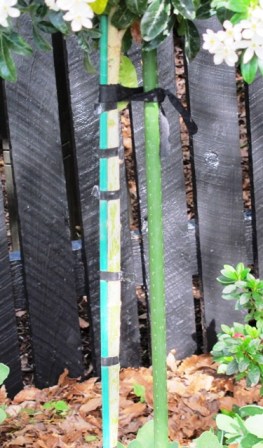
Plastic stakes and ties - never a good look

Plastic stakes and ties – never a good look

Staking plants

I know I have repeatedly mentioned staking of plants in recent months but I found a prime example of the reason why. I was out and about garden visiting last week and I took this photo in an otherwise immaculate garden where the owner paid great attention to detail and was fastidious in her presentation and maintenance. The staking, however, is awful. What you are looking at is one of a small group of standard lollipop Choisya ternata, sometimes called Mexican or mock orange-blossom because of its white scented flowers. The stem is not yet strong enough to hold the head up without snapping. The stake to the left is the nursery staking and tying, put in place to train the plant up. The stake to the right has been added, I assume, by the gardener who was presumably worried – and rightly so – that the nursery stake might not be sufficient in her garden. Both are green plastic and the nursery has used a shiny, commercial black plastic tie.

If the look doesn’t worry you, then it doesn’t matter. To me it stuck out like a sore thumb. If the plant had been positioned with the stake around the back, it would have helped. But it would look much better without the plastic. A discreet length of rusted metal would be my choice. When replacing a stake, don’t force the new stake in hard by the trunk, making a new hole. You are severing the roots and will do more damage than good. Try and use the existing channel made by the stake you have removed to avoid fresh damage.

First published in the Waikato Times and reprinted here with their permission.
Garden Lore

“A weed is a plant that is not only in the wrong place, but intends to stay.”

My Weeds by Sara Stein (1988).

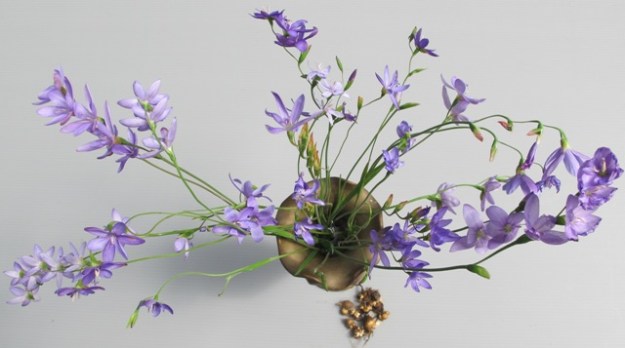
Decidedly invasive geissorhiza

Decidedly invasive geissorhiza

Dangerous Escapees

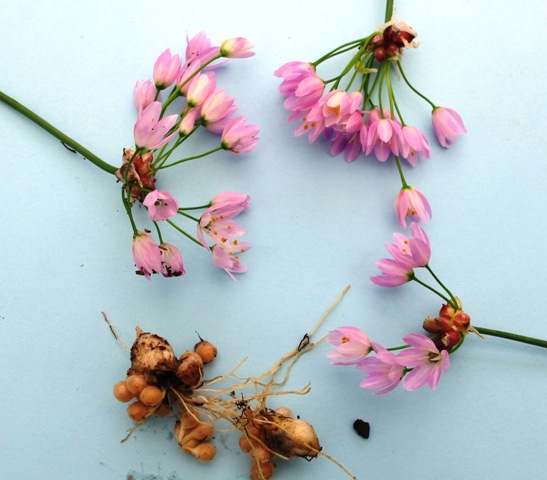
Behold two of the prettiest weeds in our rockery. Both are bulbs and have dangerously invasive habits. Both will have been bought as ornamentals and frankly should not be sold without a warning, in our opinion. The blue is a geissorhiza – probably G. aspera – and I shudder to think how many hours have been spent carefully digging out this bulb year after year after year and ensuring that none ever go to seed. It spreads readily from seed but take a look at that cluster of bulbs in the photo. It makes numerous offsets every year and as you try and dig out the flowering stem, the little bulbs detach readily and every sodding bulb grows. Every one that flowers in our rockery in spring represents a survivor from two decades of sustained attempts at weeding it out.

The pink is an allium but with over 850 different allium species, I have no idea where to start on identifying it. Pretty it may be but you can see it has the same habit of forming multiple bulb offsets as the geissorhiza. Not only that but it has another trick up its sleeve. Look at the centre of the flowers – that is not seed forming. No, it is another dozen or so offsets ready to make a bid for independent life after one season.

Pretty they may be. So is onion weed quite pretty in its way. But you liberate these sorts of pretty weeds at your peril. There are plenty of lovely plants to go without knowingly unleashing more garden escapes.

Decidedly dangerous allium

Decidedly dangerous allium

First published in the Waikato Times and reprinted here with their permission.
Garden Lore Friday 31 October

Garden Lore

“Against the uniform sheet of snow and the greyish winter sky the Italian villa loomed up rather grimly; even in summer it kept its distance, and the boldest coleus bed had never ventured nearer than thirty feet from its awful front.”

Edith Wharton, The Age of Innocence (1920)

???????????????????????????????
Garden Lore: Friday 31 October

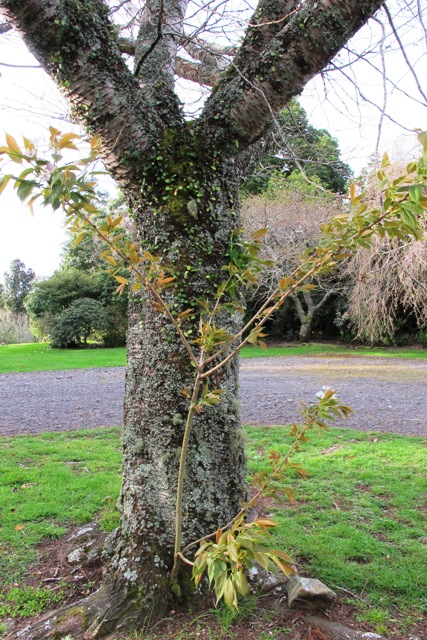
Root stock can try and make a bid for freedom instead of keeping to its place below ground, even on well established trees, as seen here. I know this is escaping root stock because it flowered white a good two weeks before the froth of pink in the main tree unfurled, as well as coming into leaf earlier. It will need to be removed. Root stock is usually vigorous and prefers its own shoots to the grafted top so will put its energies there first, if it can. From time to time, people contact us saying things like: “I bought a white magnolia but now most of the flowers are pink and we only get a few white blooms”. Escaped root stock is invariably the answer. Keep the base of the plant clear of any fresh growth.

Sometimes you can buy fruit trees which have more than one variety grafted on top – maybe two or three different apples grafted onto the one set of roots. These are designed for tiny town gardens to give a range of different produce or sometimes to give the necessary pollinators in order to get any fruit set at all. That is fine as long as the nursery understands the need to graft varieties with compatible growth habits. If one is stronger than the other, it will take over and the weaker variety is likely to die over time.

First published in the Waikato Times and reprinted here with their permission.
Garden Lore

“Hollyhocks are very aspiring Flowers.”
The Flower Garden by John Lawrence (1726)

Clivia seeds and blooms

Clivia seeds and blooms

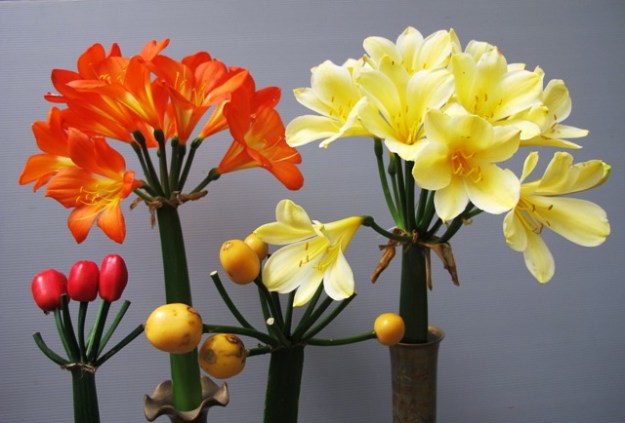
In the world of wonderfully random bits of gardening information, I thought I would demonstrate to you that red and orange clivias have red seeds while yellow clivias produce yellow seeds. Is that not an interesting fact? These seed are from last year’s blooms. They take a long time to mature. While you can, as we often do, leave them to seed down naturally where they are, picking them and sowing them in trays in more controlled conditions will usually give you a higher percentage.

The reason why clivia plants are often expensive has nothing to do with their being difficult to grow or propagate. It has to do with the time it takes for them to grow and reach flowering size. In this age of instant gratification, people want to buy big plants which will fill a space now and flower beautifully but all for $15, thank you. That is fine if it only takes three months to produce the plant but when it may be four years, you have to be prepared to either pay more or to buy small and be patient. If you have access to an established clump, these are not difficult plants to dig and divide.

First published in the Waikato Times and reprinted here with their permission.
Japanese simplicity

???????????????????????????????

“I have come to understand the unspeakable loveliness of a solitary spray of blossoms arranged as only a Japanese expert knows how to arrange it…and therefore I cannot think now of what we Occidentals call a ‘bouquet’ as anything but a vulgar murdering of flowers, an outrage upon the color-sense, a brutality, an abomination.”

Glimpses of Unfamilar Japan by Lafcadio Hearn (1894)