Tag Archives: garden quotes

Pink bluebells

Pink Hyacinthoides almost certainly hispanica - I picked them because the light conditions were not good enough for the row  multiplying in the old vegtable garden to be photographed

Pink Hyacinthoides almost certainly hispanica – I picked them because the light conditions were not good enough for the row multiplying in the old vegtable garden to be photographed

“Besides all this and spotted by awful white rocks and holed limestone rocks like a great fungus, there was the pink bluebell glade. Miss Anna Rose often remarked to him upon the prolific beauty of the pink bluebells which some aunt of hers had planted here. And he always refrained from expressing his absolute preference for the blue bluebells. Only the very young prefer pink bluebells to blue. Equally, they prefer pink primroses to yellow.”

Molly Keane Treasure Hunt (1952)

Garden Lore

A garden is a delight to the eye, and a solace to the soul; it soothes angry passions, and produces that pleasure which is a foretaste of Paradise.

Gulistān (The Rose Garden) by Sa’ Di (1258)

021 - Copy

More on narcissi

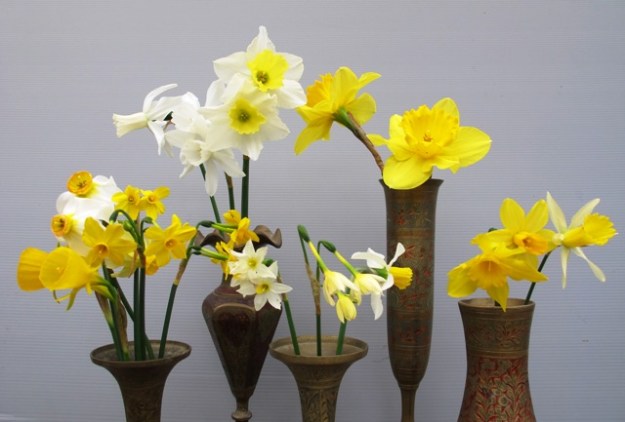
It was a full month ago that I wrote about daffodils and showed those varieties that were in bloom at the time. In peak bloom, in fact. We had hosts of golden daffodils in flower. We still have. I headed out to gather samples of the varieties currently blooming.

In the vase on front left, we have the three showiest for this time of the season – the bright yellow cups of Narcissus bulbocodium, Narcissus ‘Beryl’ and a dainty little N. jonquilla species which, despite its diminutive size, packs a powerful perfume.

In the centre front vase is a named dwarf variety which we have lost the name of. Mark thought it might be Narcissus ‘Snipe’ (who calls a dainty daff ‘Snipe’?) but the clever internet shows me that the one on the right is more likely to be. The lemon one in the middle is Narcissus ‘Hawera’ which is not growing as strongly as some of the other varieties for us. On the right we have the last blooms of Narcissi x odorus, ‘Tete a Tete’ and ‘Twilight’ – all featured a month ago and only now finishing. These are ones I mentioned don’t set seed. This is why they have such a long flowering season.

In the vases at the back, they will be named varieties on the left but we don’t have their names any longer though one is probably ‘Thalia’. I quite like the white daffodils. To the right, the classic King Alfred type is at its peak for us.

If you love narcissi, you can extend the season past two months by growing a range of different varieties.

First published in the Waikato Times and reprinted here with their permission.

Garden Lore

“Interest in flower arranging has increased in spite of the war. This may be explained by the fact that woman, with her love of beauty, turns to creating it as a way of escape from the cruel knowledge that, every day, beauty is being destroyed.”

The New Zealand Gardener, Vol 1, Issue 1, September 1944.

???????????????????????????????

The New Zealand Gardener then and now

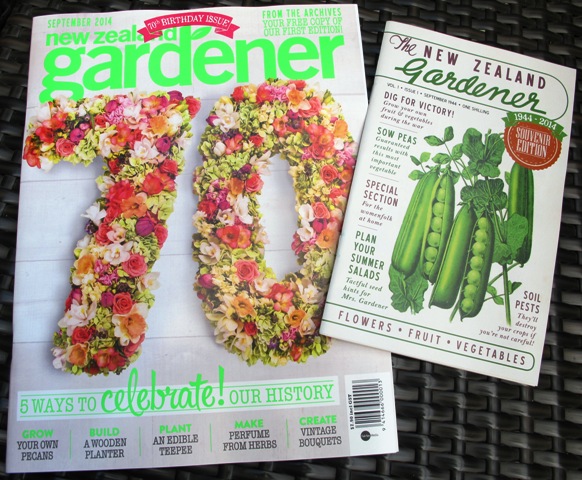
If you are not a regular reader of the New Zealand Gardener magazine, you may want to treat yourself to this month’s issue for nostalgia as much as the current content. It is the seventieth year of publication and to mark the occasion, the very first issue has been reprinted. Okay there is a bit of colour in it though I imagine the original was all black and white but it is both quaint and reassuring at the same time. The old fashioned courtesy and frugality is a reminder of times past. Honorifics are standard practice, with initials instead of christian names. Goodness, letters to the editor are to be paid at a rate of 5/-. By way of comparison, the purchase price of the magazine was only one shilling. That would make a modern letter worth $39.50, had the publisher continued with this largesse. A woman’s place is beyond doubt. It was of course during World War 2 that publication started in 1944 and that is a theme.

I used the word reassuring because quite a bit of the advice is still relevant today. Growing turnips, cape gooseberries or indeed delphiniums is not so very different now. If you are interested in the breakdown, there are seven pages on growing food crops and eight on “Science for the Gardener” (pests, disease, soil management and the like). The ornamental garden has nine pages and I particularly appreciated the column by ‘Silver Birch’ on the joys of importing rare bulbs. Not any longer with our border controls. Then “The Gardener’s Home” has eleven pages of recipes, advice and floral art. That section is by ‘Golden Willow’. Do we think she was married to ‘Silver Birch’?

The original issue comes as a free inclusion with the current September issue.

First published in the Waikato Times and reprinted here with their permission.

Garden Lore

Then in we went, to the garden glorious
Like to a place, of pleasure most salacious
With flora paynted and wrought curiously
In diverse knottes of marveylous greatnes.

Anonymous (reprinted in “Up the Garden Path” by Laura Stoddart.

Clipped rather than pleached but certainly on stilts

Clipped rather than pleached but certainly on stilts

Pleaching

It is quite recent that pleaching has become synonymous with a hedge or row of trees on stilts. Technically, pleaching is the interweaving of adjacent plants on a relatively two dimensional plane. There is a school of thought that it dates back to animal proofing hedges by making them more dense but the sophisticated version came into European gardens as much as 400 years ago – the elegant, grand allees of trained, matched trees which give architectural structure.

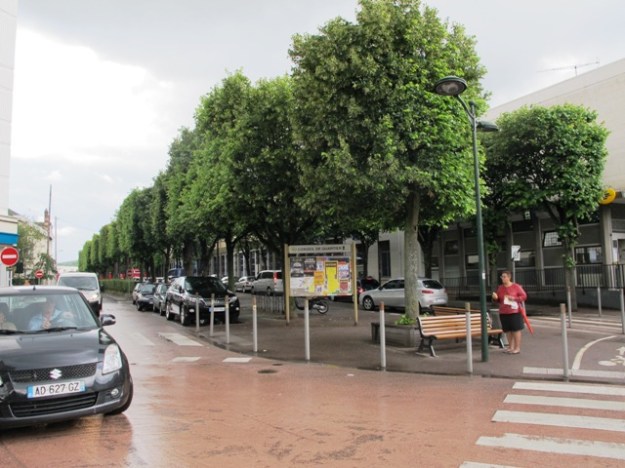
Think of it as a dense espalier where the horizontal branches are trained and interwoven. However it is more likely these days that what is called a pleached avenue is simply limbed up trees which have been allowed to merge together on the upper storey and are then shaped as one – in other words a hedge with bare legs. I am pretty sure that is what is being done in this street scene I photographed in the little French town of Vernon. It appears that a hedge trimmer may be used to shape the canopies to something resembling cubes and over time, when the trees join together, it will create a flat plane. These are tilias or lime trees.

If you want a pleached avenue, the advice I have seen is never to go less than 2.5m spacings. You can’t magic these creations up quickly. The trees take time to grow and the effect relies on generous spacings which allow each plant trunk to shine in its own right. Otherwise, you are just planting a hedge.

First published in the Waikato Times and reprinted here with their permission.

Garden Lore

I wandered lonely as a cloud
That floats on high o’er vales and hills,
When all at once I saw a crowd,
A host, of golden daffodils;
Beside the lake, beneath the trees,
Fluttering and dancing in the breeze.

William Wordsworth, Poems in Two Volumes (1807)
Bug hotels or insect hotels

Insect Hotels

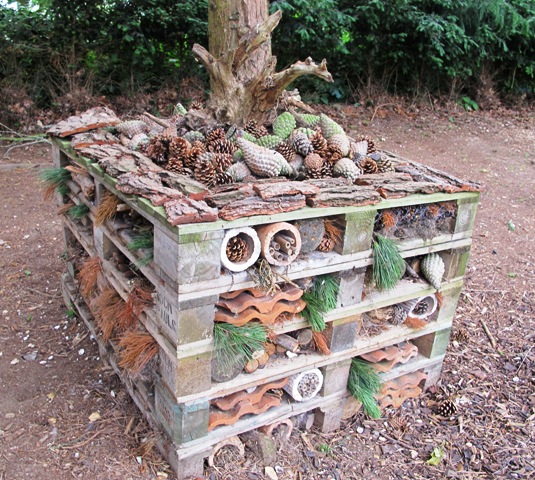
Bug hotels or insect hotels – are these the hot new accessory for gardens? This question comes from the house that inaccurately predicted the rise and rise of the garden obelisk a few years ago. These failed to make an appearance in every second garden in this country, as we expected. The insect hotel has a certain rustic and childlike charm and I am sure we will see at least some installations. The trick appears to be the use of a range of different materials to attract hibernating insects, giving them somewhere to over-winter. They need to be located in sheltered positions, out of the wind, rain and direct sunlight.

I liked the optimism in one publication which talked about appealing “to a wide variety of beneficial insects” (italics mine). Unless you are going to set up an audition for all incoming guests, there is no way that you can separate the beneficial ones from their less desirable colleagues. It is highly likely that queen wasps may find it a perfect location for over-wintering. It won’t be all charming ladybirds, damsel flies and dragon flies. There will be a fair number of slaters, earwigs, centipedes and spiders so if the children in your life are squeamish about creepy crawlies, you may want to think again before going too far down the track of this as a child-centred activity.

These constructions are favoured in Britain where there is much more conversation about ecosystems and sustainable gardening than we have here. There is also greater pressure on the environment because of population density. Unless your yard is spartan and manicured to within a centimetre of its life, odds on the bugs will find natural spots of their own as they always have – hedges, leaf litter, wood piles, beneath rocks, sheltered cracks in paving and underneath the house. The only reasons I can see to construct insect hotels are that they can look cute and are an educative tool.
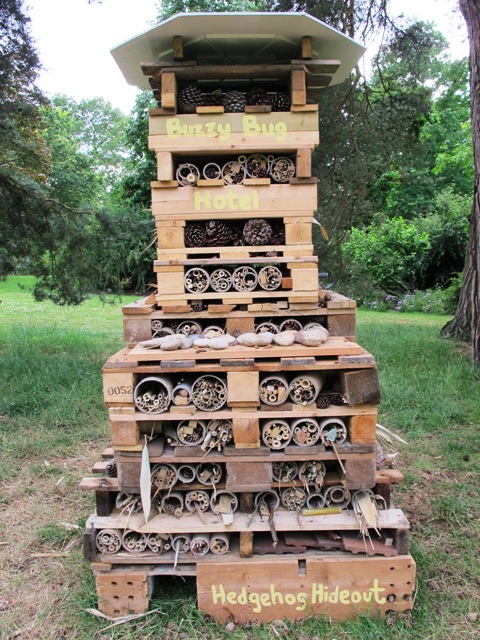
insect hotels
First published in the Waikato Times and reprinted here with their permission.