
I have come to the conclusion that road cones are like rabbits. They have gone forth and multiplied. Exponentially. Everywhere. Over the years even we have acquired maybe half a dozen road cones. Lost or abandoned by their previous owners, they found what they hoped would be their forever home with us. They found a useful new purpose in life, usually reserving space for coaches during the busy garden festival season. With the garden now closed permanently, I had wondered whether rehoming them would be a betrayal of trust, maybe putting them out with their mates in any number of places where road cones choose to congregate.
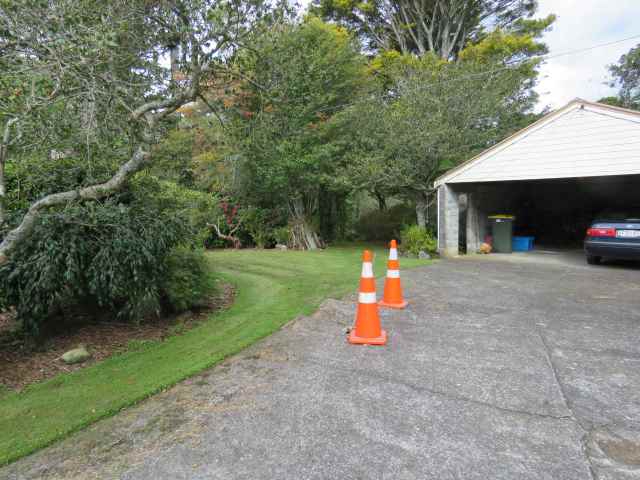
But no! They have a new role to play and much closer to our house. Every time I step out the back door, I get a minor visual jolt at the sight of them. Lloyd has placed two of them on the breaking concrete. For we have developed a sink hole and he was worried that it is now deep enough to catch any visitors’ cars that might not notice the tell-tale signs of concrete slabs askew.
The sink hole is a mystery and one we will have to live with until Lloyd returns to work in a couple of weeks and lifts the broken pieces to fully investigate the scale of the problem. I have poked around with a bamboo stake and it goes in at least 40 or 50cm so it is not a small issue.

The concrete is the parking and turning area in front of our carport and it must date back to when the house was built around 1951. Over the years, it has developed cracks and broken in a few places but it remains perfectly functional.
So why have we developed a sink hole? The gas wells that have been deviation drilled in our area are several kilometres below ground level so it won’t be those and there is no history of mine shafts in Tikorangi. We know where our house drains go and there aren’t any in that area. There is no spring water bubbling up anywhere. So we can probably rule out both human activity and water.
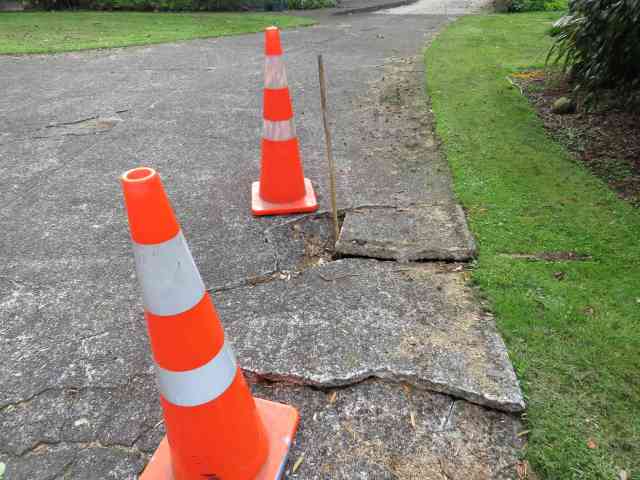
This leaves tree roots. Many of us have the experience of tree roots lifting paving but maybe not so many have the experience of tree roots of sufficient magnitude to collapse paving when they rot out entirely. It is not any tree that we have felled or lost during our time here but maybe it takes many decades for tree roots to rot out and the stump disappears first? I am hoping we can solve this mystery. And if it is tree roots, I am hoping this is a one-off and not an indicator of larger problems that may surface – or indeed cave in – over time.
In the meantime, the road cones stand as sentinels.
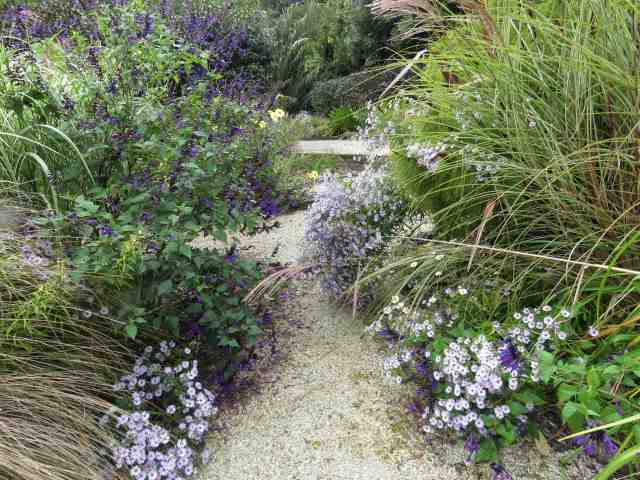
Finally, I wrote a couple of weeks ago about the species aster that I was attempting to eliminate from the twin borders. I see I relocated more than I remember to the Court Garden a few years ago and now I am having to remove most of those. I may end up resorting to total removal next year but at this stage, I am trying to restrict it to maybe three smaller areas. I took out the ones in this photograph this week even though it disturbed the very busy bees that were feeding on them. This path had become impassable because of intense bee activity once the morning sun had warmed up. Pretty, but hazardous as the bees buzzed above and the rampant root systems below were spreading in every direction.
 Tikorangi The Jury Garden