
- It is pretty much the last call for heavy pruning on flowering cherries. These need their pruning done in summer to reduce disease. While you are about it, you can prune plums and other deciduous fruit trees straight after harvest. This encourages them to set more fruiting spurs for next year, rather than too much leafy growth.
- While you are watering container plants (should be done every day), don’t forget to top up the fish pond. Even robust goldfish get stressed if their water heats up too much.
- While planting in the ornamental garden is largely on hold until temperatures cool or we get some serious rain, mid summer can be a time to give lawns some attention. You can spray for flat weeds now or sprinkle sulphate of ammonia. If you are not keen on spraying, get out with an old carving knife and crawl around the lawn. This last activity is guaranteed to engender a rosy glow of virtue. Never feed a dry lawn – the fertiliser is more likely to burn the surviving grass. If you are planning on sowing new lawns, autumn is the optimum time for this but preparation can start now. The quality of a new lawn can be directly linked to the amount of effort put into preparation. Level the area, cultivate it, remove all green cover and keep hoeing off successive waves of germinating weeds.
- Vegetable gardens are all about forward planning so while some of us are enjoying full summer (and quite possibly worrying about how to stem the deluge of courgettes), organised home growers are already on the ball for winter. As summer crops are harvested, winter veg are sown and that takes in root crops of the carrots, beetroot, turnips variety and brassicas and leafy greens. Some people start sowing onions this early. You just have time to get a final sowing of green beans but do it asap.
- Because we maintain active websites (abbiejury.co.nz for published writings and jury.co.nz for garden and plant information), I track google search terms. This week saw somebody looking for advice on how to propagate swan plants (the food for monarch caterpillars) aka asclepias. Seed, preferably fresh seed is the answer. If you sow it at this time of the year and prevent the butterflies from laying eggs on the germinated seedlings and then the baby plants, you will have well established plants next summer which in turn will produce seed. If you have room in your veg garden, it is worth putting a row in. If you are buying swan plants from garden shops at this time of the year, you will end up raising some very expensive monarchs. The idea is to have large, well established plants (bushy and chest or head height) coming ready from now through autumn to enable the monarchs to linger longer into winter.
- I fear the naïf who googled asking if snails are good for kentia plants (presumably kentia palms) may not have a great future as a gardener. I can not think that snails are good for any plants at all unless squashed and feeding the soil.
Tag Archives: garden tasks
In the garden, February 5, 2010
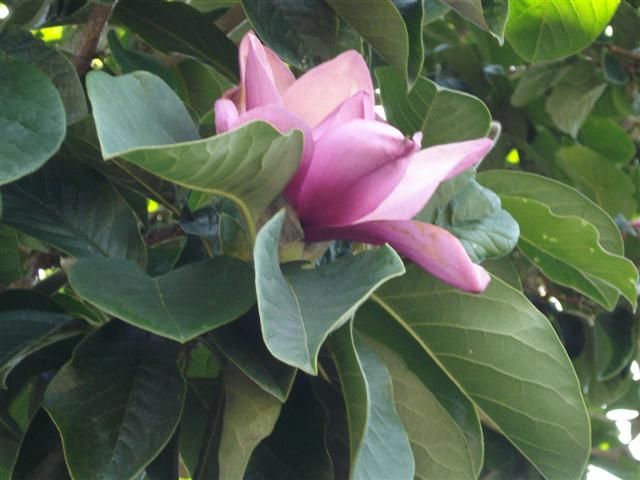
Some deciduous magnolias repeat flower in summer - this one is Apollo
- If you have deciduous magnolias which have flowers on them, this is not some freaky abnormality. It is all in the parentage. Some varieties repeat flower in summer. This second flowering is but a shadow of the early spring display but it is a bonus. Black Tulip has had particularly good, dark flowers this summer but proved too difficult to photograph.
- Naturally you will be attending to your bearded irises, as per today’s Outdoor Classroom. Just make sure that the replants don’t frazzle if we get a run of sunny, dry weather.
- Some readers may have seen the media coverage of the unfortunate arrival of the hadda beetle which so resembles the charming lady bird. In fact the potato and tomato psyllid that we referred to two weeks ago is already here, established and wreaking havoc. The psyllid attacks all solanums which includes tamarillos, cape gooseberries and capsicums. Sudden, unexplained deaths in any or all of the solanum family (which includes a range of ornamentals too) may indicate a psyllid presence. In the short term, worry more about the psyllid than the hadda beetle especially for those who prefer to garden organically. Garden centres should all be able to offer advice on controls but there is no simple answer to effective management of the psyllid.
- Spring bulbs in the garden are starting to show white roots which means they are breaking dormancy. If you were planning to lift any congested clumps of daffodils or the like, get onto the task without delay.
- In the vegetable garden, thoughts are turning to planting for winter. The idea is that most plants do their growing while temperatures are still warm and then they hold in the garden through winter so you can pick them fresh. So you can be sowing parsnips, carrots, dwarf beans and brassicas now for winter harvest.
- If your garlic harvest this year is poor, take heart. You are not alone. The wet and cold November and December probably did not help.
- Pinch back cucumbers, melons, courgettes, pumpkins and similar spreaders to keep them under control and to encourage fruit set. Tender pumpkin tips are delicious to eat, as are stuffed courgette flowers, if they are not infested with white fly. I have never seen any merit in the fruit of chokos, but we have always enjoyed eating the tender tips when lightly steamed as a fresh green.
- The rains this week and the warm, humid conditions means that the weeds will be growing and spitting out seed even as you turn your back. Ignore these at your peril.
In the garden 18/12/2009

Often called the New Zealand Christmas tree, the pohutakawa or Metrosideros excelsa is flowering right on cue
In our local city of New Plymouth this week, the sight of the flowering pohutakawa on Currie Street which should gladden the hearts of all but the most determined haters of this wonderful coastal genus. They are flowering right on cue for Christmas. This should mean that both the Patea and Waitara plantings are coming in to their own – well worth an annual trip around to admire this plant which has become an icon of our area.

Got it - Gladiolus papilio
Update: By 7.30am this morning, I had received the first phone call after this item appeared in our local paper: If anybody can name this species gladiolus, we would be pleased to hear. It is indubitably beige in colour with a burgundy flare edged in gold inside the bell flower, very pretty and a million miles from Dame Edna’s gladdies. Despite spending some time on Google, we still have not managed to identify it.
So now we know it is Gladiolus papilio, syn. G. purpurea-auratus, also referred to as the butterfly gladiolus from the Cape of Africa. It is a variable species but we seem to have two distinct forms in NZ – the one shown above and a two-toned red form. A kind reader has promised to send me the red form.
A cautionary tale from a disappointed neighbour who tied up his tomatoes with the stretchy stockinette bought in rolls – the wet weather kept the tie so wet that the poor tomato stems rotted off. A timely copper spray may have helped. Tying more loosely, using freezer twists or nylon string instead could have avoided the constant damp.
If you are feeling a tad discouraged by the weather, you are not alone. While it was brilliant during early November, the past month has been all downhill and everybody else is probably suffering similarly. Friends report roses turned to slush, buxus blight spreading rampantly along with blights and mildews on anything and many things. The good news is that we probably will not have a drought this season and the bushfire risk is non existent.
Weeds are the number one priority. It is much easier to kill them while they are small and conditions mean that they are fair rocketing away at the moment. Make the push hoe your friend and keep it at the ready. We shouldn’t need to mention it, but push hoes are better for the environment than glyphosate and if you don’t have one or more, ask for one from Santa.
In the veg garden you can sow most crops but lay off the brassicas until later in the season. It is not worth the battle with the white butterfly. You can still get tomatoes in for a late crop, but use plants now, not seed. Last chance for planting water melons. Keep successional sowings of corn, beans, peas and salad vegetables going. Thin earlier crops and eat the thinning as micro veg.
As Christmas Day falls next Friday, we will not be back for a fortnight which sees us into the New Year. May we wish all readers a happy and safe festive season. If visitors outstay their welcome, you can always head out to the garden with your secateurs and push hoe. There is something infinitely restful and soothing about the repetitive tasks of gardening.
In the garden 04/12/2009
- The rains this week will give rise to all manner of fungal attacks (moisture and warmth, even relative, encourages fungal growth). Watch tomatoes, potatoes, courgettes and other vines including grapes carefully. You may need to get an urgent copper spray onto them if you want a harvest later.
- Roses will be similarly afflicted. If you don’t spray your roses (we don’t), keep working at light summer pruning, deadheading and removing diseased leaves. Good hygiene and air movement will help reduce the impact of fungal and bacterial attack.
- Wisterias need frequent restraint as their tendrils are ensnaring anything around them. You do not have to be too particular with the summer prune and a pass over with the hedge clippers is fine. If you have a plant near a building, be vigilant. The time from fine tendril to embedded woody stem which is capable of lifting weatherboards and splitting the spouting is less than a season.
- Convolvulus is rocketing away and can become a major problem alarmingly quickly. If you are not organic, Woody Weedkiller is the way to go. If you are organic, you will probably have to start unravelling the vinous growths and trace them back to ground level where you dig the whole thing out, taking care to get all the roots because any left behind will grow again.
- Don’t ignore Wandering Jew either and the recommended chemical assault on this is Shortcut (sold in larger quantities as Buster). It is a systemic spray (gets absorbed into the plant’s circulatory system) and has a very quick kill. You can increase the hit rate by raking off as much foliage as you can first (but put these rakings into black plastic bags to rot because they are quite capable of growing again – every bit of it) and then spraying. Follow up with a spot spray a month later. Apparently Wandering Jew can cause terrible skin irritation to dogs and cats which is another good reason to clear it off your property. If you don’t want to use chemicals, you will have to hand pull every bit of it (wear gloves) and keep returning to the patch as it re-grows. Eventually you can clear it but it takes perseverance.
- The rains this week mean you can continue digging and dividing perennials and clumping plants a little longer.
- Vegetable planting continues with corn, beans, peas, salad veg, carrots and the like but lay off the brassicas now unless you are prepared to spray or cover them.
- We are running out of time for pruning. Try and get this finished as soon as possible.
- The Christmas hint this week is to try making flavoured vinegars and oils for gifts, using herbs from the garden. Wash and dry herbs such as sprays of rosemary, French tarragon (I wish), bay leaves, lime leaves, even thin parings of lemon rind. Leafy herbs like parsley don’t work so well and tend to go off. The rule of thumb is to bring the vinegar to the boil before pouring it over the herbs in the bottle. White vinegar is a neutral base for flavouring. For flavoured oils, use a neutral oil such as grape seed or rice bran and warm it before pouring into the bottle. A word of warning: the flavoured oils and vinegars in shops will be sterilised and sealed whereas home efforts are not. The liquid needs to cover the flavouring herbs. To be really safe, strain off the liquid after a few weeks or store in the fridge. If you have decorative smaller bottles, one bottle of white vinegar or grape seed oil can go a long way and make attractive and thoughtful gifts.
In the Garden November 27, 2009
• Try planting up simple pots as Christmas gifts but get them done now to have them looking at their best in a few weeks time. Punnets of annuals are ridiculously cheap to buy. Planted now, three small plants (plugs, they are called) will fill a pot which measures around 20 to 25cm across. I still remember my splendid summer combination years ago of blue ageratum and cerise petunias. Or you can find cheap herb plants if you want to give an instant herb garden. Ceramic and terracotta pots are inexpensive these days, especially the classic terracotta type despite the fact they still seem to be imported from Italy. This is a good activity to carry out with children and will go down well with grandparents as it shows thought and effort. The cheapest potting mix is fine for annuals but keep the pots well watered and protected from slugs and snails while they settle in.
• With summer coming, set the level on the lawnmower a notch higher. Cutting the lawn very short does not mean you reduce mowing. Instead it tends to stress the grass so the weeds move in.
• If you have onehunga weed in your lawn, you have left it late to spray it but it is the one really bad weed which we think justifies a chemical assault. It is the weed that puts tiny prickles into any bare feet that dare tread upon it. There is a targeted spray called, we understand, Prickleweed Killer which doesn’t kill off the desirable grasses. If there are any children in your life, get onto dealing to it this weekend as your first task. Do not let this weed go to seed.
• Apples will have set their fruit for the year which means that if you had a codling moth issue in the past which you have not done anything about, odds on the larvae are scaling the trunk now to reach the fruit, if they have not yet made the journey. This means it is too late for pheromone traps which are designed to catch the moth before it lays eggs. You will either have to put up with moth eaten fruit or resort to some insecticide spray. Apparently lavender bushes or nasturtiums planted below will discourage infestations in the future but we have yet to see proof of this. It may be worth a try but I would keep to lavender because it is likely that rampant nasturtiums will engulf your entire apple tree. Tipping new growths by hand will largely deal to the leaf curling midge which attacks the very ends. Unroll the leaves and you may find a small pink creature inside. You either nip them off or spray them.
• The end of this month means you are running out of time to plant kumara, yams and any other type of sweet potato. Give these priority along with tomatoes. Potatoes planted now will be a late crop so you don’t want to delay on these either.
• It is four weeks until Christmas so get quick maturing salad vegetables in this week for harvesting at that time. It is much nicer to head out and pick your own mesclun, rocket, microgreens and radishes.
• If you are a fan of monarch butterflies, you will need to get swan plant seed in urgently to get the autumn crop through to feed the late caterpillars. Real enthusiasts will also be sowing seed trays of zinnias, marigolds and other autumn crops of annuals to feed the butterflies.
 Tikorangi The Jury Garden