
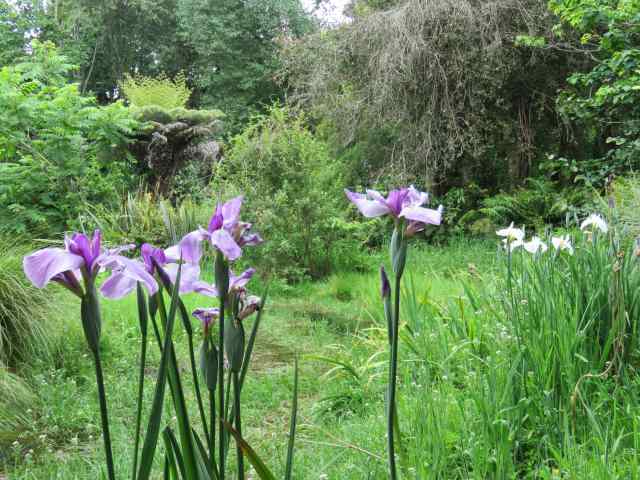
Following on from yesterday’s post considering sustainability in gardens, a new book out of the UK take the issues of sustainability and reducing negative environmental impacts to a far more holistic view. I admit I have not yet read ‘Pastoral Gardens’ by Clare Foster with photographs by Andrew Montgomery. I am not sure it is in this country yet. I am working from the interview with her on Dig Delve, the site of Dan Pearson – an English garden designer whose work we greatly admire.
I am not sure that the term ‘pastoral gardens’ will ever catch on in this country. While the word ‘pastoral’ is evocative in England with its connotations of bucolic nostalgia, here it is more likely to be associated with ‘pasture’ which immediately summons up the mental image of intensive dairy farming. I prefer the term the ‘New Naturalism’ or even our shorthand of ‘wild gardening’.
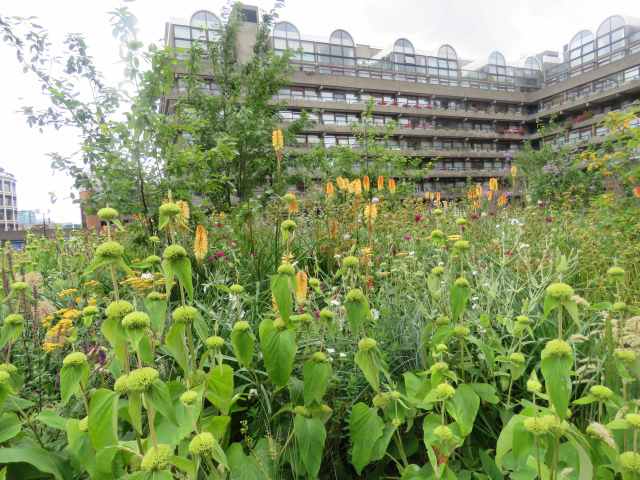
What comes through very strongly in the interview, and presumably the book, is the embrace of gardening styles that work with Nature, that prioritise biodiversity and garden practices that enhance the natural environment. It is still gardening and still focused on aesthetics, but not at the cost of damaging the environment. The author won me with this quote:
“Another uniting factor for all these gardens is their need to be gardened. So many people think that wildlife-friendly gardens are relaxed, neglected spaces, that can be left to their own devices. This is certainly not the case with the gardens we showcase in this book. The role of the gardener is almost more important than ever in overseeing, managing and editing each planting scheme, ensuring that diversity is maintained, rather than one or two species taking over.”
We saw this deterioration happen over time in in the Missouri Meadow Garden at Wisley where a dominant aster had swamped out large parts of the meadow.The role of the gardeners had fallen well short on maintaining this area and I assume it had to do with the fact it needed to be monitored and maintained in a very different way to more traditional perennial plantings and they had yet to learn those skills.
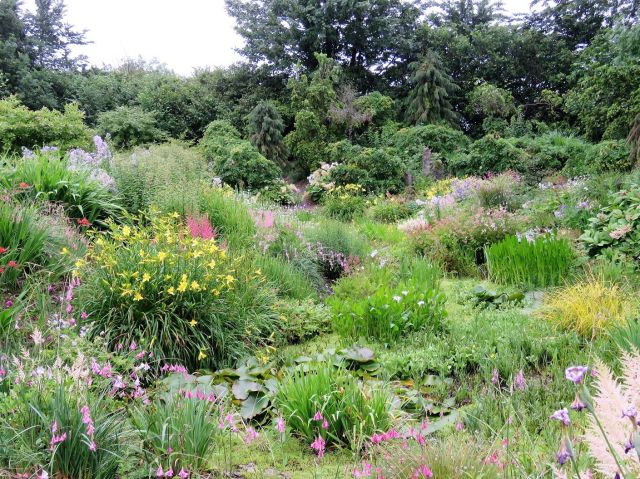
I think the author is dancing on a pin head when she attempts to differentiate current trends in naturalistic gardening from the earlier work by Irish gardener, William Robinson of Gravetye Manor in the 1880s and the more recent New Perennials movement. I may be doing her an injustice but I think she is saying that ‘pastoral gardens’ are basically the new naturalism but sitting on the higher moral ground of biodiversity. I see the difference as more linguistic. The term biodiversity is an amalgam of biological & diversity and was first coined in 1968 but didn’t enter common usage until the 1980s. Robinson didn’t have the same language to draw on but that doesn’t mean that his gardening in harmony with nature is any less for that. The loss of biodiversity, the impact of climate change and questioning of many current garden norms which run counter to the natural environment combine to give considerable urgency to the matter, but it is not necessarily new.
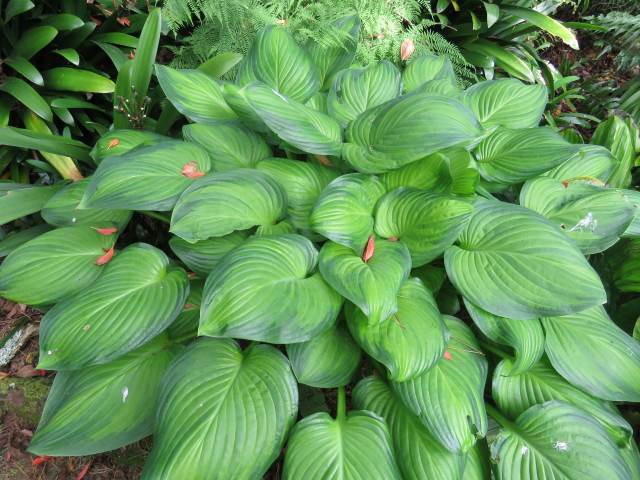
We have never done any scientific study to determine the changes to our immediate garden environment when we consciously switched to more sustainable practices. That would, I am guessing, involve analysing small sections across the property, maybe 10cm squares, maybe metre squares, starting before we changed our practices and then at various points along the way. Counting the number of different insects, fungi, bacteria, animals, plant species and analysing the soil profile could prove the case. We rely on anecdotal evidence. We never use slug bait but our hostas are largely clean and lush which would suggest that we have a very healthy bird population which keeps the slugs and snails in check and indeed, we see a great deal of bird activity all the time here. But we have never taken a census of the bird population or done any comparisons. Observation tells us that it is a healthier environment but that is not scientific proof so I am somewhat cautious about making sweeping environmental claims for how we garden.
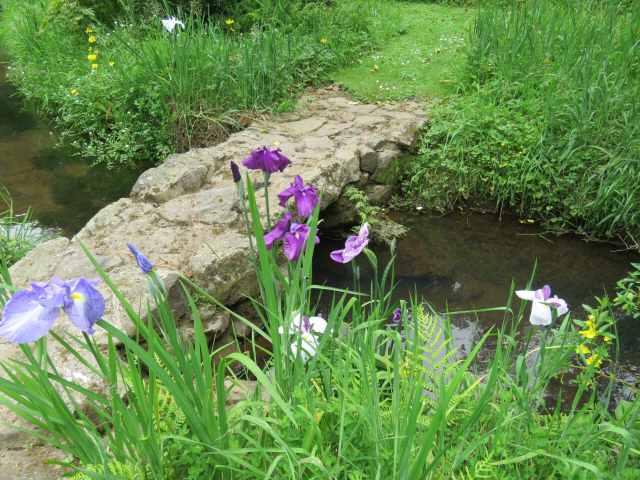
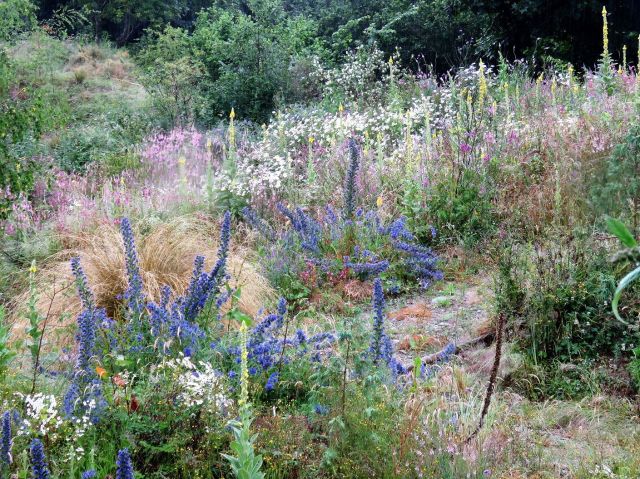
When we changed the management of the grass in our park to go with a Taranaki version of a meadow, we were not at all sure how others would react. It was even more the case when we opened the Wild North Garden which is several steps further on the naturalistic, wild gardening spectrum. When you open your garden to the public, you also open yourself to being judged. It was heartening to see an overwhelmingly positive response. It may be that the visitors who dismissed it as lazy or unkempt were too polite to say so but if that is the case, they didn’t question us or express their dislike. Most visitors visibly breathed out, relaxed and often responded to the casual environment with emotion rather than detached observation. These days, we don’t open any longer so we don’t feel at all sensitive to judgement of our garden but I have thought about it recently. In a country which places a high value on immaculate maintenance and overall tidiness in open gardens, why did visitors respond so positively to large areas which were anything but?
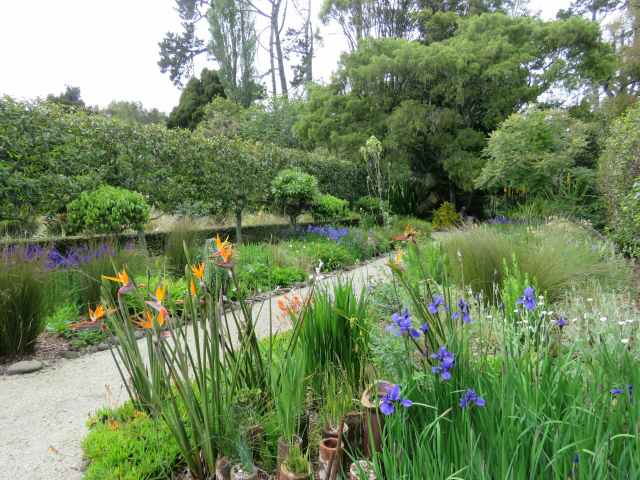
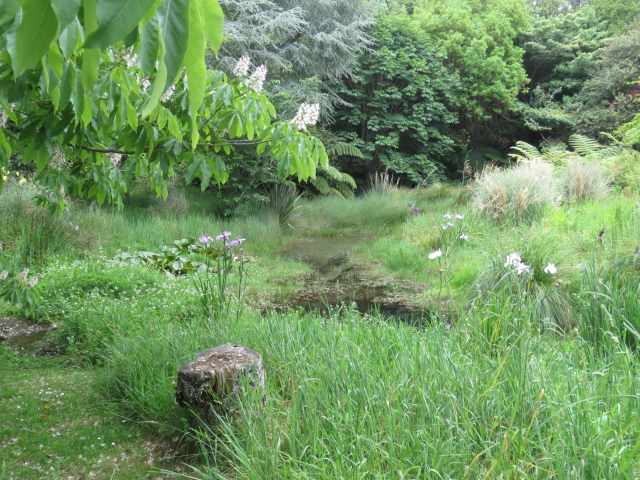
I think it is likely the contrast in our garden. We always maintain the house gardens – the area of close to two acres on the flat around the house which includes the summer gardens, the rockery, the Rimu Walk and the Avenue Gardens – to a weed-free, tidy state with areas that are quite sharply defined. The switch to the loose style of the park and the Wild North is very different and it is that contrast that makes it appear by design, not laissez faire management.
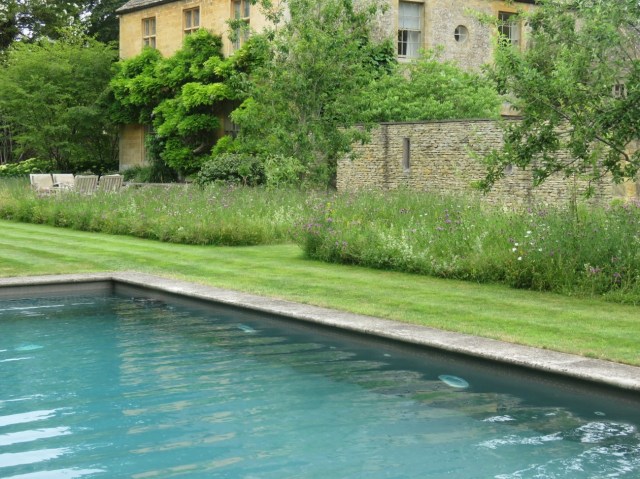
There is a lesson there that can be applied to those gardening on a smaller scale. The juxtaposition of some formality and form with more naturalistic, wilder plantings can pull it all together. It is what Dan Pearson does really well, if you scroll through to the photos of the garden he designed and planted at Little Dartmouth Farm. You can start small. We have experimented with letting our front lawn grow and flower over summer but giving it form by mowing a double width around the edge and paths on our main walking tracks across the lawn. It is not an option if your priority is an immaculate monoculture of a lawn that resembles a green velvet sward but we long ago abandoned that approach as a crime against nature.
I would suggest that if you are starting this particular journey and struggling to reconcile it with the traditional values of tidiness and visibly tight maintenance, you may find it easier if you keep the gardens closest to the house in a controlled, tidy state but start loosening that iron grip as you move further away. It creates a transition that seems to make sense to the logical parts of our brains.
It is fine to start small; it is recognising the need to change many of the ways we garden that is the very first step. Clare Foster’s book promises to show just how successful it can be to take a much more expansive view and to integrate concerns about sustainability, biodiversity and the longer term environment alongside placing a high value on aesthetics.
When I have written about working with Nature rather than gardening by controlling Nature, about gardens that sit within the landscape rather than on the land, about gardens that are immersive and not just pictorial, I think they are just variations on the topic that Clare Foster has grouped under her term of pastoral gardens. It is the same ground that I traversed with Australian gardener, Michael McCoy and it comes through repeatedly in his social media posts.
No matter the words and terms we use, I think we are all singing from the same song sheet and it is reassuring to find that the directions we have chosen in our little corner of Tikorangi are part of a wider international trend of questioning how we garden, what we value and how we can garden more positively to support an environment that gets more degraded and threatened every day.
For New Zealand readers: I went to order the book on line but blenched when it was going to cost as much for postage as the book. I can cope with £55 for the book but £54.95 for postage was an additional cost I will need to ponder further.
 Tikorangi The Jury Garden