Today is the arbitrary date that is set to tell us that we are in the first day of winter. In colder climates and far-off places like the north of the northern hemisphere, the ground can be covered for snow for months or simply freeze solid. Gardens are put to bed for winter. People retreat indoors and the view from the windows becomes extremely important. Structure and form come into their own because that is all there is to look at.
Not here. We only get periodic warnings of winter until it strikes around the solstice at the end of June and even then, it only lasts about six weeks. I retreat indoors when it is either raining or bitterly cold but otherwise, I can continue in the garden.
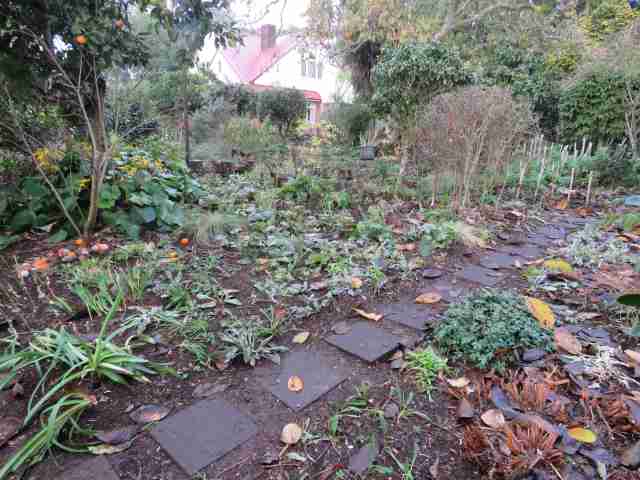
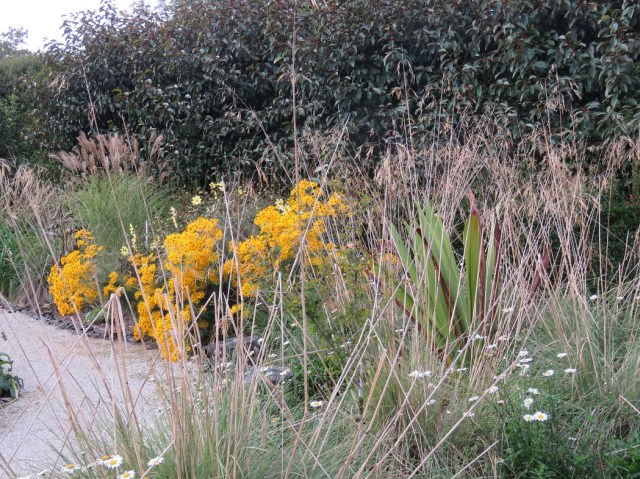
So what do our summer gardens look like as winter arrives? These were designed to bring us summer colour and are largely planted in perennials.
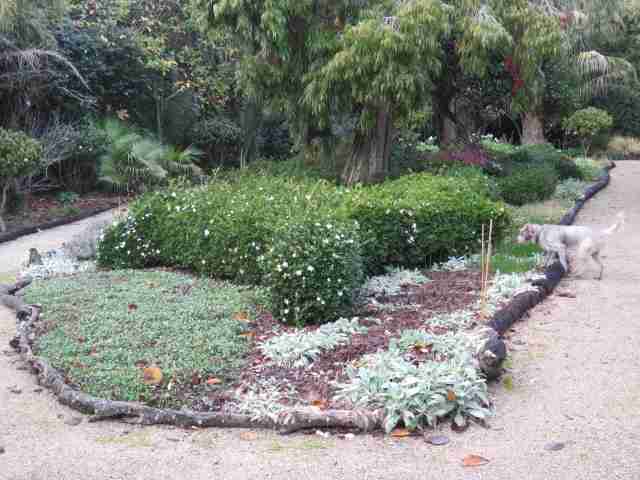
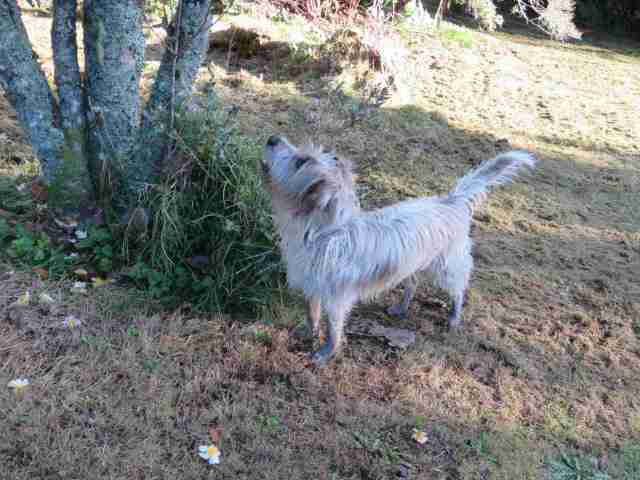
The Wave Garden, named for its undulating hedges (when trimmed) comes into its own in spring and summer. Ralph is doing his daily morning check for rabbits.
The Wave Garden is at its least interesting stage. Even the form is not strong until we clip the hedging when the little species camellia – C. microphylla – has finished flowering. The only other flowers out are the white alstromeria which seems to bloom effortlessly for about 10 months of the year.
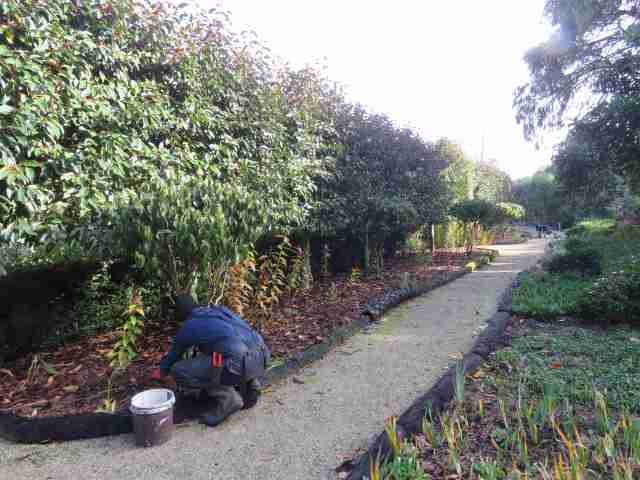
Zach weeding is the most interesting aspect of the lily border this week. This stretch is all about the auratum lilies in high summer with a second outing in mid to late winter when the michelias and camellias bloom.
There is nothing to see in the adjacent lily border. In a few weeks, the Camellia yuhsienensis which punctuate that border will be in flower and they are eyecatching. I can see the first flowers opening now. The backing hedge of Fairy Magnolia White will start to bloom soon after but at this time, the only reason to look at it is to monitor the damage by the pesky rabbits digging holes.
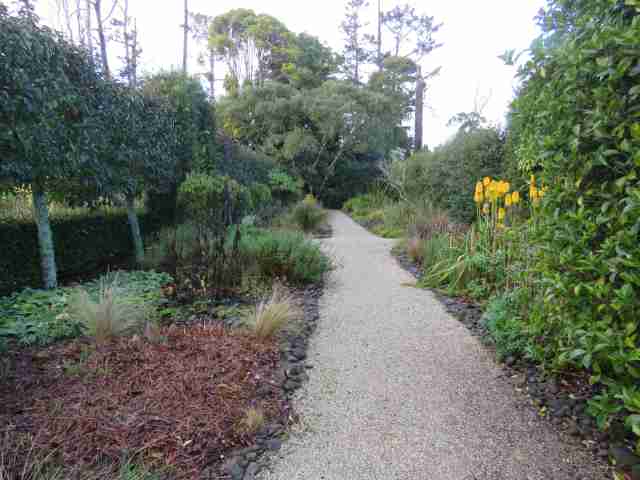
The twin borders star from spring to autumn, but not winter
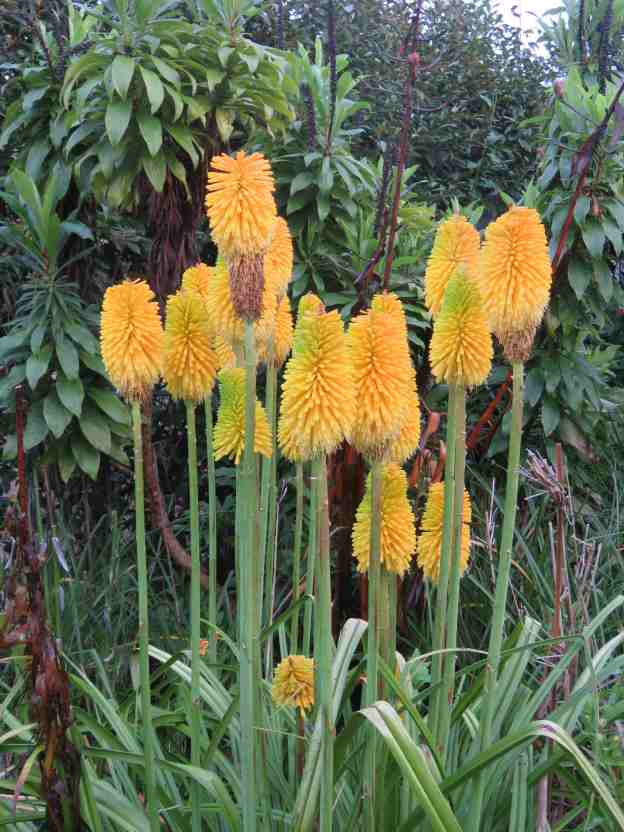
The twin borders are also largely put to bed. They are never totally flat and bare because many of the perennials are evergreen but the only point of interest at the moment is the startling delight of the yellow kniphofia.
Just recent hard work to be seen in the Iolanthe garden which is largely about flowering in spring through to early autumn
The Iolanthe Garden is currently receiving a great deal of attention but the fruits of Zach’s and my labours will not be seen until spring. The only colour is from the citrus fruit ripening.
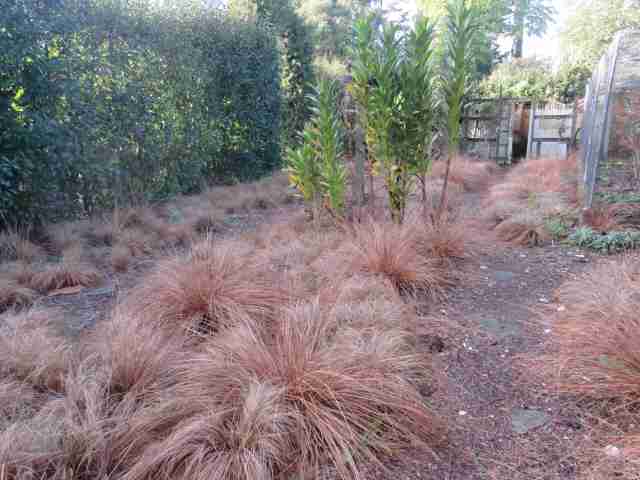
Tawny carex carry this area all year round
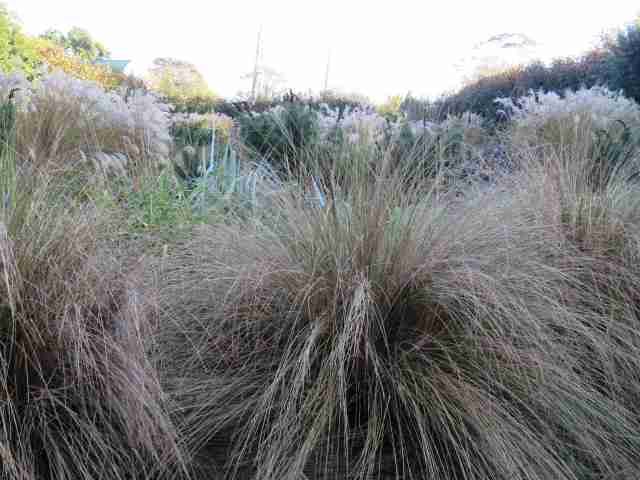
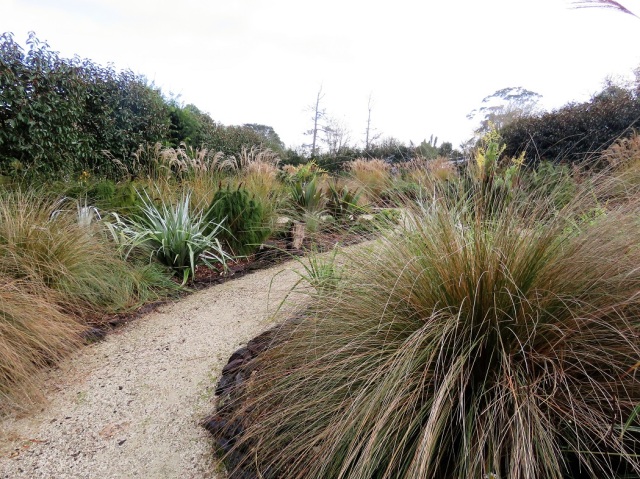
The grasslands, as we call the area linking the borders and Iolanthe Garden, uses two evergreen, native grasses (everbrown, in practice). At this time of the year, it lacks the zing from the scattering of bulbs and flowers planted between, but it remains well furnished, as it does all year round.
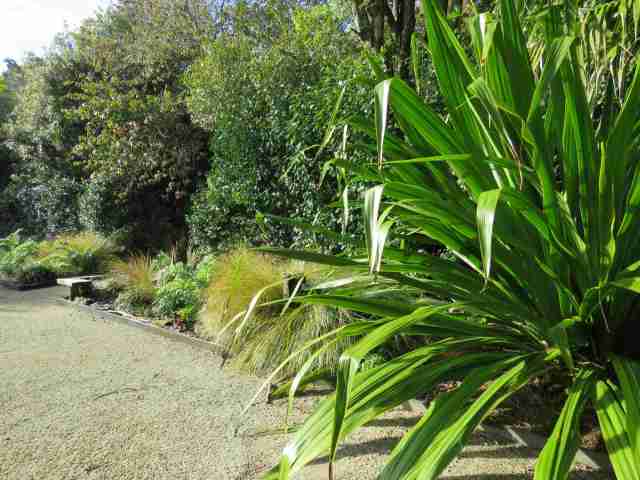
The back border with the OTT Doryanthes palmeri on the right
The back border of the summer gardens is like the back row of the chorus. It rarely gets to sing any solo lines but it adds depth to the whole area. The dominant plants here are another native grass – Anemanthele lessoniana, also known as gossamer grass – and cardoons which get too large and fall over in summer but look great in winter and spring. The Queensland spear lily (Doryanthes palmeri) adds a very dominant presence at one end.
The Court Garden in winter – need I say more?
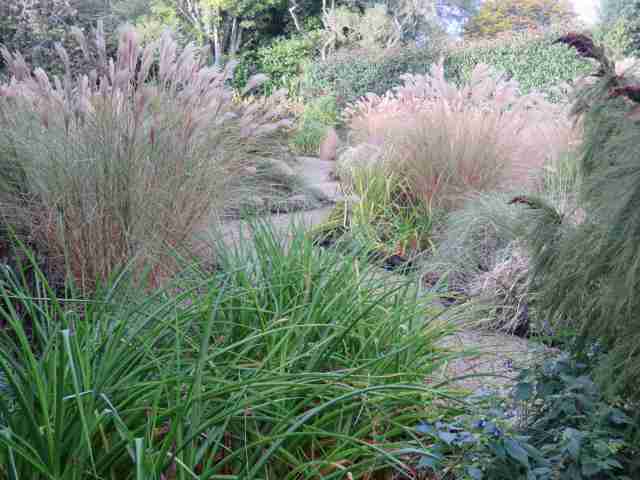
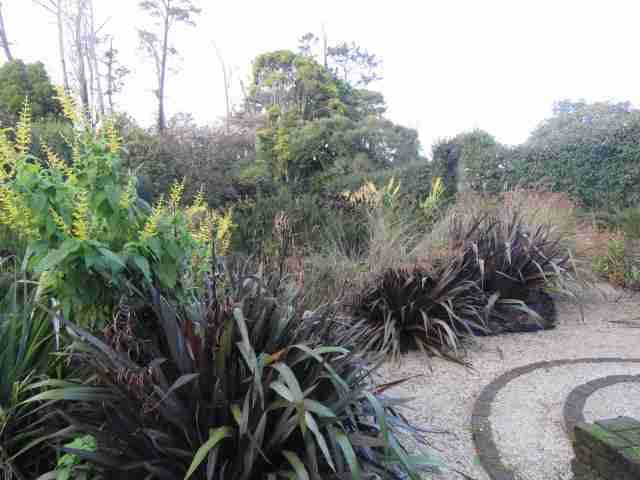
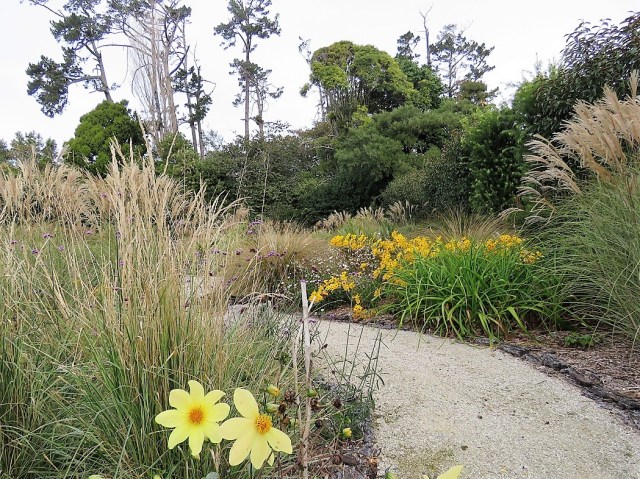
But it is the Court Garden that stars all year round. The only flowers at the moment are the late salvias, particularly the yellow Salvia madrensis (which tells you how mild our autumns and winters are) but whole area is lush and furnished with contrasting textures and tones of green, bronze, burgundy and silver. We have never gardened in this style before so it still comes as a surprise to me to see how this moderately large area (think tennis court size) performs well all year round.
I have seen gardens that claim to be ‘a garden for all seasons’ – particularly Pukeiti Rhododendron Gardens. I came to the conclusion that, at best, that means that there is something of interest all year round but you may have to search for it. Somewhat like our patch of yellow kniphofia in the borders. It rarely means that a larger area of the garden stars in the off season. It seems a little personal triumph that the Court Garden can change with the seasons but continue to star through all.
It is not just individual plants starring in their time to shine; the Court Garden doesn’t look the same all year but it looks good in every season.
While we are doing a lot of work on preparing the summer gardens for next season, the woodland areas are coming into their own. The orchids, evergreen azaleas, bromeliads, schlumbergera (zygocactus) and early clivias are coming into flower. The quiet time for the woodland areas is summer but that is another story.
I have spent the last week on my knees. Not praying, you understand, but grooming the large grasses in the Court Garden. “What you need,” said Mark, helpfully, “is a takahē.” He had read or heard somewhere that in the wild, takahē get right into the crown of grasses and clean the debris and dead patches out. That would be a fine thing. Besides, takahē would look very handsome browsing amongst the chionochloa although we might have muzzle Ralph.
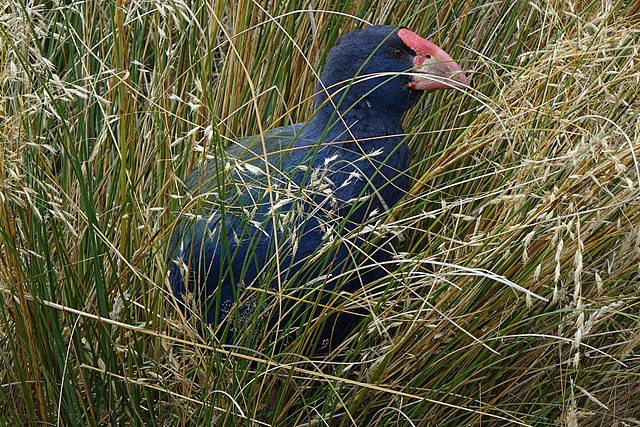
Takahē (photo credit: John Barkla via Wiki Commons)
The takahē is a large, flightless bird belonging in the group unromantically named swamp hens or rail. The North Island takahē was likely extinct by the time European settlers arrived although the South Island takahē is something of a miracle story. It, too, was thought to be extinct by the end of the nineteenth century until its rediscovery in a remote Fiordland valley in 1948. Latest figures show there are 440 live takahe, every one known individually, as a result of human intervention to save this handsome bird from extinction. There are now enough for breeding pairs to be cautiously relocated to safe sanctuaries which are free from predators. Their status has been changed from Nationally Critical to Nationally Vulnerable so they are a shining success story of saving a species in a country where we have managed to lose too many due to human settlement.
Ralph, wondering about his lack of ability to fly
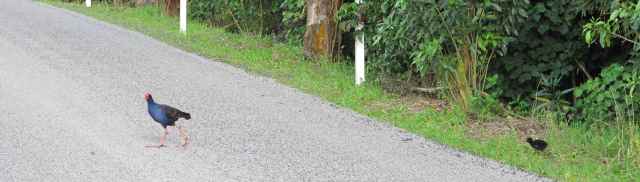
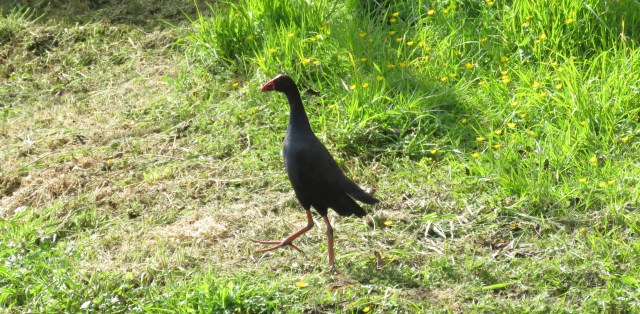
I fear Ralph would deal to any that crossed his path. Given that his biggest regret in life is his failure to master the art of flying despite all his best efforts, I do not think he would be able to resist taking down a ground bird. Indeed, dogs are one of the biggest threats to takahē, along with contracted shooters who can’t tell the difference between a pukeko and a takahē.
Pukeko which we have in abundance in this country
Takahē – spot the difference? (Photo credit Judy Lapsley Miller via Wiki Commons)
In the absence of such handy helpers, it is I who is on my knees with my trusty tools. My theory is that the native grasses we have which have a reputation of not being long lived as garden plants have an issue with a build up of debris that rots down and keeps the centre of the plant so wet that it can rot out. This is of course because our native grasses are all evergreen so they don’t shed their spent foliage. The amount of debris I pulled out from the large toe toe (Austroderia fulvida) was prodigious and there was certainly evidence of growing tips rotting out beneath the debris so I am hoping that the plants will heave a sigh of relief and stay healthy.
I probably cleaned out a third the volume remaining in dead and spent foliage – our native toe toe or Austroderia fulvida
Deciduous plants like the miscanthus get cut to the ground when the feathery plumes all start to fall over and lose their charm.
Semi-deciduous plants which just look scruffy and awful – particularly the calamagrostis – also get cut to the ground.
Evergreen grasses – which are all our natives plus the non-native Stipa gigantea – are dead-headed and individually groomed to remove spent foliage. The exception is the smaller carexes, particular C. buchananii and C. comans. These just get left alone with excess seedlings thinned out. They are such enthusiastic seeders that if any of them kark it, there are plenty there to take over and fill the space.
The advice to leave these plants until spring in order that birds may find winter feed belongs in the northern hemisphere where most of their birds are grain feeders and winters are so cold that birds can die of starvation. Our winters are mild enough that there is plenty of feed and almost all of our native birds are nectar or fruit feeders.
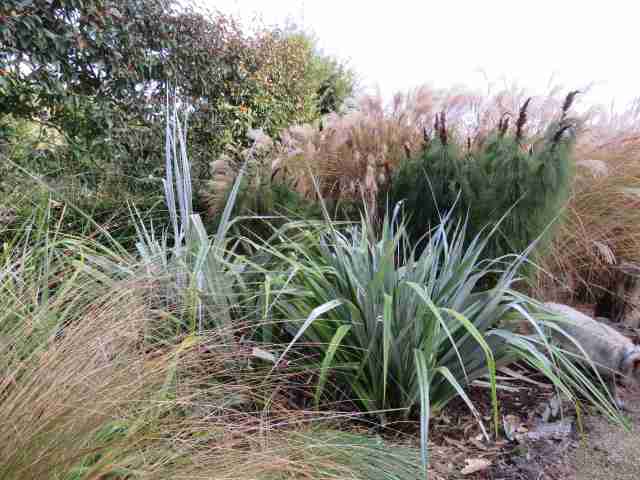
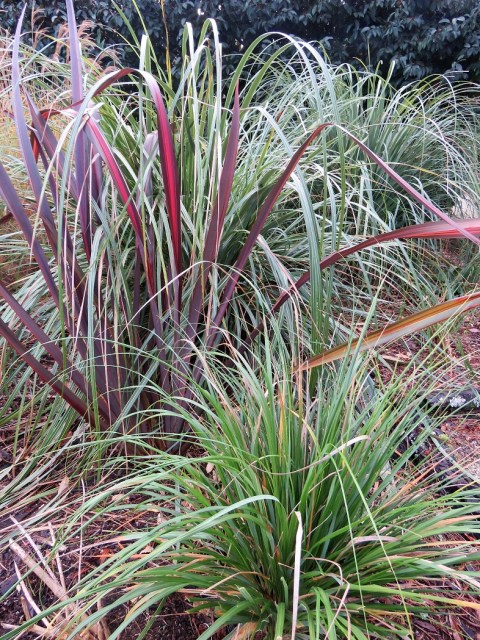
Two different named phormiums (flaxes) backed by Miscanthus ‘Morning Light’. We have just lost the names of the flaxes but they are very good.
Astelia chathamica looks a bit like a silver flax but is a different plant family. With Ralph emerging by the Elegia capensis
While I was down on my hands and knees, I also groomed the native flaxes and astelias growing in that garden, cutting off spent and damaged leaves at the base and they look a whole lot better for that. And I thinned the Elegia capensis, knocking off some of the new shoots that are appearing beyond their allotted space. No wonder it all felt quite a major clean-up this year.
Mark often refers to gardening as the act of tidying Nature. But after our discussions on the takahē, he noted that my recent efforts were ‘not so much tidying Nature in this case, as filling in an ecological gap left when humans squeezed out the birds that would have done this in the past’.
I do not subscribe to the notion of no maintenance gardening. There is low maintenance gardening, lower, lowish, high and very high maintenance gardening. The grasses are generally on the lower side of the spectrum.
Before on the Stipa gigantea
I certainly don’t groom ornamental grasses in wilder, more naturalistic settings but the Court Garden requires some quite precise maintenance to keep its looks, although it is not usually onerous. This train of thought came about because I have been grooming the Stipa gigantea and that has been more major than I anticipated. At least I have worked out that every established clump is putting up maybe 40 flower spikes which is a lot, really. But there are 24 large plants of it in that garden (yes, I counted!) and every one takes up to an hour for a thorough dead heading and grooming out the dead leaves with a few also needing to be reduced in size. It is not such low maintenance and it is entirely optional but the plants do look tidier for it.
and after on the Stipa gigantea. There is at least half a barrow load per plant removed.
The lowest maintenance option are the deciduous grasses that just get cut down to the ground. That is Miscanthus sinensis ‘Morning Light’. We also cut down Calamagrostis ‘Karl Foerster’ and ‘Overdam’ which are not deciduous but look pretty scruffy and of no merit by late autumn. We have plenty of other evergreen plant material in that garden that gives winter interest and, when cut down, the calamagrostis return with pristine fresh foliage in spring.
Cut to the ground. Maybe don’t try this with clumps that have yet to establish well because you may run the risk of them rotting out over winter but ours are now solid plants.
If you have a very sharp spade and sufficient strength, it is possible to reduce the size of the clumps when they are cut down without having to lift the plants and disturb the roots. I have our Zach with a sharp spade to do this very job, as he has done on the calamagrostis last week and will do on and miscanthus that are looking too large when we cut those down soon.
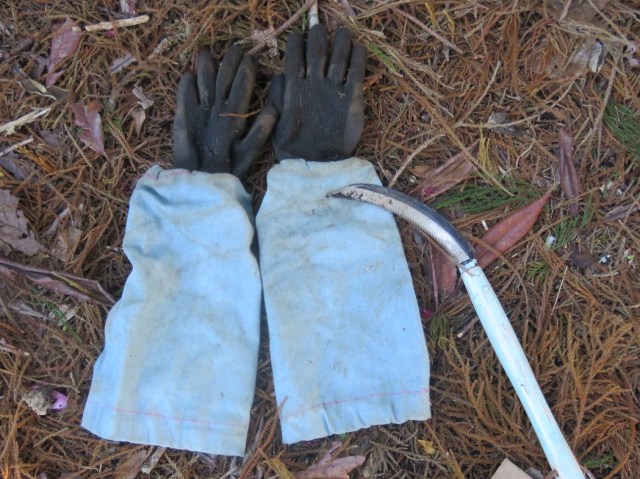
A simple tool, cheap enough and sometimes sold here as a flax cutter. Along with my homemade arm protectors and garden gloves.
For cutting down grasses or perennials, buy yourself one of these very handy little tools with serrated teeth and a curved blade. I think I bought my latest one described as a ‘flax cutter’.
Chionochloa flavicans at the front with an unnamed red phormium or flax and the rather large Austroderia fulvida or proper toetoe behind.
Our native Chionochloa flavicans (dwarf toe toe) has a reputation for ‘whiffing off’, as Mark is wont to say. In other words, it grows beautifully for a few years and then starts dying out. I feel that the proper toetoe we grow – Austroderia fulvida – is showing signs of the same trait and I put it down to a build-up of detritus and dead foliage in the middle of the plants. In the wild, it will be part of the natural cycle; in the garden, we don’t want to cope with half dead plants needing replacement. My theory is that if I keep the plants cleaned out, they won’t suffer that fate. Ask me in five years’ time if I am right on that. I cleaned the plants up in summer, after flowering. The chionochloa were fine to do and did look better for it. The mature toetoe were not much fun to groom because, like a number of our native grasses, they are a form of cutty grass and cut they do. I always wear gloves and I also covered my arms but my ears, my ears! Those very long leaves can cut ears readily. At least it is only a once-a-year job.
The adjustable metal leaf rake, long handled hand rake and flax cutter
The Stipa gigantea does not cut flesh and is probably fine to be left without intensive grooming. I have never done it this thoroughly before so maybe it is overkill or maybe just something to do every few years. You can take the Monty Don of BBC ‘Gardener’s World’ approach and just use your hands as a comb to pull out the dead leaves. He doesn’t even wear gloves that I have seen so I guess they don’t have cutty grasses. I have used the metal leaf rake before and that does a pretty good job when you have room to move around the plants. This time I got in for a thorough clean using our useful little hand rake that you won’t be able to buy at the garden centre. Mark tells me it once belonged to his father but that he replaced the broken handle with a beautifully whittled, sanded and oiled handle that is longer than the original. Not only is this a useful implement for getting in to plants, it is also very nice to handle.
Chionochloa rubra
Anemanthele lessoniana
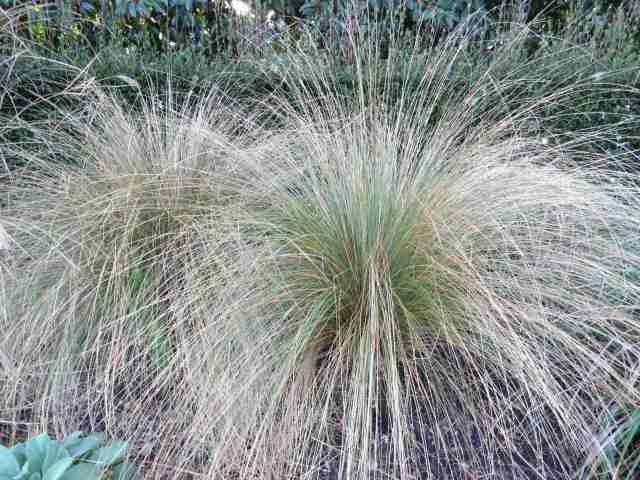
A few of the grasses don’t need much attention at all – notably our native Chionochloa rubra (red tussock) and Anemanthele lessoniana (gossamer grass). They may need digging and dividing every few years to reduce their size in a garden situation, but they don’t need routine maintenance, bar weeding out the many self-sown seedlings of anemanthele. It is the only prolific seeder we are using in the Court Garden. The miscanthus throws a few seedlings; the stipa is sterile; the others I have yet to find seedlings of (a thick mulch discourages seed germination) but the anemanthele… It is just as well it is both native and has merit because it certainly seeds down.
Ralph
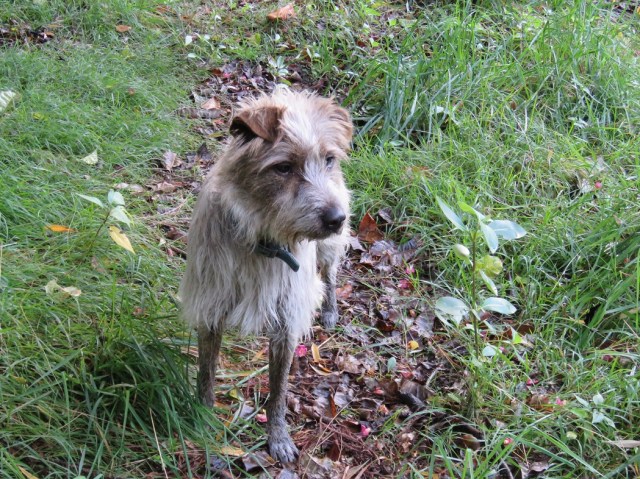
Finally, may I introduce Ralph? Ralph came to us from the city pound. He is a little larger than our usual grade of dog but he has settled in here instantly with no doubt that this is his home. Life is terribly exciting for Ralph with so many interesting smells. He is constantly on the move outside and most of my photos end up being a passing blur. But he makes us laugh and it seems that everybody loves a scruffy dog. Come the evening, tired Ralph decides he is now a lap dog and that can be a bit challenging with one his size. Engaging but challenging.
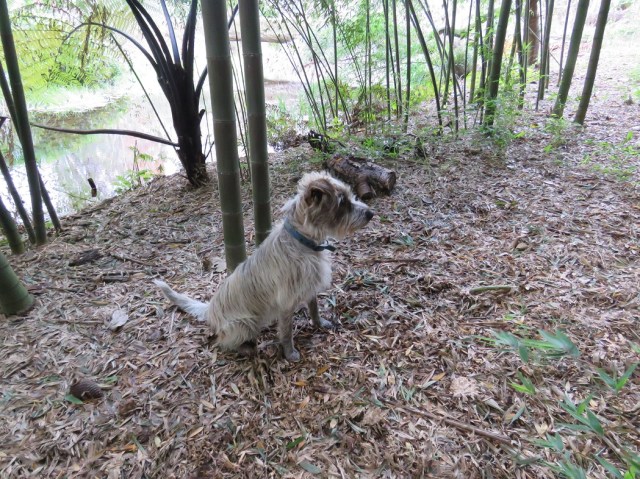
Ralph, briefly sitting down to order, in the Wild North Garden – or dog heaven as he prefers to call it
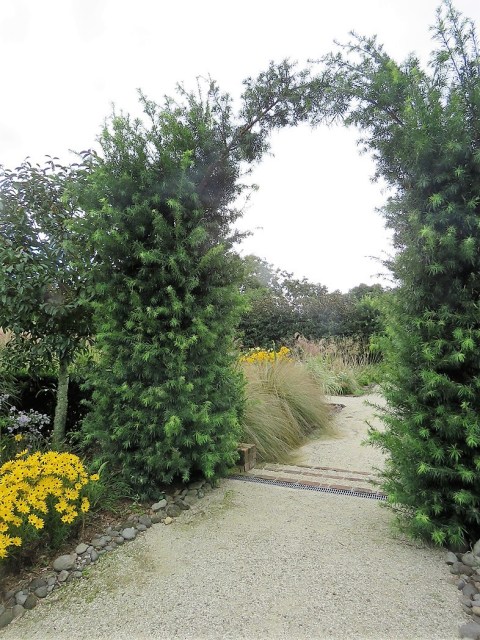
Forming the archway with Podocarpus parlatorei which leads into the Court Garden
Today, fingers crossed, all going well, negative RAT tests and no flight cancellations, we are winging our way across the Tasman to reunite with our three children and only grandchild, all of whom live in Australia. It feels momentous because it will be the first time we have seen them all for between two and three years. The small grandson is literally twice the age he was we last saw him. We are all meeting up in Bateman’s Bay, a few hours’ drive south of Sydney. I mention this because there won’t be a post next Sunday and I was chastised by a loyal reader for skipping a couple of weeks recently.
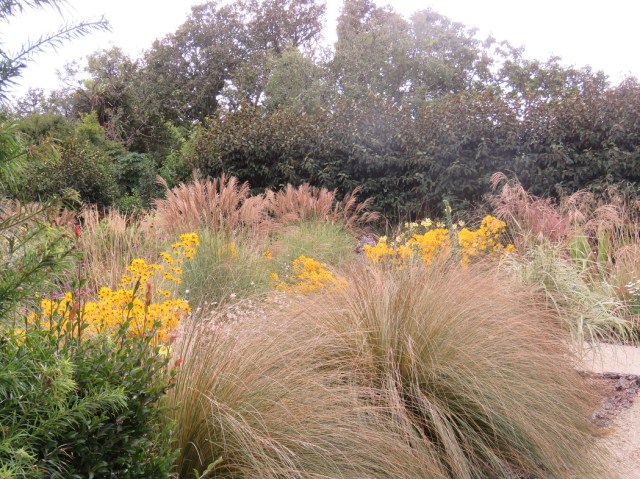
And a close-up of that view through the podocarpus archway – mostly Chionochloa rubra and helianthus
Just occasionally, I look at part of the garden and utter a sigh of utter joy and contentment. It is that glorious feeling that everything is just right, a vision realised at that moment in time on that particular day. When it is a garden that has been my vision, my plant selection, my plant combinations and largely my efforts, the feeling of deep satisfaction is even more rewarding.
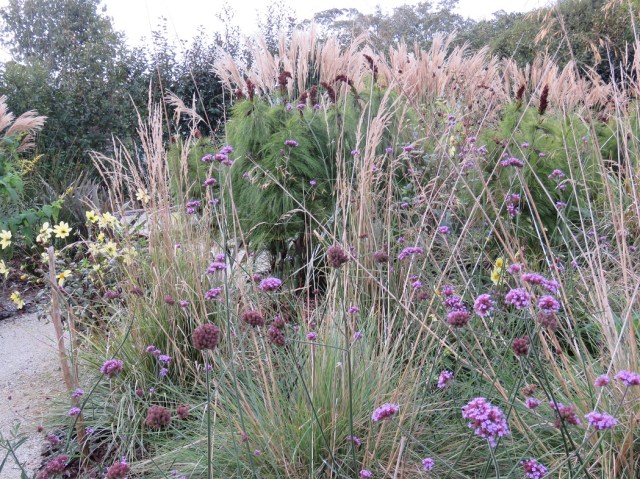
Calamagrostis ‘Overdam’ at the front with self-sown Verbena bonariensis, Elegia capendis with Dahlia ‘Conundrum” in the mid ground and Miscanthus ‘Morning Light’ at the back
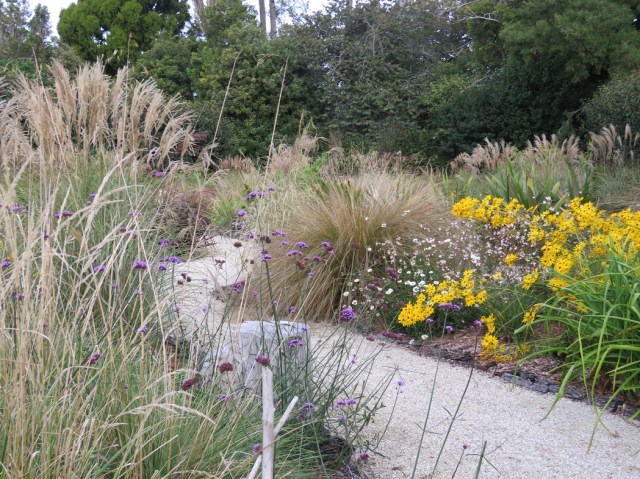
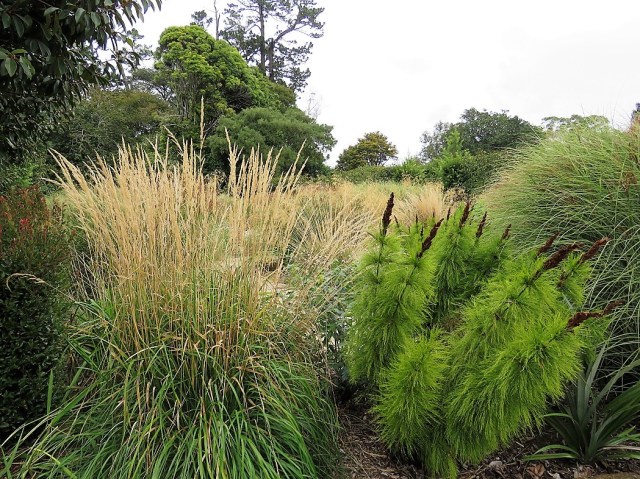
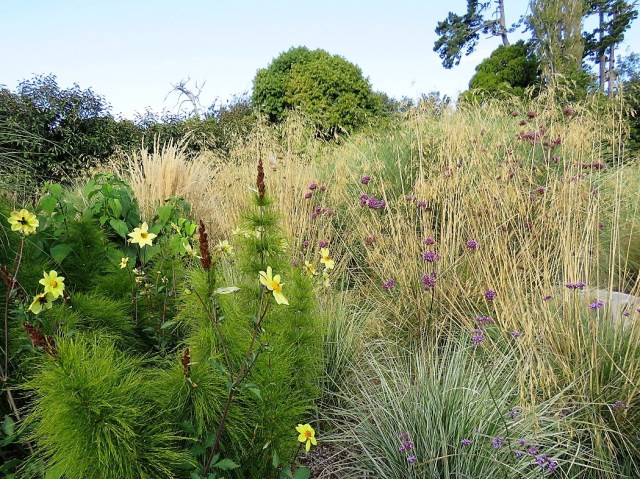
I experienced that feeling this week in the Court Garden. While it is part of the new area we call the Summer Gardens, it really stars in autumn. I wanted this area to be a wrap-around, enveloping experience – where we are IN the garden, not looking AT the garden. And this week, I felt that it had all come together.
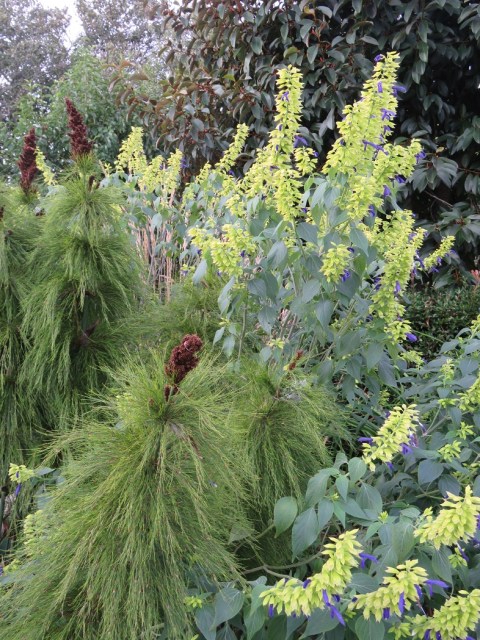
I like the combination of Elegia capensis and Salvia mexicana ‘Limelight’
Of course there are areas that I will tweak further. Zach has been reducing the size of the Elegia capensis and one of the patches of black phormium (flax) this week. I need to give the Chionochloa rubra more space if they are to be left to gain their full potential glory. I am still learning about which plants we will need to manage and control and how often this will need to be done. But this week I sighed with pleasure.
The concept works. It is an immersive experience. It is generally low(ish) maintenance – certainly lower than other areas of the Summer Gardens. It is very different to all other areas in our garden. The fact that it looks okay in winter, good in spring and summer but it really stars alone in autumn is a bonus.
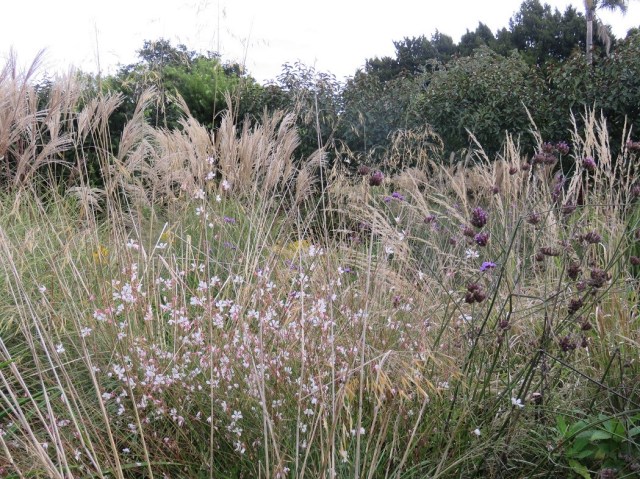
Gaura with Stipa gigantea and Miscanthus ‘Morning Light’
These photos were all taken in late afternoon on a grey day with lower light levels. It looks spectacular on blue sky days as the autumn sun is lower in the sky and highlights the plumage of the grasses in flower. On a windy day, it is full of movement but even on calm days, the slightest breeze will catch the tall plants and they will gently wave.
I feel sufficiently confident to give an interim report on the grasses I have used in the new Court Garden although it will take another few years before I can give a definitive verdict. These are bigger growing grasses because we had the space and I wanted an immersive effect that wraps around when we walk through the area.
The site is the hottest area in our garden but, being lowered, it can also be frosty in winter. Cold air flows down to lower levels to settle. The ground is typical free-draining, Taranaki volcanic soils that do not become water-logged and never dry out entirely. We haven’t added any fertiliser and once planted, we never water. The area is mulched with wood chip.
Chionochloa rubra – commonly known as red tussock but this form is only brownish red in winter
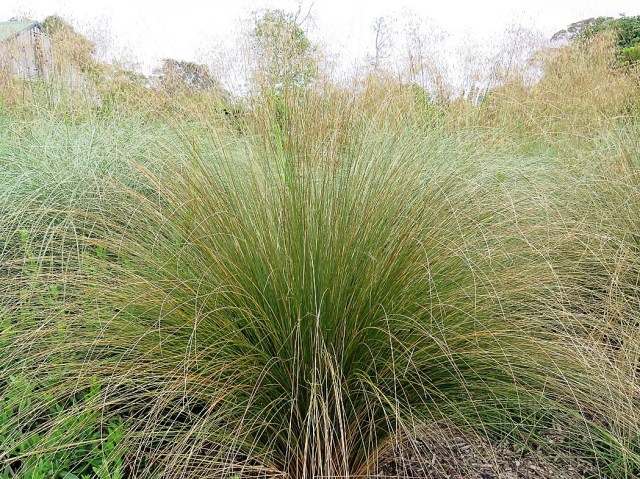
Chionochloa rubra– NZ native so evergreen. It takes first prize for graceful form because it fountains out from a narrow base and that form makes it a real star in the winter garden. Its flowering is relatively insignificant but I don’t have to groom the plants to remove dead sections. We started with just one plant and I kept dividing it, which it does easily. I have never lost a plant. It needs space to be able to appreciate the graceful form and the best plants are now 120cm high with a spread up to 2 metres.
Chionochloa flavicans, sometimes sold as ‘miniature toetoe’ though it is a different family
Chionochloa flavicans – also a native, sometimes referred to as ‘miniature toetoe’, so evergreen. At its best in spring but holds its showy flowers right through until autumn. Rabbit fodder when young. Has the reputation of ‘whiffing off’ unpredictably and it certainly doesn’t appreciate being crowded by other plants. Again, we started with a single plant and kept dividing. I have overplanted it so will lift the lot shortly and split the plants, replanting fewer and at wider spacings. I am hoping that by dividing, it will stimulate more growth and delay any inclination to ‘whiff off’. Plants are now about 75cm high and up to 140cm wide.
Anemanthele lessoniana or NZ wind grass, sometimes gossamer grass (you can see the ethereal flowers in pink tones) in the borders before I moved it over to the Court Garden
Anemanthele after moving – it turns golden under stress and it was still hot weather when I moved these plants but I expect them to recover
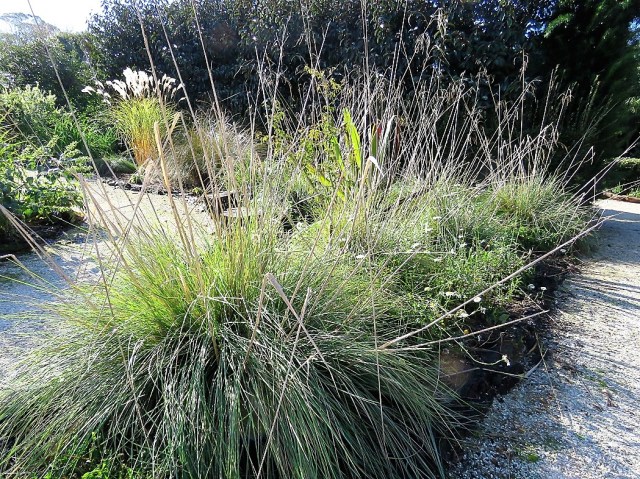
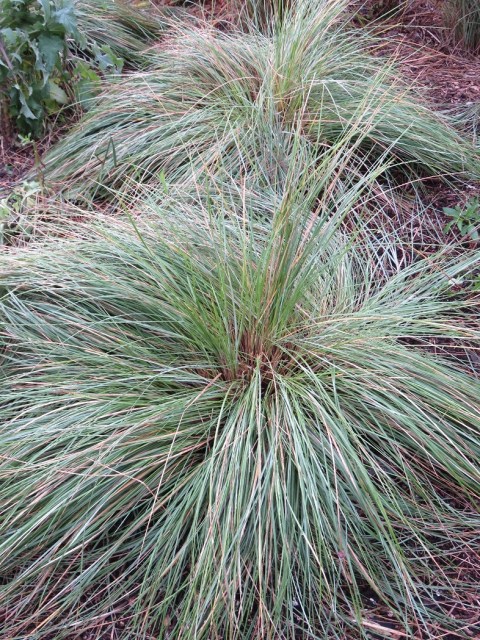
Anemanthele lessoniana – another native – so evergreen – with a vase shaped habit of growth and more colour variation in the foliage. Lovely in bloom with a cloud of fine flower heads. I had this in the twin borders but the plants were getting too large so I have now moved them to the Court Garden. When stressed (and my plants have often been stressed as I have lifted and divided them to increase the number from the original three), it turns an attractive gold but I will need to groom the foliage to remove dead thatch when the plants make fresh growth. It has reached about 90cm high and up to 140cm wide.
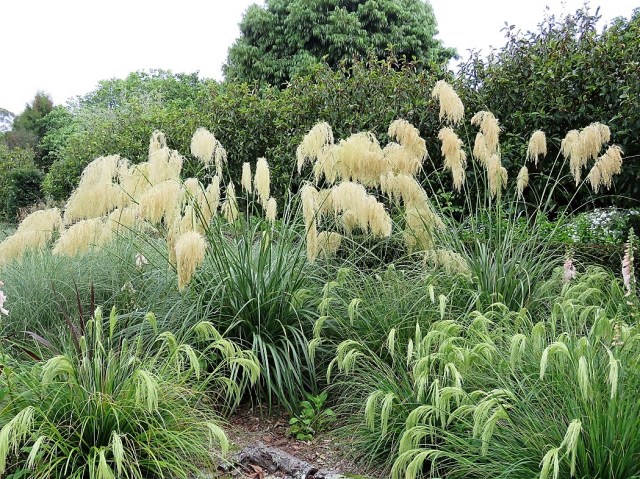
The tall plumes are the austroderia – NZ toetoe and a better choice than Argentinian pampas
Austroderia fulvida – toetoe so another evergreen native. Very large growing and too early for me to comment on its longer term performance. I bought three small plants through Trade Me and they have already reached 1.7m high and 2.4 metres wide.
Stipa gigantea I have referenced countless times. It, too, is evergreen in our conditions and I give it the occasional groom (by hand or with a leaf rake) to remove dead foliage. Excluding the tall flower spikes, it is about 80cm high and 160 cm wide as it matures. It divides and increases easily so just start with a single plant but you do need a certain critical mass to have sufficient to share with the sparrows. We found the pesky birds stripped the blooms in the first season and the whole reason for growing this grass is for its showy, long-lived flower spikes so that was disappointing. This year we have had plenty to share with the birds. The foliage has a glaucous tint which is a contrast.
Calamagrostis ‘Karl Foerster’ to the left with the plumes still looking good after four months
Calamagrostis ‘Karl Foerster‘ – I have written about this before. It is such a strong grower, spreading at an alarming speed, that I reduced it down to just six plants which I am hoping I can keep in check by root pruning on an annual basis. By root pruning, I mean getting a very sharp spade and cutting back the size of the clump without digging it all out. That way, I can get the spreading fresh growth off it. This works because it makes its new growths on the outside of the clump. It is evergreen in our climate but the foliage looks pretty scruffy by the end of season. I am pretty sure I cut it back hard last winter so the spring growth was all fresh and lush. It is one of the first grasses to flower in spring and those lovely plumes hold all summer and into autumn. It is all about the plumes because the foliage and form are nothing remarkable.
That is what I think is ‘Overdam’ in the front right, Stipa gigantea behind
Calamagrostis ‘Overdam‘. At least, I think it is Overdam. It was given to me. It is strong growing too, but not as threatening as Karl. It has the same lovely plumes but the bonus of clean, variegated foliage which stays looking fresh through the season, somewhat like a lower growing variegated miscanthus, though it spreads sideways rather than up. It will likely need root pruning, too.
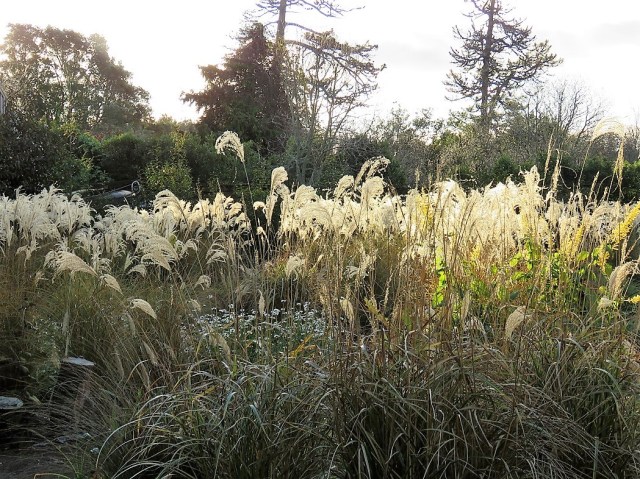
Miscanthus is a lovely grass from spring onwards but the glow of those white plumes in the low winter sun is nothing short of amazing
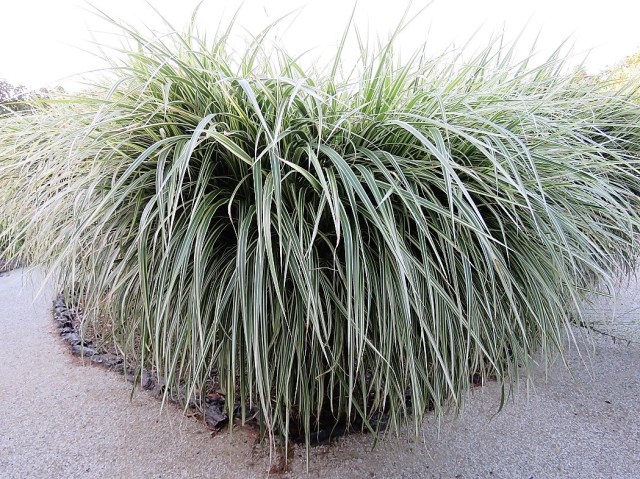
Miscanthus sinensis ‘Morning Light’. Look, we started with one plant in the garden years ago that just sat, grew annually and fell apart because it needed dividing. As soon as I started dividing it (done variously with a sharp spade, an old handsaw or a small axe), it responded by growing with huge enthusiasm. I overplanted badly and need to take out at least half of the plants but as it is all about the plumes in late autumn and early winter when they glow white in the low sun angles, I will wait. The plants are around 1.7 to 1.8 metres high with flower spikes on top of that so it is very tall. If it is divided often enough, it will stay together – falling apart from the middle is a sign it needs dividing. It is fully deciduous, fine leaved and variegated. Mark is sure that the old foliage has potential for thatching but he has yet to test this theory. This is the only grass that I have spotted seeding down so far but the seedlings are easy to pull out when small.
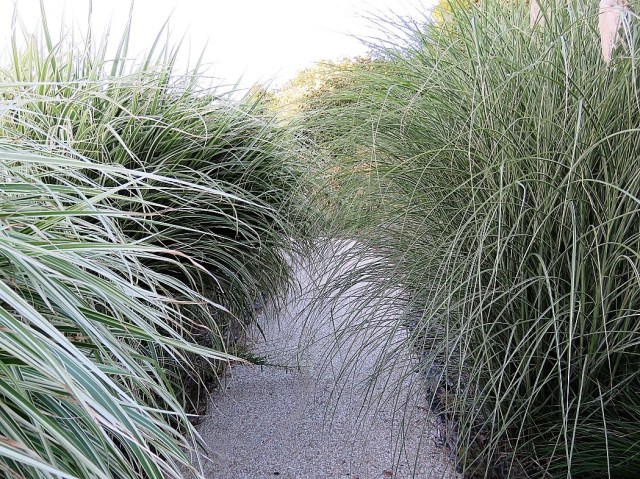
Miscanthus ‘Morning Light’ on the right, giant miscanthus on the left
Miscanthus whatever whatever – may be just a larger growing form of sinensis with a wider leaf but it should be called Miscanthus giganteus variegatus. The leaves are wider and with a most attractive, clean variegation but the vigour and size is daunting. We ended up digging out three massive plants because I couldn’t hold them together and, as they fell apart, they blocked the path entirely. This is a triffid of a grass. Gardening friend, Susan, suggested that maybe the way forward is to do the Chelsea chop on them – cut them back to ground after the first big flush. I think she is right and I will be cutting them back to ground level about mid November. The second flush of growth should be more compact and shorter. If I can’t keep them under control this way, they will have to go. The plants are too big for me to lift alone and I don’t want to commit to plants that need lifting and dividing annually.
Just too big – they grew even larger and floppier after I took this photo
Lomandra We had a named variety in the garden but I found a better option to replace it with. I rate lomandra as one of the world’s more boring plants and I suggest you leave lomandras to supermarket carparks and roading roundabouts. We have more interesting and attractive native grasses without having to resort to this utility Aussie in NZ gardens.
Here endeth the interim grass report. Except to say that I am moving and dividing some now because we still have at least six to eight weeks of the growing season left before temperatures drop and growth slows or stops over winter. That said, I have done this in winter and we can get away with it but it is not recommended in less benign conditions where the plants may just sit and decompose in sodden, cold soils.






 Tikorangi The Jury Garden