Tag Archives: gardening

Garden lore

“(Gardening) is not graceful, and it makes one hot; but it is a blessed sort of work, and if Eve had had a spade in Paradise and had known what to do with it, we should not have had all that sad business of the apple.”

Elizabeth, Countess von Arnim, (1866-1941).

002 (2)

Autumn leaves
Most of us are probably at peak leaf fall at the moment. One more strong wind and they will all be on the ground where they will turn uniformly brown and sludgy. Do not think of fallen leaves as a bother but as a resource. Never tell me you burn your leaves.

That is just bad and wasteful. Leaf litter is not as nutritious and balanced as good compost but it has merit and should be regarded as an important part of the cycle of nature.

The simplest method is to use a leaf rake to scoop all the leaves back discreetly under the trees where they can gently break down to humus with the winter rains and microbial action. Come spring time, you can rake them back out to use as garden mulch if you wish.

Dried leaves can be put through a composting process where they count as adding carbon content.

In our vegetable garden, which has a couple of very large deciduous trees which drop a prodigious amount of autumn leaves, we use a simple circle of chicken netting tied together. All the leaves get piled into it and left to decompose. It stops the birds from making a mess of the piles.

It pays to clear fallen leaves out from fishponds. Rotting leaves will increase the nutrient levels, leading to later problems with algae growth and, in really bad cases, can kill the fish by reducing oxygen levels as they break down.

First published in the Waikato Times and reprinted here with their permission.

Stripes, hedges and gardening on the flat

Striped gardening a la Monet (photo: Michal Osmenda via Wiki Commons)

Striped gardening a la Monet (photo: Michal Osmenda via Wiki Commons)

There I was last week, railing against the fad for edging plants everywhere and referencing planting in stripes. We watched a programme which we had recorded on Monet’s famous garden at Giverny. There was his striking central allée and it was planted in long stripes! But beautiful, complex stripes created with painterly style and panache.

I have yet to visit Giverny and I may have trouble motivating Mark to accompany me. Being a New Zealander, he has an abhorrence of crowds and that particular garden is renowned for packing ‘em in. That said, good friends of ours went last year, not expecting to be overly impressed, but they were blown away by it so if we are in that part of the world (an hour or so north of Paris), we will probably go. And admire planting in stripes.

It is probably no surprise that a Frenchman would go with formalised planting. The genre of parterres (regimented planting of colour on formal terraces) is closely identified with the French nobility of old. It was primarily designed to be viewed from upper windows and is essentially using flowering plants as a tool to paint patterns in stylised form, such as we see on fabrics.

Monet used more of a mix and match of colours to get the beguiling complexity we associate with Impressionist art, but if you look at the composition around that central allée, it is still geometric.

The danger is that if you over simplify it, you are more likely to end up with bedding plants arrayed in the style of the old fashioned traffic island or floral clock.

Next up came a programme we had of BBC Gardener’s World where lead presenter, Monty Don, was walking down one of the paths in his garden and lo! There was another garden in distinctive stripes. It was all dead straight. Very tall hedges either side, a middle layer of matched small bushes planted in long stripes inside, edged by buxus with a narrow path between the matched borders. There is something engaging in the simplicity of such a scene, but it is still really like a house hallway outdoors – an access way which you want to lead to somewhere more open and spacious at either end.

David Hobb's garden in Canterbury

David Hobb’s garden in Canterbury

It started a conversation here about creating a garden on a dead flat site with no established trees or structure. That is apparently what Monty Don did and he went with masses of clipped hedges to give form. I saw the same strategy in large Christchurch gardens on the flat. These hedges gave both structure and protection from Canterbury’s winds which can howl across the plains.
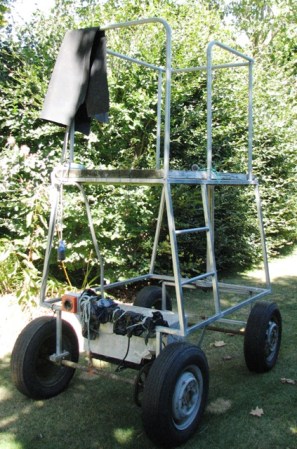
Mobile hedge-trimming platform from Trotts Garden in Canterbury

Mobile hedge-trimming platform from Trotts Garden in Canterbury

Ever practical gardeners, we could see difficulties in the longer term. In order to get good structure, you need to let the hedges grow tall – around the 4 metre mark in large spaces. Formal hedges need trimming at least once a year, more often if you want clean crisp lines. If you get the mechanical hedge trimming contractors in, you have to keep a vehicle path width down either side of the hedge. If you do it yourself, you need mobile scaffolding, a good eye and the determination to get it right. It is not a path we would choose to go down ourselves. There are more fun things to do in the garden than endless hedge trimming. These may not be gardens to grow old in, unless you can afford the labour to carry out the trimming.

The alternative in large flat gardens is to plant good long term trees with sufficient space to grow to reach their potential. They can give the structure and form in the long term and as long as you choose well, they are not going to need anywhere near the regular maintenance of the formal hedge.

Next, on the long, wet weekend, we reviewed yet another of the gardening programmes we had saved. This time it was the UK’s longstanding and vastly experienced garden presenter, Alan Titchmarsh (a refreshingly unpretentious Yorkshireman) with his Love Your Garden series. One episode showed a simply astounding, verdant, lush forest on a very traditional, flat, rear section.

If you have ever seen British suburbia, the British equivalent of our traditional quarter acre section is a narrow plot which is the width of the semi detached or terraced house (in other words, two rooms wide if you are lucky) with a small front area and a longer rear area. This was one of those. I think Alan Titchmarsh said it was 30 metres long but it can’t have been more than 8 metres wide, if that.

The gardening owner had taken this long, thin rectangle and entirely disguised it. The main device was a zigzag wall structure running diagonally across the yard which had then been planted heavily. The foliage hid the wall but that structure turned a blank, open canvas into a much more complex design with different conditions in which to grow plants. Against the odds, there were hidden areas to be discovered and the garden was not visible at any point in its entirety (except, presumably from an upstairs window).

You can take a dead flat, unprepossessing piece of ground and turn it into something surprising and deceptive if you have flair. But then you can take planting in stripes and turn it into something special as well, if you are another Claude Monet.

First published in the Waikato Times and reprinted here with their permission.

Plant Collector: Pyrostegia venusta

Pyrostegia venusta

Pyrostegia venusta

Like a bright beacon from the tropics on a bleak winter’s day, is this somewhat rampant climber with its common name of the flame vine. It is usually associated with Brazil, probably because that is where it was first collected for the west, but in fact occurs naturally throughout Argentina, Paraguay and Bolivia as well. Unfortunately, it is proving a bit weedy in some parts of the world because it can be invasive but there does not seem to be any record of problems in this country. It is frost tender.

It is a member of the Bignoniaceae family, for the botanically minded, and is evergreen. In the wild, it reportedly flowers in the cool, dry season and is pollinated by humming birds. I have long regretted the absence of exotic little humming birds in my life and the fact ours never sets seed may be due to the lack of a pollinator. Given its rampant growth, this is probably a good thing. Ours is growing outdoors against a warm wall and it is a bit of a miracle that it flowers at all, given that our cooler seasons are invariably wet. Photos on the internet suggest that it may be a great deal more floriferous in drier, warmer climates. It does, however, continually stage a takeover bid for the garage and we regularly hack it back. At this time of the year, its exotic flowers remind me of why it is still in the garden here.

First published in the Waikato Times and reprinted here with their permission.

Begone edging plants!

Shocked to realise I had planted the Tiger’s Jaw (Faucaria tigrinia) in a row...

Shocked to realise I had planted the Tiger’s Jaw (Faucaria tigrinia) in a row…

Ahem. I risk annoying many readers this morning. I know this because odds on, many follow trend and do not think gardens are complete without tidy rows of edging plants. Noooo, I say.

There is a difference between hedges and edgers. Hedges are living walls, usually green, giving structure to a garden. Edgers are edging plants. The baby Buxus suffruticosa is commonly an edging plant. Edgers are designed to make a garden look tidy.

There is a school of thought that if you have tidy rows of edging plants, the garden will always look neat. I beg to differ. If you have a messy garden, you have a messy garden. If you have a messy garden with a tidy row of edging plants, said edging does not make the rest of your garden look neat. It will look precisely what it is.

When you have a garden bed already defined by sharp edging – whether a path, pavers, or a mowing strip – you don’t actually need edging plants to add further definition. That is unless you like gardening in stripes.

I looked at a photo in another publication last week. There was a border beside a driveway. The drive was paved and then edged in a concrete nib wall. But that double definition was apparently insufficient for the owner. The line was further defined by an unbroken row of variegated Agapanthus Tinkerbelle, with another row of matched low shrubs behind, punctuated by dot plants at regular intervals, used as vertical accents.

If you asked ten year olds to design a garden, what would most of them come up with? A bed in long stripes, I would guess. A row of one colour, backed by another row of a different colour and broken up by regular placement of upright lollipops or pillars. Just as the adult owner of the aforementioned garden did. Tidy. Tidy and suburban. It is so ubiquitous these days that it has become the norm.

Mondo grass – black or green, liriope, blue carex, fescue, dwarf agapanthus, dietes, lavender, rosemary, renga renga lilies, even hostas in shady conditions – what is with this need to plant them all in edging rows, I ask. It is all a bit too reminiscent of traffic island planting, in my opinion.

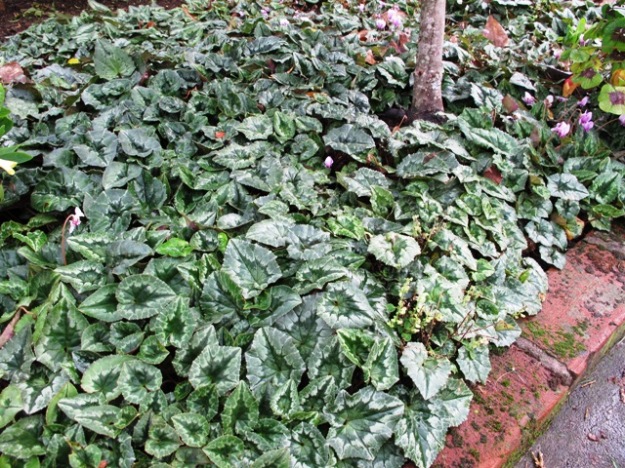
Would an edging of mondo grass really improve this bed of cyclamen which is already defined by brick edging and mowing strip?

Would an edging of mondo grass really improve this bed of cyclamen which is already defined by brick edging and mowing strip?

Yes, defining lines and shapes in the garden by ribbon planting the same plant is a tool, but only one tool and not a compulsory one at that. I had hoped that the advent of buxus blight with the unfortunate result of a whole lot of dying edging plants might encourage a rethink on their role by many gardeners. Alas that does not appear to be the situation, judging by the frequent searches I see for alternatives to buxus. Many people are simply looking for a suitable plant to use instead rather than reviewing the role of the little garden hedge.

Formal gardens are planted in stripes and blocks, everything measured so that the spaces are even. It is all about control and maintenance. That is the style. Informal or naturalistic gardens are at the other end of the scale. There is nothing so contrived or tightly managed as a row or an edging stripe. This style is more about emulating Nature, recreating but improving on what occurs naturally. Most of us choose to garden somewhere in the middle between those two ends of the spectrum. As such, we are in good company. That mix is the hallmark of some great gardeners like Vita Sackville West and Gertrude Jekyll.

I just can’t imagine that Vita or Gertrude would have forseen the translation into edgings of mondo grass or bedding begonias. They didn’t ever straitjacket every garden bed and every garden border in behind tidy edges of border plants. Woodland and cottage gardens were spared. Herbaceous borders were allowed to festoon outwards over the wide mowing strips, softening the hard lines. One of the lovely distinctive styles of many English gardens is their use of wide gravel paths (usually a honey coloured gravel rather than sombre grey) with voluptuous plantings allowed to overflow to the path and often gently seeding down.

I admit that I gave myself a shock when I headed out to photograph the Tiger’s Jaw (Faucaria tigrinia) plants which were opening their faces to the sun. It wasn’t until I lined up the photo that I realised I had planted them in a row at the front of that particular garden border. There was a good reason. They are very low growing and will rot out if larger plants flop over them. But a row! I shocked myself. It may just be the only edging row you will find our garden outside of the vegetable patch (excluding proper hedges) but we are in a minority among New Zealand gardens. Pretty much every one I go into these days is defined by the use of edging plants.

Consider grouping the plants, darlings, rather than planting them in single file. You may even like the different effect.

First published in the Waikato Times and reprinted here with their permission.

Garden lore

“A honeybee would have to fly around 100,000 kilometres and visit over a million flowers to find the nectar to make two kilos of honey. As it happens, they can only manage about 800 kilometres before they exhaust themselves and die.”

Niall Edworthy, The Curious Gardener’s Almanac (2006).

Green crops
It is your very last call for sowing green crops if they are to be of any value this winter. Green crops are a time honoured method of conditioning soils. They are a particularly useful tool on heavy soils. These can compact badly when left bare through a sodden winter and then turn to concrete when they dry out again. The roots penetrate the soil and keep it open, making it easier to work when it is time to dig again.

Green crops also slow the leaching effect of winter rains. They take up nutrients which would otherwise be washed away and release these nutrients in the spring when dug in to the soil. Think of them like a nutrient bank.

Recommended practice is to dig in green crops two to three weeks before you start replanting in spring – which means about the beginning of October. If you are not using all your vegetable garden in winter, green crops also look a great deal tidier than a forest of weeds and seedlings. Logic says that forest of weeds will also act as a green crop but you only get the full benefit if you dig the entire plant in later and you don’t want to be digging weeds with seed heads already formed into your ground.

Lupins and mustard are other winter options. Lupin is good for adding nitrogen. Mustard is reputed to kill undesirable nematodes by a form of natural sterilisation. Oats are the quickest growing option and will germinate the fastest. At this late stage, they are probably the best choice.

First published in the Waikato Times and reprinted here with their permission.