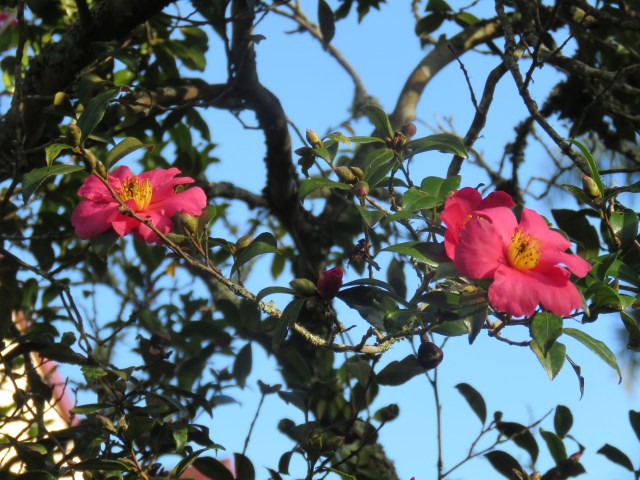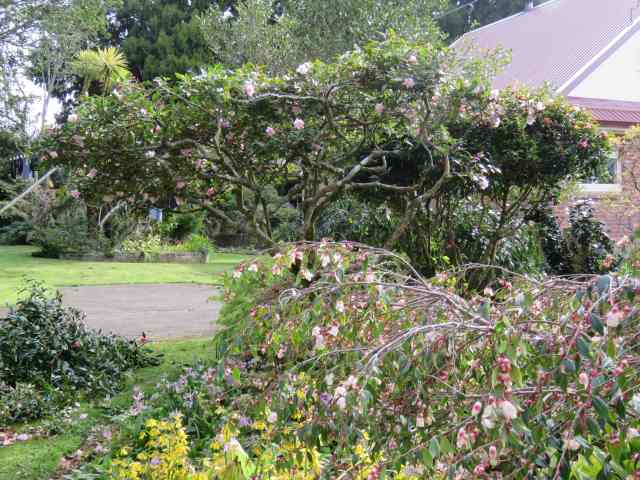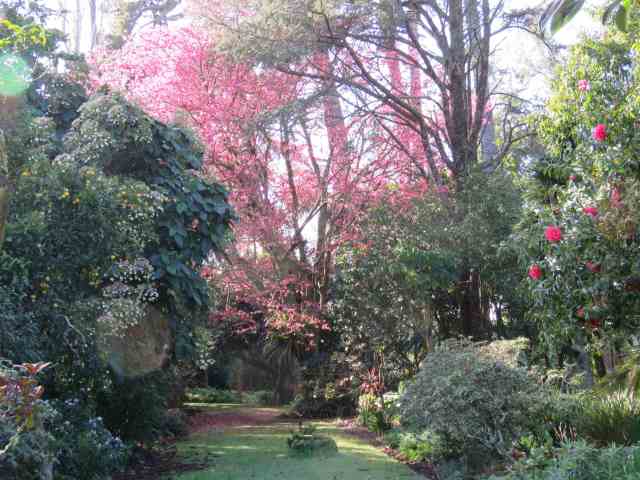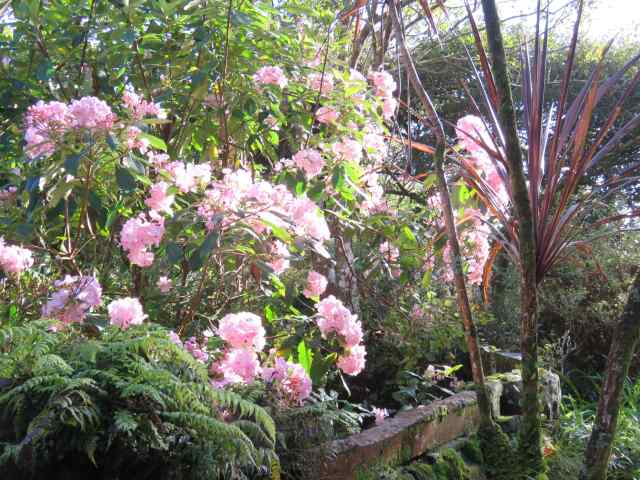

The bright pink Prunus campanulata are controversial in this country because of their seeding ways but this enormous specimen is sterile and doesn’t set seed. The greatest danger is being hit by low flying birds as scores of tui move around the garden.
We are very sensitive about criticism of the climate in our neck of the woods. It is true that other places warm up more quickly in spring, some of us would like another degree or two of heat in summer and spring can be wet and windy. For many years we would cringe as garden and nursery visitors from further north or east would come in, hopping out of their heated cars and shivering, saying how cold and miserable it was here and asking if it was always like this. Or worse, asking “How can you grow such tender material in your cold climate?” One person clearly pushed Mark too far because I heard him reply with a dead pan face that we get out at night with little woolly jumpers and blankets to cover them up.
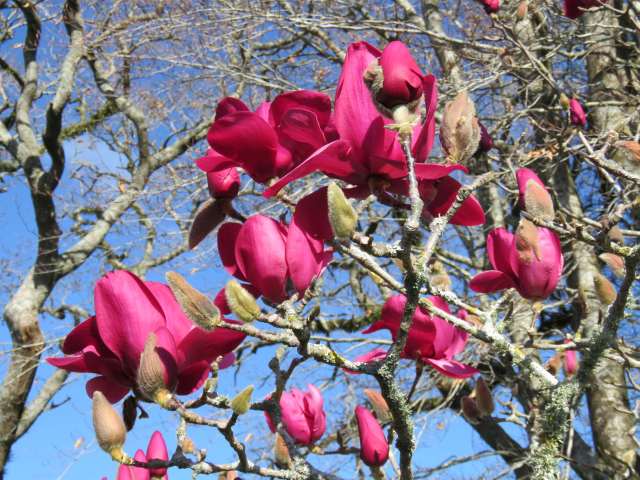
First blooms opening on Magnolia Vulcan, one of our early flagship Jury magnolias
We may not have higher temperatures in summer but we have high sunshine hours and high light levels and that makes a big difference in winter. Of course, it can get cold and we have winter storms as cold fronts move over bringing wind, rain and gloomy skies. But in between, we can get bright blue skies and sunshine for days on end. Right now, in what we deem midwinter and our bleakest month, we still get 10 hours of daylight.
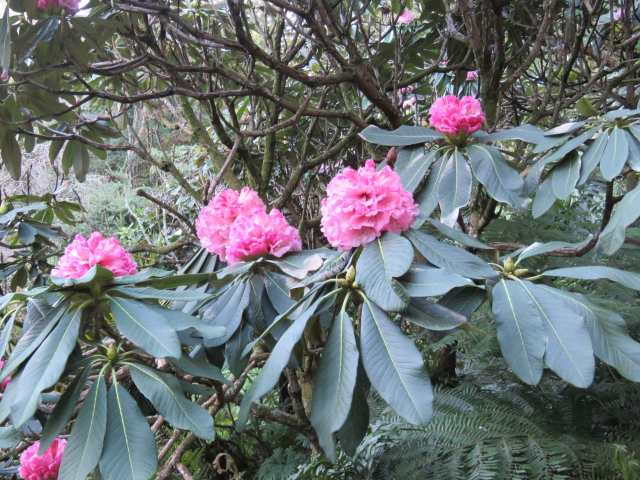
Rhododendron protistum var. giganteum ‘Pukeiti – one of the big leafed varieties that flower early. We also have subtropical vireya rhododendrons in bloom.
This train of thought was started by reading a blog post by Christchurch gardening colleague and friend, Robyn Kilty. Headed ‘It’s winter drear, my dear’, it vividly conveys her experience of mid winter, where low light levels and grey skies suck the colour out of both garden and landscape.
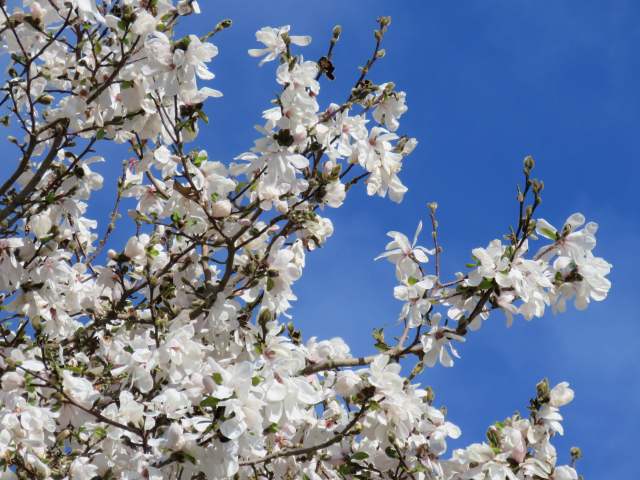
Blue skies a-plenty. With a white magnolia – likely kobus, flowering in a garden down the road.
I have not been to Christchurch in midwinter so I have no opinion on their winter conditions. For overseas readers, we are in the middle of the west coast of the North Island. Christchurch is in the middle of the east coast of the South Island. Clearly our winter experiences are totally different and that is what happens when you live in a country of long thin islands that run north to south, surrounded by vast oceans with no major land masses nearby. There are big variations in climate.
Luculia ‘Fragrant Cloud’ flowers on, undeterred by winter.
Nobody is going to suffer from seasonal affective disorder here in Taranaki. We are at latitude 39° south. If you match that to the 39th parallel north, we correspond to places like Ibiza, Sardinia and a line through California. Not that this means in any way that our climates are similar but it does mean our winter daylight hours are greater, as is the height the sun rises in the winter sky.
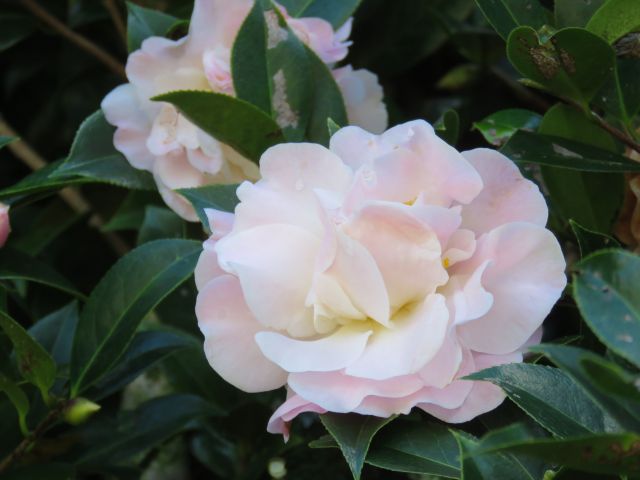
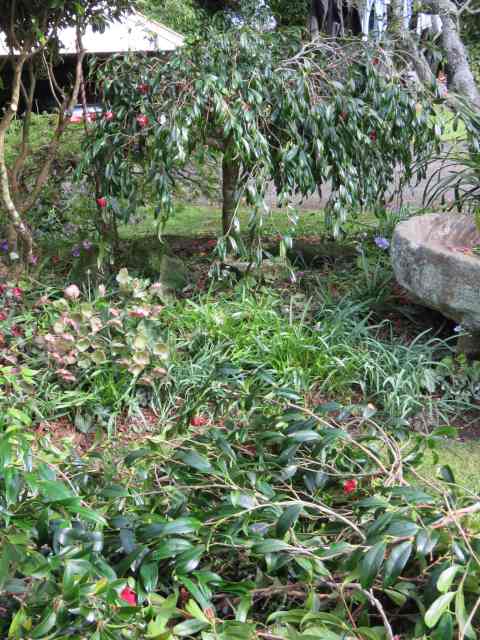
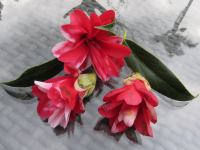
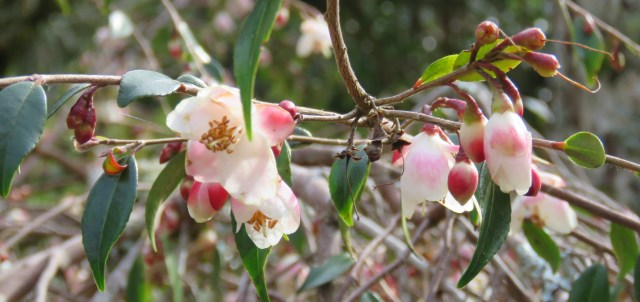
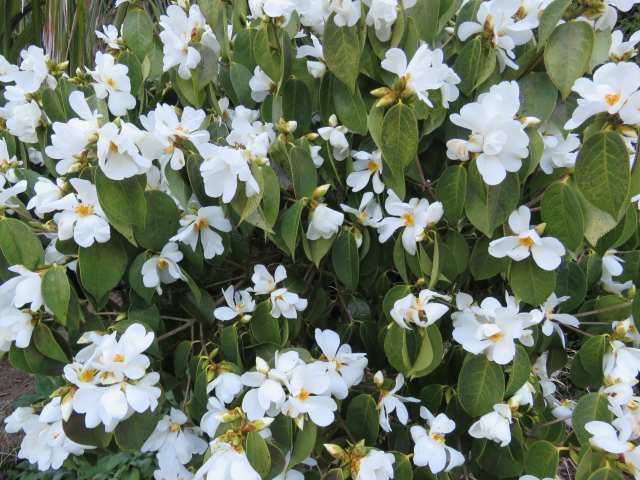
Camellias in bloom – this is Camellia yuhsienensis (syn C. grijsii var grijsii)
We garden all year round. If it is wet and windy or bleak, I will stay inside. I wait until the mornings have warmed up a bit before heading out, retiring indoors when it starts to cool off at 4.30pm. But most days, we are out and about for most of the day. I have a penchant for photographing flowers against blue skies but I don’t colour enhance my photos so what I show is colour as my camera captures it.
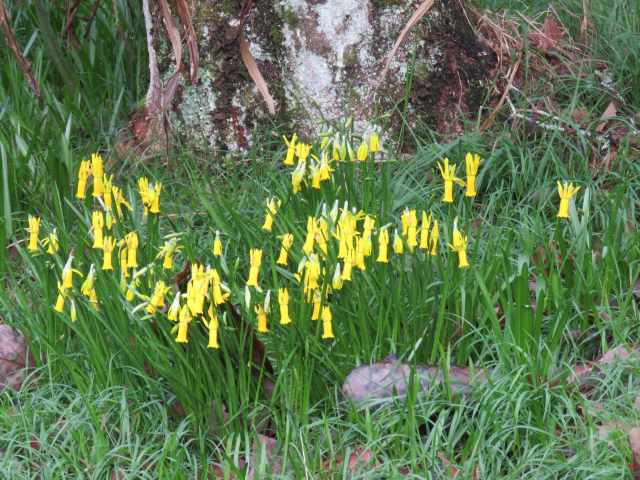
Loads of narcissi in bloom. We mostly grow the early flowering dwarf varieties because they are over before the nasty narcissi fly is on the wing.
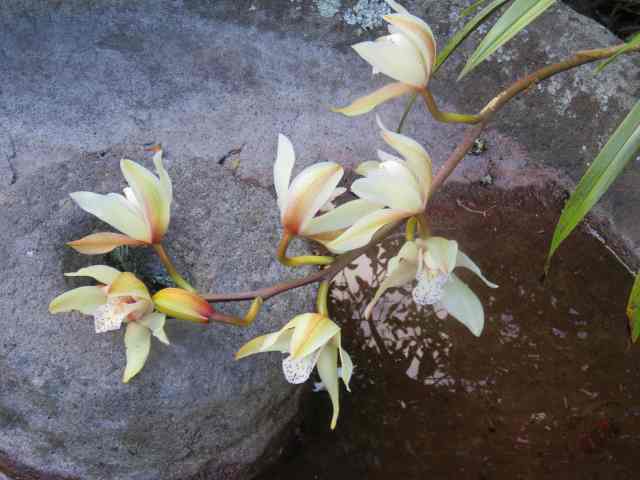
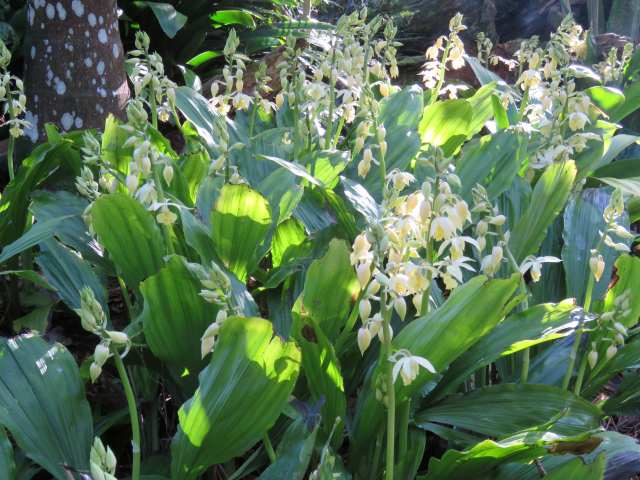
Everybody grows narcissi but not everybody grows orchids in the garden. These are calanthes opening and most of our cymbidiums are already in flower.
Our winters are still filled with colour and flowers. As the snowdrops pass over – their season is but brief in our mild conditions – so much else is coming into flower that I feel that slight sense of panic that I may miss something altogether if I don’t get right around the garden every few days. At least we no longer suffer from anxious pressure at the need to get many tasks done before the garden visiting season starts – on account of us no longer opening the garden, you understand.
There are many worse places to spend winter than here in North Taranaki.
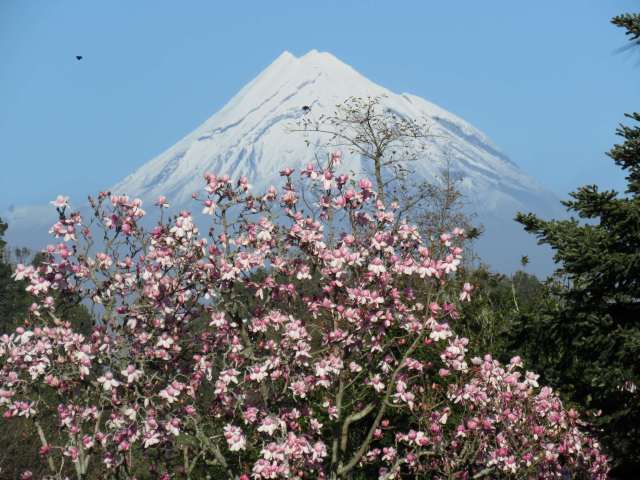
Magnolia campbellii var campbellii in our park. The snow line on Mount Taranaki is high this year, indicating a milder winter than some other years.
From the Ephrussi de Rothschild garden, it was on to the village of Èze and its famed Jardin Exotique. Èze is pronounced somewhere between ‘ezz’ and ‘airz’, not to be confused with the modern, novelty spelling of ‘easy’ – as in the Eze Wash carwash franchise I drive past as I go to town. I feel the village of Èze deserves more respect than that.
A few km north of Nice, Èze is recorded as having been occupied since 200BC. Its long history involves the Romans, Moors, Italians, French, Spanish and Turks. Surprisingly, it has only been formally French since the 1860s. It has attracted so much interest because the fortified village is on an elevated promontory with cliffs on the seaward side and views right around, making it both strategic and defendable. The fortifications tell quite a story.
I assume the brick path through the centre of the cobbled lanes has been laid in modern times to make the terrain a little easier for visitors but the rest of it seems to be largely original. Maybe they laid the modern services of water, drains and wiring beneath the bricks?
The village layout and buildings date back to the early 14th century, although fragments of walls from those BC times, 14 or 15 centuries earlier, still exist. Significantly, there is no vehicle access into the village. Everything comes in and out by hand and manual trolley. Well, almost everything but more on that later. It seems the two hotels in the old village use porters. I laughed when I looked up accommodation in Èze, just out of curiosity. There was a review, clearly of a place by the new town, not the medieval village, and written by an American. “We could walk to the grocery, quiche place, bus, and to the old city of Eze. All the other accommodations I saw were on hilly roads without sidewalks.”
Pretty much the whole of the French Riviera I saw is built on steep hills with uneven terrain, narrow, winding roads and certainly no footpaths outside of urban centres. Every road was a foot path for centuries of occupants here, long before the car was even thought of. This is not a place for people with restricted mobility.
Just a ruin from three centuries ago of a fort that may have been built six centuries ago
Above the village, at the highest point, stand the ruins of a fortified castle, sacked in 1706 by the soldiers of French King Louis XIV. At that point Èze was still under the control of the House of Savoy, so Italian, but largely inhabited by people known as Ezasques. Interestingly, the native dialect of Èze – rarely used nowadays – is most closely related to the Monegasque language of nearby Monaco. I find Europe’s fluid land borders fascinating.
My eye is drawn to all those conspicuous white labels but there is an educational role to play in naming plants for easy visibility.
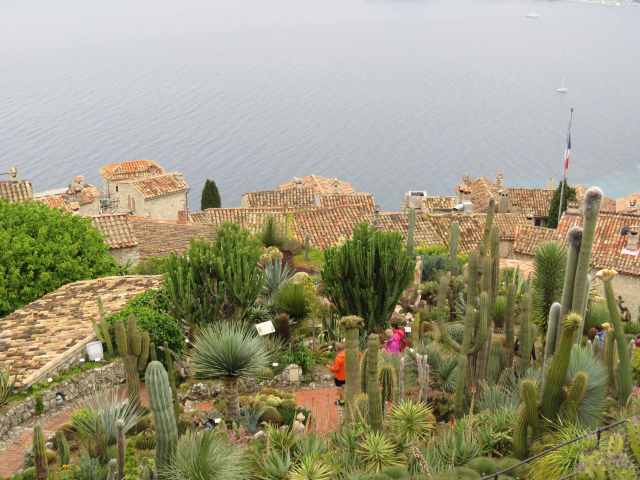
The ExotIc Garden is positively modern because it only dates back to 1949. Just down the road, so to speak, Jean Gaustad had already played a major role in creating the Jardin Exotique de Monaco. The mayor of Èze apparently thought it would be a good idea for his area too, as he is credited with a role in creating the Èze garden. Conditions are tough – exposed, coastal, precipitous, rocky, windy, very dry and hot in summer. What grows in those conditions? Cacti and succulents. They grow very well. I see a note that in getting the garden established, crews of men carted soil up the hill in bags on their backs so clearly efforts were made to give the plants a good start.
I am not a fan of prickly plants in any way, shape or form but they look right at home in these exposed conditions and I was somewhat won over by their textures and colours. Being a designated botanic garden, plants are all labelled. The gardener in me finds my eyes zooming in on those white labels and the aesthetics worry me but labels are the way in public and botanic gardens; private gardens need to make their labelling very discreet or non-existent to avoid looking amenity or municipal, in my opinion.
I felt obliged to photograph the tree fern out of southern loyalty. Truth be told, it is probably the Australian Dicksonia antarctica rather than one of our NZ species. It seems to be more widely available in Europe and Australian plants were being widely grown in the area whereas NZ plants were rare. But you know, we claim all tree ferns as ours, in an inclusive sort of way.
When I say a long way down, you can see the coach park in the centre, below the church.
As I understand it, Bono’s French pad is somewhere down below at sea level. It is quite a bit further down than the coach park and new town in the previous photograph.
The setting is amazing with 360° views. It is a long way down, whether on the land side or even further down to the sea. Apparently the Irish rock star Bono (of U2 and social activism fame) has a house down by the sea and the story is that he and his good friend Barack Obama walked up the hill for a drink at the hotel in the old village, somewhat to the surprise of village and garden visitors. All I could think was that if they walked all the way up there from the sea, they deserved a long, cold drink in peace.
The aspect of this garden that did worry me was the answer I was given to how they got large plants and sculptures to the upper levels. I didn’t think they were being levered around the tight lanes and steep steps. Helicopter, I was told, with the additional information that garden waste is also lifted out by helicopter. Surely not? Colour me shocked. In 2024, I would expect garden waste to be dealt with on site in a sustainable way, not loaded into bags to be airlifted out. I hope the information I was given is wrong but I fear it may be accurate.
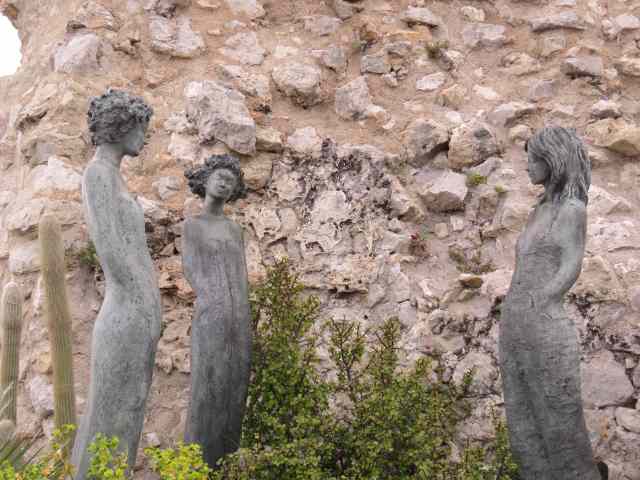
Each figure has a name and a somewhat obscure sign. That is Mélisande to the right above. Others seem to have somewhat eclectic names ranging from Justine or Isis, to Margot, Rose and Anais. I found a blog on line that referenced one named Barbara but I can not vouch for that and, if true, I want to know where the name Barbara came from for the artist.
More classical at La Mortola
The Earth Goddess sculptures were an interesting, contemporary touch. Jean-Philippe Richard started on his earth goddess works in the 1990s. Their elegant, elongated bodies stretch from chunky bases as though emerging from the earth and metamorphosing into stylised interpretations of classical, maybe stereotypical, feminine beauty. They were striking and after my reservations about the cliches of feminine beauty (I kept looking in hope that they may be either androgynous or maybe include some examples of young male beauty) I decided that they were indeed striking and entirely appropriate to the setting. And, in fact, no more cliched than the classical concepts of feminine beauty seen in La Mortola and the Ephrussi de Rothschild gardens.
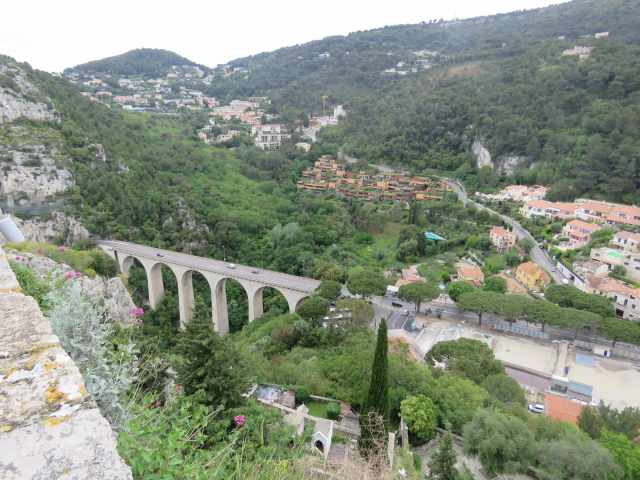
Looking across to a recent housing development
Privacy and green space is possible with good design
Finally, on a change of topic: looking out from the top of Eze, my eyes focused on an interesting example of green high density housing. I don’t for one moment imagine it is cheap – this is the Riviera after all – but it appears that good, modern design can give privacy and some outdoor green space while achieving housing density which blends harmoniously into the surrounding environment.
As seen in the middle of the photograph – blending into the wider landscape.
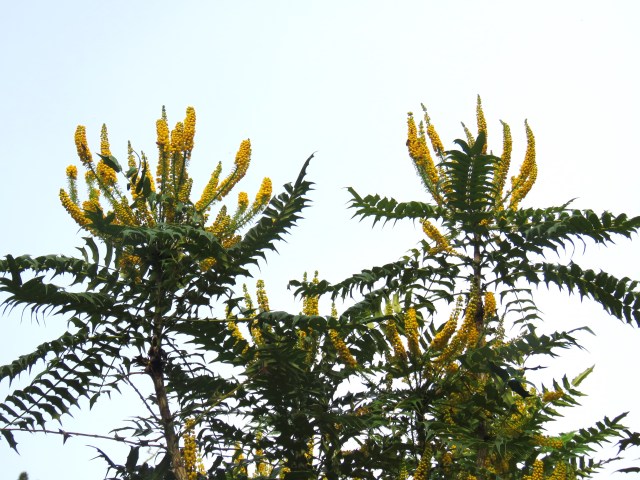
Mahonia. Which one we don’t know. Neither of us has ever been interested enough to look into the different mahonias but this one does put on a good display in autumn and is alive with the hum of bees.
I had cause recently to look up how many years I spent writing weekly for newspapers. EIGHTEEN YEARS, first for Taranaki Daily News, then adding the Wanganui Chronicle and finally the Waikato Times. You could knock me down with a feather. It is so long ago that I started by faxing my articles to the paper. There are children alive now who don’t even know what a fax machine was and how magical it was for its brief office reign. No wonder I have such a big back catalogue of writings because on top of the newspaper contracts, there were shorter stints with magazines.
More of the mahonia
The high point was probably when a survey conducted by one of the newspapers had readership of the garden pages (where I was the main contributor) ranking higher than the sports pages. You would never guess that by the current invisibility of gardening in the media and the amount of space and time still given to sports coverage. But times change.
There are times, I admit, when I feel I have nothing left to say that I have not written before and I wonder what I can photograph that I have not shown before. Quite a large part of that is the result of our personal world becoming so much smaller. I have always relied on seeing gardens that are new to us, new landscapes, talking to more people for the stimulation of new perspectives. The last time we did a major trip overseas – I don’t count Australia as overseas – was 2017. Covid saw us cancel our 2020 plans.
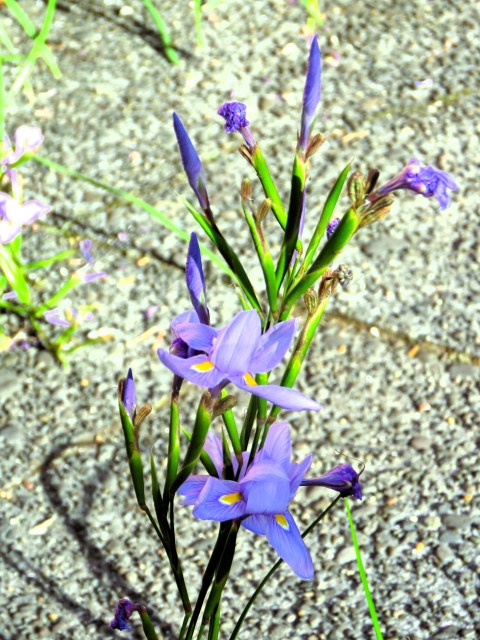
Self-sown Moraea polystachya just out from the back door. it is probably the longest flowering of any of the autumn bulbs and belongs in the iris family
I am flying off to the south of France in ten days time, via Barcelona as the closest airport to where our second daughter, her partner and their beautiful baby live across the border. I think it may be my last long-haul trip in the face of an uncertain future with climate change and geopolitical upheaval. I haven’t been to that northern corner of Spain or any of the south of France so I expect to be invigorated with new sights and experiences. We have scheduled Gaudi’s Park Güell for the day after I arrive.
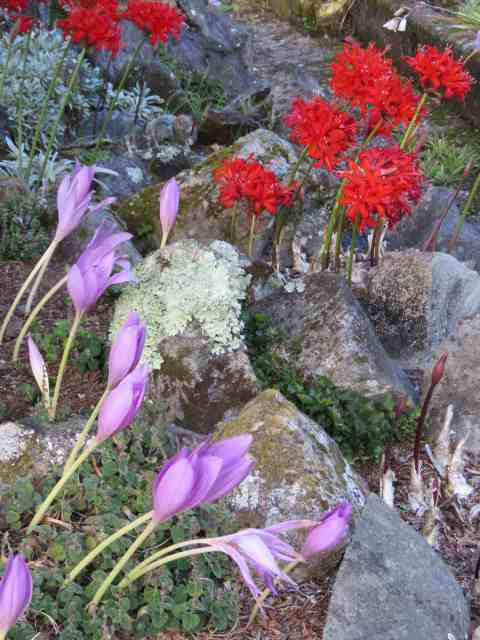
The rockery is bursting with colour as it hits its autumn peak.
In the middle of my trip, I am heading east, to what used to be known as the French Riviera. There I am joining a six day tour of the gardens in the area around Nice, starting with Lawrence Johnson’s indulgence called Serre de la Madone. Johnson is most famous for creating the garden at Hidcote Manor, which which just blew our minds when we first saw it, back in 2009 I think. At the time it was, quite simply, everything we aspired to with our own garden. In the years since, our directions have changed and I doubt that we would respond so intensely now but I have always wanted to see his French garden which is, I believe, very different to his English one.
I expect to return stimulated and inspired from seeing these largely classical French gardens with forays to Monte Carlo and across the border to Italy. Crossing borders in Europe never fails to delight me, as a New Zealander whose nearest neighbour is a minimum 3 hour flight away. I am anxiously watching the situation in the Middle East and the flooding in Dubai because I am flying that way. For overseas readers, to get to Europe or the UK from here involves two long-haul legs. We can do it via USA or Asia with with two flights of 12 hours each, give or take. Or we fly via Dubai or Doha and that starts with a non-stop 17 hour flight from Auckland, followed by a shorter second leg. That 17 hour flight is quite a lot … a lot of something, probably endurance.
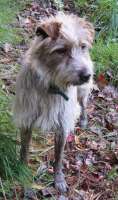
Back to more local concerns: this path of pavers marks a degree of resignation to the inevitable. Ralph had established a speed track across the bed – the shortest distance out to the carpark. After all, he needs to respond quickly to any vehicle or strange voices because, you understand, he is never sure whether it is a maniacal axe-wielding man intent on doing harm or the lovely electricity meter reader who feeds him dog biscuits. Speed is of the essence.
I debated about trying to block him off but he would jump any barrier up to a metre high and the potential for injuring himself on bamboo stakes is pretty high. I think we can conclude Ralph won that round.
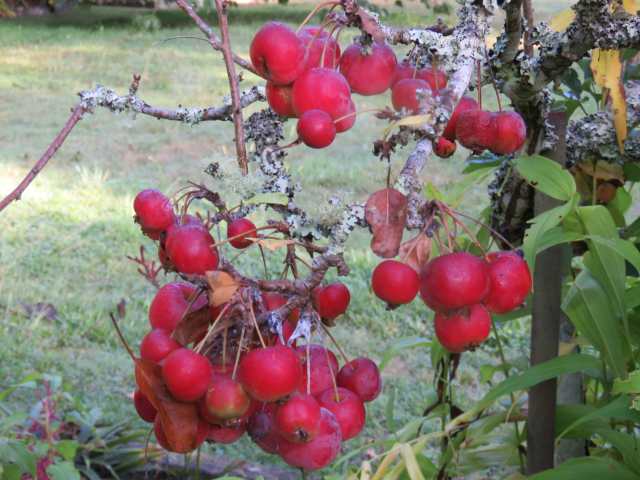
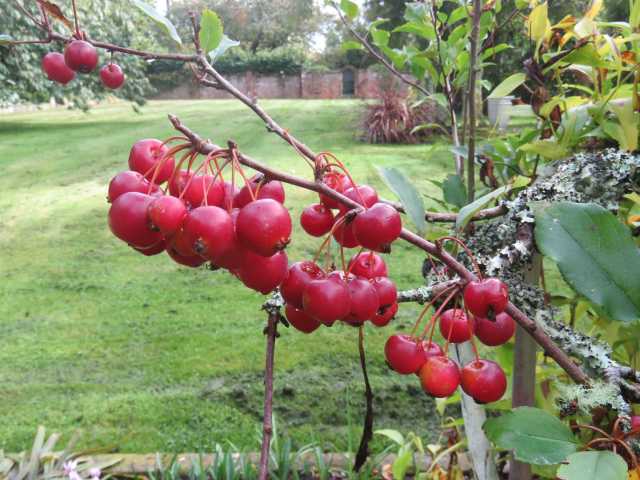
A dwarf crabapple in the rockery . Its name is lost in the mists of time but in all the decades it has been there, it is still only a metre and a half in height.
Despite my intentions, life has got in the way and I have not been out and about visiting gardens and artist’s studios open on various trails this week in Taranaki as much as I thought I would. But I did get to three gardens on Thursday, which is about my limit for a day.
How to completely screen your neighbour’s house from view when it is very close – at Three Elms
First up was Three Elms, in New Plymouth which exceeded my expectations. The owners, Shane and Lisa McNab, have always credited us with inspiring them to garden – albeit several decades ago – and they tell me they made their first plant purchase from us. It was a pot of rhodohypoxis. They have clearly learned a huge amount in the time since.
It takes a lot of skill to manage a very steep section but Three Elms show it can be done in such a way that the changes in level seem effortless
Three Elms is a town garden on a section that is not large but started out as a steep challenge. It is a due to their hard work and thoughtfulness that the gradient is no longer a problem. They have created small terraces with fairly easy transitions between them, belying the original slope and making moving around the area straightforward. Talk to Shane, if you visit, about the lengths he had to go to installing the large boulders and rocks that are used extensively. They are a feat of determination and physical effort.
That is a tropical cordyline, believe it not, with strelitzia, a dwarf maple and a palm.
The hard landscaping provides the framework but it is the plantings that star. As they should, in my opinion. Pretty much every square metre has been carefully thought about and tended with skill and care over many years and it shows in the plant selections, the health of the plants and the harmonious combinations. There are a lot of bromeliads but it is not only bromeliads, by any manner of means.
A nod to Japan makes use of a challenging space between the back of the house and a ponga (tree fern) retaining wall.
Gardens are only work if you don’t enjoy what you are doing. Three Elms has had a lot of time, thought, skill and – yes – love given to it over many years and it shows. If you are out and about garden visiting locally this weekend, go and see it.
Hurworth Country Garden
Hurworth Country Garden also delighted me. I had been to an event there late last year but events distract from looking at a garden and I wanted to have a better look. I was about a third of the way around it when I found myself thinking, “This is a really graceful garden” and that is not a descriptor that I have ever used about a garden before.
It is pretty large for a retirement garden situated just beyond the city limits and immaculately presented, but that high level of maintenance doesn’t interfere with the feeling of relaxed charm and space – and indeed, grace. Again, it reflects the skill, experience and thought of its owners, Jan and Graeme Worthington. I do like a thoughtful garden.
I loved the vibrant colour of the raised beds edging to the house verandahs, contrasting with the more subtle colours of much of the rest of the garden.
Jan’s use of colour is subtle but not monochromatic. When I commented on this, she put it down to her experience in quilt making. I haven’t seen her quilts but I imagine they are as immaculate and harmonious as her garden.
I coveted Hurworth’s garden room
They also have one of the loveliest garden rooms I have seen and I do like a good garden room. I didn’t even think to ask how and when they use it when the garden is not open to the public; it is perhaps a little too far from the house to use for summer meals and entertaining but it is the sort of room I could visualise sitting in myself, just to enjoy the ambience and views. Hurworth is a garden with a particularly lovely ambience.
Kowhai Garden
The third garden I went to was Kowhai Garden which has a remarkable collection of rhododendrons – over 900, I believe. It is not just rhododendrons but they are the stars at this time of the year. I entertained myself identifying those I knew, dredging my memory banks from the days when we had a nursery that specialised in the genus. Again, it is an example of how people cope with gardens that include a very steep slope, as much of this large garden has. What stood out for me were the rhododendrons that are thriving in a low maintenance environment – not only flowering well but also keeping good foliage and good plant form. Some are performing much better than others.
Rhododendron ‘Lemon Lodge’
Near the house is an outstanding plant of ‘Lemon Lodge’ – simply the best specimen I have ever seen.
Rhododendron ‘Floral Fete’
Also looking lovely were plants of R.nuttallii x lindley hybrids – these ones are ‘Floral Fete’, the owner, Neil Tapsell told me. There used to be a number of named forms of this cross around including the likes of ‘Mi Amor’, ‘Stead’s Best’ and ‘White Waves’. I am not sure how many are still available commercially but it remains a beautiful hybrid and ‘Floral Fete’ is as good as any of the forms I have seen and arguably better than ‘Mi Amor’.
Here endeth my summary of Thursday’s garden visits. I am hoping to get to see another couple over the weekend but the arrival today of our most beautiful Jury hybrid, our little baby granddaughter accompanied by her mama, may yet derail my plans.
Finally, I add this photo from Three Elms not because it shows much of the garden but I am always interested in how gardeners manage their behind the scenes workspaces in small town gardens. Tidily and discreetly, in this case, I would say. Our behind the scenes spaces are much more expansive and untidy and I am in awe at anybody who can manage to screen and disguise garden service areas so well.
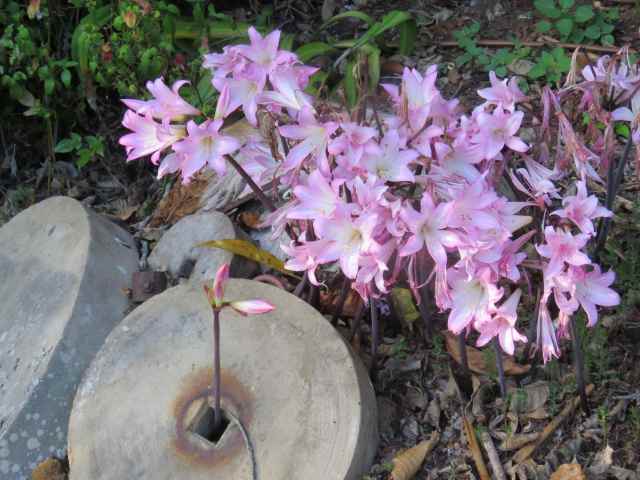
Amaryllis belladonna – more roadside flower than garden plant in our conditions
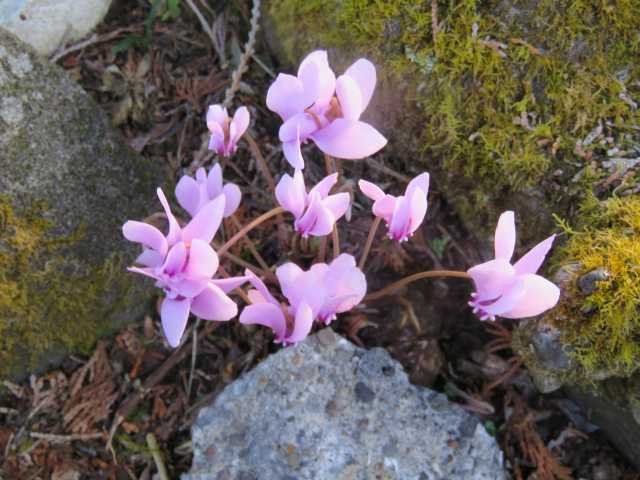
As the calendar moves into March, the autumn bulbs are the first reminder that summer will not be endless. First Cyclamen hederafolium and Colchicum autumnale remind is that the seasons wait for no man or woman. Now they have been joined by the belladonnas and the truly tiny Leucojum autumnale.
Colchicum, not autumn crocus. The foliage is unrelated, being a dianthus
Colchicums are often referred to as autumn crocus but there is no botanical connection, just a visual perception. The best known leucojum is L. vernum or the common snowflake which flowers in spring – a vigorous bulb that is widely found around old house sites that date back to the nineteenth century. The old brick chimney may be all that is left standing but it is highly likely to have clumps of the double daffodils and snowflakes, maybe some violets and a couple of really old camellia trees. For overseas readers, almost all the early European settlers’ homes were built in wood and house fires were common which is why the chimney is the only remaining evidence.
Blink and you may miss the delight of tiny Leucojum autumnale
Little Leucojum autumnale is a very different creature, a fleeting, dainty little flower that has to be measured in millimetres, not centimetres. It is very cute but easily swamped by larger plants if you are not careful. I see it is now classified as an acis, not a leucojum but it may take me a while to remember that. It comes from the western areas of the southern Mediterranean so places like Spain, Morocco, Tunisia and Sicily which are very hot and bone dry but the first autumn rain will trigger the bulbs into their very short flowering and growing season.
Some welcome rain fell this week – 62ml to be precise, which was very welcome after an exceptionally dry summer. Sadly it was followed by the first chill wind of autumn which rather reinforced the message of the autumn bulbs. Summer 2020 is over and we are now entering our long autumn season. I have removed my togs and towel from the swimming pool and put them in the laundry basket although the younger visitors here are still swimming.
What I call English manor house style of twin borders – seen here at Parham House
Cottage garden style as per Margery Fish at East Lambook Manor
Beth Chatto’s dry garden
As the summer borders reach their point of peak profusion, I ponder again how full I want these borders to look. The tradition of herbaceous borders is to have them packed so full that no soil is visible. Cottage gardening encourages the plants to meld and run together whereas herbaceous tradition says that each plant occupies its own space without much intermeshing with its neighbours. And then there is the Beth Chatto dry garden where, even in a mature garden, she kept each plant standing alone in its own space. Mark likes the Chatto approach because it displays the individual plants to their best. It is a style he has used extensively in the more detailed woodland areas. If you analyse the Chatto dry garden, they are predominantly smaller plant varieties growing in very hard condtions (dry river bed with very low rainfall) which could not be further from our summer garden conditions which foster lush and exuberant growth.
I am leaning to the traditional herbaceous position for these summer borders but it is a constant learning process about how each plant variety performs. I want to be able to walk amongst the plants to weed, stake and dead-head and that means knowing how much space to leave between each different clump that they may floof themselves over the space to fill it but still leave me passage between the plants at ground level without tramping on them.
The summer borders here
The bouffy aster needs staking to keep the path clear. I do it very simply and this is not visible when the plant is allowed to flop back
I love this big, bouffy aster coming into flower. We have the more compact version that makes a low carpet in bloom and another similar one that is just above waist height. I am guessing this larger version is a species – or close to it – with its daintier, paler blue blooms that are like a cloud of butterflies dancing on the bush. This year I have had to stake it to keep the path clear and it is obvious I have too much of it too close together for future seasons. Some at least will need to be moved to another area before next summer.
It is a constant learning process but that is what makes gardening interesting. Once a garden is all planted up, most of the gardening activity is simple and repetitive maintenance – outdoor housework, in effect. The interest levels in that are not high. It is the ongoing learning and constant tweaking in search of the impossible state of perfection that makes it interesting. That is how I see it for those of us who actively garden.
As a final comment: the new summer gardens have all been planted following the modern trends of lower labour input and management than the older, more traditional herbaceous plantings of the English manor house style of borders. But they still involve me in quite a lot of deadheading, dividing, staking and cutting back. I enjoy doing it but it is certainly more than I originally anticipated. My gardening nirvana may be when I have tweaked the plantings to the point where such a high level of intervention is no longer required.