Tag Archives: gardening

Garden lore

” There are some botanical names that are teasers. Where the Polish discoverers or Russian explorers come upon the scene the result is apt to be an appalling jungle of horrors. Michaux, Stribnry, Przewalsky, Tchihatchew are responsible for some real jawbreakers; and when it comes to Michauxia tchihatchewi, exhausted humanity gives up in despair.”

My Rock Garden by Reginald Farrer (1907)

Just a few of my aged concrete pots - far too heavy to use with ease

Just a few of my aged concrete pots – far too heavy to use with ease

Making your own plant containers

I was looking at step by step instructions for DIY concrete pots in a NZ publication and have one word of advice: don’t. I inherited concrete pots from my in-laws, made in the days before mass produced ceramic pots became so cheap and widely available. They look aged and anonymous but over the years, I have found I use them less and less because they are just too heavy to be convenient. If you want that aged look, go back to hypertufa which has been used since 1930 to recreate a weathered stone look. There is plenty of information on the internet but the general recipe for hypertufa is 1 part cement to 3 parts aggregate (often a mix of perlite, peat moss or river sand). It is no more bother than making pots completely out of concrete but much lighter to handle.

First published in the Waikato Times and reprinted here with their permission.

Plant Collector: Hydrangea serrata “Preziosa”

Hydrangea "Preziosa" - generally colour stable in all soil conditions.

Hydrangea “Preziosa” – generally colour stable in all soil conditions.

In the world of summer flowering shrubs, hydrangeas are surely king. There are many others beyond the common macrophylla types and the serrata family from Japan and Korea are perhaps a little more refined. Certainly they are smaller growing and perfect for semi shaded positions. “Preziosa” is a hybrid but predominantly of serrata lineage. It is a smaller moptop – the pompom type of flowers. Two factors set it apart from many others. Its colouring is not affected by soil type and its flowers change colour as they age so you get a range of different colours on the one bush. They open green, changing through yellow tones to cream, fading to white with pink tinges on the petals, then deepening to pink shades and ending up dark cherry red. It also has attractive red stems and the foliage is often tinged red.

“Preziosa” is a not happy in full sun and it particularly dislikes hot, dry conditions. I moved these plants from an area where there was too much root competition from surrounding trees and they perked up enormously in well dug soil with plenty of compost added but still in open shade. They reach about 150cm in height and a metre wide, making them a good option for smaller, town gardens.

First published in the Waikato Times and reprinted here with their permission.

Lower maintenance gardening

Do away with island beds in the midst of the lawn if you want to reduce maintenance

Do away with island beds in the midst of the lawn if you want to reduce maintenance

I thought I would spare readers from the New Year’s gardening resolution column. Most will resolve to weed more often and keep their garden looking tidier, only to fall by the wayside very quickly. So it is onto lower maintenance gardening this week.

Note the qualifier – lower maintenance. I don’t think there is any such thing as low maintenance gardening. These are mutually exclusive concepts. The only way to eliminate gardening altogether is by living on the upper floor of an apartment block.

You can do away with plants and pave, seal or turf your entire section but that should not be confused with gardening. Nor does it eliminate all maintenance. Paved areas need attention. Weeds will forever pop up in any cracks or gaps. Dust and grit accumulate and need to be swept or blown away. Shaded areas will grow moss and lichen and may become slippery. There is nowhere for the family pet to do its business.

You can grass out your section but it will need mowing. It will need a whole lot more than just mowing if you want a proper lawn. Maintaining even a half way decent lawn takes a surprisingly large amount of time and effort. But at least you can get a lawn mowing contractor in and trust him or her to get the grass down. But that is not a garden, either.

Gardens have plants and plants are tricky, messy and unreliable living organisms. They grow. They drop bits. Some grow too well, others not well enough. They also have the capacity to delight and to surprise, to soften a view and to blur the hard edges, particularly in an urban environment. It is about much more than just feeding the body by growing edible plants. You can wrap it up in a spiritual framework if you wish or you can be more prosaic in your terminology but the bottom line is that it is a rare person who remains oblivious to the beauty that is in nature and plants are integral to that. Most of us are driven to recreate some of that nature in our immediate environs. And if you want to stay on good terms with neighbours, an ugly wasteland is not going to do it.

So, to dispute some common myths about low maintenance gardening.

  • Evergreen plants are not low maintenance. They still drop a full set of leaves every year. They just do it gently all year round rather than in one big hit like deciduous plants.
  • Vegetable gardening is probably the highest maintenance form of gardening there is. Forget any advice that you can have a low maintenance yet productive vegetable garden.
  • Similarly, you can’t just plant an orchard and leave it, expecting to harvest fruit in season. Most fruit trees require regular attention; some require a great deal of care.
  • Simple gardens or formal gardens defined by sculptured plants (hedges and the like) are not easy care. They depend on pristine maintenance for their effect. It is like doing the housework but outdoors and no sooner have you done it than the wind will blow or the plants will grow. You can’t keep the outdoors static.
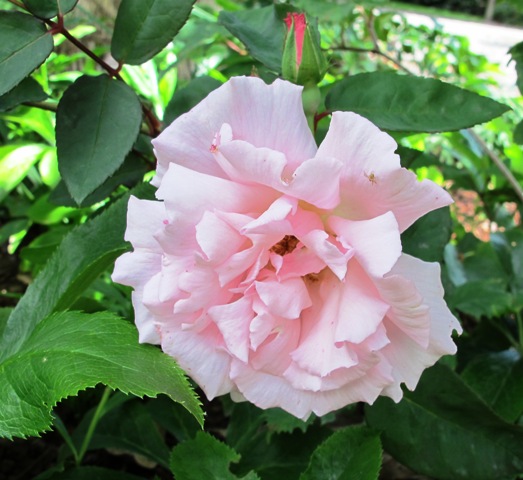
Roses need more care than many other plants if they are to look good

Roses need more care than many other plants if they are to look good

If you want to reduce your workload however, there are certain things you can do.

Shun plants which need staking each season if you want an easier care garden

Shun plants which need staking each season if you want an easier care garden

  • Don’t have island beds and specimen trees or shrubs sitting in the middle of the lawn. It is easier to do a clean sweep with the lawnmower than to be weaving around curvy obstacles. It also cuts out the potentially messy edges you get around island beds.
  • Reduce the number of itsy bitsy little beds and plantings that you have. Keep the lines simple.
  • Reduce the number of plants you have growing in pots and containers. These take quite a bit of effort to keep them looking good, as evidenced by the number of sad, neglected, even dying plants you can see all round different gardens.
  • Weed thoroughly and then lay a weed free mulch to suppress further germination. Try and get weeds before they are large enough to set seed and remember the old adage: “one year’s seeding, seven years’ weeding”.
  • Leave enough space around plants to be able to use the push hoe and if you haven’t got a push hoe then get one, learn how to use it and keep it sharp. You can then do the summer weeding without bending – but only if you do it before the weeds set seed. There is no point in hoeing out weeds and then leaving them lying on top if they are going to spit out their seeds on the spot.
  • Do away with plants which require frequent attention to keep them looking good. The prettiest but worst offenders are probably roses and wisterias. Most plants will need a little attention once a year, but some plants need much more than that. Similarly, do away with plants that need to be staked to stop them flopping all over the place.
  • Do not garden in such a manner that you have to water frequently in summer.

When I used to pay someone to do my housework, I felt privileged but not ashamed. The same goes for gardening. If you don’t get pleasure from doing it yourself and you can afford it, pay someone else to come and do it for you. A lovely garden is a joy to all, but getting there is not always fun.

First published in the Waikato Times and reprinted here with their permission.

Meadows, prairies and wildflower gardens

041
We gave our eldest a particularly good book on American wildflower and prairie gardens for Christmas and her eyes lit up. It seemed a moment of triumph in parenting which I have not seen recorded before – the age when children of gardening parents are delighted to be given such a gift. There was a touch of envy from us. It was a lovely book but also a gardening genre which is largely beyond our reach.

Prairie gardens and meadow gardens are not compatible with good dairy country so this garden style is likely to be unattainable for a fair swag of readers too, but it doesn’t mean we can’t admire it elsewhere. Dairy country by definition has high fertility and good rainfall along with temperatures that are mild enough to grow grass strongly all year round. That is not prairie territory.

Our eldest lives in Canberra which offers perfect conditions. It has low rainfall, low fertility and is very cold and dry in winter (which stops pretty much all plant growth) and very hot and dry in summer. Pasture grasses and weeds will not overtake the chosen plants. Annuals and perennials will not romp away with lush growth that gets flattened here by frequent heavy downpours. Instead, plants will hang in and grow slowly, tenaciously putting down roots in search of elusive moisture and sustenance and flower stems will be much shorter and sturdier. Prairie conditions, in fact. So it is perfectly realistic to think that one can create a garden sward of tough perennials and ornamental grasses which will sway in the wind and put up a succession of blooms over a period of several months.

074

Essentially a meadow garden is made up of wild flowers as close to their natural form as possible, often natives. This means shunning modern, sometimes over-bred hybrids which tend to go for much larger flowers and compact, bushy growth. A meadow garden is simulating the wild but modifying it to a garden setting. There is a long tradition in English gardening and the routines are well known. It relies on low fertility to keep down competing grasses and the parasitic plant referred to as Yellow Rattle is often introduced because it weakens the roots of grasses.

At the end of the season in autumn, the meadow is mown and left to lie for a week or maybe two. This allows the seed to fall out of the spent plants. After 10 days, the mown area is raked free of the cut vegetation to keep fertility low. The area is then left to come again the following spring.

Can you imagine doing that in dairy country? It will not work.

076The advice I saw in a NZ magazine, which I will not name here, to sow your wildflower garden into an area which you have cultivated and fed to the max with proprietary fertilisers and then to sow again in mid season if it starts to pass over is not a wildflower garden at all. It is simply mixed annuals.

Introduce grasses to the mix along with at least some North American native flowers and your meadow garden becomes a prairie garden, more or less. Cone flowers (echinacea), ox-eye daisies (Heliopsis helianthoides), monardas, Californian poppies (properly called eschsholtzias but I have to check the spelling every time) – North America is rich in wildflowers. The prairie garden has been embraced by contemporary European and UK gardens and designers and I can see why. Clumps of grasses are deathly dull when planted in groups or when mass planted to achieve the motorway embankment look, but take on huge charm in the company of a wide range of flowering plants, both perennials and annuals.

What characterises both meadow and prairie gardens is an absence of woody plants, an absence of layers (plants tend to be of a similar, low height), a higher tolerance of weeds and seasonality – in winter there is no garden at all to speak of. It is a much more relaxed style, hugely different to how many of us choose to garden. It can also be environmentally sound, especially in harsh climates, because it provides food for birds and insects while anchoring the soil in windy conditions with no fertiliser inputs or spraying.

In season, such gardens are infinitely charming in all their manifestations. It has a lot to do with the simplicity and the relaxed style. We are still wondering whether we can manage something similar here in a new garden we have planned but we are fighting nature and will have to choose plants carefully as well as overcoming our ingrained antipathy to weeds and a belief that gardens should look good for all twelve months of the year.
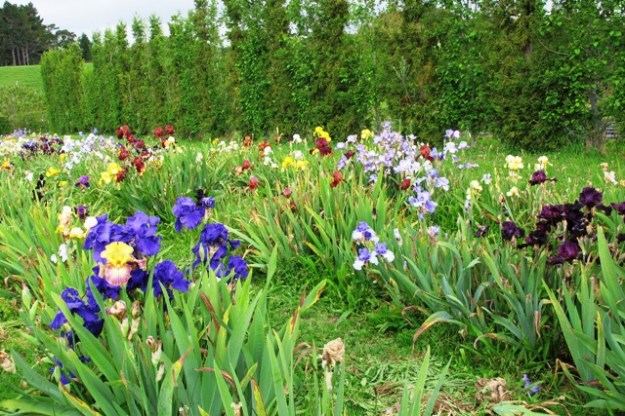
045

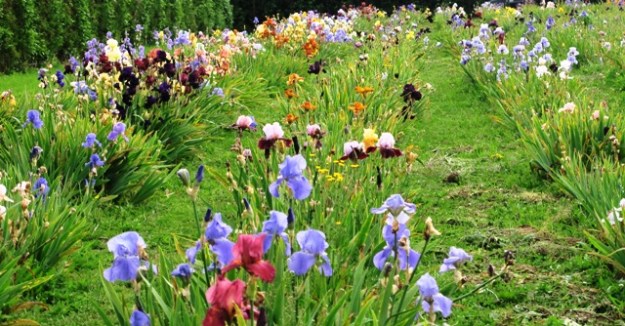
Earlier last month, I visited a field of bearded iris in flower. I don’t want to overstate the case. It was a nursery (http://www.theirisboutique.co.nz/) growing the iris rhizomes in rows in a field and there were a fair number weeds, to the embarrassment of the owner. It was also an absolute delight which made me smile.

It is the simplicity of an expanse of flowers in a field situation which appeals. Gardens do not have to be heavily designed and intensively maintained with high quality permanent plantings of trees and shrubs to make one’s heart sing.

First published in the Waikato Times and reprinted here with their permission.

A pedestrian matter

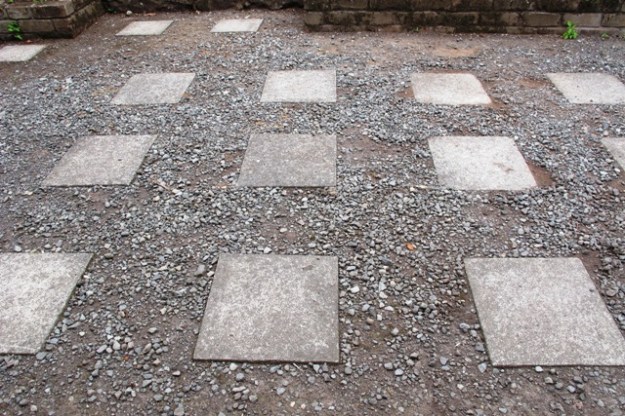
The chequer board approach (in need of a gravel top up)

The chequer board approach (in need of a gravel top up)

This morning’s column is for readers on low budgets or in mature gardens. Path surfaces. If you are on a new property which has been landscaped, or what passes for landscaping, odds on your paths are in place and are concrete. We just love the utility and endurance of concrete in this country.

New concrete dries to a somewhat startling white which is usually appropriate to a new build, but can look garish and out of place on an older property. It also leaches lime for the first few years so you are likely to have trouble growing plants such as rhododendrons and camellias alongside it. The foliage will go yellow on acid loving plants.

Aged concrete softened at the edge with prostrate thyme

Aged concrete softened at the edge with prostrate thyme

Because we have a fair amount of old concrete here, where we have chosen to go with extending concreted areas or new paths, we take the trouble to mask the new look. Adding colouring (black oxide) counteracts the whiteness. Once it is all smooth and starting to start dry, we spray a sugar and water solution over the top. That strips the smooth top layer and exposes the aggregate. Voila. The concrete looks aged from the start.

Were we English, we would have a tradition of flag stones and stone pavers. We are not, so they are a very expensive option. You can get a similar effect in concrete pavers which come already roughed up and coloured to give the overall impression of stone. It’s a good product. We have used it to pave a small courtyard and the same style of pavers were used in a modern outdoor dining area I featured on this page a fortnight ago. The larger sized pavers look better if you want the flagstone look. Ours are 600mm square.

I don’t recommend brick unless you live in a dry climate. Old bricks are porous which means they soak up moisture and retain it, enabling moss to grow very nicely thank you. Brick paths tend to be extremely slippery for much of the year and therefore hazardous. It is also difficult to get a relatively even surface and if you don’t construct a solid edging, the side bricks roll out.

Gravel paths are usually best retained with a solid edging to reduce spilling. We have used concrete sidings on ours. We like gravel paths. There is something satisfying about the scrunch as you walk along them and they are softer on the eye than unforgiving concrete. They are not as simple to install as they first look, however. You can’t just pile gravel onto the ground because the mud will rise from below. You need to excavate down to lay a compacted base course first before you top with your choice of gravel. For foot traffic, a 5cm base should be fine. Don’t lay the top gravel so thickly that it makes walking difficult. You also need to choose your gravel with care. Rounded stones can be like walking on marbles but you want a grade which is reasonably consistent (in other words it has passed through a screen) to look attractive.

Gravel can be quite difficult to keep looking smart without a leaf blower. We did it for years with a leaf rake to remove the build up of litter but it is labour intensive and doesn’t do a particularly thorough job. The leaf blower removes humus in a trice and we wondered why it took us so long to discover its merits. However it is a noisy and intrusive machine and your neighbours will come to dread it as much as your lawnmower. A certain amount of gravel will get blown into the surrounds too.

If you have a larger area to cover, placing pavers at regular intervals throughout a gravel area can add interest and style cheaply. To look good, measure the placement of the pavers to keep them regular and put them down before you lay the top layer of gravel.

We have not gone with wooden walkways at all. In our garden, they would make us look too much like an institutional or public garden (“the DOC look” as we call it). Having seen them elsewhere, I would comment that even corrugated decking timber can get slippery if it is wet for protracted periods or in shade areas and it can be particularly hazardous on slopes. There are non slip products you can buy to secure to your wooden paths or steps but they will add to the cost. If you are not a public garden, then I think wooden walkways tend to be a better aesthetic fit to a modern house with acres of timber decking.

Mulching the leaf litter for the most pleasant walking surface of all

Mulching the leaf litter for the most pleasant walking surface of all

In woodland areas, we keep a thick layer of natural mulch on paths and we shun hard edgings because we want a natural look. In the last few years, when we groom up for our annual spring garden festival, we have gone a step further and raked up the all the litter and fed it through the mulcher. What comes out is a consistent grade of anonymous brown mulch which we then rake back over the paths. It gives the softest and springiest surface to walk on. While it doesn’t compact down, it is remarkably durable as long as it doesn’t get washed away and it can be maintained with a leaf rake. It looks really good until autumn when we get both wind and fresh leaf drop so it is not a long term solution but it gives an attractive option for wooded areas without expenditure.

Some level of consistency is desirable. No matter what size your garden is, you probably don’t want to be using a whole range of different path surfaces. They don’t all have to be the same and paths can differentiate between high use, formal and informal areas. But the overall effect will usually be more cohesive if you can keep some level of uniformity.

First published in the Waikato Times and reprinted here with their permission.