Tag Archives: gardening

Garden lore

If your relatives are coming for Christmas and you are worried about the state of your garden, prioritise. You don’t have time to clean up the lot so take a leaf out of the garden openers’ book. Hedges, edges and lawns are what present a garden well. Clip any wayward hedges, cut your edges to give sharp lines and mow your lawns (but not too short). Sweep hard surfaces and, if time allows, clean up the bit that people see first (usually around the letter box or entranceway). Only keen gardeners or those determined to find fault will see beyond that veneer of presentation. The rest will see tidy, sharp lines and not even think to look at the weed infested garden.

The Terminator of the World of Weeds?

A free sample for review! The terminator of the weed world.

A free sample for review! The terminator of the weed world.

It is not in the job description for garden writers that freebies are included. In all my years of garden writing, excluding books for review, I could count such things on the fingers of one hand. I only mention this because I once found out that the wine writer for a provincial newspaper received boxes of samples to his door. I was so jealous.

Imagine my excitement when something arrived. Even more excitable was the accompanying publicity sheet which proclaimed “hasta la vista” to weeds when using (wait for the drum roll) Weed Weapon. Yes folks, I had a convenient spray bottle of weed killer in my hands.

First up, let us be clear. Despite the name of the company that produces this product being Kiwicare, which sounds so wholesome, there is nothing organic about it. It is a new twist on an old standby which is glyphosate (formerly sold only as RoundUp). Forty years of experience tell us that of all the herbicides around, glyphosate is as close to safe as you can get. It could be argued that it has revolutionised the way we think about gardening and lowered our tolerance for weeds. Glyphosate has often been described as the equivalent of a labour unit because you can whip around with a knapsack on your back and cover a large area very quickly.

We use glyphosate here and Mark has always dreaded the day that it may be found dangerous because we could not maintain the standard we want in our garden without it. He has kept an eye on the research and there is no hard evidence that it is damaging or dangerous. This is because it does not accumulate and it breaks down very rapidly on contact with soil or water. It does not cause cancers, it does not appear to harm insect life and basically you would have to swallow a fair amount of it undiluted to cause yourself any harm.

It was a very different story with earlier weed killers. Paraquat was and still is used in some quarters as an alternative to glyphosate. It knocks down plants within hours of application and its environmental bill of health is not too bad. It is also the main tool with which to commit suicide in third world countries because it is cheap, readily available, has no antidote and you need very little in order to cause a deeply unpleasant death. Its dermal toxicity (in other words the ability to be absorbed through the skin) is very high which makes it dangerous for gung-ho home gardeners.

Back to Weed Weapon, which gives the quick hit of Paraquat, apparently without the dangers. One of the problems with glyphosate is that it takes a long time to be sucked into the plant’s system and to kill it. This is temperature related so it can be about seven days in summer and anything up to three weeks in the depths of winter. In that time, some weeds have the capacity to set viable seed. Weed Weapon’s active ingredient remains glyphosate, at 7.2 grams per litre. As far as I can see from Monsanto’s website, this is at the weaker end of dilution rates best suited to quick growing annual weeds and grasses. What makes the difference is the combination with saflufenacil which is a recent addition to the weedkiller range. It is this that gives the knockdown, browning effect on weed leaves within hours. I did a bit of a search on this saflufenacil but the papers Google pulled up were all highly technical and well beyond my very limited high school science. The publicity from Kiwicare blinded me further with science (Protoporphyrinogen Oxidase inhibitor) but it will have been approved for sale by the appropriate New Zealand authorities. It is claimed that it is biodegradable in soil. I mention this because we know glyphosate is but sometimes, when different chemicals are combined, the result can be less predictable than just the sum of the parts.

At least the pesky equisetum is dying

At least the pesky equisetum is dying

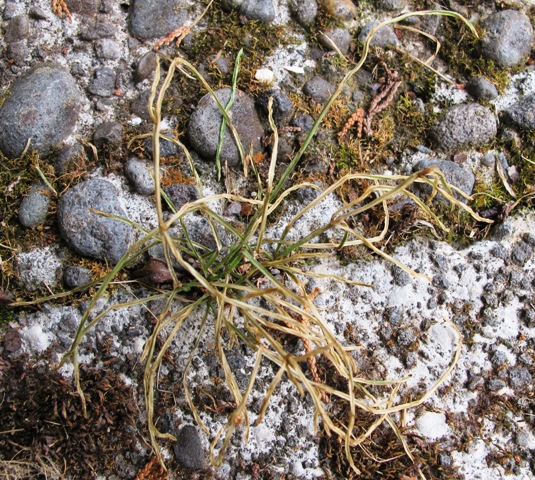
What I can tell you is that Weed Weapon in its ready to use form is perhaps worryingly easy to use. It comes in a squirty bottle like window cleaner. It requires an accurate aim because if you catch other plants, you may kill them too. It certainly knocks down most plants quickly – the dying process is visible within hours. You will be paying for convenience. It retails for around $20 for a one litre squirt bottle. For me, its most useful application is killing out a nasty, invasive equisetum which wriggles out between rock walls but resists being pulled out with its roots. Paraquat users would be well advised to swap to this safer option.

If you are going to use it, you should always wear gloves and not just gardening gloves as shown on the little pic on the back of the pack. Most gardening gloves are absorbent to some degree. You should be using rubber, plastic or latex gloves which you can buy at the supermarket. While it may well be relatively safe to use with low dermal toxicity, good practice says to take precautions. Wearing impermeable gloves is one and never spraying on a windy day is another.

First published in the Waikato Times and reprinted here with their permission.

Garden lore

“I asked a schoolboy, in the sweet summertide, ‘what he thought a garden was for?’ and he said Strawberries. His younger sister suggested Croquet and the elder Garden-parties. The brother from Oxford made a prompt declaration in favour of Lawn Tennis and Cigarettes, but he was rebuked by a solemn senior…and was told that ‘a garden was designed for botanical research, and for the classification of plants.”

Is He Dead Yet by Rev Samuel Hole (1819-1904)

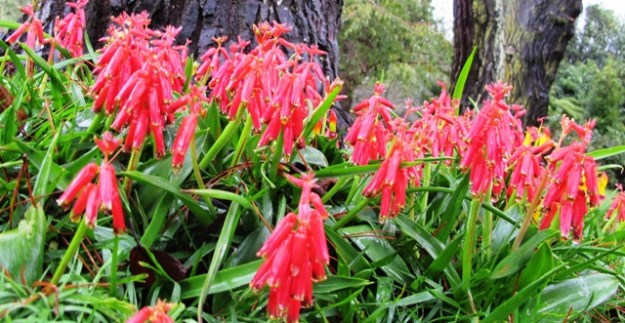
Late winter flowering Lachenalia bulbifera

Late winter flowering Lachenalia bulbifera

Digging and dividing part 2: bulbs

While the season has passed for planting trees and shrubs, think bulbs. All the autumn bulbs will be dormant now but ready to spring into growth with the trigger of summer rains. This takes in bulbs such as nerines, colchicums, many of the species cyclamen and ornamental oxalis. Lift them and spread them or repot them now if they were looking overcrowded last autumn. It is also a good time to do the same with the early spring bulbs such as daffodils, tulips, bluebells, lachenalias, snowdrops and snowflakes. Many of these still have vestiges of foliage hanging on so you can actually find the clump without having to exploratory excavations. If the clump is pushing itself up out of the ground, it is a sure sign you need to thin them out.

First published in the Waikato Times and reprinted here with their permission.

The outdoor dining and entertaining conundrum

A well designed outdoor dining area at Foreman's garden in Lepperton - and well under 20 paces from the kitchen

A well designed outdoor dining area at Foreman’s garden in Lepperton – and well under 20 paces from the kitchen

We live in a house which was built in 1950, long before “indoor outdoor flow” was ever conceived of and there is no doubt that we lack it. At one time, I had ideas to rectify this and went as far as getting concept plans drawn by an architect. The estimate of $100 000 for the work was a bit of a disincentive so we did not proceed, for which I am now relieved.

The latest House and Garden magazine has an article on the renovation of a Wellington property where the owner is quoted as saying: “We didn’t want to open the front of the house to the weather because, if we did, we’d all get blown away. We designed our house as an interior home, not an exterior one. Wellington is not a sit-outside sort of environment.” Actually, much of this country is not best suited to outside entertaining, at least when it comes to evening dining. Witness the plethora of fire pits, gas heaters and outdoor fireplaces. But you would not think that to look at modern design in houses and gardens.

One of the properties featured in the new book “Contemporary Gardens of New Zealand”, shows an outdoor dining area on an exposed platform with no shelter or shade and down a flight of 37 steps. Or it may be 39. I bet they never use it. Who wants to dash up so many steps to get the dipping sauce you forgot, or the serving spoon? Make that glass of wine last because the first to finish gets to climb the steps to the house to get another bottle or two. If the owners leave the dirty dishes on the table until the next morning, the neighbours will be able to see and judge. That particular property has a second outdoor eating area immediately by the house so you can be pretty sure that is the one they use.

Oft times, home owners place seating and entertaining areas too far from the service areas. I paced it out and think that few people would want their outdoor eating area more than 20 paces from the kitchen. It becomes inconvenient and if it is inconvenient, you won’t use it much. I’ve seen too many summer houses placed where they will create a focal point in the garden but they are just in the wrong place for use. Unless you have servants at your beck and call (and children are an unreliable substitute), save your money and make a focal point in some other way.

Most of us will wander a little further with just a cup of coffee in hand, but again if your seating areas are beyond about 30 paces from the electric jug or fridge, you are not likely to use them for morning teas or evening drinks. Even more than gazebos, garden seats are often stationed as focal points rather than for use. Never is this more obvious than when it is but one gaily painted chair. I think that seats need to be placed where you will use them, not used as de facto garden ornaments.

Just our glorified porch but an indication to me of how well used a garden room could be

Just our glorified porch but an indication to me of how well used a garden room could be

Garden rooms are my preferred solution after noticing these in a number of English gardens. These differ from gazebos and summer houses in that they have the capacity for more protective walls. There are times when just a roof is not enough to keep the situation pleasant enough to linger longer. Most of us find eating outdoors very pleasant in the right conditions and it can also make for more relaxed entertaining. After all, gardens are best enjoyed when you are out amongst them, not viewed from house windows so a charming and versatile garden room situated not more than 20 paces from my kitchen would be lovely addition. With some forethought and investigation, it could be so much more than just a free standing conservatory or a trellised gazebo. In the meantime, we make do with a comfortable outdoor dining suite beneath a large sun umbrella which is good for daytime use when there are more than just the two of us, but not so good for long evenings, even in summer. The closest we get to a garden room and the reason I know one would be well used, is our favoured sitting spot which we use all year round and at all times of the day. It is enclosed on three sides but completely open to the garden. It is just a glorified front porch and it only fits two comfortably but I think it is a pointer in the right direction for my choice of a garden entertaining area.

My all time favourite garden room from the Alhambra in Granada but it may look a tad pretentious here

My all time favourite garden room from the Alhambra in Granada but it may look a tad pretentious here

I leave you with the very best example of a garden room or gallery that I have seen. It might look just a little pretentious in my garden, it being of Moorish origin dating back to the tenth century and located in a palace at the Alhambra and Generalife in Granada, Spain. But can you imagine entertaining in that space and glorying in your garden surrounds?

First published in the Waikato Times and reprinted here with their permission.

Plant Collector: Cardiocrinum giganteum

The three metre flower spike of Cardiocrinum giganteum - worth the wait of up to 7 years to bloom

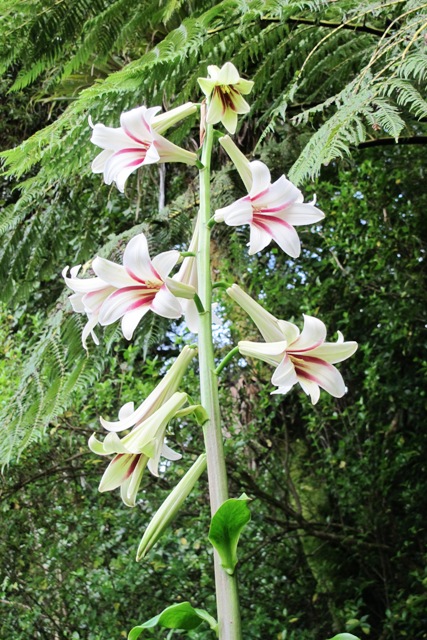
The three metre flower spike of Cardiocrinum giganteum – worth the wait of up to 7 years to bloom

If any bulb were to be the king or queen of wow, it is this giant Himalayan lily in full bloom. That is because these flowers are on a hefty stem that is around three metres high. Add to that the fact that it takes somewhere around seven years to flower and each bulb only flowers once. It then sets large amounts of seed and forms offsets around the base of the original bulb, each of which will take another five to seven years to flower. That life cycle must offer a metaphor for something. In the interim years, it just forms a seasonal clump of large, luscious, heart-shaped leaves reminiscent of an arum lily. This is a plant for cool, open, woodland conditions with soils which never dry out and are rich in humus. It does not perform in warm regions and won’t take much wind because of that great height in flower. We grow the plants in a cold, south facing border.

Cardiocrinums are very fragrant but the flowers are a fair way up in the air so to get the full impact of the scent, one possibly needs a veritable grove of them to walk through. The scent is stronger in the evening.

First published in the Waikato Times and reprinted here with their permission.