Tag Archives: gardening

The late spring bulbs


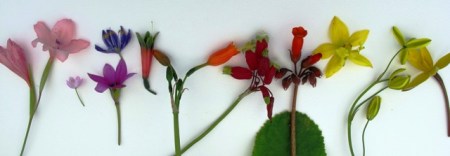
Left to right: Gladious carneus, a dainty allium, Romulea rosea, camassia, Phaedranassa cinerea, Stenomesson miniatum, Gesneria cardinalis, calanthe orchid, Albuca candadensis and spiloxene.

When spring bulbs are mentioned, most people think of daffodils, bluebells and tulips. But when they have been and gone and all that is left is the scruffy foliage, there are the late spring bulbs coming into flower. Most of these are less well known and certainly less celebrated in literature and art. For all that, they are often more interesting, maybe because they are unexpected.

We love bulbs here and with bulbs I include corms, rhizomes and tubers. More than any other type of plant, they seem to mark the passage of the seasons and to create the smaller, detailed pictures that add layers of interest to the garden. Maybe because the perennials and annuals are coming into their own at this time, the late spring bulbs are often ignored and therefore harder to source.

I headed out to the garden to see what was coming into flower. Discounting the earlier bulbs which are still flowering but well past their peak (veltheimias, the late lachenalias, Hippeastrum aulicum and the like), I found about 20 different types of bulbs coming into their own and that is by no means complete. There is little which is duller than endless lists and plant descriptions so I lined a number up for photographs.
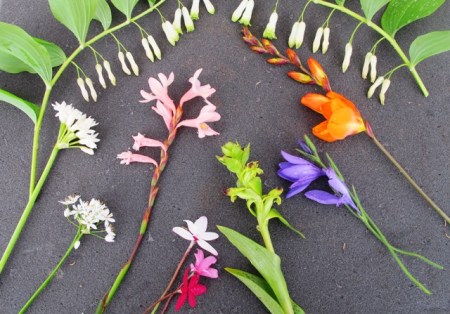

Clockwise from top – Soloman Seal (Polygonatum multiflorum), tritonia, babiana, Satyrium odorum (orchid), rhodohypoxis, Watsonia brevifolia, tulbaghias – probably comminsii and possibly simmleri

I featured the rhodohypoxis in Plant Collector a fortnight ago. These are relatively common and form attractive carpets in pinks, whites and carmine red with their mass of star flowers. There is nothing rare or exclusive about Soloman Seal (Polygonatum multiflorum) either. It was common in the gardens of grandparents and is perhaps undergoing a surge of discovery amongst newer generations of gardeners. It is particularly handy for semi shade positions and, after battling a near impenetrable mass of entangled rhizomes, I decided it may well have some merit as a natural stabiliser for an eroding bank. I will report back in three years about the success or otherwise of this venture but as it will grow pretty much on top of the ground and grip hard, I am optimistic. As a bonus, the foliage turns golden in autumn – an unexpected source of autumn colour for us.
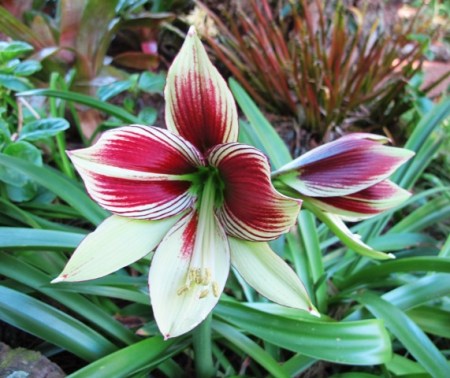
Hippeastrum papilio

Hippeastrum papilio

For sheer exotica, it is hard to beat Hippeastrum papilio which is just opening. Papilio means butterfly though I think it is more orchid-like really. This is a spectacular bulb from Brazil which is offered for sale from time to time. It is more expensive than rare. We had to try a couple of different places in the garden before we found a spot where it was happy but we now have it thriving in open woodland conditions.
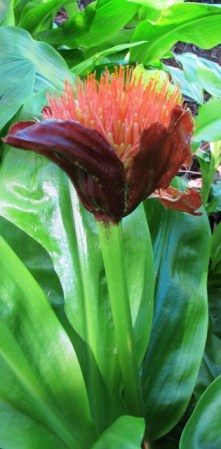
Scadoxus puniceus

Scadoxus puniceus

While on the big bulbs, Scadoxus puniceusis one of our showiest but I won’t dwell too long on it because it is rather too frost tender for inland areas and rare in this country. Its cousin, Scadoxus katherinae, is a better bet for frosty areas because it is dormant in winter and doesn’t start moving until spring, flowering in summer. Similarly, our love affair with the arisaema family (sometimes called snake’s head lilies though they aren’t lilies) is of limited value because our showiest ones are Mark’s hybrids which we have never sold so they can’t be seen anywhere but in our garden. Given time, we may put them on the market but that is a way off. Most of the arisaema family hide their flowers below the foliage but Mark has managed to breed with varieties to bring out the desirable trait of holding their flowers above the leaves, making them much showier as well as being easy garden plants. You may, however, find Arisaema speciosum which is easy to grow and Arisaema ringens is relatively common. If you have a bank that you look up to, the flowers are little more obvious without having to part the leaves to see them. We describe A. speciosum as the closest thing to a cobra you would want in the garden.

If you are getting frustrated trying to find more unusual plants, there are good reasons why. Many if not most of the specialist nurseries throughout the country have closed down over the last decade as have most mail order nurseries. Treasure the ones that are left because there are few new plant businesses opening. However, bulbs are perhaps a little easier than trees and shrubs and I occasionally look at the bulbs section of Trade Me and see some interesting and less common material offered for sale there. Beyond that, you may have to start haunting your local horticultural society or keen gardening groups where there are likely to be one or two people who know their bulbs from their onions.

First published in the Waikato Times and reprinted here with their permission.
Garden lore

There is nothing like the first hot days of spring when the gardener stops wondering if it’s too soon to plant the dahlias and starts wondering if it’s too late.

The Essential Earthman by Henry Mitchell (1981).

Late spring planting
The cool start to spring may have lulled you into a false sense of security when it comes to planting trees and shrubs but the warmer days this week should be warning that it is getting late in the season. If you are still planting, make sure you plunge the plant, pot or bag and all into a bucket of water. Either hold it down until the bubbles stop rising or leave it sitting in the bucket for 20 minutes or more. This makes sure that the root ball is saturated before planting. Just watering on top won’t penetrate if the plant is already dry. The water will just run straight through and not be absorbed. After planting, water again and get up to 10cm of mulch laid on top to stop the soils from drying out too quickly.

Meet the maddenii rhododendrons

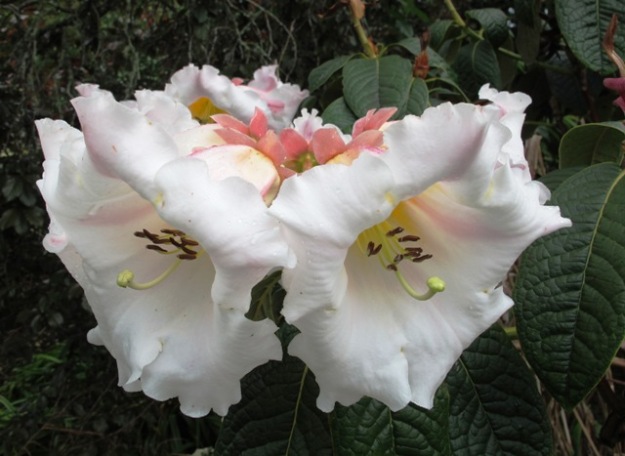
The Rolls Royce of rhododendrons - sino nuttallii

The Rolls Royce of rhododendrons – sino nuttallii

Allow me to introduce you to maddenii rhododendrons. We are pretty keen on them here, although you may not share our enthusiasm if you think all rhododendrons should have the tight ball truss of blooms which is usually regarded as typical of the family. Maddenias don’t hold their flowers in that style.

But the family does include the spectacular nuttalliis with their huge trumpets. I rate these as the most stunning rhododendrons of all with their flowers which look as if they have been cast out of wax and their wonderful, big leaves which are heavily veined – described as bullate foliage. There is nothing quite like them but they are not generally available on the market. They don’t produce much cutting material and they are not easy to propagate but many will set seed so, if you are really keen, you could try raising seed. Some of the hybrids can be found from time to time – Mi Amor and Floral Sun in particular.

There are two huge pluses for the maddeniis. Most are scented, some strongly so. R. polyandrum can waft out for a metre or two which is an indication of a strong scent. Many will pass the 30cm sniff test which is good. And if you are willing to risk the pollen on the nose, most have a sweet scent when you bury your face in the flower.

The second big bonus is that the maddeniis show much better resistance to thrips than most other rhododendrons. Thrips are nasty sucking insects that hide away beneath the leaves, sucking out the chlorophyll. This turns the leaves silver and once that has happened, they can never be turned green again though the new season’s growth will be green, at least until the thrips get hold. Over time, serious infestations can weaken a plant past the point of return. Very cold winters will kill the bugs off, but we don’t get cold enough here so there is not a whole lot one can do beyond spraying with insecticide or neem oil, or trying a cloth collar soaked in systemic insecticide wrapped around the main trunk. Or you can choose varieties which are more resistant.

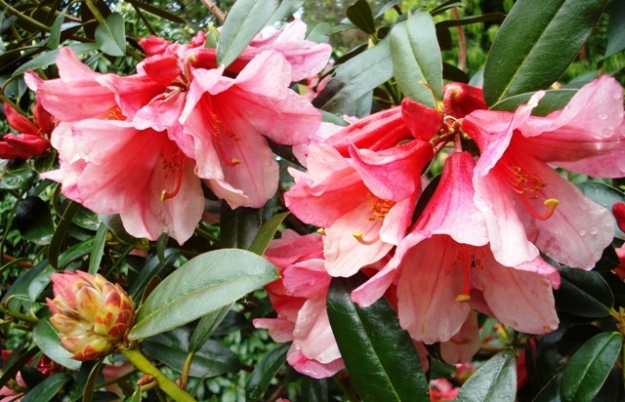
Bernice, as red as the maddeniis get

Bernice, as red as the maddeniis get

There is a preponderance of whites and pastels in the maddeniis and where there are coloured ones, they lean to the subtler, softer shades. In other words, there are no pure reds, purples, blues or oranges. We don’t mind because we can get the stronger colours in azaleas and other types of rhododendrons. Some of the hybrids flower so heavily that it can be like viewing a wall of bloom with barely any foliage visible at all.

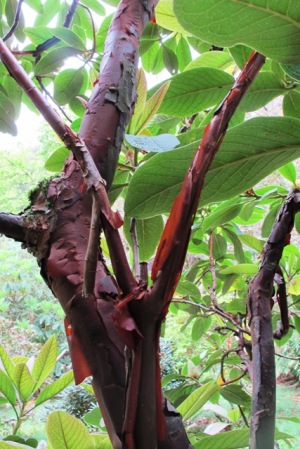
Wonderful peeling bark and bullate foliage

Wonderful peeling bark and bullate foliage

I should perhaps mention also that most of Maddenia types don’t make tidy compact little buns of bushes either. They are inclined to be more open in their growth – though by no means are all of them giants. Some can only be described as leggy, but all is forgiven when they flower. Besides, another attractive feature of these rhododendrons is the lovely peeling cinnamon bark many have. If they were bushy, dense plants, you would never see it.

Google tells me that this group were first introduced to the West in 1849 by famous plant collector Joseph Hooker – he who also visited New Zealand. For reasons which are not entirely clear, he named them after Lieutenant Colonel E Madden of the Bengal Civil Service. How random is that? Given that these rhododendrons are found in northern India, Burma, southern China and the milder areas of Tibet, maybe Lt.-Col. Madden was particularly helpful to Hooker’s expeditions.

Internationally the maddeniis are rated as subtropical and somewhat tender so they are the envy of gardeners from cold climates. Our climate in New Zealand is so temperate that you are able to grow most of the maddeniis in all but the coldest, inland conditions. They form the backbone of the rhododendron collection in our garden and, being later flowering than many others, are coming into bloom right now.

There is no simple way to determine which rhododendrons fall into the maddenii group. That is what books and Google are for. But ones you may find, or know of, include Fragrantissima, Elsie Frye, Princess Alice, Bernice, Moon Orchid, the aforementioned Mi Amor and the plant confusingly known simply as Rhododendron maddenii.

The problem is sourcing these rhododendrons. In fact the problem is sourcing any interesting rhododendrons at all in these days when specialist nurseries have fallen like flies. The best option for Waikato readers may be Rhodohill or Tikitere Nurseries in Rotorua. Failing that, try Trade Me where there is a South Island grower, RhodoDirect, producing and selling by mail order. I have seen them listing the lovely Floral Sun and there are other maddeniis in their range.

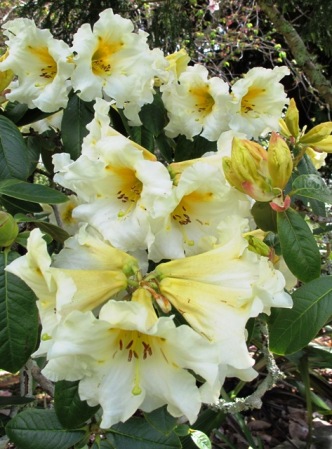
Our very own Floral Sun

Our very own Floral Sun

First published in the Waikato Times and reprinted here with their permission.

Plant Collector: Rhododendron Rubicon

Rhododendron Rubicon - in our opinion, the best big red in the country.

Rhododendron Rubicon – in our opinion, the best big red in the country.

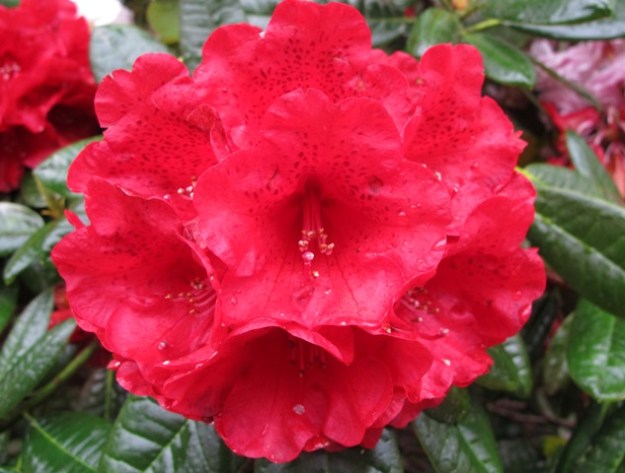
In the world of red rhododendrons, Rubicon stands clear of the rest – at least in my opinion. It is the purest of reds without that common tendency to develop pink tones as it ages, has lovely foliage and a very tidy, rounded habit. It is pretty much perfect in that big full truss class. I should perhaps have qualified my first sentence by saying in the New Zealand world of red rhododendrons because I don’t know how successful it has been overseas but it sure beats the imported varieties we grow. It was bred by the late Ron Gordon from Taihape and first became available in the late 1980s. It is a cross between Kilimanjaro and Noyo Chief and it is superior to both its parents though it was the latter which contributed the good dark, heavily veined foliage that is a feature of Rubicon.

The one downside for us is that Rubicon can get attacked by thrips – those nasty, leaf sucking critters which turn rhododendron leaves silver. Because our plant is in such a prominent position, it is one of the few Mark will spray here. He uses an insecticide but other people report good results using Neem oil to beat thrips.

Rubicon is widely available on the market in this country and is an essential in any collection.

First published in the Waikato Times and reprinted here with their permission.

Garden lore

It is obvious that close planting [of shrubs] gives a furnished look to a border almost immediately, equally obvious that it is wasteful and expensive.

The Well-Tempered Garden by Christopher Lloyd (1973).

Dead heading rhododendrons

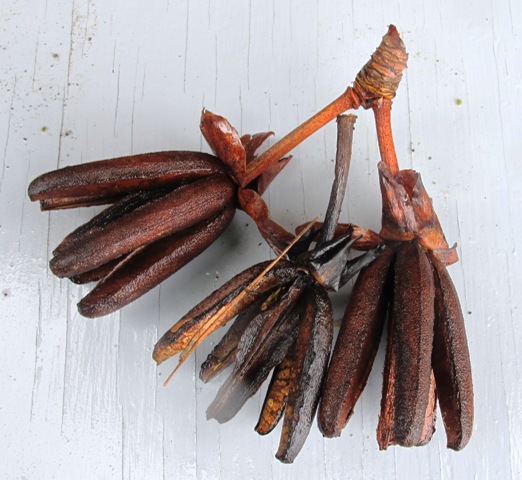
The usual advice is to dead head all rhododendrons. In fact, while they all look a great deal better for dead heading, it is really only necessary to do the ones that set seed. You will be able to tell by looking, if you didn’t do them last year, because they will have spent pods similar (but almost certainly smaller) to the ones shown in the photo. Some rhododendrons can set so much seed that they weaken themselves and eventually die. My neighbour swears by coating his fingers in olive oil before he goes out to dead head. It stops the gunky residue from making your hands sticky.