Tag Archives: gardening

A blight upon your camellias

I married in to a camellia family. Long before the Jury name ever became associated with magnolias, it was known both in New Zealand and overseas for camellias. That is because there were two brothers working independently on camellias in the previous generation.

Les Jury (known here as Uncle Les, for obvious reasons) was the better known and some of his cultivars are classics in the camellia world – Anticipation, Debbie and Jury’s Yellow to name just three. Not far behind was Felix Jury who created Water Lily, Dream Boat, Rose Bouquet and many others.

Encouraged by his father and his uncle, my Mark was following suit. They were heady days and camellias ranked second only to roses in volume of plant sales in New Zealand. Both Mark and I remember the Day of Doom. Mark received an unannounced visit from senior members of the local Camellia Society bringing him the bad news that camellia petal blight had been found in Wellington. It took quite a while for the implications to sink in for me but Mark knew instantly what it meant and that was the day he stopped camellia breeding. Only now, more than twenty years down the track, is he starting to return to it as the picture has become clearer.
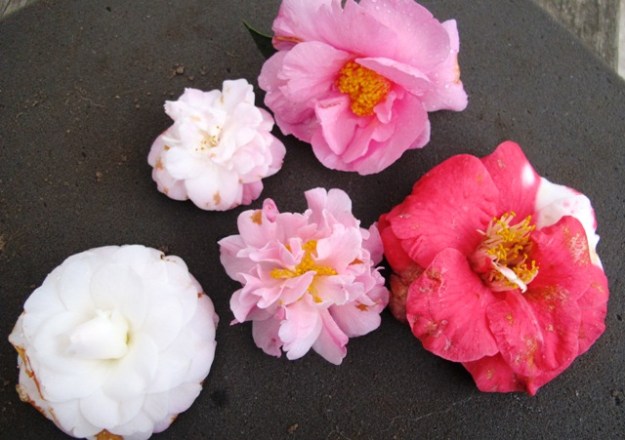
From these slightly blemished blooms...

From these slightly blemished blooms…

Camellia petal blight is endemic to China and Japan and has long been a problem on the west coast of the USA. More recently, it has struck the UK and Europe though apparently Australia is still free from it. A plant can’t carry it. It is transmitted on the flower or in the soil. Even back when it was first found in this country, standard practice was to ensure that all plants being shipped in or out of New Zealand were stripped of all flower buds and had their roots washed clean. It is quite possible that it entered this country inadvertently in a corsage somebody failed to discard safely or some similar incident. The discovery of infected blooms in Wellington Botanic Gardens and in two locations in the Hutt (if my memory serves me right) was hardly painted apple moth or Queensland fruit fly territory but its impact has certainly been very disappointing.
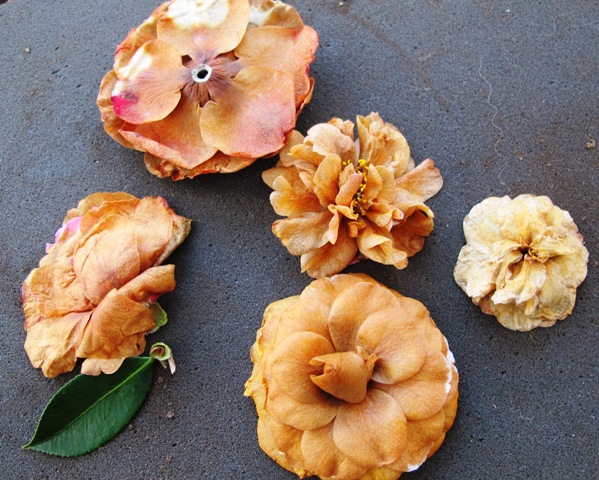
... to this in two short days

… to this in two short days

It is a fungus – Ciborinia camelliae, to be precise and the spore are dispersed through the air. The problem in this country is that the camellia is so ubiquitous and the distances from host plant to next potential host so short that the disease spread rapidly. For the same reason, you can’t eradicate it because you will just get reinfected. So we have learned to live with it.

We have always had botrytis which turns blooms dark brown but petal blight is much more rampant. What may be light brown speck on a bloom one day can show as riddled as the pox the following day and pale mush the day after. And it usually hangs on the plant, which is the worst aspect of all because blighted blooms look awful. A lot of modern breeding has been to get camellias that are self grooming – in other words they fall when finished. But not the blighted blooms.

If you want to check that you have it, flip a bloom over and peel off the calyx which holds the petals together in the centre. If it has a telltale white powdery ring inside the calyx, that is petal blight. If it is greyish black, it is botrytis.
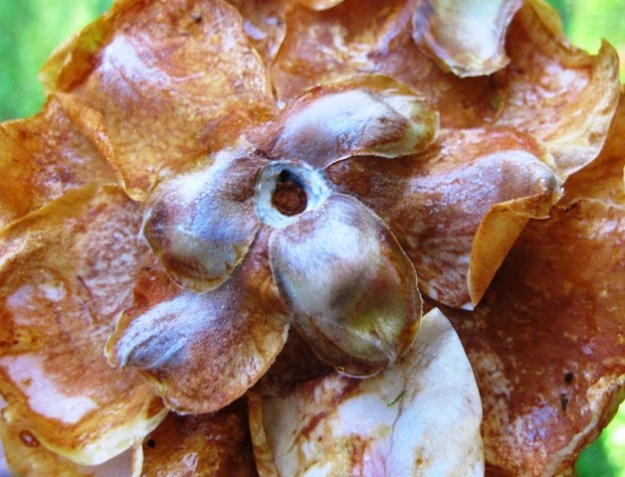
The white ring of death - camellia petal blight

The white ring of death – camellia petal blight

Petal blight does not weaken the plant. It merely cuts the floral display. You won’t get as many blooms, though given camellias’ propensity for massive bud set, they will still out flower most other shrubs. You will probably have to do more of a clean up, maybe shake the bush as you pass and rake up the debris to keep them looking attractive. It is still a lot less than many other plants require.

Reticulata camellias (the ones with the huge blooms the size of lunch plates) tend to drop their blighted blooms because they are so heavy. And many are red which doesn’t show the brown blemishes as badly. But reticulatas are very hard to find for sale these days. Despite what some information on the internet says, we have never found petal blight on our sasanqua camelliaseither, and that is not for want of looking. As far as we are concerned they are clean.

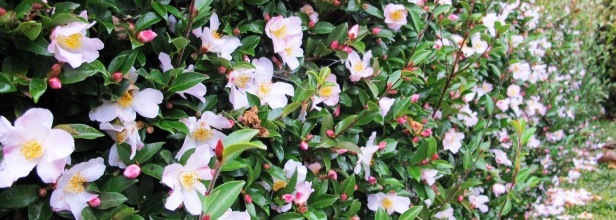
The smaller flowered camellias with masses of shortlived blooms in succession are just as good as ever. We had a rush of blood to the head when Mark thought last week that petal blight was entirely absent from his Camellia Fairy Blush (the first camellia he ever named – a C. lutchuensis hybrid, not a sasanqua). He examined many spent blooms and finally found one with the telltale white ring. So not blight free, but unaffected in its display.

It is the bigger flowered, paler varieties that look the worst along with the ones bred for show blooms – fewer flowers but with perfect form. It has pretty well wrecked the traditions of camellia shows. Whether time and renewed efforts by plant breeders can replace these types with blight resistant options is still unknown.

Camellia Fairy Blush - not immune but the display is unaffected

Camellia Fairy Blush – not immune but the display is unaffected

First published in the Waikato Times and reprinted here with their permission.
Grow it Yourself: courgettes (the final in this series)

This is a great crop for a beginner because it is so easy and productive. Rampant, but easy. Courgettes (French) are the same as zucchini (Italian), sometimes reshaped as scallopini (like flattened muffins) and also known as summer squash. They are a cucurbit, as is pumpkin. You probably only need two plants and they will need a good metre each in area. In under two months, they will drown you with such a deluge of produce that you will wonder why they are relatively expensive to buy. If you tire of the taste and texture, look up recipes for stuffed courgette flowers and nip them off in their infancy.

Courgettes are started in individual pots and planted out when soil temperatures rise around late October (or even later in colder areas). You can start seeds in pots under cover in September or just buy a couple of plants when you need them. The reason you start with individually potted plants is because they don’t appreciate their roots being disturbed.. Because they are such large and rampant growers, they need rich, well drained soils. We prefer to use compost to feed all our vegetables. Worm wee would also be a good option or you could turn to some of the off the shelf fertiliser options. Keep the moisture levels up through summer because these are plants with a very high water content. Keep harvesting every couple of days to encourage the plant to keep producing. The time between a desirable little courgette and a large, tasteless marrow is short indeed and if the plant is left with maturing marrows, it will stop producing baby courgettes for you.

First published in the Waikato Times and reprinted here with their permission.
Tikorangi Notes: Friday 3 August, 2012

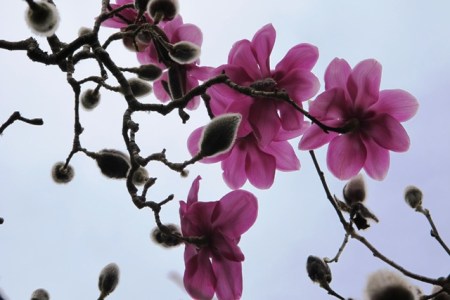
Magnolia Lanarth is coming into flower

Magnolia Lanarth is coming into flower

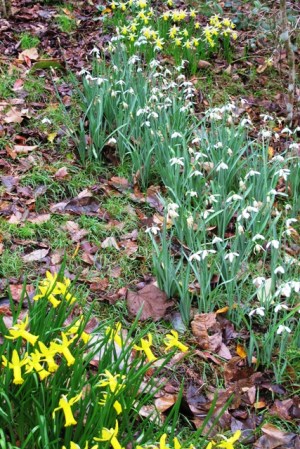
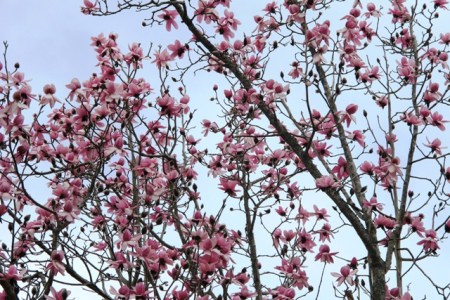
With the advent of August, our garden is now open again for the season and more is coming into flower every day. Magnolia campbellii is in full bloom, Lanarth is opening as is Vulcan, assorted unnamed seedlings are opening and the early michelias (now reclassified as magnolias) are in full bloom. Between the michelias and the many daphne plants, the garden is full of scent. The earliest of the big leafed rhododendrons (R. macabeanum and R. sino grande types) are coming into flower. And at the lowest level, there are many early spring bulbs blooming. As the snowdrops start to pass over, the early narcissi (many of the cyclamineus type) are blooming and Cyclamen coum flowers on. Mark’s efforts on his bulb hillside are bearing fruit (or maybe bearing flowers in ever increasing quantities is a better description). While we may get a cold snap or two, spring has very much arrived.

Mark's bulb hillside - Narcissus cyclamineus at the front, galanthus in the centre and Narcissus Twilight to the rear

Mark’s bulb hillside – Narcissus cyclamineus at the front, galanthus in the centre and Narcissus Twilight to the rear

We have no new posts this week to list – the gardening page of the Waikato Times has been put to one side to make additional space for Olympic sports news.

Magnolia campbellii in full flight this week

Magnolia campbellii in full flight this week

The curse of the narcissus fly

A selection of early flowering narcissi from the garden this week

A selection of early flowering narcissi from the garden this week

The offending narcissi fly larva to the right of the blade point

The offending narcissi fly larva to the right of the blade point

Behold, the narcissus fly larvae. This creamy brown grub is not your garden friend. In fact, in the world of insects, grubs and greeblies that would have been better kept out of this country, the narcissus fly ranks up the scale. It is European in origin – what they call a hoverfly though not a desirable species.

I had to look it up because I only knew it as the narcissus fly. It is Merodon equestris, in case you want to know. On the wing, the adult looks inoffensive – a bit like a cross between a lean, mean bumblebee and a blow fly boasting a yellow back. It is its reproductive habits which are the problem. The female adult zips around at great speed, laying its eggs, usually one by one, at the base of the bulb foliage. When the egg hatches, the juvenile larva burrows down and makes a cosy home for itself inside the bulb where it sustains itself by eating it from the inside out, in preparation for hatching the following spring.

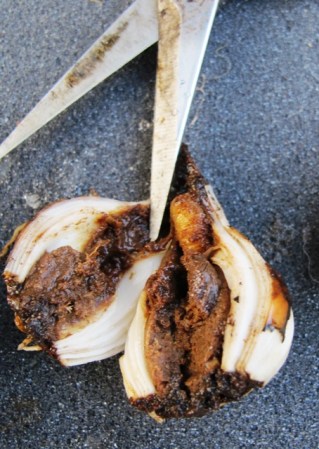
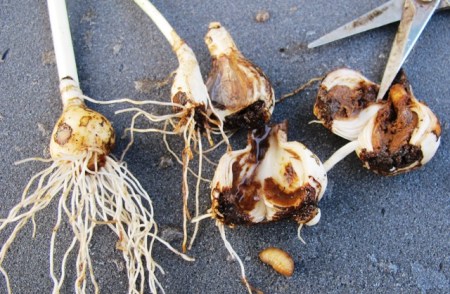
You can see the damage in the photograph. As I was redoing the rose garden, I was splitting clumps of bulbs in full growth (not generally recommended but I find it works out fine as long as I am replanting straight away into good conditions). Some of the bulbs were soft and sporting very few, if any, fresh roots. That is a sure sign of narcissus fly. There is something deeply compelling about squeezing the bulb and having the larva exude out the top, or splitting the bulb and digging it out. They are quite tough so difficult to squish between your fingers (I wear gardening gloves at all times, lest you recoil at the thought) but can emit a satisfying pop and explode in a very small way if you squish them below foot. Generally, there is only one per bulb.

The inoffensive adult fly (photo credit: Sandy Rae via Wiki Commons)

The inoffensive adult fly (photo credit: Sandy Rae via Wiki Commons)

While this critter is widely referred to as the narcissus fly, by no means does it limit its predations to daffodils. It attacks many members of the amaryllidaceae family. This is a fairly large family and includes snowdrops (galanthus), snowflakes (leucojum) and hippeastrums. According to bulb expert, Terry Hatch, it also attacks hyacinths but as we only have two hyacinths, we have never noticed. As an aside, hyacinths need a winter chill to flower well so are better in colder climates.

You can’t eradicate it. The fly is airborne and does not respect boundaries. A multi pronged defensive strategy is required. The fly does not like shade, so all our hippeastrums are now woodland plants because they were getting hammered by the larvae infestations. Now they are untouched.

We favour the early flowering narcissi because they are done, dusted and pretty much dormant by the time the fly is on the wing in late spring and summer. The galanthus are also back below ground by then, so it is never a major problem with them. It doesn’t seem to be a problem with the autumn flowering bulbs such as the nerines and the belladonnas, even though, sitting half in and half out of the ground, you would think they might be vulnerable.

Don’t let your daffodil bulbs become so congested they squeeze themselves above the ground and planting them in shallow bowls may be like a creche to a passing fly. Most of the advice is to leave the foliage on the bulb until it turns yellow and dies off naturally because this is how the bulb builds up strength to flower again next season. You are not meant to tie it in knots or plait it (as some tidy gardeners do) because that inhibits the photosynthesis process. However, a visiting daffodil breeder told us that in fact the bulbs only need 65 days to fortify themselves which is a great deal less than nature gives them. The daffies in our lawn are somewhere over 100 days. This is not universally acclaimed advice but if you have a problem with bulb fly, removing the foliage soon after two months and piling extra dirt or mulch on top of the bulbs may help to break the cycle. The worst that will happen is that your bulbs won’t flower well if you strip off the leaves too early.

Come spring, Mark can be found stalking narcissus fly in our rockery. They become active in the warmth of the day. They are very quick so it is hard to get them with a fly swat. He uses a little sprayer of Decis and squirts them. Decis is a synthetic pyrethroid (as is fly spray) so not a particularly nasty insecticide. Vigilance is what keeps the flies under some semblance of control here. Though he was a little wry on the day he told me he had been walking through the rockery minus his sprayer when he saw an offending fly. It was an open garden day so he looked around to check that no visitors were within view, took off his tee shirt and was stalking the offender to swat it when he noticed the woman at the side of the garden watching. “Eye candy,” I told him. “You are now officially eye candy.”


Left to right: a perfectly healthy bulb, an infested bulb which had already formed a healthy offset, the offending larva in front, and a second infested bulb with it’s larva still ensconced (but no longer – I squished it after its photo shoot).

First published in the Waikato Times and reprinted here with their permission.
Plant collector : Helleborus x sternii

IMG_9684

Helleborus x sternii

There are more hellebores than just the common H. orientalis and sternii is one we appreciate in the winter woodland. It has distinctive green flowers, sometimes flushed purple, and lovely glaucous foliage which is finer in appearance. Glaucous just means it has a blue or grey cast to the colour. It is more upright in growth and does not make as dense a clump as orientalis. In addition to that, it holds its flowers in a cluster above the foliage and many of them are outward facing rather than all nodding (or facing downwards). So it displays its flowers a little better than H. orientalis.

The x sternii means it is a hybrid – in this case a cross between H. argutifolius (from Corsica and Sardinia) and H. lividus (from Majorca). From those origins, you can guess that it is quite happy in hot, dry conditions and the information is often given that it is suited to sunny positions. In our garden, sunny positions are at a premium whereas we have woodland in abundance so we are always after plant candidates for shadier positions. Plants like this hellebore which are not at all fussy, are very handy to add winter interest.

Sternii can be raised from seed or by division. There are named selections of sternii around – the seed from these won’t come true so they need to be divided or increased by cutting if you want to keep their special features. It appears that many of the newer forms are extending the colour range into purer pinks, burgundy, slate and white – akin to the orientalis colour range. We only have the original green flowered forms and have not seen the other colours in this country yet.

First published in the Waikato Times and reprinted here with their permission.