Tag Archives: gardening

Grow it yourself: strawberries

If you have been thinking of growing strawberries, do not delay. They should be planted immediately. As with most edible crops, they need full sun and plenty of rich, well dug soil to get them away to a good start. Good drainage is important. If you mound the soil, you get maximum exposure to the sun for the berries but you also hasten drying out over summer. Commercially, strawberries are usually grown in black plastic. This heats up the soil faster for early production and keeps the fruit clean by stopping splashing of mud. If you prefer not to use plastic, the traditional mulch is straw – hence the name of strawberries, perhaps? You may need to keep applying mulch as the season progresses.

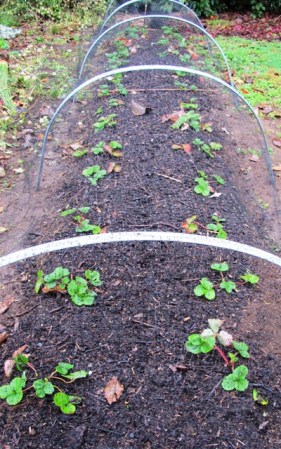
Netted already - mostly because of our unwelcome resident rabbit.

Netted already – mostly because of our unwelcome resident rabbit.

Space plants at about 30cm, usually staggered in a double row. Garden centres will be selling reliable named varieties or you can take runners off your last year’s crop if you grew them. The runners are the plant’s way of increasing itself and good strong ones will be full of vim and vigour. Expect the biggest and the best berries in the first season (maybe even for Christmas dinner). If you keep the plants well fed, you will get more but smaller berries the following summer but it is not usually worth persisting with the same plants past the second season.

Plan from the start how you will cover your plants. If you don’t, the birds will beat you to every red fruit. We cover ours from the start to stop the birds from raking over the mulch and to foil the elusive resident rabbit from excavating the plants, using netting spread over cloche hoops.

If you are going to grow them in pots, they will need frequent watering and liquid feeding as soon as temperatures rise again.

First published in the Waikato Times and reproduced here with their permission.

The sweet smell of daphne in winter

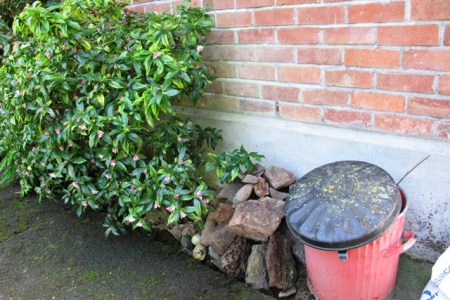
Daphne odora - happy around the back by the rubbish tin.

Daphne odora – happy around the back by the rubbish tin.

We have never forgotten the nursery colleagues who told us that their range included lemon trees and daphnes “because you can sell a lemon tree to pretty much every household and everybody has to replace their daphne every five years or so”. I had never thought about it before, but they were right. Most New Zealand gardens have at least one of each and daphnes do not rank up there as long lived plants. But we wouldn’t be without them in the winter garden.

While there are upwards of 60 different species in the wild, in terms of garden plants in this country, generally you have a choice of odora, odora or odora with occasional breaks for D. bholua and if you are really lucky, you might spot the little ground hugging D. cneorum (with its silent c), the dainty D. x burkwoodii, or the remarkable blue D. genkwa. You may buy your odora by many other names, but if it has typical daphne foliage and flowers, it is just an odora selection. The flowers are generally small and a mix of lilac pink and white with a range of subtle variations. Some are darker, pinker or even pure white. I bought one that was reputedly apricot but that was wishful thinking with the description.

The good and the bad of the Himalayan Daphne bholua

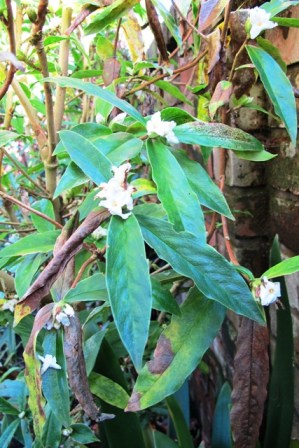
The good and the bad of the Himalayan Daphne bholua

We have a bit of a love-hate relationship with the Himalayan Daphne bholua. In our opinion it has the best and strongest fragrance of all and it has a long flowering season. Its upright habit of growth means it fits into borders and beside paths well. That is the good side. On the down side it suckers (spreads underground), seeds much too freely and is dispersed by birds so has weed potential. It also becomes very scruffy with time. It is semi deciduous which means it is neither one thing nor the other – it drops some leaves and those that hang on often look messy. The form is ugly and it can get quite large after a few years if you don’t stay on top of the pruning. So it is not a plant of great beauty at all, but its scent is superb. Hide it at the back of the border in behind more attractive plants so that it can wow you with its fragrance.

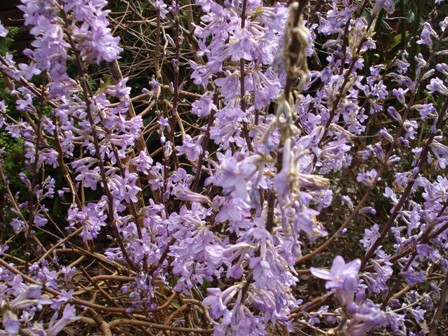
The blue flowered Daphne genkwa from China is remarkable. For most of the year it is just an anonymous willowy shrub. It is fully deciduous, so drops all its leaves in autumn. Then in late August, all those whippy growths burst into lilac blue flowers down their length. It is a wondrous sight. Some claim a light perfume, but I think that is imagination. It is just one of the loveliest shrubs you will ever see in flower. Alas, it is difficult to propagate (it is generally done from root cuttings) and can be difficult to get established so it is not common. However, it is still produced commercially and a good garden centre may be able to order it in for you. Plant it where it has good light, good drainage and plenty of space so it won’t need trimming. I killed a well established plant by cutting it back and I wasn’t that brutal. I loved it so much I bought three replacements and these will be planted with plenty of space so they should never need pruning.

Deciduous, lacking scent and blue lilac but it is probably the most spectacular - Daphne genkwa

Deciduous, lacking scent and blue lilac but it is probably the most spectacular – Daphne genkwa

Growing tips: daphnes are not suitable plants to grow in containers. Mostly they look unhealthy and straggly because it is hard to get the potting mix right. It is much easier to keep them lush and healthy planted in the garden, even more so if you pick a position out of full sun. The odoras and bholua are often a good choice for the more shaded house borders. While they need good light levels, they are quite happy with little or no direct sun.

Daphnes prefer rich loamy conditions, neither acid nor alkaline. They won’t love you if you put them in waterlogged conditions either so look for spots with good drainage which never get bone dry either. Keep them mulched with compost or leaf litter.

While Daphne bholua will accept hard pruning, most other types won’t. You are better to take a bit more care and think more about pinching out new growth to encourage bushiness and shaping with secateurs, rather than hacking bark hard all over.

Because they are winter flowering, finding locations near to where you walk in winter means you will get more benefit. This is one of the few plants with such strong scent that you will pause and look for the source so plant it where that can happen. Only D. genkwa is spectacular in flower, so they are wasted in more removed locations. Round the back of house near the rubbish bin is a handy location for us though we have quite a few other plants all over the place.

First published in the Waikato Times and reprinted here with their permission.

Grow it yourself: European radishes

I still associate radishes with encouraging young children to garden. The little red globes of the European radish grow so rapidly that you can be eating them in just over three weeks which gives a wonderfully quick result, even if the flavour may not be to littlies’ taste. If you haven’t had a look at radishes in recent years, you may be surprised by the range now available. There are long thin ones, large and small globed ones and colours range through reds, pinks, whites and bicolours to pure gold (Radish Zlata from Poland) and the Black Spanish Radishes which are black skinned with white flesh. And that is without even considering the oriental radish varieties.

The common garden radish has a bit of a split personality. It is almost exclusively served as a salad vegetable in this country though there is no reason why you cannot cook with it, in a similar manner to other root vegetables, albeit being of rather small stature. However it is a brassica which explains why it is better as a cool season crop. In mild areas, radishes can be grown right through winter. Yet it is a root crop, unlike most brassicas, so it does not want soils rich in nitrogen which encourage too much leafy top growth at the expense of the roots.

Sow seed directly into finely tilled soil and cover lightly to a depth of a centimetre. They will need to be thinned out after germination to allow room for the roots to develop. Pick them young. They soon get woody and too peppery so are best pulled, washed and stored in the fridge if you have too many. And you can always try Hugh Fearnley Whittingstall’s unlikely fresh radish dish – serve with softened but not melted butter and lashings of salt. No Heart Foundation tick for that one.

First published in the Waikato Times and reprinted here with their permission.

In praise of ornamental oxalis (or wood sorrel, if you prefer)

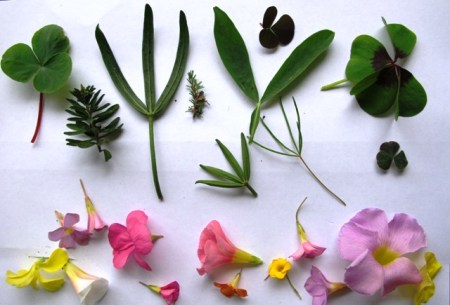
Oxalis show considerable variation in leaf form (and in flower colour)

Oxalis show considerable variation in leaf form (and in flower colour)

Most people shudder at the mere mention of oxalis. The bad reputation of a few has tarnished the entire population. We would not be without the cheerful sight of them blooming from early autumn through winter, but the most common reaction from others is complete dismissal. I have even resorted to their colloquial name overseas – wood sorrel. It sounds so much prettier and more acceptable than oxalis.

Over the years, we have gathered up around 30 different ornamental varieties but these are a mere drop in the bucket. The oxalis family is huge. In the wild, the number of different species is into the late hundreds. That is not to say that they are all of great merit. Nor are they all bulbs. Equally, not all are invasive.

O. deppei "Iron Cross" grows and flowers in the opposite seasons to most ornamental varieties

O. deppei "Iron Cross" grows and flowers in the opposite seasons to most ornamental varieties

Most oxalis are native to either South Africa or South America, though it is the former that gives us the majority of varieties which have garden merit. Most are triggered into growth by late summer rain, so they come into flower around this time of year. The two notable exceptions we have in our collection are both from South America. Oxalis deppei “Iron Cross” (named for the markings on its leaves) is from Mexico and going dormant now, to return to growth at the start of November. O. triangularis, with its triangle shaped leaves in deep burgundy, is Brazilian and also flowers in summer. I bought this one at a car boot sale where I commented that it was an oxalis that I did not have. “No,” protested the vendors. “It is not an oxalis. It is a triangularus.” I didn’t argue.

Some of these oxalis are perfectly safe in the garden. I can vouch for this after decades of growing them in the rockery where they have never threatened to become a weed. Others are downright dangerous. Turn your back and they will invade at alarming speed. Such wayward habits don’t mean you have to shun them. Keep them in pots. You can either plunge the pot into the garden (which reduces the need to water it), or have a collection on a sunny doorstep. Oxalis only open their flowers in the sunshine. When they have ceased being attractive, you can move the pots out of sight for the rest of the year. We have not had problems with them setting seed so as long as the bulbs are confined, they rarely escape.
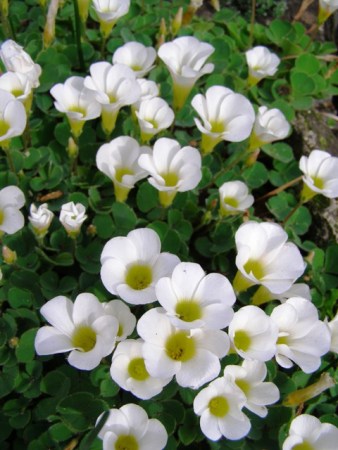
My all time favourite - O. purpurea alba
My all time favourite - O. purpurea alba

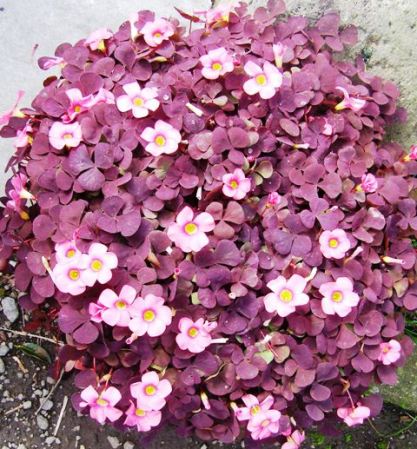
Same species but different form and very different behaviour. Keep O. purpurea "Nigrescens" confined to a pot

Same species but different form and very different behaviour. Keep O. purpurea "Nigrescens" confined to a pot

My all time favourite is the pristine white O. purpurea alba. It has an exceptionally long flowering season and is extremely well behaved in the garden. A mat of this plant opening up its large blooms to the sunshine is a delightful sight. Each flower has a golden eye. Purpurea is a variable species. The green form (same clover-like leaves but with large pink flowers) also has an excellent length of flowering but I haven’t had it long enough to know whether it is garden safe or not so I still keep it in pots. The reason for my caution is that O. purpurea ‘Nigrescens’, highly desirable for its deep burgundy foliage and big pink flowers, is dangerous. I have seen it invade an Auckland garden on heavy clay. It was as bad as the weedy varieties, just more ornamental. Keep it confined at all times.

My second place favourite is the lavender O. hirta. We also have a bright pink form of it, but the pastel lavender is prettier. This has very different foliage – trailing clusters of leaves. The range in leaf form is surprising. O. fabaefolia is often called the rabbits’ ear oxalis because its leaves look like pointed rabbits’ ears. It has a big yellow flower but a very short season.
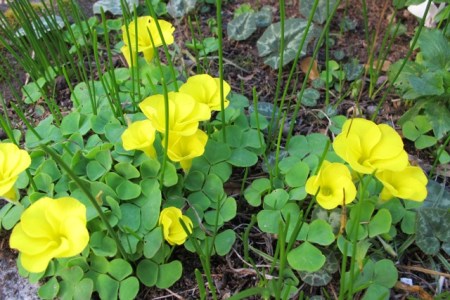
O. luteola - an excellent garden variety

O. luteola - an excellent garden variety

Oxalis luteola, with its neat mat of clover-like leaves and masses of sunshine yellow blooms over many weeks, is another tried and true garden plant here. It has never been a problem in the rockery and gently grows amid other plants without ranging far afield. O. lobata is like a miniature form of O. luteola and equally garden safe.

Oxalis flower in colours from white, through the full gamut of pinks and lavenders to the crimson red of O. braziliensis, yellow, and apricot-orange tones. The well known O. versicolour has a pointed bud which is candy striped pink and white, like a traditional barber’s pole, though in the sun the flowers open to white. It is the only one I know which is showier when it is not open.
Oxalis (or wood sorrel, if that sounds better) are easy and fun to grow for a bit of cheer as the autumn draws in.

We keep O. eckloniana in a pot plunged into the garden

We keep O. eckloniana in a pot plunged into the garden

Growing oxalis in containers:

If in doubt, keep oxalis confined to pots in sunny positions.
• Pots can be plunged in the garden to reduce watering.
• Repot every year or two.
• Empty the pot onto newspaper and choose only the best looking bulbs. You will see which varieties have dangerous tendencies – either masses of tiny bulbs or long runners with too many bulbils attached. Throw the rest out with household rubbish to prevent any escaping.
• Free draining potting mix is recommended.
• If you have used a commercial potting mix, it will have fertiliser already added. If you are not repotting every year, the time to feed is as the bulbs are coming in to growth.
• Wide, shallow pots give the best display.
• Keep pots dry when bulbs are dormant to stop them from rotting out.
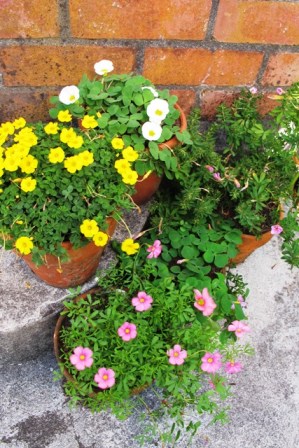
Perfect for sunny doorsteps

Perfect for sunny doorsteps

Dealing to the weedy ones:

There are no easy answers when it comes to getting rid of the weedy oxalis in gardens and lawns. O. corniculata is a creeping plant which doesn’t have a bulb so it can be weeded out. It spreads rapidly from seed and matures quickly so it pays to be vigilant and to dispose of plants in the household rubbish to avoid dispersing the seed. It can be green or red-brown in leaf and has tiny yellow flowers.
The pink or yellow flowered weedy bulb forms are more problematic, especially if they are growing through other plants. Glyphosate will kill them eventually, if you keep applying it every time you see leaves reappearing. I have never tried Death to Oxalis but it appears to need frequent reapplications as well. If you can lift all the other plants out of the garden border, you can sieve the soil or even replace it all. If you cover the area in black plastic and let it bake throughout a hot summer, it will sterilise the soil to some extent. Failing that, you just have to be persistent and vigilant, getting rid of every little bit you see.
First published in the Weekend Gardener and reproduced here with their permission.
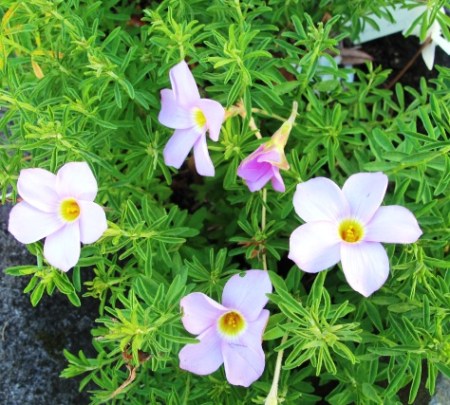
O.hirta lavender - second place favourite
O.hirta lavender - second place favourite


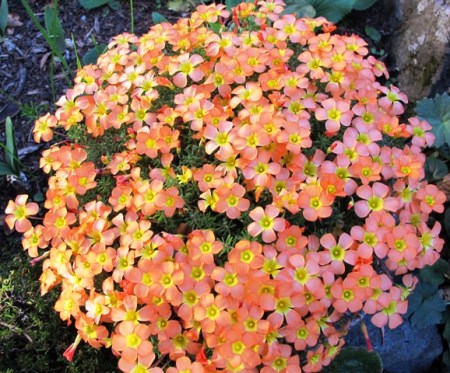
O.massoniana - massed in a wide, shallow container in full sun

O.massoniana - massed in a wide, shallow container in full sun


O. polyphylla shows very different foliage
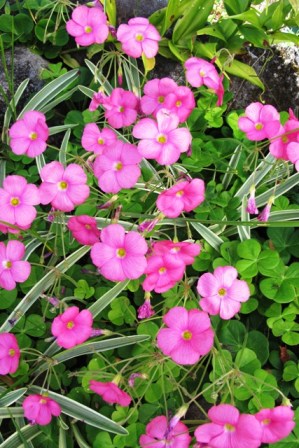
O. polyphylla shows very different foliage


O. bowiei - bold and showy very early in the season

O. bowiei - bold and showy very early in the season

In the garden this fortnight: June 7, 2012

A fortnightly series first published in the Weekend Gardener and reproduced here with their permission.

Naturalising bulbs in conditions of rampant grass growth

Naturalising bulbs in conditions of rampant grass growth

Meadows of naturalised bulbs are a complete delight and a contrast to the highly cultivated type of garden most of us have. But they are best suited to places where there isn’t vigorous grass growth and regular rain. This means that good dairy country like Taranaki is by definition not suitable for bulb meadows. All that grass overpowers and hides them. But we are undeterred. Mark has been working on a bulb hillside in recent years where we have a native microlaena grass (probably M. stipoides) which is much finer and less vigorous than introduced pasture and lawn grasses. He likes the bulbs on a hill because it is possible to get closer and to look up at the flowers from a pathway. He is very pleased with how the dwarf narcissi, species cyclamen, colchicums, snowdrops (mostly Galanthus S. Arnott) and pleione orchids have settled in over the last three years and started multiplying. The bluebells (hyacinthoides) are more robust and build up well in open areas under the trees where we can control the grass with a weed-eater. The exercise is getting the last grass trimming round done before the bulb foliage is too far through the ground with flower spikes formed.

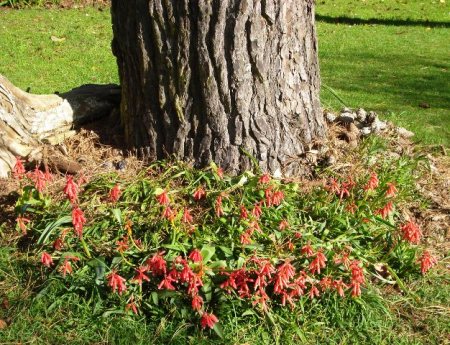
Lachenalia bulbifera

Lachenalia bulbifera

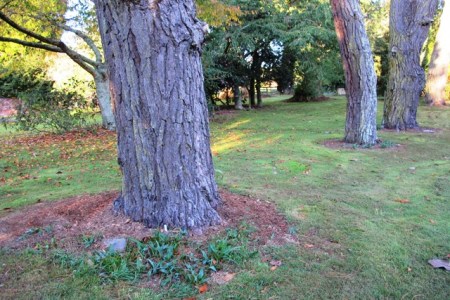
In a different area of the garden, in recent years I have been planting surplus bulbs around the trunks of large trees where the grass won’t grow because the ground is too dry and poor. These are ideal conditions for some bulbs and the lachenalias from South Africa, stronger growing dwarf narcissi like the bulbocodiums and peacock iris (Moraea villosa) don’t mind at all. There is plenty of light because these trees have dropped all their lower limbs over time. It is not quite the meadow we would like with big drifts, but it is what we can manage in our climate.

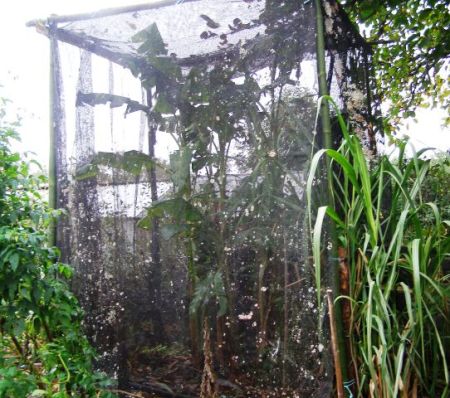
The Theatre of the Banana

The Theatre of the Banana

Top tasks:

1) Get the winter cage erected around the bananas. They are the only plants we wrap up for winter but we are very marginal banana growing territory and we are willing to work at trying to get a home grown banana crop. I refer to the construction as the Theatre of the Banana.

2) Sort out the compost heaps. We make quite large quantities of compost but at the moment, the waste is accumulating faster than we are layering it into compost piles. We work a three heap system – the heap we are currently using, the heap that is curing and the one we are building. At the moment there seems to be enough for two new compost heaps.