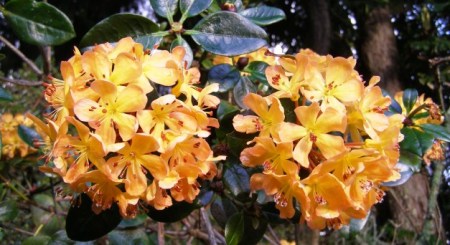
The original plant of R.macgregoriae, collected by Felix in New Guinea
Back in the 1950s when Felix Jury first became interested in vireyas, they were pretty much unknown in New Zealand with few enthusiasts internationally.
When Felix started raising seed and trying controlled crosses, he was just after anything that was new and therefore interesting. There was so little raw material to choose from in those early stages. He named maybe a dozen and with the passage of decades, about four of that dozen have stood the test of time very well and may still be around in another thirty years’ time. Unfortunately, the finer details on his crosses were never recorded so it is not possible to state with certainty which were Felix’s own crosses and which came from seed sent to him from overseas and were therefore just raised and selected by him. We know that the Australian, Tom Lelliot was particularly generous with seed and there were others from that country.
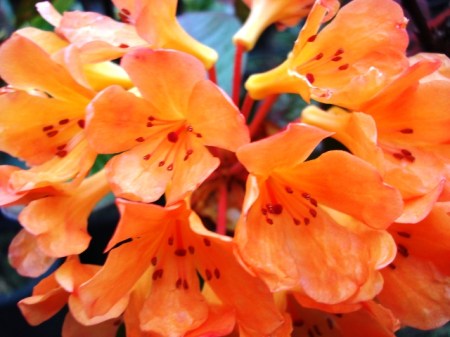
Golden Charm
In 1957, Felix went plant collecting in the highlands of New Guinea. He brought back a few interesting plants. Ficus antiarus is still the most asked about tree in our garden. Schefflera septulosa is one of the most beautiful members of that plant family you will ever see. His form of Rhododendron macgregoriae is still rated as one of the best in circulation and, astonishingly, the original plant is still surviving. This is an achievement because vireyas are not noted for being long-lived in our climate. It was that plant of R. macgregoriae which gave rise to one of Felix’s best cultivars – Golden Charm (R.macgregoriae x Princess Alexandra). We still rate it highly after several decades. The foliage is dark and glossy, the new stems are red, the habit is compact and healthy and the many flowers, while relatively small, are in good sized heads and attractive apricot to orange tones. It is also relatively hardy.
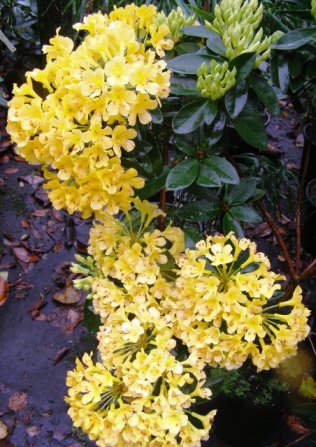
Buttermaid
With the benefit of hindsight, we now wonder whether Felix’s other two notable R. macgregoriae hybrids, Buttermaid (R.aurigeranum x R.macgregoriae) and Orangemaid (R.laetum x R.macgregoriae) might not in fact be Lelliot seed, raised and selected by Felix. Alternatively, he may have been sent pollen. Mark is not at all sure that Felix had R.aurigeranum at that stage and he is sure he did not have R.laetum. The R.macgregoriae parentage shows dominance in both the flower form and colouring of these selections but hybrid vigour makes them more reliable and tidier garden plants. Queen of Diamonds (R.viriosum x R.macgregoriae) was indubitably Felix’s own cross, a pink version this time but rather too tall and leggy to be of great merit. [Apparently R.viriosum was misidentified for 70 years as R.lochiae. Most records use the R.lochiae name when it appears that they are all in fact R.viriosum. I will defer to those with a great deal more expertise in this matter and have according changed to using R.viriosum.]
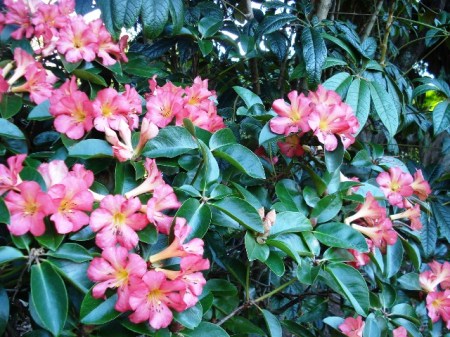
Satan's Gift planted by the Schefflera septulosa
Satan’s Gift (R.konori x R.zoelleri) and Silken Shimmer (R.konori x Dr Herman Sleumer) were selections from Australian seed, raised by Felix. These were spectacular for their day, being big and lush, colourful and fragrant. Satan’s Gift is the stand-out plant which has passed the test of time and is still a wonderful performer. The name amuses us. Felix was a completely non-religious man and to him, Satan merely evoked hot colours. Over the years, more devout nurseries have clearly had a problem with the name and this cultivar has been marketed variously as Jury’s Gift, Satin Gift and, best of all, Santa’s Gift. One wishes nurseries would understand that it is fine to reject a plant because of ethical issues with the name, but it is not acceptable to rename it willy nilly.
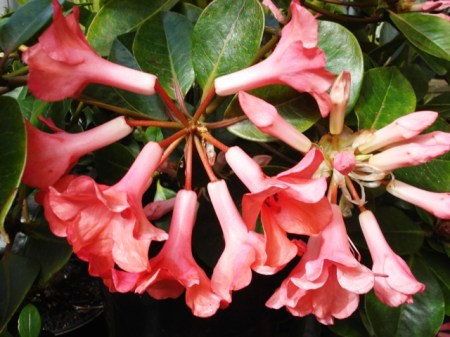
Cherry Pie
Felix was very taken with the big, scented blooms of R.konori and his own hybrids were the pink Cherry Pie, red Hot Gossip – both sister seedlings of a viriosum hybrid x R. konori – and Lipstick. Cherry Pie is particularly lush and has good bushy, spreading growth along with a good flower (though much of the scent has gone) and we still rate it as a good garden plant.
Red Rover (R.viriosum x R.javanicum) is another of Felix’s early hybrids that we continue to rate for its bushy growth habit, healthy characteristics and plenty of good red flowers in a mid-size. However his R.jasminiflorum hybrid called Lullaby has dropped off the radar now and, while a good performer, Lulu (unknown) has probably been superseded by modern selections with more flowers to the truss.
By the time Mark started hybridising vireyas, there was a veritable explosion of recently discovered species and newly imported species becoming available. He collected every single one he could lay his hands on at the time and propagated a few to distribute to collectors. Our nursery records show that we produced over 60 different species at that time, and very difficult most of them were too. The death rate in the species was far higher than in the hybrids, both in the nursery and when planted in the garden. It was with some relief that we decided after a few years that the few collectors in the country (there were probably only 5 or 10 of them) had everything we held so we stopped feeling obliged to produce them. Similarly we decided that it was not critical to keep every species represented in the garden. We have never coveted a national collection of any plant genus because we would prefer to garden with plants which justify their position as being garden worthy. Only some of the vireya species perform well for us – we would be sorry to lose varieties such as R.himantodes, R.goodenoughii, R.taxifolium, R.hellwigii, R.macgregoriae and R.konori but many of the other species are either too difficult for us to keep going, or not worth the effort (R.inconspicuum, we have always felt, was particularly well named).
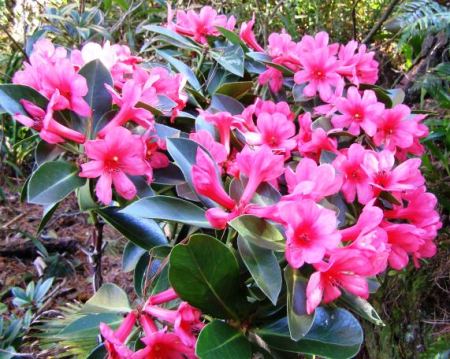
Sweet Cherry
So Mark had a much bigger plant palette to work with and this included an ever increasing number of new hybrids as well as the species. Vireyas were suddenly a fashion plant in New Zealand. They were seen as a wonderful alternative for warmer areas of the country where the hardy rhododendrons do not thrive. Added to that, in a country where we would like to be tropical but aren’t, vireyas fitted that exotic look and often obliged by flowering throughout the year. From being an unknown plant family with no market at all, they were a gardening sensation for a few years in the nineties. Fashions change and vireyas are no longer as popular as they were – they are somewhat harder to keep alive, let alone looking good, than many people realised. But in those heady days, there was an insatiable demand for new varieties which had large luscious blooms with heady fragrance and large, heavily felted foliage. Unfortunately, this sometimes meant using breeder parents which, with the passage of time, have not proven to be particularly resilient in our climate.
Mark was also keen to extend the flower form of vireyas into full trusses which more closely resemble the hardy rhododendrons. Many of the species and early hybrids are quite sparse in their flowering and have few flowers to the truss. He also wanted to explore what could be done with colour.
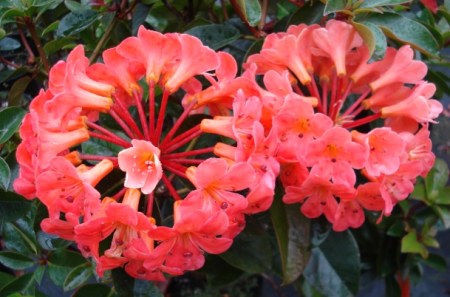
Mango Sunset
With the benefit of twenty years experience, he has gone full circle and come back to the point his father reached earlier – a conclusion that it is more important to produce healthy plants which stay alive, with compact growth and masses of flowers as top priorities. More hardiness and less flash and dash, one could say. This tends to mean sacrificing individual bloom size, foliage size and often fragrance. It may end up that his R.macgregoriae hybrid, Mango Sunset, proves to be one of his best. While he achieved the much fuller truss, he was looking for, it is just a good all round performer without being spectacular.
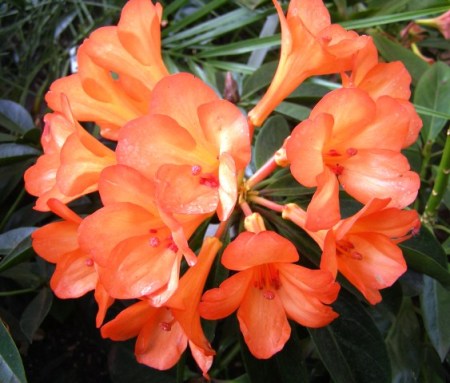
Jaffa
Market demands meant Mark made the same mistakes as many other vireya breeders – selecting new cultivars on the beauty of their blooms and on initial performance as a nursery plant. The test of longevity rests, for us, on long term health and performance as a garden plant. More than we would wish have fallen by the wayside. Candy Sunrise (R.konori x Halo series) had beautiful, big fragrant flowers with good colour but was very susceptible to phytopthora. Ditto the red Sweet Cherry (R.konori x R.hellwigii) – wonderful as a garden plant but not easy in the nursery, Strawberry Fields (Satan’s Gift x R.brookenaum) – gorgeous big red flower but leggy growth over time and inclined to die, Orange Sparkles (R.retusum x R.macgregoriae) and cute little Jellybean (Red Rover x R.stenophyllum). Frosted Candy, another of the R.konorii x Halo series hybrids, is performing very well as a large garden plant (now two metres plus which is large for a vireya) and it has huge blooms, but again is difficult in the nursery with an unacceptably high death rate from phytopthora.
Jaffa (Halo series x R.javanicum) is in the right direction for a full truss. There are now up to 15 large blooms per flower head (which is a big increase from the 2 to 5 range of many of the species and early hybrids) and a good, strong orange combined with large, lettuce green foliage. It is more frost tender and sensitive than the tougher cultivars (which tend to be those with R.macgregoriae, R.viriosum or R.saxifragoides in their parentage). It certainly has the right tropical look and is a better nursery plant than many.

Pink Jazz
Pink Jazz (R.konorii x Halo series) is another splendid large grower with enormous blooms – bright pink with a central star of cream and scented too. It also has the stand out feature of deep maroon new growth and even the old foliage keeps the burgundy tint. It is not easy as a nursery plant and it is too big for many gardens, but the plants we have in our garden are standing the test of time. We have a special fondness for this one. Mark rarely names plants after people, but this one is for our older daughter who, in her teens, was called Jazz by many friends and who nursed a penchant for wearing hot pink.
Mark has always been lukewarm about Peach Puff ([R.phaeopeplum x R.leucogigas] x R.viriosum selfed) because he regards the pastel peach colouring as insipid. It was an interior fashion colour a decade ago and I still find it very pretty. Again the truss is satisfyingly full with big blooms, good scent and felted foliage.
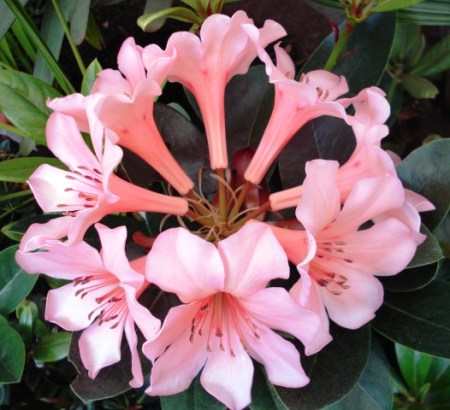
Sweet Vanilla
Of that type of larger flowered, scented hybrid, Sweet Vanilla ([R.leucogigas x R.viriosum] x Silken Shimmer) is probably the best garden plant for fragrance. Its flowers, while not huge, are a good size, opening soft pink and fading out to cream. This is one plant which garden visitors regularly ask about when in flower – always a good indicator of showy performance. Sherbert Rose (Hot Gossip sister x R.herzogii) matches Sweet Vanilla for scent and it is very floriferous but the small tubular mid pink blooms simply aren’t showy enough for most people. We still like it because we don’t want only big showy or blowsy vireyas in the garden, but we stopped producing it commercially because scent alone was not enough to sell the plant.
Practical Matters:
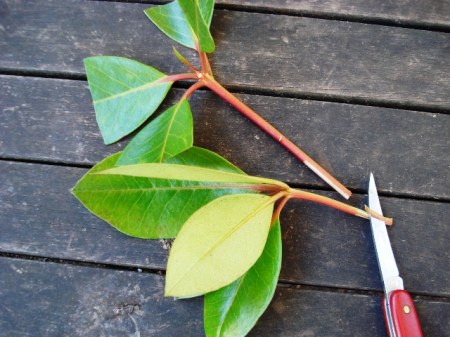
Preparing vireya cuttings - wound both sides
Vireya rhododendrons must rank amongst the easiest of the woody plants to propagate but one of the hardest to produce commercially. Neither are they bullet proof as garden plants. As long as you have firm, green material, it is easy to get cuttings to root. You don’t even need rooting hormone. In fact it is so easy that we routinely showed customers how to take autumn cuttings so they could have back up plants lest their specimen get taken out by a hard frost or wet roots. The one critical issue is to remember to have a generous sized cutting and to take the sliver off two sides of the stem (wounding). Vireyas put their roots out from the exposed cambium layer and having two wounds gives a more balanced root system and therefore more stability. It is keeping them alive after rooting which is the tricky part, especially in nursery production. Vireyas are not only frost tender and deeply intolerant of wet feet (sodden root systems), but they are vulnerable to pretty much every strain of phytopthora and a fair range of other diseases common in nursery production. In the wild, many of the vireya species are epiphytic or semi epiphytic which is an indicator that their roots need open conditions. This is what fits them to a role as permanent pot plants though they appear to last better in pots which are more permeable (terracotta or wood) than in containers which are impermeable (glazed pottery or plastic) and dependent for drainage on one or two holes in the bottom. When producing commercial runs of vireyas, we maintained a rigorous spray programme to keep disease at bay. Even so, we tolerated a far higher mortality rate in nursery plants than we would in any other crop. We have always produced them outdoors, under protective shade cloth and overhead irrigation – identical conditions to most of our nursery crops.
Vireyas tend to put on a lot of top growth, supported by small, inadequate root systems (an indicator of their epiphytic origins), and new growth is often very soft and brittle. As nursery crops in our climate, they grow very rapidly at all times of the year and it is possible to get a saleable plant through in half the time of a hardy rhododendron, but they are correspondingly more vulnerable to damage by mishandling and disease.
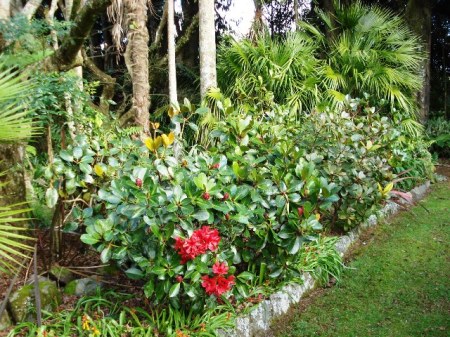
Vireyas used in a garden border
We are blessed with a climate which enables us to use vireya rhododendrons as garden plants. We are not entirely frost free so we use them on the woodland margins where temperatures may get cool but never cold enough to cause significant damage. Any frost at all can burn the most tender varieties which includes anything with R.leucogigas, R.konorii, R.hellwigii and sometimes even R.laetum in the breeding. The hardier types will take two or three degrees of frost without damage but more than that can be a problem. Get it up to five degrees of frost and plants can be killed stone dead. The beauty of vireyas as garden plants is that they do not have a set flowering season so if you have sufficient numbers, there are always plants in bloom – even in the depths of winter. Added to that, they are tolerant of hard pruning so easy to renovate. Even when cut back to bare wood, most will force out dormant leaf buds from old wood and can be bushy and fresh again within a matter of months, even if it takes longer for them to set flower buds. It is a misconception that vireyas are all tropical plants. While natural habitats are often in the tropical latitudes, they are in elevated sites which cool the temperatures.
With their climatic limitations, vireya rhododendrons will never have the geographic distribution of hardier plants and, no matter how good the hybrids, they are unlikely to achieve international standing. There is a long way to go yet in breeding reliable cultivars which are likely to stand the test of time but it is certainly interesting to have been in from the early days on the development of new selections and Mark will continue to work with them here, albeit on a rather casual basis.
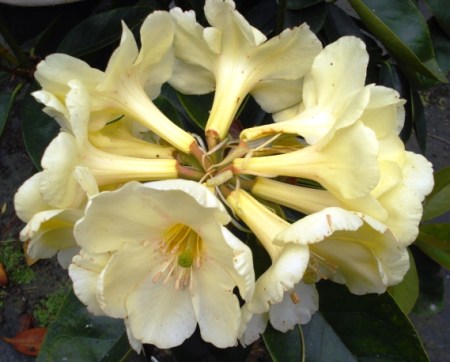
A promising lemon seedling - the breeding continues
The first instalment of this series was the 2011 article on Jury rhododendrons.


 Tikorangi The Jury Garden