
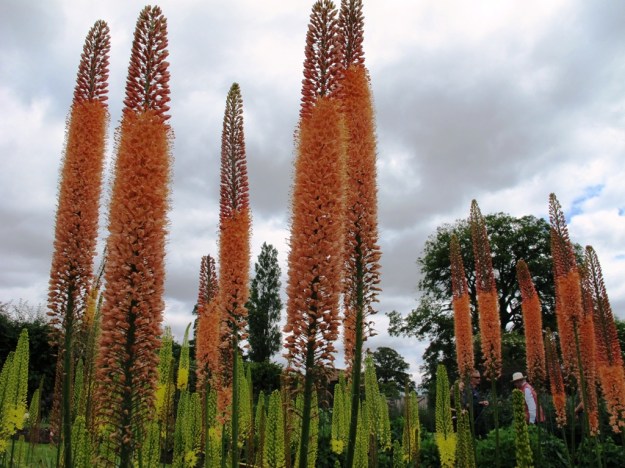
Eremurus – but in Yorkshire not Tikorangi
garden slugs and snails and assorted other introductions, but foxes we did not get.
This is by way of introducing the so-called foxtail lily, which we don’t have here in the warmer north although plants are sold and no doubt perform well the further south one gardens. I imagine they are perfect in Central Otago. I photographed these in the cutting garden at Mount St John in Yorkshire last June, so in early summer. I had not seen them before and I wondered why we were not growing them. Having Mark at my side is akin to a resident technical advisor and he immediately commented that he had tried growing them (of course he had, how could I have doubted that?) but they don’t like our conditions.
The reason eremurus don’t like our conditions is that in their native habitat, stretching from north eastern Europe across western and central Asia to China, they have good drainage, especially in winter and winter chill. They also need full sun. These are areas we might describe as cold climate deserts and the other common name for eremurus is desert candles. No desert here in Tikorangi.
Eremurus are deciduous perennials in the asphodeloideae family, growing from fleshy root systems. Their growth is rapid and their season is short – again indications of a harsh climate. There are a fair number of different species which I have not unravelled (somewhere over 60 of them, according to Wiki) as well as hybrids. Some will put up flower spikes to 3 metres of more, so as a cut flower they might be better suited to the baronial hall than the domestic living room. I would hazard a guess that modern hybridists have set about breeding more compact forms, allegedly better suited to edging suburban gardens in the same manner that handsome alstromeria, eryngiums, zinnias and many other plants have been scaled down to compact little clumps. I have yet to see any that are improved by this treatment but if you have the right conditions, full-sized eremurus are a handsome delight. They also come in white and pink and any number of colour combinations between those and the oranges and yellows.

The cutting or picking garden at Mount St John in Yorkshire
* The foxglove reference is to the post immediately preceding this one.
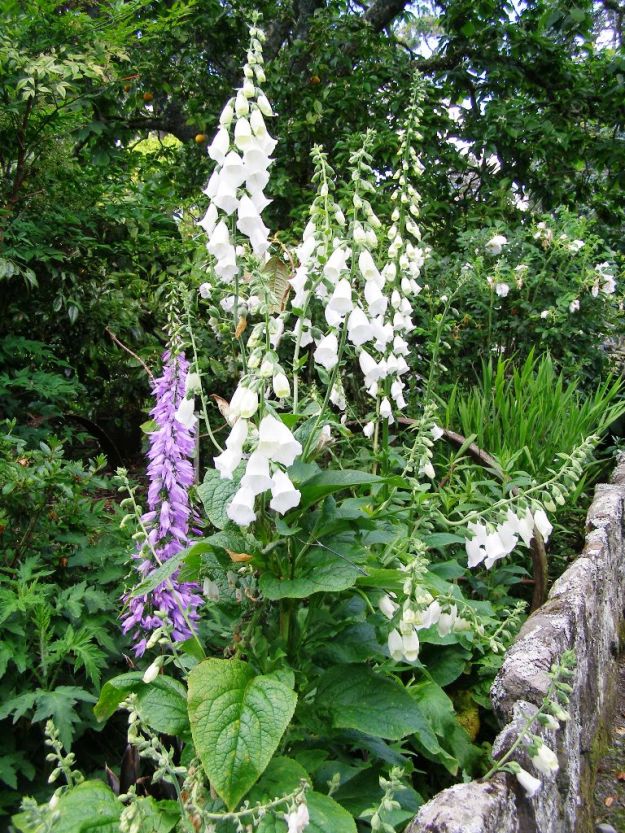

 The whites I wanted for my rose and perennial garden. After a few years, I am now moving them. They are too big and choke and swamp the smaller perennials I have in that area. I have found a couple of spots which they can have all to themselves. I was amused to see English gardener, Keith Wiley – for whom we have huge respect – on TV talking about growing plants in colonies but noting that some plants are so dominant that they do not want to grow in colonies. He cited foxgloves as an example. They are way too thuggish to co-exist happily with many other plants.
 Carol Klein on BBC’s Gardeners’ World, once said that she sorted her foxgloves as juvenile plants – the pink ones had pink veining in the leaves and the crown whereas the white ones were all green. I am not convinced she is right though I went through a stage of culling all pink-veined seedlings. I am happy to stand corrected if somebody has been more systematic in assessing this, but I am pretty sure that I have pink-veined ones flowering white and vice versa.
 In the garden it is still all about lilies. Big, blowsy, over the top auratum lilies. I am not picking the ones in the garden but in a small area of Mark’s new vegetable garden is a congested block of his seedling auratums, raised in anticipation of our new summer garden. There I can pick by the armful and oh, how I love these extravagant blooms. Auratums are a strong argument for the vigilant border control we have in this country. We do not, repeat NOT, need the lily beetle here. It is a nasty critter that takes up residence on auratum lilies and covers itself in its own excrement. We have seen it in the UK where it is an unwelcome arrival which has all but destroyed the auratum display in some areas.

 Following my final photo feature for the Waikato Times on the topic of
 Tikorangi The Jury Garden