Tag Archives: gardening

Plant Collector – Sprekelia formosissima

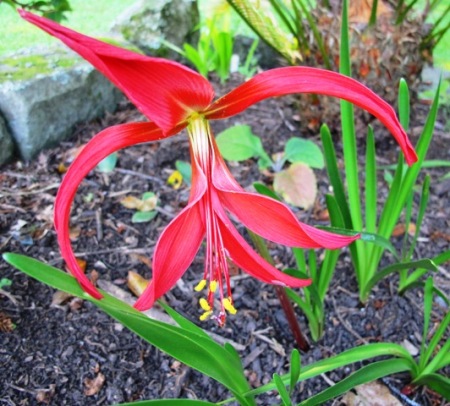
The Sprekelia formosissima or Jacobean lily

The Sprekelia formosissima or Jacobean lily

You learn something every day. This bulb is what is commonly known as the Jacobean Lily, even though it has nothing to do with the Jacobeans and it is not a lily. For years I have freely tossed the descriptor around, “it resembles a Jacobean lily”, thinking more of William Morris textile design than botany. And all the time, there is a wide level of agreement internationally that the Jacobean lily is Sprekelia formosissima. Added to that, when a species name is formasana or formasanum, it usually means that the plant comes from the former island of Formosa (now Taiwan). But the unwieldy formosissima means, loosely, beautiful. In fact it comes from Mexico.

It is indeed a beautiful flower with its rich red strappy petals and elegant form. A member of the amaryllis family, it is closely related to hippeastrums. It grows on quite a tall stem, around 30cm, with just a single flower per stem but fairly long lived. Aside from the genuine lilies, there aren’t a lot of bulbs that flower in early to mid summer. It is not particularly rare but it is one of those collectors’ items that is getting ever harder to source with the shrinking plant range offered for sale these days. If you find a plant with seed, it germinates easily when fresh.

As with all bulbs, the sprekelia likes well drained, friable soils and good light levels. It can get attacked by bulb fly (as can the hippeastrums) so we go for the woodland margins to outwit the sun-loving bulb fly. Despite its Mexican origins, sprekelia is regarded as half hardy which means that it can tolerate cool conditions and light frosts.

First published in the Waikato Times and reproduced here with their permission.

Rata and pohutukawa – the metrosideros family

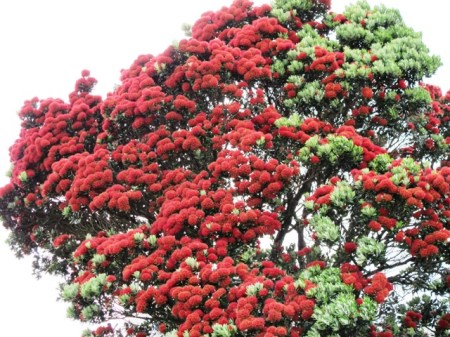
Pohutakawa, maybe Scarlet Pimpernel, in Hamilton on Christmas Day (photo: Michael Jeans)

Pohutakawa, maybe Scarlet Pimpernel, in Hamilton on Christmas Day (photo: Michael Jeans)

I have to start with a touch of mea culpa. I will never misspell pohutukawa again. It had never even occurred to me that I did not know how to spell it correctly. See, I had a Dunedin childhood and in the deep south, we probably had rata on our spelling lists rather than pohutukawa. At least that is my story. My only consolation in the matter is that my misspelling of the Maori name for Metrosideros excelsa apparently escaped the notice of everyone else involved with the production of the paper I write for, so I was not alone. But I was probably alone with my embarrassment. In case you missed it last Friday (before I corrected the website post), I turned the second u into an a.

As a peace offering, I give you a photo of a lovely pohutukawa in full flower at Millenium Heights in Flagstaff, Hamilton. The owner, Bronwyn, tells me it was meant to be a dwarf but it is already three metres high and it flowers profusely every year. When she said it was meant to be a dwarf, I thought initially that it might be one of the Kermadec pohutukawa (M. kermadecensis) which is sometimes used as a smaller selection – though only relatively smaller. However, I ruled that out because the Raoul Island pohutukawa flowers intermittently all year in dribs and drabs and it does not put on a mass display as shown. Added to that, it is more frost tender so it is never going to be happy in inland Hamilton. It is more likely to be a selection of the common form, M. excelsa. In fact it may even be the one named Scarlet Pimpernel (which was selected by my late father-inlaw). There is considerable variation within this species. If you start looking at trees you see over the next couple of weeks, you will pick huge variation in colour. Some look almost rusty brown from a distance, some deep red. The ones that stand out in the landscape tend to have orange tones to the colouring which gives vibrancy. It is called seedling variation – they don’t grow identical from seed. To get an exact clone of the parent, you have to propagate by cuttings.

The yellow pohutukawa are sometimes seen as a novelty. They are pretty enough in their own way but to my eyes they are nowhere near as spectacular as a good red specimen. The yellows are just another seedling variant of the same species, most common on Motiti Island. The reason you see them in mainland gardens and public plantings is because Duncan and Davies Nursery produced them commercially some decades ago – always the quest for the different and the new. It was that quest that also saw variegated forms offered for sale. These are not my favourite. I am not a great fan of variegated plants so I am unconvinced that a variegated form of our iconic pohutukawa was ever going to be an improvement on the usual forms in the wild. But because they were seen as different and new, they sold well for a while and there are big specimens around.

M. excelsa grows naturally as far south as Poverty Bay in the east and North Taranaki in the west. The pohutukawa that grows and flowers in the top of the South Island is a different species, M. parkinsonii. It tends to be rather more scruffy in its habit of growth.

The rata does not just go up, it goes along in every which way

The rata does not just go up, it goes along in every which way

It is of course the rata that is to the South Island what the pohutakawa is to the North Island, though we do have the northern rata as well. These are all the same family (so all metrosideros) but different species. Think of them being like cousins, perhaps. So the South Island rata is M. umbellata and the North Island rata is M. robusta. It is the latter that starts life as an epiphyte, living on a host tree that will ultimately die. The rata sends down roots that eventually reach the ground and develop into a strong vine. Over time, the vinous roots fuse together to form what looks like a trunk (called a psuedotrunk) so, by the time the host tree is strangled, dies and rots away, the rata can hold itself up. We have this rata here in the garden and we find that it does not just go up the host trees, not at all. In an hospitable garden woodland situation, there is little holding it back as it attempts to take over the entire area. I have to have words with it about its smothering ways. There is a limit to how much ground cover we want. Besides it only flowers on the tops and even then is but a shadow of the magnificent display the pohutukawa put on.

The southern rata is less determinedly epiphytic and can establish itself on its own roots in conditions which vary from nearly sub alpine to wet coastal forest. I recall as a child the excitement expressed by adults at the flowering of the rata in the wild, but it tends to be more a haze of red than an in-your-eye statement of summer and Christmas as with the pohutukawa. Unfortunately rampant possums have destroyed much of the impact of the southern rata in bloom.

Of the family, it is the good red pohutukawa or M. excelsa that remains my firm favourite.

First published in the Waikato Times and reproduced here with their permission.

Grow it Yourself (or not, in the case of American school lunch pizza)

Yes! Pizza. In honour of one of life’s bizarre rulings of 2011, that pizza counts as a vegetable serving. Here I was thinking that by definition, vegetables are edible plants that one grows but apparently not. Mass produced pizza with a smidgeon of a red substance which once, some time and distance past, had a debt to a tomato, can now officially count as a vegetable. One might not have been quite so surprised had the good gnomes of Brussels made a formal decree. It was the European Community, after all, that passed regulations on how bent a banana was permitted to be and they also addressed the perplexing issue of cucumbers. I can’t recall the details of that but I think it was probably on how far a cucumber was permitted to bend from a straight line. But it was the United States Congress, that fine law making body, which bowed to the pressures of the frozen food industry and reclassified pizza to enable it to remain as a healthy option (ie: counting as a serving of vegetable) on the menu of school lunches for American children.

Our diets in New Zealand may be far from perfect and we have a growing issue with obesity, but I think we have far too much respect for the Heart Foundation and the healthy tick to consider mass produced pizza as a healthy food choice. If you are worried about your weight, just ponder for a moment how many obese vegetarians you have met. I failed to come up with any. Certainly it is not common and while giving up eating meat may be a step too far for many (including me), doubling the fresh vegetable intake might be a good New Year’s resolution to make, along with trying to grow at least some at home.

First published in the Waikato Times and reprinted here with their permission.

Tikorangi Notes: Friday 23 December, 2011

Red dahlias for Christmas (but not for Plant Collector profiling)

Red dahlias for Christmas (but not for Plant Collector profiling)

Latest posts:
1) Oh Christmas tree, oh Christmas tree (Abbie’s column) and why it may be a misnomer to brand the iconic pohutukawa as the New Zealand Christmas tree.
2) While the reasons why philadelphus is often referred to as mock orange blossom may elude me, the pure, fragrant beauty of the flowers at Christmas is above reproach.
3) Was there even life before basil?

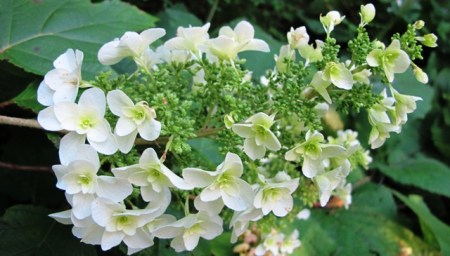
The dainty Hydrangea quercifolia "Snowflake"

The dainty Hydrangea quercifolia "Snowflake"

Tikorangi Notes: Friday December 23, 2011
Just two days before Christmas and the sun is shining brightly, temperatures are rising and there is no wind. After the torrential downpours of last week, it feels like a little Christmas blessing. In the garden we are busy with a grooming round. Well, two of us are. Mark is determinedly following his own path of draining the settling pond which stops our stream in the park from silting up and doing a weeding round. He takes the lion’s share of responsibility for weeding here. Lloyd and I are titivating in preparation for a wedding to be held here on New Year’s Eve.

Other gardens focus on the wedding venue market but not us. Mark prefers people to come because they want to see the garden rather than to see the place used as a venue. I did a handful of weddings a few years ago – singlehandedly because Mark resolutely stuck to his principles and made himself scarce. But then I met… Bridezilla. That was my last ever booking. If I had known how demanding she would be, I would have trebled the price I quoted and even then I do not think that would have compensated for treating me like the hired help in my own garden.

But, we have a wedding coming and we agreed to this one because it is our daughter’s best friend. And it is proving to be a Major Event. Pride says we have to have the top gardens in immaculate condition, even though we know that guests are here for the event and few will do anything more than cast their eyes around and say, “Oh, very nice…”. Given that the colour scheme for the wedding is the wonderfully retro orange and brown, it is perhaps just as well that the dominant garden colour at this time is lush green. We are in the gentle hiatus between late spring flowers and summer lilies, though the hydrangeas are coming into their own.

The garden remains open for visiting each day. There is an honesty box if we are not around. Best wishes for Christmas to all who read this page.

Oh Christmas tree, oh Christmas tree…

The pohutukawa - often called the NZ Christmas tree

The pohutukawa - often called the NZ Christmas tree

Ah, the Christmas tree. I was a little amused by a comment on Twitter from somebody that their potted pohutukawa had arrived but was considerably smaller than they had expected so their decorations were now placed beside it. Somebody else posted a photo of their potted karaka tree festooned in gold tinsel, Christmas balls and lights. It looked odd, but logic says it is no odder than adorning a pine tree in similar fashion.

Some brand the pohutukawa as the New Zealand Christmas tree. Living near the coast as I do, pohutukawa feature very strongly in the landscape. They obligingly flower at Christmas, lighting up the landscape. But of course there are large parts of New Zealand where they don’t grow or aren’t needed and residents there may well question the seasonal accolades bestowed upon it. When I say they don’t grow, the problem is that this special tree is not overly hardy. Indeed it is distinctly frost tender when juvenile. If you look at the distribution, it is largely coastal because disturbed air flows from the sea prevent frosts. Head just five or more kilometres inland and it can be too cold for them.

The other aspect of pohutukawa is that they are a wonderfully obliging and resilient coastal tree, putting up with salt laden wind and making enormous buttress roots to hold back the ravages of coastal erosion. They will grow where most other trees struggle badly, defoliate and die. Our coastal areas would be barren wastelands without them. Once you move to more sheltered areas inland, you have a much larger palette of trees to choose from so the tough pohutukawa might not be the tree of first choice. So for those of us who live in coastal areas from about the lower middle of the North Island upwards, the pohutukawa is our New Zealand Christmas tree but there will be New Zealanders who have never seen one in flower.
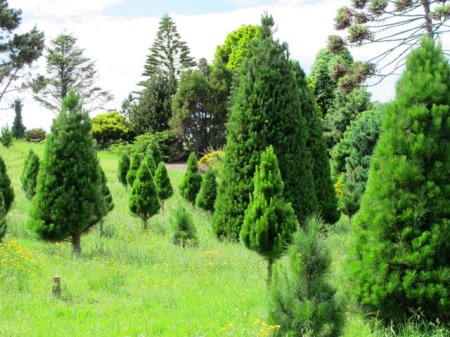
Did some not make the grade in years past? A commercial grower's roadside field. Spot the two that have never been clipped

Did some not make the grade in years past? A commercial grower's roadside field. Spot the two that have never been clipped

For others, it has to be said the common old pine tree is more likely to deserve the award. Many people do not realise it is in fact native to California – it grows wild in a limited area of the Monterey Peninsula. But I think we could probably crown this country as the Pinus radiata capital of the world and certainly other countries don’t tend to use the humble pine as a Christmas tree. The handsome abies family are the favoured tree in Europe, particularly A. procera and A. nordmanniana, and these are so much slower growing that there are good grounds for raising eyebrows at the environmental vandalism of severing them to become temporary frames for Christmas lights. At least Pinus radiata grows so quickly in this country that it is more or less disposable. It also clips very well and if you buy a cut tree from a commercial grower, you should get a well shaped specimen with shorter needles. We were always into gathering wildlings, though the children would have liked better shaped specimens when they were young. They used to bewail the unbalanced shapes, the scruffy branches and the extra bits tied in to pad out particularly sparse areas.

Should you contemplate a growing Christmas tree in a pot as a last minute green alternative, you need to factor in three aspects. A large tree has a correspondingly large root system and is damned heavy. Don’t expect a living tree of two metres plus unless you have a small fork lift. It then takes a fair amount of skill to keep large plants healthy for an entire year so thinking you can keep your living Christmas tree and reuse it in future years may not be entirely practical. You are far more likely to have a moth eaten looking specimen with dead patches, badly root bound and hungry come next December. Thirdly, should you have purchased a living tree with a view to planting it out in the New Year, make sure you harden it off slowly to the bright sunlight when you bring it outdoors, saturate the root ball before planting and keep watering the poor thing all summer. But above all, choose the site carefully. Most living Christmas trees are forest giants in their infancy. They are not generally suitable candidates for suburban gardens, even less so if you are planting one a year.
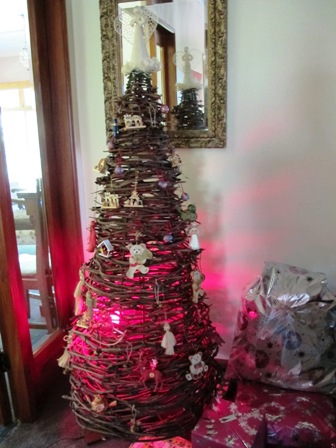
The grapevine version

The grapevine version

If you are still determined to try a live option for the future, take a look at our native matai and start clipping and training it early.

If the live Christmas tree is an ethical option based on concerns about the abject waste of severing a tree in its prime to adorn your house for two short weeks, it would probably be kinder to the environment to stick to the disposable pine tree or go for the reusable option. As a family which shuns the horrors of the tinsel Christmas tree, I am hoping my efforts with the woven grapevine pyramid will be greeted by the returning adult children today as an acceptable alternative.

Merry Christmas everyone and best wishes for a safe and happy festive season.

First published in the Waikato Times and reproduced here with their permission.