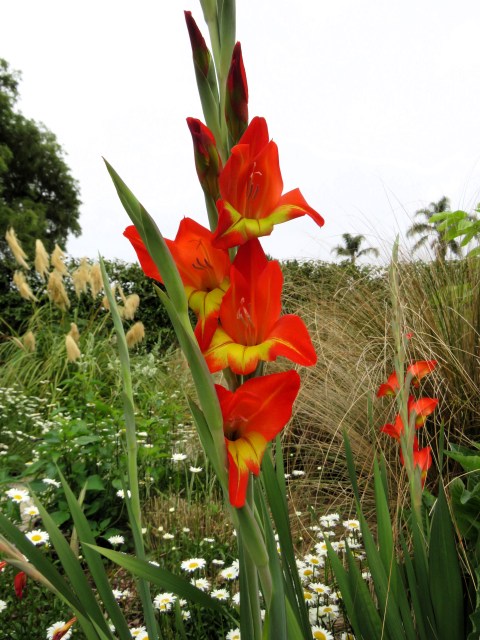
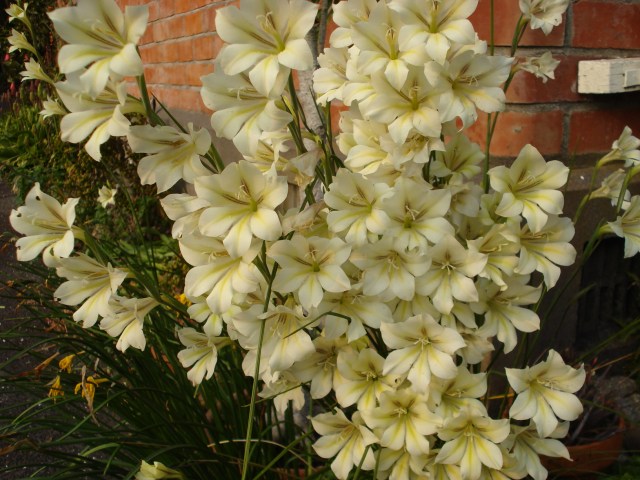
Occasionally, a plant turns up in the garden that is a mystery. So it is with this gladiolus. It is flowering for a second season in the Court Garden. I know I didn’t plant it – at least, not knowingly. I would never have put gladioli in that garden, or so I tell myself. There is nothing around it that it could have snuck in as corms in the root ball. Neither Mark nor I can remember seeing it flower elsewhere in the garden but it must have been in the rockery because it has also turned up in the Wild North Garden after I gave Zach a random collection of surplus bulbs to try naturalising.

It is a mystery and may remain that way. I will have to move it. When it flowered last year, it was beside a dark blue salvia that has since gone into serious decline and the combination was striking. I looked at it and wondered if it was too striking or just unexpected in that context. This year, it is more jarring than striking because the colour palette of the Court Garden is otherwise soft and muted. I will move it after flowering. It will fit more harmoniously into the borders.
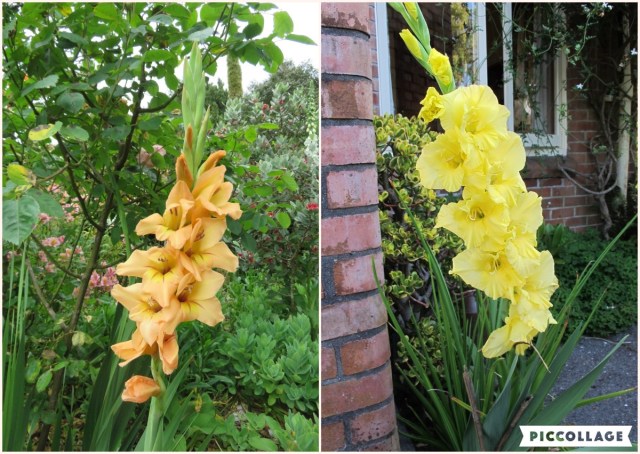
I assumed it was a legacy from Mark’s mother (who died in the mid 1980s so we are going back a long way, now). Somebody gave her a collection of different gladioli hybrids that she planted in the rockery, not so much because she liked them as because they were a gift of colour. I am not a fan of those big, vulgar gladdies – too Dame Edna Everage-ish for my taste – and the foliage succumbs to rust in our climate so they don’t stay looking good and their scale is wrong for our rockery. Over the years, I discarded most of them although I did find another spot for a pure yellow one that does not displease me. A few others have gone into the mix and match of the Iolanthe Garden.
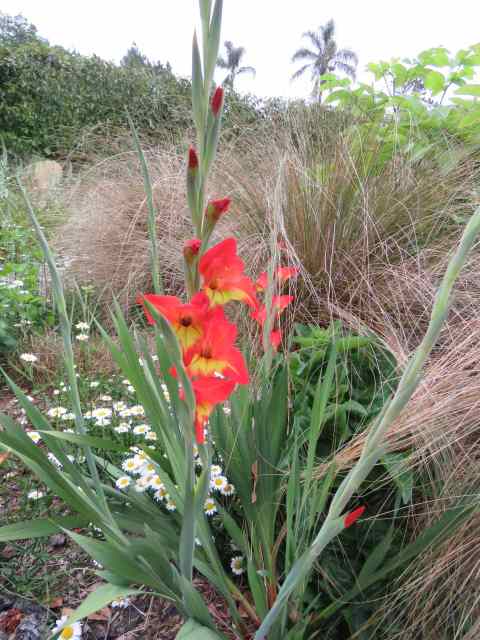
“I think it might be a species,” said Mark. That makes more sense because if it is a species, there is every chance he bought it at some point. If he had ever kept an accessions book, we would be able to check but he never has so we can’t. I reached for Terry Hatch’s book “Bulbs for New Zealand Gardeners” which is somewhat out of date now but still a useful record of many of the more obscure bulbs that were available in this country at the time when Mark was buying and acquiring plants to extend the collection. From Terry’s book, I found a few names to look at further on the internet and I am wondering if it is Gladiolus dalenii syn natalensis, or, if not a species, then maybe a first generation hybrid. Maybe some reader has more expertise in this area than I have?

What I did learn from the internet is that there are at least 255 different gladiolus species and those species can be highly variable. I was curious as to the main breeder species that have been used to get those Dame Edna hybrids and the two main ones, it turns out, are the rather odd little G. papilio (otherwise known as the butterfly gladiolus) which we have in abundance and the aforementioned G. dalenii syn natalensis. So that was interesting.

What I was delighted to be given as the red form of G. papilio named ‘Ruby’ or ‘Ruby Red’ turns out to be a hybrid, too. Technically, it should be named as G. X papilio ‘Ruby’. The X is shorthand for a hybrid although my somewhat superficial search didn’t find what it is crossed with. It is very good.
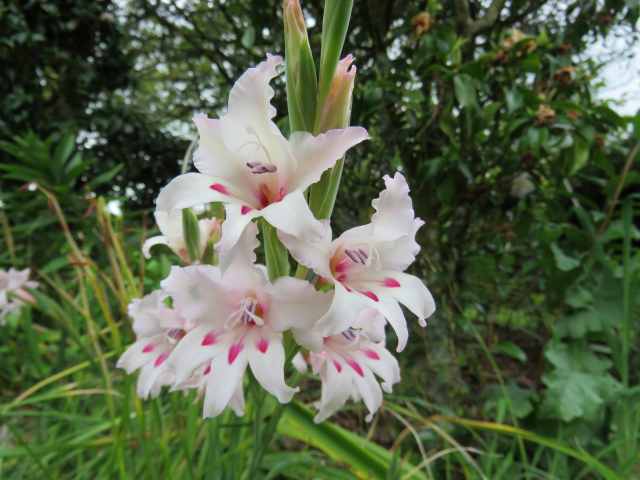
It is only the OTT hybrids I am so dismissive about. We grow a few of the species and I would happily add more. I wouldn’t be without the night-scented G. tristis that is a graceful and charming addition to the in spring and we seem to have a number of different forms of the variable Painted Lady gladiolus, otherwise known as G. carneus. If you want to see more of the charming species, the Pacific Bulb Society has a gallery of dainty delights. Many of them won’t be in Aotearoa New Zealand and few that are will be commercially available. Gladiolus species are somewhat of a niche interest.


 Tikorangi The Jury Garden