Tag Archives: in the garden this week

In the Garden: March 4, 2011

• It is now officially autumn, a much more favourable season for keen gardeners but it does bring a slight sense of melancholy to many. This is exacerbated by the national sense of shock at the Christchurch earthquake. Friends who are currently refugees from that fair city tell me that they knew that there was up and down movement as well as the more common sideways vibration because any plants in their garden which were not very well established with big root systems were thrust upwards, right out of the ground, like corks bursting out from a bottle of bubbly. Their former garden is littered with plants pushed up, tossed sideways and now lying some distance away. Sadly, that is the least of their problems but they found it an interesting phenomenon.
Cover grape vines urgently

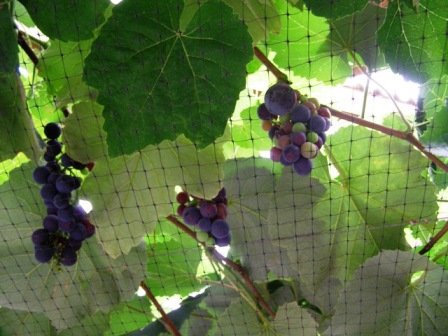
Cover grape vines urgently

• If you have yet to cover your grapevines with bird netting, get onto it. Today. Otherwise you will have no crop because the birds will get there first. Even netted in, wily blackbirds will find the smallest opening but it does slow down the onslaught.

• With autumn rains threatening, harvest onions and pumpkins. It does not do them any good to be left out in the weather. Your garlic should have been gathered already.

• Most of the garden centres have their autumn bulbs in stock and the earlier you buy them, the better condition they will be in. If you are not ready to plant them, store them in the fridge but in paper bags, not plastic, so they can still breathe. Many bulbs appreciate that chill before being planted and it is recommended for anemones and ranunculus. Remember to plant anemones with the pointy side down and ranunculus with the claws down.

• Tulips are not easy to keep in our climate which is why mass displays of them are not common. Freshly purchased bulbs should give a wonderful display this spring but future seasons will be all downhill unless you live halfway up the mountain or in cold inland areas. They need winter chill to keep performing well. Even so, many of the spectacular displays in Europe depend on replanting every year and discarding the bulbs that have already flowered.

• Hyacinths are even worse in our climate which is a shame for such lovely flowers. Really, you have to see them as an annual here.

• Take out spent canes on raspberries. Next season’s crop comes on the new canes.

In the Garden: February 25, 2011

Impressed by the Japanese Black Trifele tomatoes

Impressed by the Japanese Black Trifele tomatoes

• There is not a whole lot you can be doing in the ornamental garden at this time of the year but history tells us that we will start cooling off within the next fortnight so enjoy the respite. Try at least to stop summer weeds from seeding to reduce next year’s crop. Snip the seed heads straight into a bucket and dispose of in the rubbish or burn them if you are in an area that allows fires.


• It is pretty much the last call for summer pruning of cherry trees. While you are about it, you may want to tidy up plums and peaches as they finish cropping.

• Mark has tried a relatively large assortment of tomato varieties this year but top of the popularity poll is Japanese Black Trifele. It is a curious dark tomato, more deep green and black than red so traditionalists may find it slightly disturbing but it more than makes up for that with good flavour, fleshy texture (rather than too juicy) and good production.

• You can save seed from most vegetables (we will be saving the tomato seed), confident that future crops will come true but with two provisos. Save the seed from the best specimen in the harvest, not some poor little weakling. The quality of future crops depends on the quality of the parent plant. And F1 hybrids will give very patchy results and don’t generally come true to the parent. F1 hybrid seed is the result of controlled pollination between two selected parents and was the origin of the super sweet corn we now take for granted and of some of the modern tomato cultivars. The only way of telling if you have F1 hybrids growing is from the original seed packet.

• Keep up the deadheading on summer flowering plants like dahlias and cosmos to extend the blooming season.

• Deadhead agapanthus by waterways and near native bush areas.

• Get the winter veg into the ground but plant brassicas in small numbers successively every month to avoid the common problem of a huge surplus of cabbages and cauliflowers all coming ready at the same time.

In the Garden: February 18, 2010

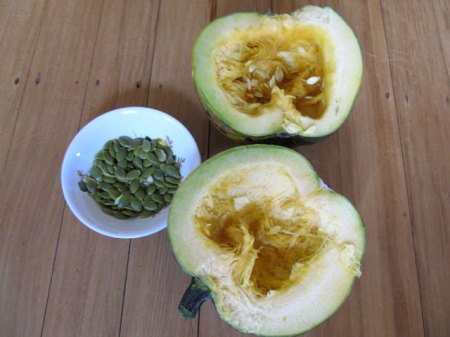
Rather too high a ratio of barely edible pumpkin to seed yield

Rather too high a ratio of barely edible pumpkin to seed yield


· Do not delay on summer pruning cherry trees as time is running out.

· Get on to planting the winter vegetables too. They need the rest of summer and all of autumn to grow because once the winter cold comes, they stop growing though they will hold in the garden so you can harvest fresh each day. Fresh veg are usually much more expensive to buy in winter and spring rather than the bountiful summer and autumn so it makes economic sense to grow your own, even aside from the pleasure and satisfaction of gathering your own produce. So get the parsnips, carrots, peas, Florence fennel, beetroot and brassicas in. The turnip family too, if you regard them as suitable food for humans.

· We have been trying out growing pumpkin for seed this year – a variety that has no hulls so needs no separation. It is an oil-seed variety. Certainly the fresh pumpkin seed is delicious but based on the first gathering, it appears that you would need a very large area to attain self sufficiency in pumpkin seeds. And alas, the pumpkin flesh itself is of no merit. If you were starving, it might be okay to eat but it is nearly as bland as marrow.

· We have been a little slow on the uptake revisiting beetroot here but, as many others have discovered, when picked young and tender (about golf ball size), they are delicious cooked in a variety of ways but especially roasted. Beetroot can be sown from seed pretty much all year.

· Rocket and mesclun bolt to seed in summer but with cooler weather just around the corner, it is fine to return to sowing these crops from seed.

· If you have been intending to spray your rhododendrons for thrips (the cause of irrevocably silver leaves and a weaker plant), now is the time. You need to use a systemic insecticide so the plant sucks it into its system. Contact insecticide only kills where it touches and as the offenders are on the undersides of the leaf, you can’t get total coverage. The alternative is bands of old carpet or similar soaked in neem oil and secured around the main trunk. This approach seems to be getting good reports though we have yet to get around to trying it ourselves. Soaking a band in Confidor or similar insecticide will also work but wear gloves when handling it.

A handy implement for dealing to lawn weeds

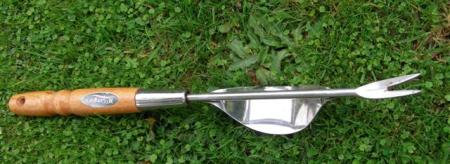
A handy implement for dealing to lawn weeds

· Autumn is an optimum time for sowing or over sowing grass so if your lawn is looking very sad, you can start preparing it now for resowing in a few weeks time. Getting out the flat weeds is a good start. You can either dig them out (I have a very handy tool for this), sprinkle them with sulphate of ammonia or use a designated lawn spray. Don’t feed your lawn at this time. We are too dry and it is more likely to kill the remaining grass instead.

In the Garden this week: January 28, 2011

• A point of clarification from last week: if you want to try water retention crystals (Saturaid, Crystal Rain or similar) on a dry lawn, you must rake them in, not just leave them scattered on top. Otherwise you will just hoover them all up with the lawnmower.

• If you read the article on the food pages of our local paper last Tuesday about pine nuts, you may be interested to know that they are easy enough to grow here. Pinus pinea, the Italian stone pine, is the most common variety though there are other species suitable for seed (pine nut) production. However, and it is a big however, as soon as it comes to harvesting the seeds and peeling off the outer coating of each seed, you will realise why they are relatively expensive in the supermarket. You are more likely to decide that they are actually extremely cheap to buy instead.

• If you needed an extra reason to get motivated to plant a winter vegetable garden, the Australian floods may be it. Vegetables are tipped for hefty price rises this year – it is all a matter of supply and demand. So start digging. If you are working on grassed areas skim off the top layer of turf and stack it to one side to rot down. Or, if you are not determined to be organic, spray with glyphosate (formerly known as Round Up) which will also kill off most of the perennial weeds (but not clover). Current evidence is that glyphosate is safe to use when applied according to directions. It has been around for many years now so there has been time to discover lingering ill effects or contraindications.

Last weekend's rain means it is safe to return to planting out herbaceous material

Last weekend's rain means it is safe to return to planting out herbaceous material

• With the heavy rain last weekend and more forecast, we have resumed planting but only of herbaceous material, not woody trees and shrubs which will get stressed when we next dry out again. Herbaceous material is quicker to establish itself and to get its roots out and it responds much faster to watering if necessary. I have been digging, dividing and replanting an enormous clump of Ligularia reniformis (the tractor seat one) – but cautiously. It is within reach of a hose just in case.

• If your potatoes are showing signs of blight (dark brown wet patches on the leaves), you have to be in really early with a fungicide spray to stop it. If the foliage is already collapsing, it is too late. Dig the potatoes immediately and you may save some of the crop. Delay and the blight will also infect the potato tubers. You have to remove all the diseased foliage and tubers to try and stop the fungus from remaining. Either burn the affected plants, put them out in the rubbish or hot compost them. Don’t just throw them in a heap or cold compost them. It is this blight (Phytophthora infestans) that caused the Irish potato famines.

• On the grounds that a few phone calls asking the same question may indicate a landslide of curiosity out amongst the readership, I found the rolling compost maker shown in Outdoor Classroom last week at Mitre 10 Mega in New Plymouth. This is not to say that other outlets do not also have it in stock – I did not look further.

In the Garden: January 21, 2011

Dry bulbs can still be planted

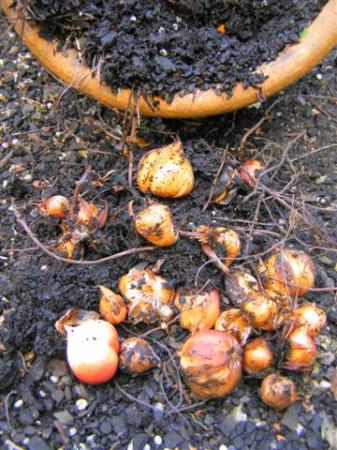
Dry bulbs can still be planted

• Saturaid or Crystal Rain can look like a good idea at this time of the year. These products generally resemble rock salt crystals when dry but absorb large quantities of water, expanding and changing to chopped jelly in appearance. Use them for hanging baskets, potted annuals or short term potted vegetables. Don’t make the mistake of using them in the garden. While they look appealing at this dry time of the year, with our high rainfall, for ten months of the year they will hold water and ensure that our free draining soils become water logged. Once you have them in the soil, they will stay for years. Longer term container plants don’t want to be kept waterlogged in winter either. So restrict their use.

• However, I am told that these water retention crystals can be very good on lawns which dry out badly over summer and turn brown. I have yet to try this myself but I will in a couple of small problem areas. Carol at my local garden centre says that scattered lightly on the lawn, they have proven very effective and there is good logic to that but be sparing in the quantity used.

• Summer prune cherry trees.

• We have pretty much stopped planting any ornamentals here now until we get significant amounts of rain. If you insist on continuing to plant, you must water well before, during and after the planting process and continuing to water over the next weeks. With water restrictions being imposed in much of our area, it is better to delay all but vegetable planting.

• You can plant dry bulbs and leave them for nature to take its course though garden centres will not generally get any of the new season’s bulbs in stock until the start of February.

• If you grow your own vegetables from seed, you should be getting onto sowing winter vegetables – brassicas, parsnip, carrots, winter spinach and lettuce, leeks and celery. If you are going to buy plants, you have plenty of time. However, starting from seed will save money and give you extra to share.

• This does not apply to Brussel sprouts which must be planted immediately, using young plants, if you are to get a crop through. They have a longer growing season and need to be big, strong plants by winter. This is assuming you eat these gourmet baby cabbages, as we do.

• The food pages of our local paper had a piece tea this week. You may be interested to know that you can grow the tea camellia easily here, as long as you do not get very heavy frosts. What is more, it is sometimes available to buy. Look for Camellia sinensis. Mark brewed the best tea from ours when he bruised the leaves and left them to ferment slightly for 24 hours – apparently closer to Oolong tea. Our home grown product has not replaced our favoured Earl Grey but it is not a bad substitute for those in search of self sufficiency or those who love the freshest of green tea.