Tag Archives: in the garden this week

In the Garden this Week: November 5, 2010

· Narcissi fly are on the wing, circling in search of somewhere to lay their eggs. It is the hatched larvae which will burrow in and consume bulbs, causing the damage from inside out. The flies start circling in the heat of the day. Mark can be found in our rockery stalking them individually with his little sprayer of Decis, which is a synthetic pyrethroid. The non chemical alternative is to stalk them with a fly swat in hand but you have to be very quick to get them. Removing spent foliage and mounding the soil a little deeper over the bulbs will also help protect them. Narcissi (daffodils) need 65 days of growth in order to make the bulbs strong for next season so as long as you recall seeing the foliage emerging by late August, it is safe to strip it off now. Narcissi fly attack daffodils, hippeastrums, snowdrops, snowflakes and quite a number of other bulbs growing in sunny positions. The offender looks like an inoffensive small blowfly but with a yellow lower abdomen.

· In the vegetable garden, leave the brassicas now til the end of summer (that is the cabbage, broc, cauli family) because the white butterfly will decimate summer crops but you can be planting pretty much anything and everything else now – lettuces and all salad veg, peas, green beans, runner beans, cucurbits, main crop potatoes, kumara, yams, tomatoes. If space is very limited, go for quick turnaround greens and higher value crops rather than those that take up a lot of space (in other words lettuces and capsicums rather than gherkins and pumpkins).
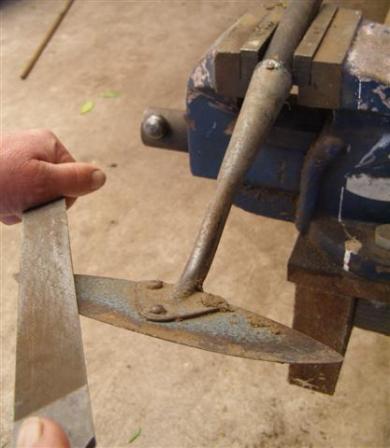
Keep your push hoe sharp for good results

Keep your push hoe sharp for good results

· Stay on top of the weeding. Regular push hoeing before plants have a chance to set seed is very effective, especially done on a hot, sunny day so the weeds wither and die quickly. Push hoeing also keeps the soil tilled and friable. It is easier if you keep your push hoe sharpened – you can do this with a file from time to time.

· If you have not covered your strawberries yet, you are risking your harvest. The birds don’t understand about waiting until they are ripe – as soon as they showing any sign of red, they will be into them. Use bird netting held up with cane hoops or something similar. Laying straw or dried grass beneath the plants helps keep the fruit clean and reduces the chances of rotting if we get a wet spell.

· Water container plants daily now unless we get rain. A little often is the mantra.

· Coating your fingers in cooking oil before going out to deadhead rhododendrons stops the sticky goop on your fingers.

· If you have small children in your life, plant a few sunflower seeds with them and go for the giant heads. They will need staking and tying in due course but it is a pretty amazing experience for little ones to see plants which will grow quickly to three or four metres and have a spectacular flower head. They won’t forget it.
In the Garden this week: October 29, 2010

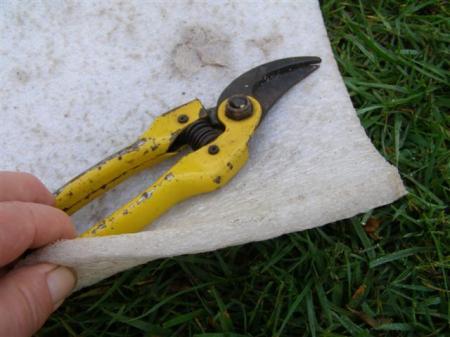
A remarkably useful square of high density foam packing

A remarkably useful square of high density foam packing

• Advice this week is out of the do- as- I-say school, rather than our usual efforts to lead by example. This is the only week of the year that there will be no gardening happening here as we, along with other garden openers, are completely committed to garden visitors. So the first suggestion for locals is to get out and visit a few of the many gardens open for your pleasure this week.

• Winter has at least gone once and for all and after a slow start, we are rushing headlong into warmer and drier weather. Start a watering routine now on baskets, pots and containers. They dry out really quickly and a little water often is always better than a flood when they start wilting or dropping leaves.

• It should be safe now in all areas to get the summer vegetables planted out – corn, capsicums, tomatoes, cucumbers, pumpkins, aubergine, basil, yams, lettuce, kumara and the rest. If you are a novice, this spring planting will give the quickest results to keep you motivated.

• Try and avoid compacting your garden by walking on it where possible. Quick maturing leafy crops, such as are being planted now, like light, friable, well tilled soil. Having a board to walk on is the traditional way of avoiding stomping the soils.

• Another warning about hormone sprays (commonly used on lawns) – earlier in the season we counselled against using them as deciduous trees, and particularly magnolias were coming into leaf. At this time we advise against them if you have grapevines or tomatoes, or indeed kiwifruit. All are very susceptible to the slightest hint of spray drift. Our overall advice is to manage your lawn in other ways if possible and only turn to hormone sprays as a last resort.

• The window of opportunity for planting melons with reasonable chance of success is narrow. Get them in asap because they need a long growing season. Watermelons are easier than rock melons but both need maximum heat and sun. Your chances of harvest will reduce greatly if you live inland where temperatures are cooler.

• Deadhead pieris (lily of the valley shrubs) to keep them flowering well next year.

• Some of the most useful pieces of equipment that we have were free – squares of thin, high density foam which came as packing around something. As convenient kneeling pads, they leave the expensive kneeling stools for dead. They cushion the knees, don’t let moisture through, repel dirt and are as light as a feather to carry around.

In the Garden: October 22, 2010

· While Labour Weekend is the traditional time to get the The Great Summer Veg Plant Out done, the lingering cool temperatures, wind and rain have mitigated against it this year. The soils have not had much of a chance to warm up yet. Don’t rush it especially if you are in a cooler, inland area. A week or two is neither here nor there.

· Priority for planting out when conditions are suitable are the crops which require a long growing season which include aubergines, capsicums, cucumbers, both rock and water melons, kumara, tomatoes and corn. If you have starter plants of these in small pots under cover, be careful about planting them straight out in the open in either blazing sun (unlikely) or torrential ran. You may need to give them some protection while they get established. Cut off soft drink bottles can work as can plastic bags held up by sticks if you don’t have a cloche. A single sheet of newspaper will protect them from the bright sun. You can avoid this by hardening them off gradually over several days by exposing them to a few hours of direct sun only.

· If you are not planting out the little plants yet, make sure that they don’t get set back by being held in pots that are too small or by forgetting to water them. They rarely recover well from such set-backs.

· Clematis are rocketing away and most need something to climb up. If you leave them any longer, you will cause a lot of damage trying to get them to grow in the right direction. A bamboo tepee is a quick and easy solution.

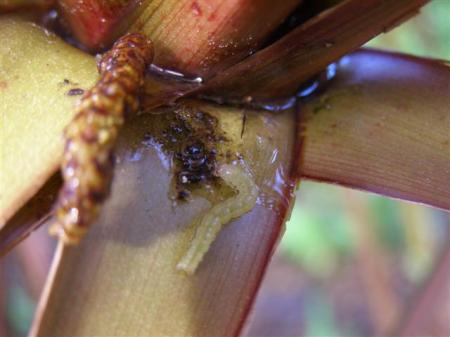
Greeblies in the cordyline

Greeblies in the cordyline

· The caterpillars that chew holes in our native cordylines (cabbage trees) are at their most active. These are the progeny of a native moth (which is why NZ cordylines overseas look so clean and smart). On small plants, running your hands up the base of the tufts of leaves can effect a good kill. On larger plants, if you want clean foliage, you will have to spray with an insecticide. If you look, you may be surprised at what other greeblies your cordyline is hiding, including slugs and snails.

· Esteemed colleague, George Fuller, tells us that it is not a rust that causes orange blotching on renga renga lilies (arthropodium) but in fact a nematode (or wire worm). These critters can build up in a patch over time so if it worries you, it may be necessary to resort to using a systemic insecticide. A systemic insecticide is one that the plant absorbs as opposed to contact insecticides which only kill with a direct hit. The nematode is actually in the plant and it is the same one that attacks chrysanthemums and black currants, answering to the name of afelenchoides ritzemabosi.

· As evergreen azaleas finish flowering, it is time to trim them. These are a forgiving plant which means you can trim back to bare wood and they will shoot again but do not delay if you plan on cutting hard because you want the plant to be flushing with spring growth to help its recovery.

· It is safe to plant both green beans and runner beans now. These are very worthwhile crops for the home gardener, giving good yields and planting successional crops of green beans two weeks apart will extend the harvest season.

In the Garden this Week – October 15, 2010

• I headed overseas for three weeks and came home to find that I had successfully missed two weeks of hideous weather and the season had changed completely in the third week. The pressure is on in the garden. Most plants are putting on their main growth spurt for the year and that includes the weeds. If you can eliminate the first round of germinating weeds this season, you can do a lot to break the cycle.

• When you have done a weeding round, pile on the mulch to nourish the soil, suppress the next series of weed seeds which will be wanting to germinate and stop the garden from drying out over summer. We favour a thick layer of compost which we make ourselves (but you need to make sure your compost is free of weed seeds). Leaf litter, bark or woodchip, calf shed shavings, old silage, barley straw, pine needles or pea straw are other options.

• Get woody trees and shrubs planted as soon as possible. That includes any new hedging and fruit trees. They need time to settle in and make some fresh root growth before the heat and dry of summer. This is even more important if you live close to the coast where soils are usually lighter or in South Taranaki which dries out faster than the north.

• The cold snap earlier this week was a good reminder as to why it does not pay to rush planting out summer vegetables like tomatoes, capsicums and corn. Labour Weekend is the traditional time but it may pay to wait a little longer until it is clear that we are consistently warmer. These plants don’t like cold changes.

• Get peas sown now. You are running out of time for this season. Planted now, you may have your timing right for fresh peas for Christmas dinner.

• You should be planting out main crop potatoes and in warmer areas, kumara runners can go in soon. Kumara need a long growing season.

• If you have your vegetable garden dug over and prepared for planting, go in with the rake every few days. You will keep cultivating the soil to a fine tilth and hoeing off successive waves of germinating seeds.

• If you persist with the opinion that our native plants are boring, take a look at the island bed on Courtenay Street outside the fire station. It stopped me dead in my tracks from right across the road and I had to go and have a closer look. It is as good a combination of plants as you will ever see. The fact that they are natives is almost irrelevant to the fact that it is just an exceptionally pleasing and interesting small public planting.

In the garden this week: October 8, 2010

  • Leave spring bulbs to die down at their own speed, no matter how untidy they look. Resist the temptation to tie the foliage in knots because this interferes with the plant’s ability to build up its energy for next season’s appearance. If flopping foliage is a real problem, construct a low trellis out of twigs or old bamboo stakes criss-crossed to keep the plants tidier.
  • Keep earthing up potatoes (piling on the garden soil to build ever higher mounds) to stop the tubers going green. Both potatoes and broad beans may need a copper spray to stop rust or blight taking hold.
  • Basil can be started now but it will need to be kept warm for a few weeks now before planting out in the garden.
  • Parsley can be sown any time but if you lack a perpetual supply self seeding down and keeping you going when green vegetables are in short supply, you can sow it down. A visiting expert here advocates sowing the seed, covering it and then head out with jug of boiling water and pour it over the row to aid germination.
  • It is the last chance for getting a crop of Florence fennel (finocchio) in for eating over summer. After this, you are best to leave it until late summer or early autumn and sow then for winter harvest because it will tend to bolt to seed too early over summer. We rate this as a fantastically versatile vegetable and are working to increase production on a regular basis here.
  • Time is running out for winter/spring pruning. Shortly it will be time to put away all the loppers and the cutters until the summer prune of cherry trees calls.