Tag Archives: Jury camellias

Tried and True – Camellia Mimosa Jury

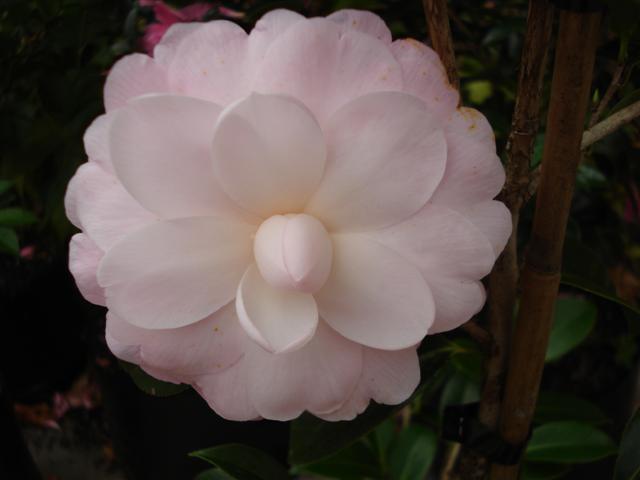
The floral perfection of Camellia Mimosa Jury

The floral perfection of Camellia Mimosa Jury

We have a familial connection here – this camellia was bred by Mark’s father, Felix, and named for his mother – but that is not why it is a tried and true plant. It is the perfection of the bloom which is its appeal, along with a much higher degree of weather hardiness than most pale, formal camellias. The regular arrangement of the petals, in similar lay-out to a water lily with no central stamens visible, is what makes it fall under the classification of formal (these rules are written down, I tell you). The soft pink colouring is particularly pretty. When the blooms are spent, they fall to the ground rather than hanging on as brown mush – a characteristic which is called self grooming.

Mimosa Jury has been around for some years now – there are established specimens locally in New Plymouth in St Mary’s Cathedral grounds. Left to its own devices, as has been the original plant behind our house, it grows tall and columnar, making an excellent hedger or accent plant. It also makes a brilliant clipped specimen. The neighbours have a perfect big lollipop Mimosa Jury as a feature. They have kept it tightly clipped and pinched out so that it is a solid ball of healthy foliage which will hold the perfect blooms out to display. In our opinion, this camellia is probably the best that Felix named and it is no wonder that it has stayed so popular over a period of years. Other formal camellias have bigger blooms but usually sustain much more weather damage and do not have as many flowers over a period of many months.

Camellia diary – the first entry April 7, 2010

Click to see all Camellia diary entries

Click on the Camellia diary logo above to see all diary entries

Crimson King - the first of the season's sasanquas to flower

Crimson King - the first of the season's sasanquas to flower

Our interest is in camellias as good garden plants, not blooms for the show bench or scientific analysis. We remain focused on the garden. The first camellias started to come into flower here about three weeks ago, at a time when we were still reluctant to admit that summer is over for another year. The fact that we can flower camellias from March to November is perhaps one reason why they have been so popular in New Zealand.

At this stage, it is only a few species and the very earliest sasanquas with flowers. Microphylla and brevistyla were the first and while their flowers are soft and easily damaged, there are so many still to open that the simplicity and brevity does not pall. Mark had to get out the hand lens to pick the difference in the flowers of these species but microphylla seems to grow a little larger as a bush. We are raising a batch of microphylla seedlings for use as a hedge in the future, though we wonder whether what we have are natural hybrids between the two – the parent plants are in close proximity.

Punicieflora is also in flower with its tiny little daisy-like pink flowers. These are understated but charming in their own way. The foliage is a bit of a pale olive green in full sun but the upright to arching growth and small leaves mean it is a good subject for clipping as a feature plant. I am gradually shaping ours to resemble a two metre high tiered cake stand.

Sinensis, the tea camellia, is also in flower but these are of little merit despite the form we have being pink. We have tried brewing our own tea and blind taste tests from the tasting panel of two felt it came creditably close to our favoured Earl Grey.

The earliest species to flower for us this season

The earliest species to flower for us this season

Amongst the sasanquas, Crimson King is the most advanced. Mahogany red perhaps a generous descriptor of the shade of red (in the Camellia Nomenclature), it being closer to pink-red but it is an open, graceful shrub that we keep pruned to 2.5 metres. Elfin Rose has her first flowers showing colour.

In the nursery with protected conditions, flowering is usually advanced by a good couple of weeks and lo and behold, we have the first flowers on Mark’s camellia Fairy Blush. This was the first camellia he named, an open pollinated lutchuensis seedling and because it wasn’t a controlled cross, Mark was rather off-hand about it. Now we feel that it is the one that got away from us and we should have protected it with a plant patent. Hindsight is a wonderful thing. We simply did not see that it was going to be such a commercial success but a pretty little scented camellia which flowers in abundance for a good six months is a recipe for good sales. All the same, it can be a little galling when an Australian nurseryman visits and tells you just how well he has done out of Fairy Blush.