Tag Archives: low maintenance gardening

‘Editing’ the plants for a lower maintenance garden

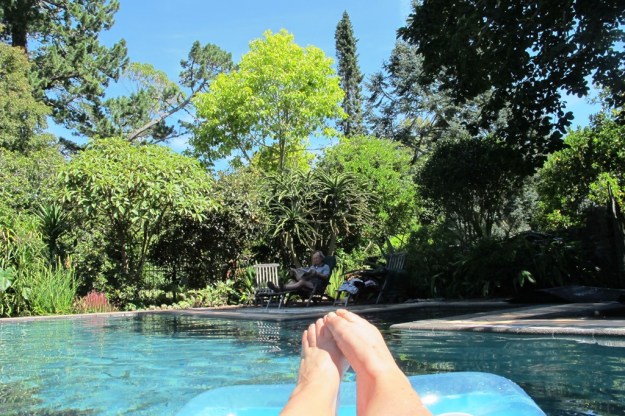
A few years ago. It is amazing how much the skyline of trees has changed since. My feet.

A few years ago. It is amazing how much the skyline of trees has changed since. My feet.

Editing, dear New Zealand readers. Cleaning up the borders and beds is often about editing the plantings.  I know this because I read a certain amount of British garden media.

I have certainly been editing the plantings in the gardens around our swimming pool. It seemed a good summer occupation and on a few hot days this week, the flow between gardening and cooling off in the pool has been excellent.

The gardens were put in when we built the pool in the late 1990s and, in that clichéd way, we naturally opted for a sort of tropical feel. It was never thought out very well at the time. In the years since, I recall doing one relatively major rejig of the gardens but beyond that, they have only had the most perfunctory of care and minimal maintenance. This often included plugging gaps with whatever I had to hand.  And it was showing that lack of attention.

I am a more thoughtful gardener than I used to be. I think that comes with experience. Knowing that we were unlikely maintain a pristine swimming pool, we had chosen from the start not to make it a key landscape feature but rather to site it discreetly where it is largely out of view. I am not keen on garish blue pools taking centre stage so ours is also a modest dark grey and we went with a black pool cover.
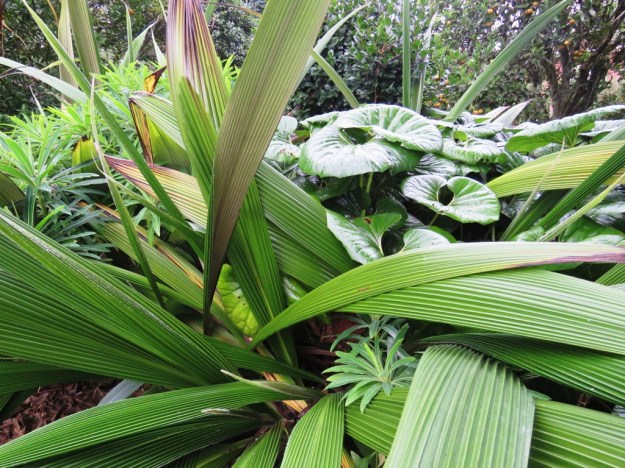
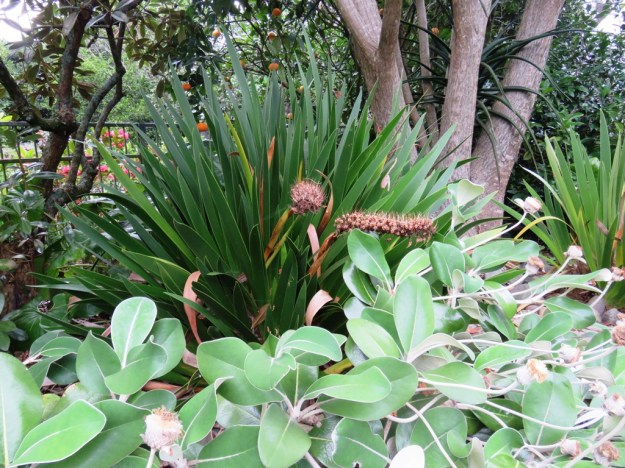
Curculigo, euphorbia and Ligularia reniformis, lush enough to pretend to be tropical and low maintenance

Curculigo, euphorbia and Ligularia reniformis, lush enough to pretend to be tropical and low maintenance

The upshot of this is that I figured we want a really low maintenance approach to the gardens around the pool and that it should be specifically targeted to the swimming season – which for us is mid to late December through to mid February. There is no point in putting in plants that flower outside that time because we won’t see them. Extreme editing was called for to eliminate my previous efforts to plug gaps and add seasonal interest with assorted perennials and bulbs.

I am quite happy with the earlier effort blocking up the Ligularia reniformis with Curculigo recurvata (nice foliage contrast and happily co-existing). We removed all but one of the damn dangerous euphorbia (E. mellifera, I think) which seeds far too freely and has disappointingly insignificant flowers but compensates with good form and foliage. Ligularia reniformis is getting to be a cliché in New Zealand gardens and I will restrict how widely we use it elsewhere in the garden, but it is very handsome and lush here, reaching well over a metre in height. However, the compact red dahlia hybrid will have to go. Not our style. Too suburban in our context.
Pachystegia insignis in the foreground, Xeronema callistemon behind and overhead a large Aloe bainseii

Pachystegia insignis in the foreground, Xeronema callistemon behind and overhead a large Aloe bainseii

The Pachystegia insignis (Marlborough rock daisy)  and Xeronema callistemon (Poor Knights lily)  flower outside the summer season entirely but these native plants are not the easiest to grow in our environment and the plants are handsome and well established with good foliage contrast. Besides, it is not in our nature to edit our plantings down to a simplistic mass.

IMG_6956It is the next ten square metres or so where I have gone for a block planting. It was a mish-mash. No longer. I chose to use two common plants – the pretty but tough Dietes grandiflora and black taro. At least we know it as black taro but I am not sure if it is a colocasia (in which case it may be ‘Black Magic’) or an alocasia.  It looks very new and raw at this stage, but I expect it to be a pleasing combination with plenty of pretty flowers next summer and good foliage interest. And low maintenance, without looking like a supermarket carpark.

Patience is a virtue. The freshly planted dietes and black taro.

Patience is a virtue. The freshly planted dietes and black taro.

I see some debate in garden media about whether digging and dividing perennials is necessary. Many folk seem to dread and shun digging – hence the no-dig craze for vegetable gardens. All I can say is that since I started doing a lot more digging and dividing, the garden looks hugely better for these efforts and the perennial plants thrive in more friable conditions with less soil compaction. It is also a learning experience as I experiment with plant combinations and think through the seasonal effects. It is a whole lot more interesting than mere garden maintenance and gives an opportunity to review and edit the plant selections. And it doesn’t even cost any money because I am working with plants already in the garden. There is nothing to fear from increasing the dig and divide regime.

IMG_6892And for those of you who don’t follow the garden Facebook page, I offer you my little study in dietes blooms. It makes no logical sense to float them in water, because they are not damp-loving plants at all. I just thought they would look charming, and they did – first in the swimming pool and then I gathered them all (slightly battered) to float them in the stream. Because I could.

IMG_6896

IMG_6907

Lower maintenance gardening

Do away with island beds in the midst of the lawn if you want to reduce maintenance

Do away with island beds in the midst of the lawn if you want to reduce maintenance

I thought I would spare readers from the New Year’s gardening resolution column. Most will resolve to weed more often and keep their garden looking tidier, only to fall by the wayside very quickly. So it is onto lower maintenance gardening this week.

Note the qualifier – lower maintenance. I don’t think there is any such thing as low maintenance gardening. These are mutually exclusive concepts. The only way to eliminate gardening altogether is by living on the upper floor of an apartment block.

You can do away with plants and pave, seal or turf your entire section but that should not be confused with gardening. Nor does it eliminate all maintenance. Paved areas need attention. Weeds will forever pop up in any cracks or gaps. Dust and grit accumulate and need to be swept or blown away. Shaded areas will grow moss and lichen and may become slippery. There is nowhere for the family pet to do its business.

You can grass out your section but it will need mowing. It will need a whole lot more than just mowing if you want a proper lawn. Maintaining even a half way decent lawn takes a surprisingly large amount of time and effort. But at least you can get a lawn mowing contractor in and trust him or her to get the grass down. But that is not a garden, either.

Gardens have plants and plants are tricky, messy and unreliable living organisms. They grow. They drop bits. Some grow too well, others not well enough. They also have the capacity to delight and to surprise, to soften a view and to blur the hard edges, particularly in an urban environment. It is about much more than just feeding the body by growing edible plants. You can wrap it up in a spiritual framework if you wish or you can be more prosaic in your terminology but the bottom line is that it is a rare person who remains oblivious to the beauty that is in nature and plants are integral to that. Most of us are driven to recreate some of that nature in our immediate environs. And if you want to stay on good terms with neighbours, an ugly wasteland is not going to do it.

So, to dispute some common myths about low maintenance gardening.

  • Evergreen plants are not low maintenance. They still drop a full set of leaves every year. They just do it gently all year round rather than in one big hit like deciduous plants.
  • Vegetable gardening is probably the highest maintenance form of gardening there is. Forget any advice that you can have a low maintenance yet productive vegetable garden.
  • Similarly, you can’t just plant an orchard and leave it, expecting to harvest fruit in season. Most fruit trees require regular attention; some require a great deal of care.
  • Simple gardens or formal gardens defined by sculptured plants (hedges and the like) are not easy care. They depend on pristine maintenance for their effect. It is like doing the housework but outdoors and no sooner have you done it than the wind will blow or the plants will grow. You can’t keep the outdoors static.
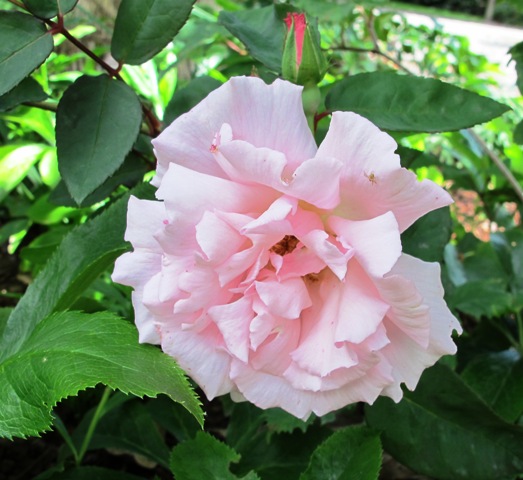
Roses need more care than many other plants if they are to look good

Roses need more care than many other plants if they are to look good

If you want to reduce your workload however, there are certain things you can do.

Shun plants which need staking each season if you want an easier care garden

Shun plants which need staking each season if you want an easier care garden

  • Don’t have island beds and specimen trees or shrubs sitting in the middle of the lawn. It is easier to do a clean sweep with the lawnmower than to be weaving around curvy obstacles. It also cuts out the potentially messy edges you get around island beds.
  • Reduce the number of itsy bitsy little beds and plantings that you have. Keep the lines simple.
  • Reduce the number of plants you have growing in pots and containers. These take quite a bit of effort to keep them looking good, as evidenced by the number of sad, neglected, even dying plants you can see all round different gardens.
  • Weed thoroughly and then lay a weed free mulch to suppress further germination. Try and get weeds before they are large enough to set seed and remember the old adage: “one year’s seeding, seven years’ weeding”.
  • Leave enough space around plants to be able to use the push hoe and if you haven’t got a push hoe then get one, learn how to use it and keep it sharp. You can then do the summer weeding without bending – but only if you do it before the weeds set seed. There is no point in hoeing out weeds and then leaving them lying on top if they are going to spit out their seeds on the spot.
  • Do away with plants which require frequent attention to keep them looking good. The prettiest but worst offenders are probably roses and wisterias. Most plants will need a little attention once a year, but some plants need much more than that. Similarly, do away with plants that need to be staked to stop them flopping all over the place.
  • Do not garden in such a manner that you have to water frequently in summer.

When I used to pay someone to do my housework, I felt privileged but not ashamed. The same goes for gardening. If you don’t get pleasure from doing it yourself and you can afford it, pay someone else to come and do it for you. A lovely garden is a joy to all, but getting there is not always fun.

First published in the Waikato Times and reprinted here with their permission.

Lower maintenance gardening

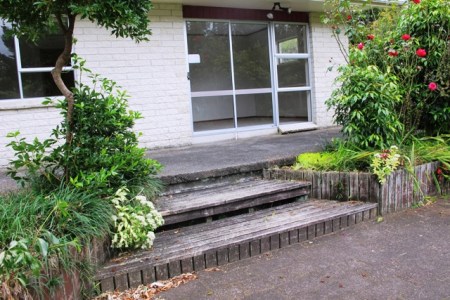
The raised beds are going - to be replaced by wider steps

The raised beds are going - to be replaced by wider steps

I have been forced to look at practical lower maintenance gardening this week. Most of the time, we are practitioners of relatively high maintenance gardening on a large scale. I think it was the late Christopher Lloyd (he of Great Dixter fame) who made a comment that the more experienced one is, the more one realises that a high maintenance garden is a great more interesting. But there are times when a low maintenance one is required, particularly with rental properties.

For our sins, we are landlords. Just the one rental house and it is one we used to live in ourselves. There was a certain irony when we bought the property many years ago. We were doing a little land amalgamation at the time and Mark had exchanged quite a few plants with a previous owner for some work with his handy little bob-cat. When we came to buy the property, the valuation mentioned the high quality plantings. We certainly paid dearly to get our own plants back.

While living in the house, we duly extended the gardens and plantings to the point where they were reasonably expansive. When it came to letting the house, we realised the scope of the lawns and gardens were beyond what most tenants would manage, so part of the successive tenancy agreements has been that we will mow the lawns and loosely maintain the gardens as required.

Mowing tenants’ lawns is not a bad thing. We mow pretty much every Friday and it gets you onto the property on a regular basis so you can keep a discreet eye on things. It operates as an early warning system, so to speak.

But gardens are another thing. Few tenants garden. A few scratch around from time to time, but none we have met take as good care as we did. It is a fact of life. In this hiatus between tenants, we are doing a major clean out and simplification in the garden. Once it has been reduced to bare bones, the onus will be on the incoming tenants to maintain the gardens at that standard. There will be nothing too demanding.

Simplification has been ongoing but reached its zenith this time. The only garden borders left are the two defined by concrete paths alongside the house. A previous property owner had put in a number of raised garden beds. The last two are going now. Out with garden beds. They just look messy if not maintained.

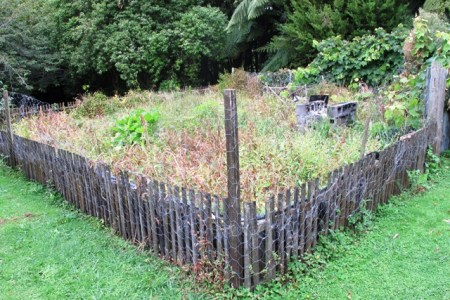
The designated vegetable garden needs clearing but is being retained

The designated vegetable garden needs clearing but is being retained

The designated and fenced vegetable garden is staying. In this day and age, it is probably an asset and it has good soil, is an appropriate size and is sheltered but in full sun. It will be ready for a tenant to plant. We just need to clear it first. Similarly, the citrus trees can stay. They are fine with total neglect.

The extensive perimeter plantings have matured to shrubbery and they are staying. If you want low maintenance, long term plantings, go for shrubberies. Over time, shrubs and small trees will gently mesh and knit together to provide a green and flowery undulating wall of foliage. Being relatively dense, few weeds grow beneath. The herbaceous plantings we had there have long gone but that is fine. All we have to do from time to time in the shrubberies is to go through with a pruning saw and trim anything that is getting too large. In return, the mixed plantings of camellias, rhododendrons, magnolias, maples, self sown pongas, feijoas and the rest provide a soft and pleasing backdrop to the property. They stop it from being too austere and bare.

Any plants that require regular attention have gone. The last of the roses are on the burning heap. The espaliered camellias have gone. The devastatingly rampant wisteria has gone. It put up a brave fight but truly, wisterias are unsuitable plants to leave in a situation where they are not actively managed. This beautiful Blue Sapphire had put out its runners a good 20 metres away.

I have replanted the remaining, tiny house borders. I couldn’t stop myself especially as I found spring bulbs. But I have gone for simple mass plantings. A shaded, dry border which is a pathetic 20cm wide (honestly, who would make a permanent border 20cm wide?) is now mass planted with green mondo grass and bedding begonias. Utility and easy to maintain by non gardeners. The one hot, dry border retained its existing vireya rhododendrons which have survived total neglect and fifteen years of tenants, underplanted en masse with a compact yellow sedum. That is it for herbaceous material. As the one who does the knapsack spraying, Mark approved the mondo grass and sedums as being largely resistant to glyphosate so he could spray amongst them if necessary.

When you are preparing a property for sale, it is often about good looks in the short term – as we have all learned from those property makeover programmes on TV. When you are preparing a rental, it is about easy care, easy living in the long term. It can be done.

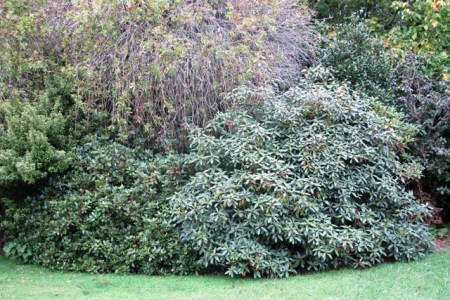
The shrubbery is the lowest maintenance form of gardening I know

The shrubbery is the lowest maintenance form of gardening I know

First published in the Waikato Times and reprinted here with their permission.