
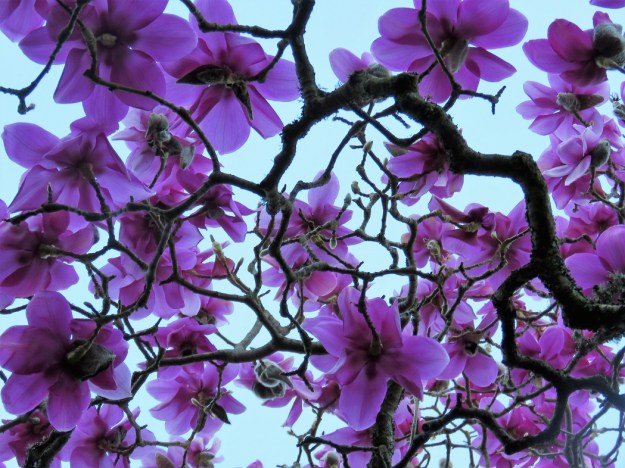
We have entered the season of floral skypaper
It would be churlish to complain too much about our winters here. Common wisdom divides the months of the year into four seasons so winter is June, July and August. But spring came this week. Sunny, calm, blue skies and sunshine with the temperature yesterday reaching 18° – clearly it is time I put away my merino thermals and found the mid-season tee shirts. The dreary rains of winter are but a memory at the moment (though they will return in spring for we are a high rainfall climate). Canberra had us thinking that a dry climate is much easier to live in but a high sunshine, high rainfall climate without extremes of temperature is much easier to garden in.
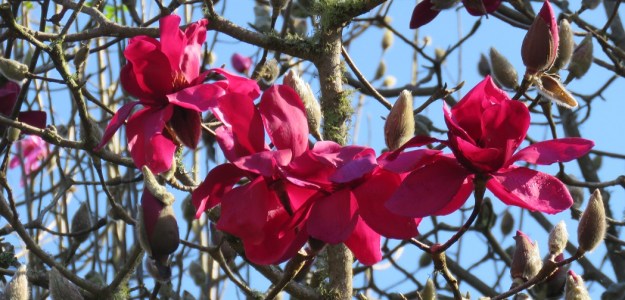
“Just an unnamed seedling from the breeding programme here,” as we say often
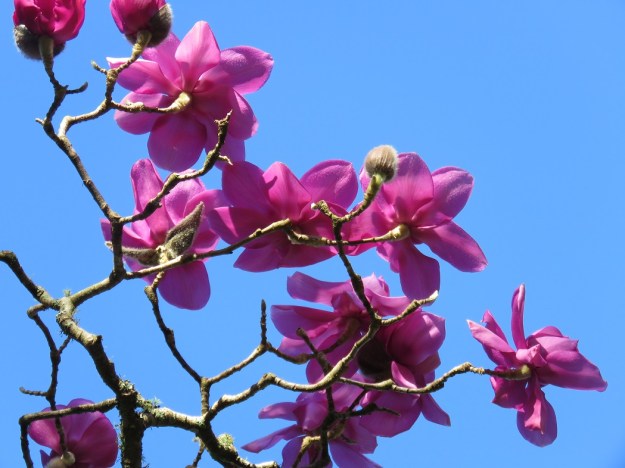
Magnolia campbellii var. mollicomata ‘Lanarth’, commonly referred to just as Lanarth
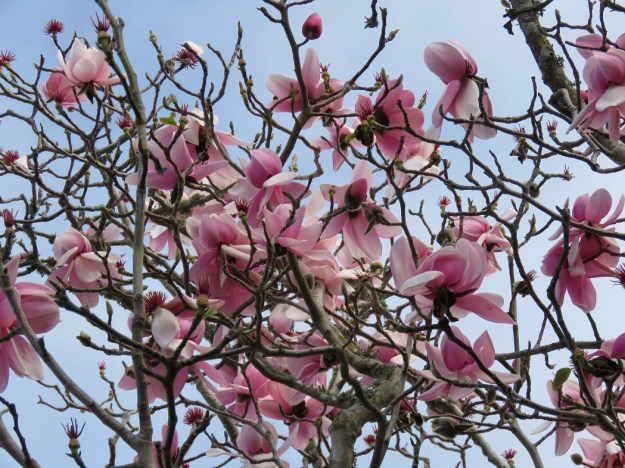
I am very sympathetic to those readers sweltering and burning in the northern hemisphere and grateful not to be there. I am even more grateful to be here where the spring garden has exploded into life. I always say our gardening year starts with the first magnolias to flower. Each year, it feels like a new beginning. Oh, the magnolias! All those views of floral skypaper and big, bold blooms in the landscape. It is beyond glorious and this is why I try and encourage people to grow Proper Trees, not scaled down, dwarfed, shrubby things with scaled down blooms. If space is a problem, go for a narrow, upright tree (fastigiate, is the term) rather than one that promises to stay at two metres high (which it won’t, unless it is the white stellata). Aside from the soft pink M. campbellii, the dominant colours of the first varieties to flower in the season are red and purple. Believe me, looking at the first light of morning shining through these rich colours is like a stained glass window.
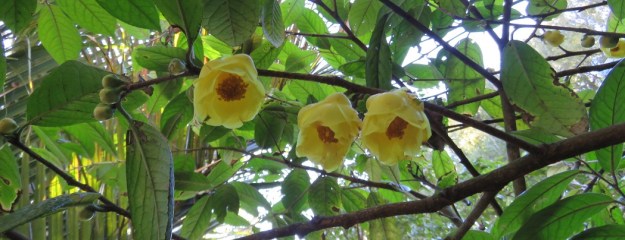
The yellow camellias are flowering again. This is C. nitidissima
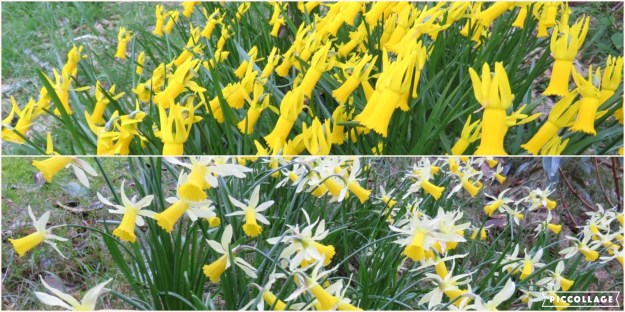
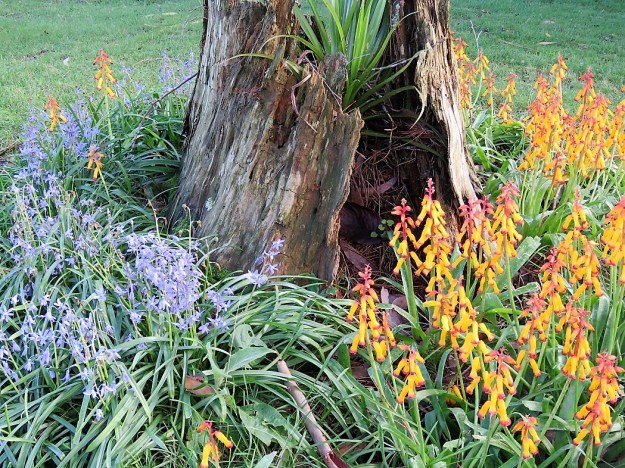
Lachenalia aloides and an early flowering scilla that I once sorted out a species name for but have since forgotten where I recorded it…
It is not just the magnolias. While the snowdrops are already passing over (their season is but a short delight here), we have masses of different narcissi flowering all over the place, along with lachenalias, leucojums, early scillas and late cyclamen. The camellias are blooming, along with the big-leafed rhododendrons like macabeanum and giganteum. Every day, I go out and find something else to delight.
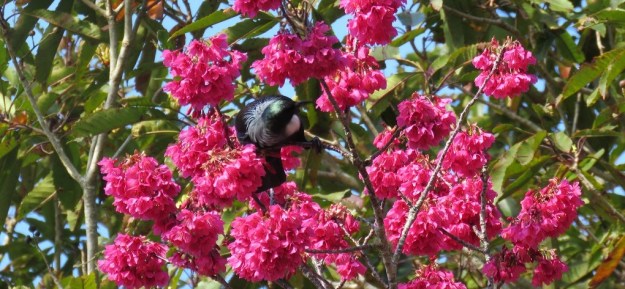
A tui in Prunus campanulata ‘Felix Jury’
I had an idea that I would pick a branch of each of the Prunus campanulata (Taiwanese cherries) currently flowering to show the range of colours and flower size. We have somewhere over a dozen in bloom at the moment and more still opening, with a garden full of tui and bees as a result. So I headed out with my flower basket and snips, channelling my very late mother in law who left the basket… and gave up. Maybe next year. The problem, I realised quickly, is that I would need a ladder. Too many are flowering well above my reach. And as the trees are spread far and wide through the garden, it is a task that would be better carried out with obliging ladder carrier. But that is the thing about long term gardening: there is always next year.
 Finally, an animal story. When we first adopted poor, unloved Spikey dog in 2009, we worried that he felt the cold badly. His coat was very thin – at least compared to the Shetland sheep dog we also had at the time – and he had not one ounce of body fat. Daughter made him a coat of many colours. I put it on him one chilly morn and Mark laughed at the ridiculous sight. Spike then hurtled down the avenue gardens after a rabbit and reappeared without his coat. Suggestions ranged from him being too embarrassed to be seen in the coat to Mark’s idea that he had regifted it to a needy rabbit family. Years passed and we never found the Joseph coat – until this week. It is a little brittle after 8 or 9 years in the open but a triumph to the resilience of yarn blends. One minute – that is how much wear that coat had.
 In the meantime, he had been gifted a genuine Harrods coat and I had bought him a little number that made him look like the canine version of Julian Clary. But we always knew that as a bogan, freewheeling dog, he would have preferred a black vinyl number with chrome studs. These days he is over 14, stone deaf with a heart condition and possibly some level of dementia so he has passed the winter days sleeping in his bed by the fire. Yesterday, with spring in the air, he came out of hibernation and could even have been described as frolicking as he accompanied us around the garden with visiting friends. There may be life in the old dog yet, if he doesn’t get taken out by a heart attack.

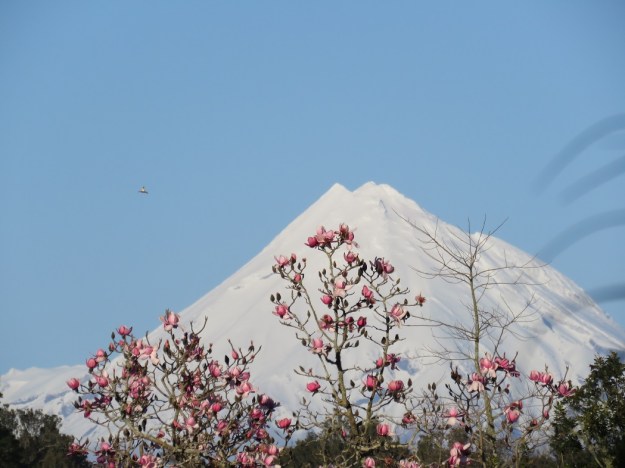
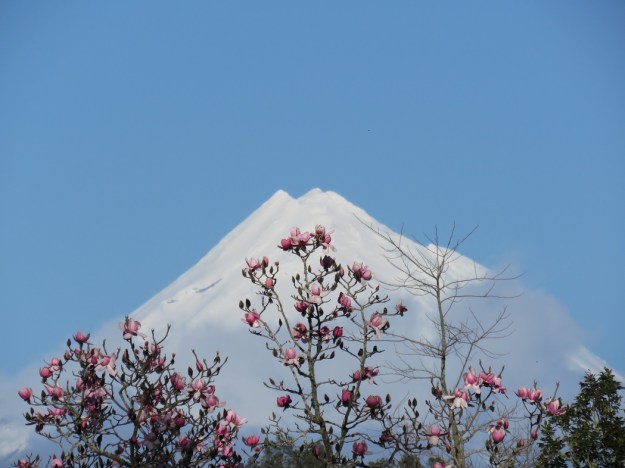
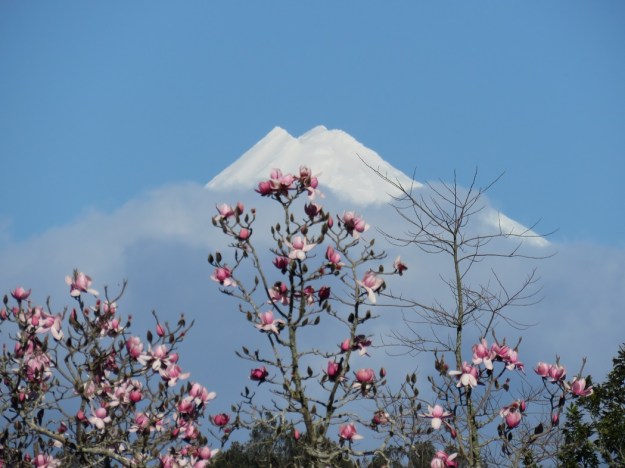
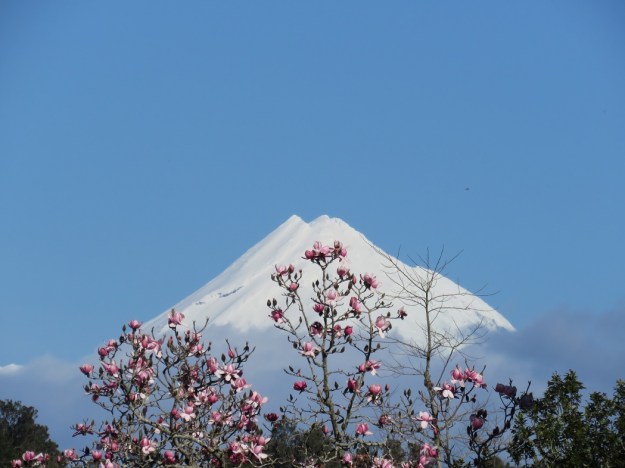
Magnolia campbellii, looking more like a painting at maximum zoom with the snow of the distant mountain behind
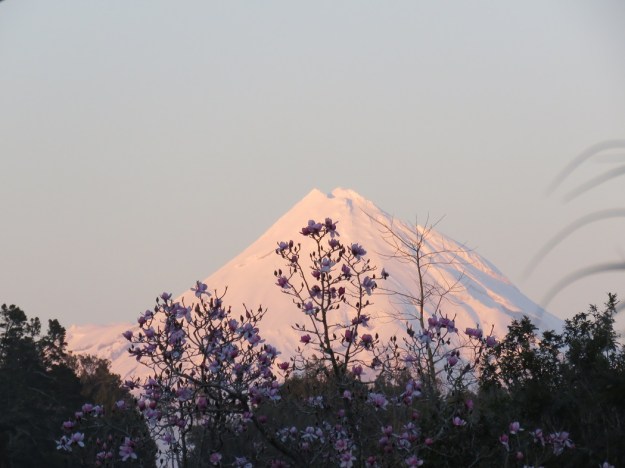 I rushed out at 7.40am on Monday because the day had dawned sunny, clear and calm and I thought the mountain should be in view. We only have one really good view from the garden and at this time of the year, Magnolia campbellii is in bloom in our park. It being just past mid winter here and the subject being a mountain, it is more often shrouded in cloud. We are inclined to get apologetic about this in Taranaki but I remember driving round the South Island with our son some years ago. We never once saw the Southern Alps and that was down the east coast and up the west coast in January. Mountains attract cloud which is all the more reason to celebrate the winter view when it is revealed.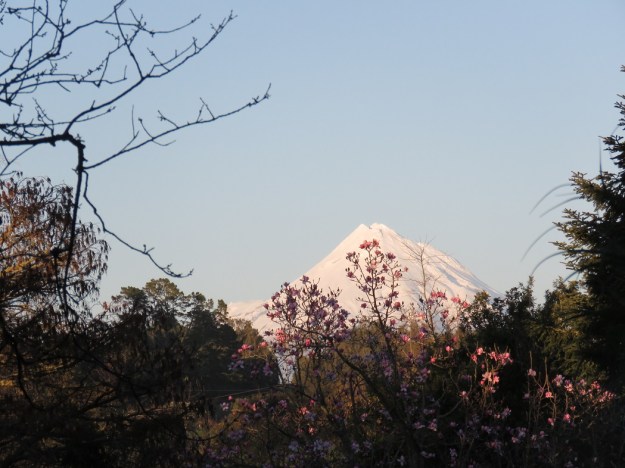

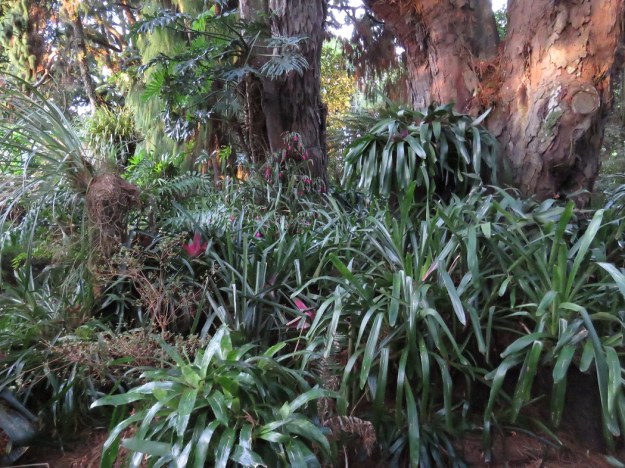
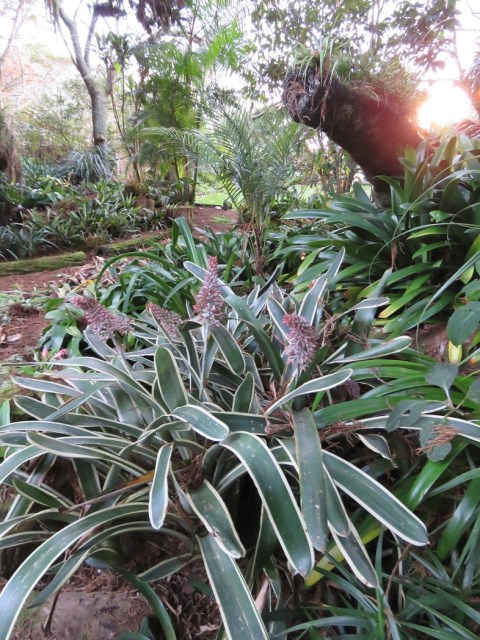 Beneath these rimu, we have what is probably the most complex planting of anywhere in our garden. Oddly, it occurred to me this week that it is the least demanding in terms of regular maintenance. This is not related to the complexity of the planting; it is to do with the fact that it is all in dry shade and also to the plant selection over time. In the last five years, we have gone through it and pulled out fallen branches and a bit of occasional debris but it has not had the loving attention to detail that I am currently giving it.


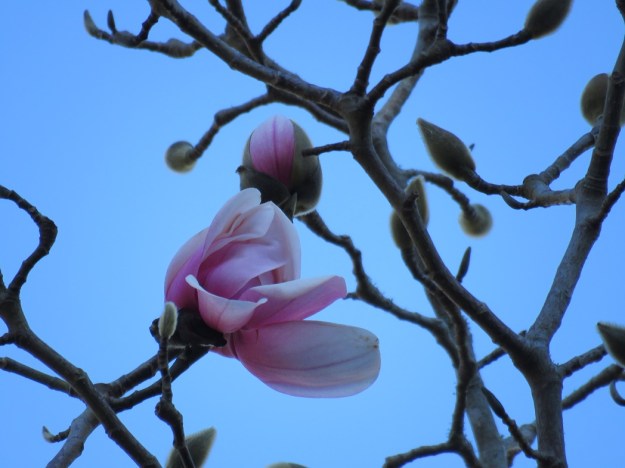
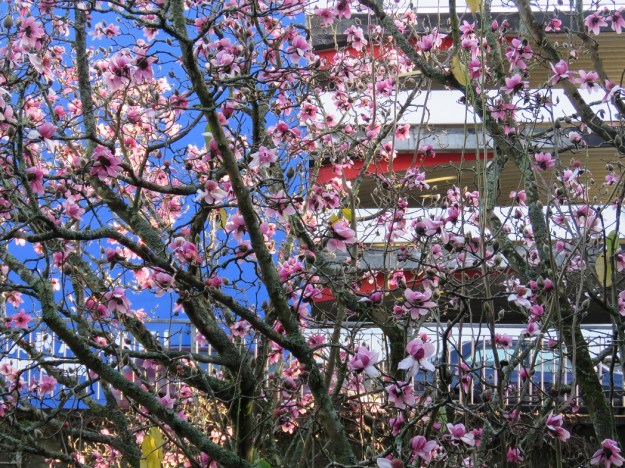
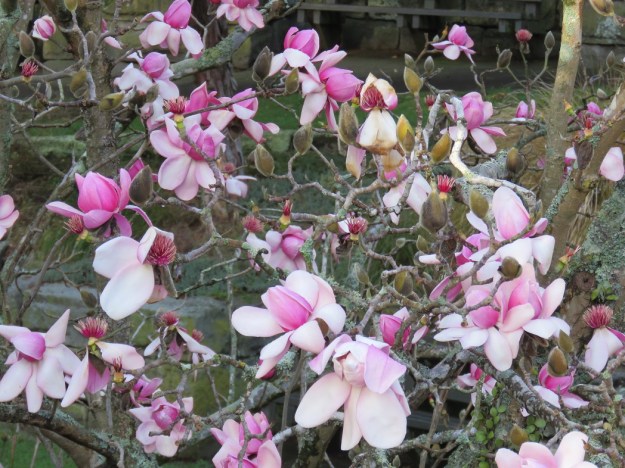
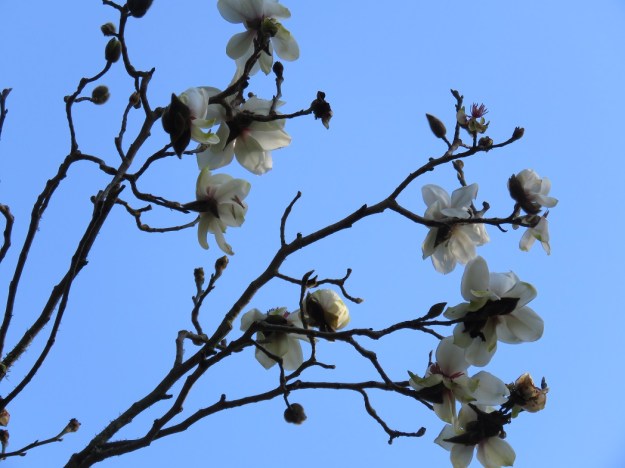
 Tupare Garden in New Plymouth has one of the oldest white forms of campbellii in our area, though the tree is not a particularly strong grower. It has a different provenance which the late Jack Goodwin relayed to Mark. Alas Mark did not write it down at the time but his recollection is that Russell Matthews, who created Tupare, bought it as a seedling grown plant from a local nurseryman who had imported seed, probably in the 1940s. This may have been James or Francis Morshead. M. campbellii is renowned for taking many years before it sets flower buds and an anecdote from another source relates the huge disappointment Matthews felt when the first blooms opened white, not pink. More a collector of status plants than a plantsman, he was apparently delighted when Victor Davies – of Duncan and Davies Nurseries – assured him that the white form was most unusual and therefore a real treasure. Only history puts this into context – that the white form is unusual for Taranaki because of all our Quaker Mason pink plants, but not at all unusual in the wild.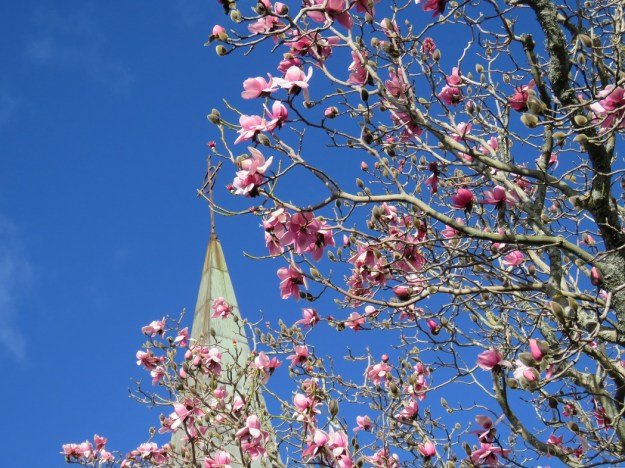
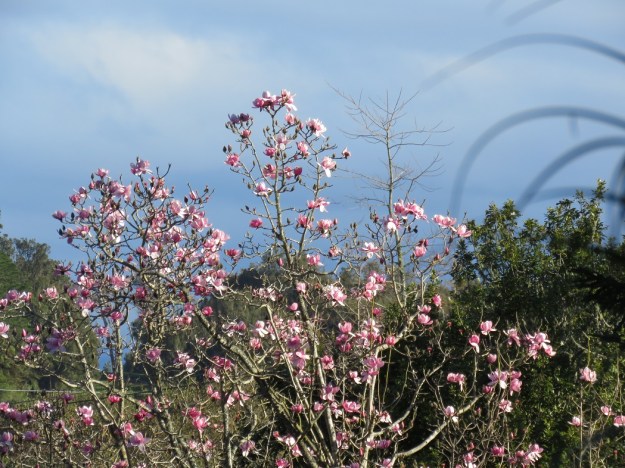
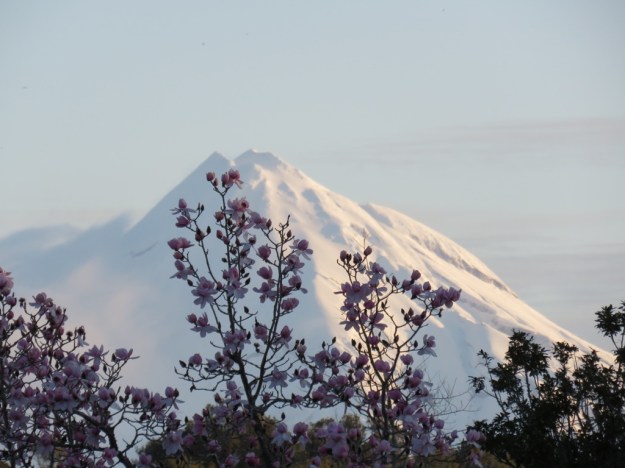 August 9 at 5.00pm as the sun is going down.
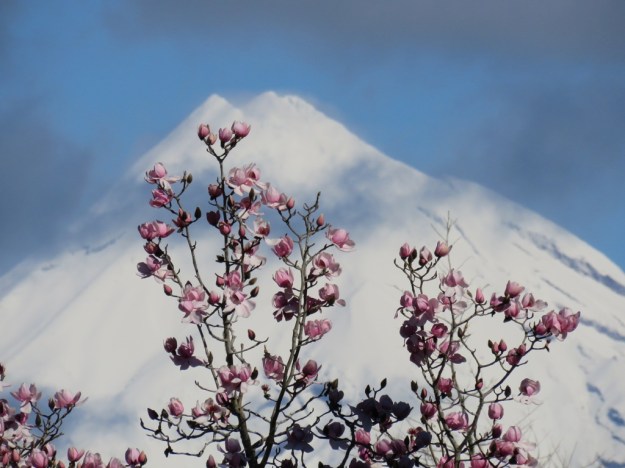 August 10, just after midday.
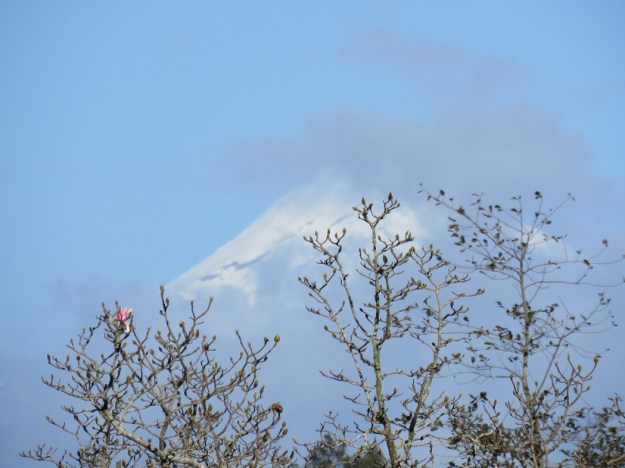
 August 12, at 9.45am.
  At the risk of destroying the perception, this is the reality. In the bottom right hand corner, you can see the mountain which is at least 35km away from us. We do not have an alpine climate here – far from it, given that we grow oranges and avocados – but a zoom on my new camera is very good.
  Tikorangi The Jury Garden