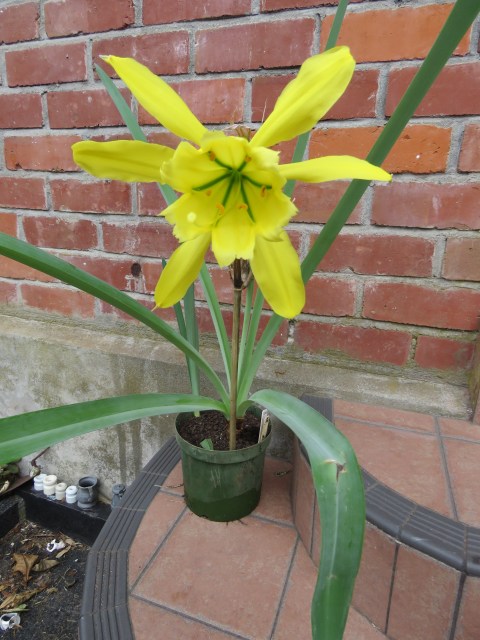
A paramongaia, no less, which does not seem to have a helpful common name
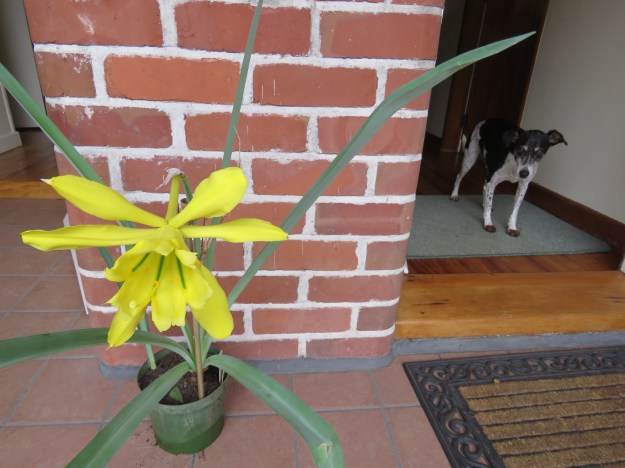
Well lookee here! Zach appeared brandishing this pot from one of our covered houses in amazement. I was equally astonished that Mark could dredge the species name from somewhere in the deep recesses of his memory, loosely connected to his remembering seeing its relative the pamianthe in flower at Jack Goodwin’s and that must have been at least 35 years ago.
This is in fact Paramongaia weberbaueri, native to Peru and Bolivia where it grows in harsh, dry, stony conditions. It looks a bit like a totally over the top daffodil on steroids. That flower is 20cm across and the trumpet is 10cm long. I measured. It must be night-scented because it was very strongly scented first thing this morning but only pleasantly scented later in the day.
Patience rewarded – the first flowering on our paramongaia
It goes so far back here that even Mark, with his elephantine memory when it comes to the source of plants, can’t recall who gave it to him but we have not seen it in flower before. It has been repotted occasionally down the years and we seem to have about 10 plants of it when he will have started with only one. That is enough for me to plant out half of them in the rockery to see it they like our conditions.
We have succeeded with its compatriot bulb, the Worsleya procera as a garden plant; the challenge now is to see if we can succeed with the paramongaia in the garden. This may take time. Ask me in ten or twelve years if we have them flowering in the rockery.
Even elderly Dudley may have been surprised by its appearance on the doorstep.
It is an instant garden approach and sometimes that quick result approach is the very best way to reward effort and encourage further learning.
The magnolia in winter
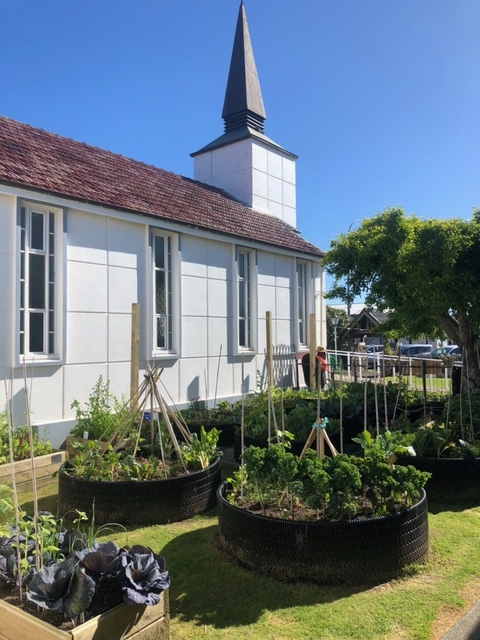
I have various photos of the modest little Anglican Church of St John the Baptist in my local town of Waitara. Until now, all have involved either the splendid Magnolia campbellii which brings me great delight every winter or the golden delight of their Ginkgo biloba. But look! Now they are supporting a community garden and the Waitara Foodbank, Pataka Kai. For overseas readers, kai is the Māori word for food while pataka is a place of food storage or pantry.
The ginkgo in autumn
Just as with Pataka Kai’s free cooking classes, there is a strong element of learning and sharing in their community garden project. This is not just about crisis intervention for those who cannot afford food; it is equally about building community and sharing skills to equip people with confidence and knowledge, now and into the future.
I have no affiliation to any church but their act of making land available for a community garden is Christian outreach at the most local, grassroots level and that is to be lauded. The Magnolia campbellii remains untouched and is on the other side of the church. Where the garden is now, used to just be tidy, mown grass that contributed nothing obvious to the wellbeing of the congregation, the wider community or the environment.
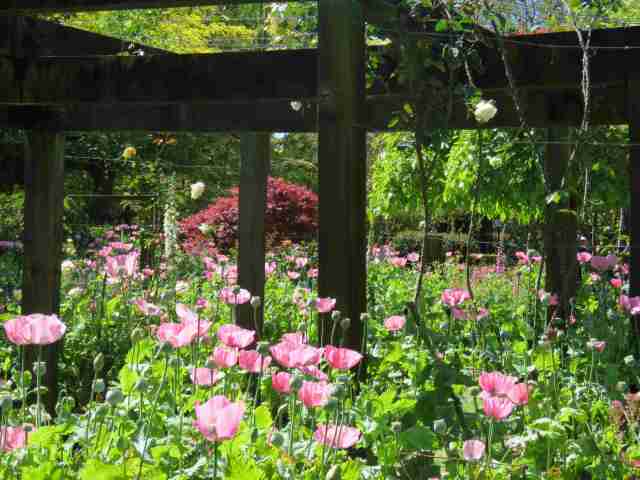
The transient delight of a bed of poppies amongst the roses at Waiongana Gardens
The annual Taranaki garden festival is now well behind us but we did get out to a few gardens. The bed of self-sown pink poppies in Waiongana Gardens was a particular delight in its charming simplicity, even knowing that it will have been an ephemeral affair.
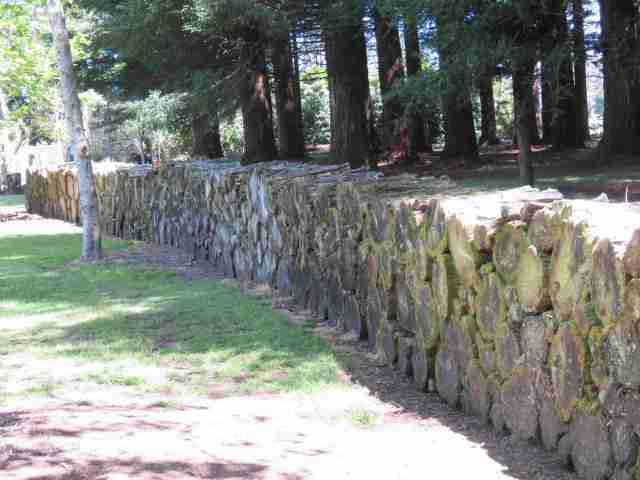
Waiongana’s distinctive log walls
Their log walls are pretty unique and likely to stay that way when you consider the logistics of creating them, needing the raw material, the equipment to cut the logs and then the machinery to move them into place. Who needs insect hotels when you can edge your large property with au naturelle log walls providing habitats and acting as an attractive boundary?
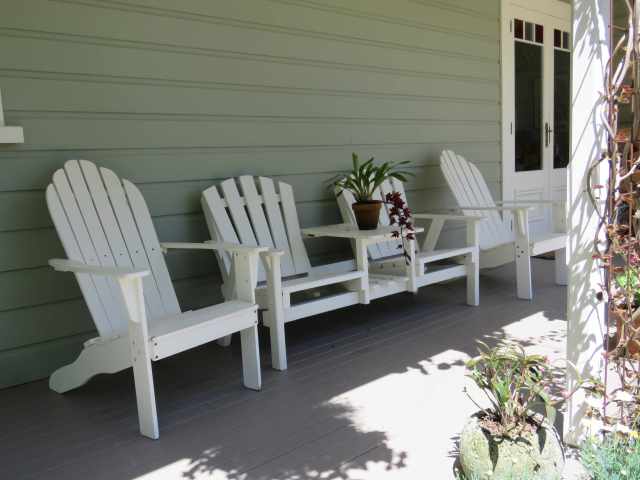
There is a whole lot more to Riverlea, but look at their outdoor seating
Riverlea is a stand-out garden for a number of aspects. I could highlight several but I would single out the placement of garden seating. Mark has always been adamant that gardens should, as he says, ‘make sense’. There needs to be an underpinning logic. He is not big on contrivances. So garden seating should be where you use it, not a single painted chair placed in the middle of a border as a dreaded focal point. Same with gazebos, summer houses – or *pavilions* as the aspirational call them these days. These should have a useful purpose and location, by very definition. Being an ornament or a statement of opulence is not enough, at least in our books. At Riverlea, every space to pause and sit a while, either alone or with friends, impressed with its placement and its welcoming feel. It makes a garden feel occupied, enjoyed and appreciated, personalised.
The devastation wrought by the storms at the beginning of November, particularly in Southland, brought up the thorny issue of trees and power lines. Again. The power was out in some areas for weeks and the photos of fallen trees showed some extreme scenes. We went through Cyclone Dovi a few years ago. That was bad enough but the Southland storms were way worse. Trees and power lines are not a good combination.
I have every sympathy with linesmen who go out in all sorts of extreme conditions to try and restore essential services. I can understand why the lines and power companies do not like trees and would like clearways around every power line.
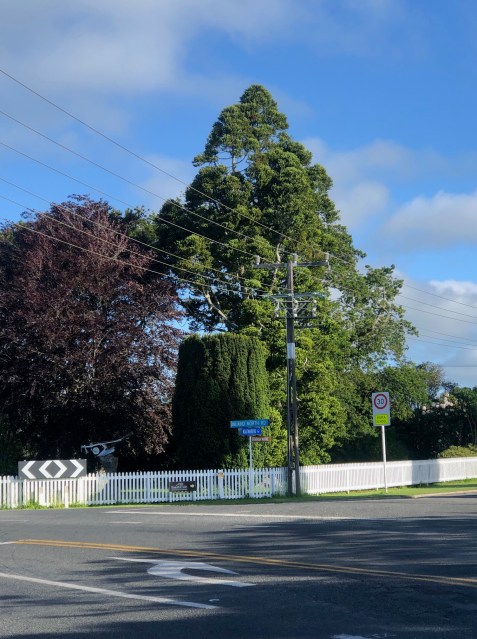
If we must have clearways around power lines, all but the conifer would have to go from our little historic church in Tikorangi,
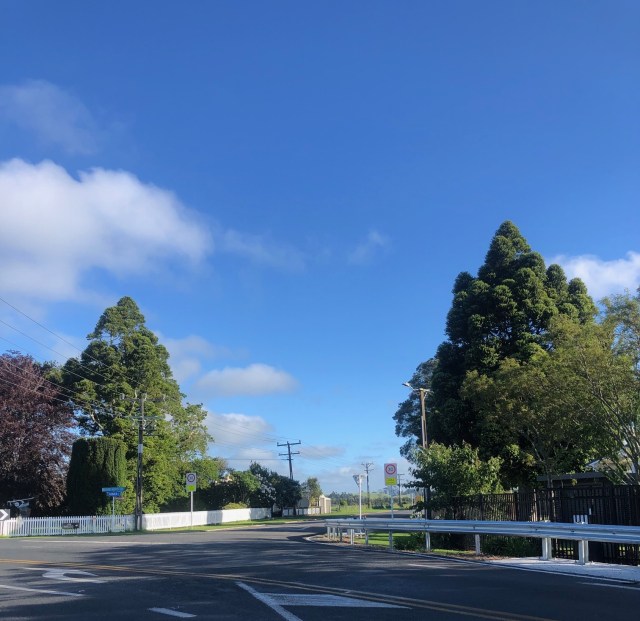
Draw back a little and that is the Tikorangi church on the left and the school on the right. Some of those trees at the school would have to be felled if every tree that could potentially fall on the power lines had to go.
But what would clearways look like? It is one thing to expect trees to be kept out of the lines so that wind won’t blow the branches around and cause damage and power outages. It is quite another if every tree that could potentially fall upon a line were it to be uprooted had to be removed or have the top taken out of it as a precaution.
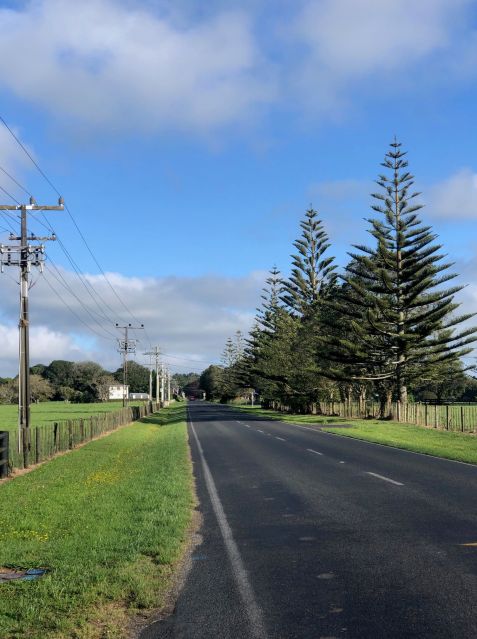
Clearways for power lines would mean the removal of the Norfolk Island pines on the right in the near future.
Climate change is here. It seems that what it will look like in our country includes extreme storms with increasing frequency. Trees, especially very large, mature trees, are a critical part of attempting to counter climate change. It takes decades for trees to reach maturity. Historically, we have many power lines which were placed where it was most convenient or the cheapest option and now they are in the wrong places, really. I don’t know what the answer is. How do we balance the environmental benefits of large trees with the need to keep electricity supply?
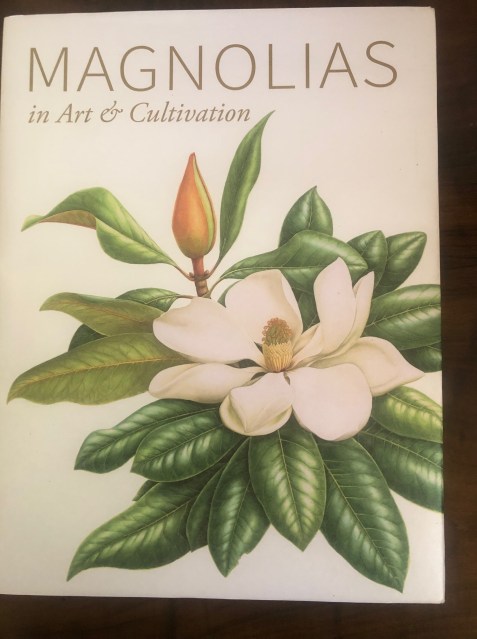
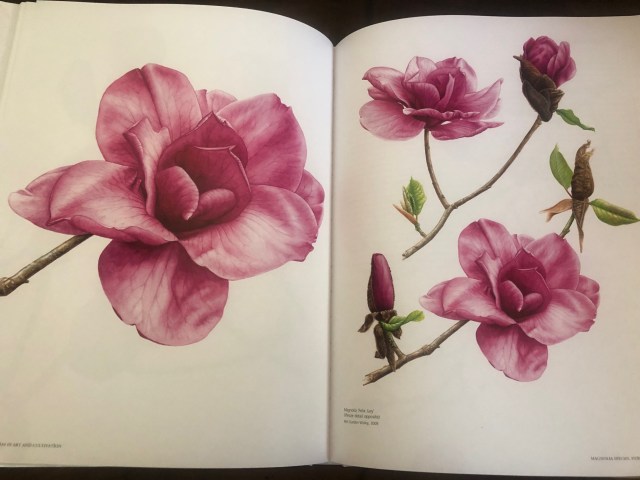
Sometimes life can deliver unexpected delights and so it was with a delivery of a magnificent book sent to us by the UK-based botanical artist, Barbara Oozeerally. There are several pages of paintings of Jury magnolias in a large format book full of exquisite magnolia paintings. It is a book to be treasured. When I wrote to thank her, it transpired that she is a long-time subscriber to this site and her love for magnolias goes beyond painting them. She has a collection of nearly 50 different magnolias in her own garden. If you don’t have space for 50 magnolias in your garden, I can recommend her book to experience the genus vicariously, all year round.
Magnolia ‘Felix Jury’ , as painted by Barbara Oozeerally
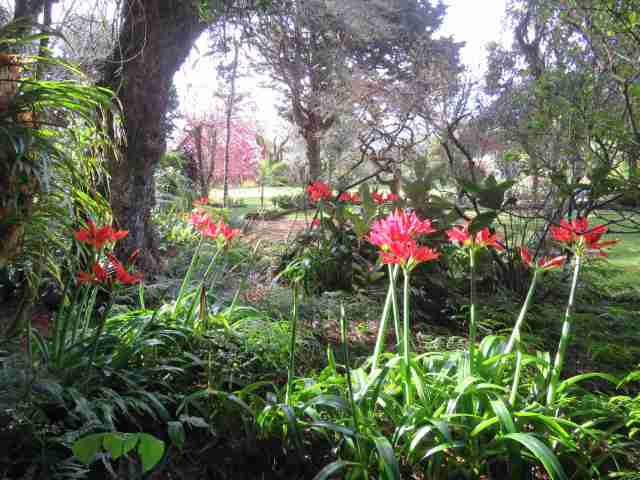
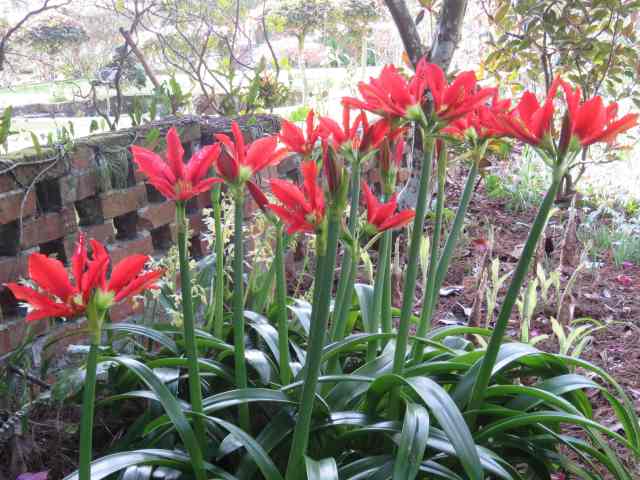
Hippeastrum aulicum – we plant it in semi shade to shaded areas because it will still flower and the dreaded narcissi fly only attack plants in sunny spots
Maybe I will do a monthly post on the bulbs in flower here during each month, I thought in August. I am pretty sure that we have bulbs, corms and tubers of one sort or another flowering twelve months of the year. But August came and went and here we are, well into September and peak spring.
Hippeastrum aulicum
Ah well, there is always some crossover. The narcissi and the Hippeastrum aulicum both started in August and are still in full bloom. The aulicums bring us great pleasure and are a significant feature as winter breaks to spring in our garden but are probably beyond the reach of most people. It is not that they are difficult to grow but they are not widely available and, purchased individually, they will be expensive. Mark’s dad probably started from one or maybe three bulbs, as was his and now our way, and the results here have been achieved over about seventy years of quietly lifting, dividing and planting around the garden, now with many hundreds of bulbs in various locations. Not every gardener has the time, patience and willingness to achieve this, let alone the longevity of stay in one garden location.
Narcissus Twilight
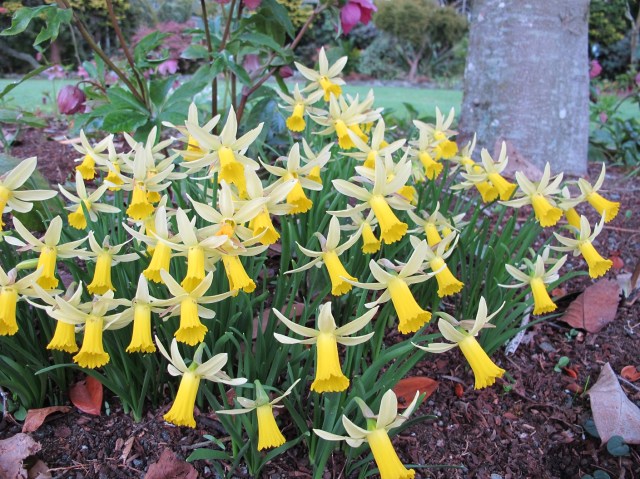
The narcissi are more achievable and will give a quicker result. We grow as many different types as we can, bar the modern hybrids (the King Alfred types) that are most commonly sold. They are better as cut flowers (the weight of the bloom often bends them over in the garden) and are better in places that don’t have issues with narcissi fly. We favour the earlier flowering dwarf narcissi. Growing a range of different species, named hybrids and seedlings raised here on site extends the season into many weeks from early August right through September.
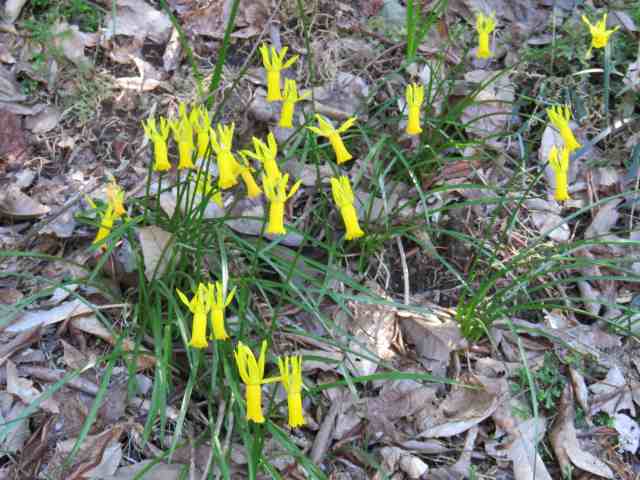
Narcissus cyclamineus seedlings growing on one of our bulb hillsides
We use narcissi everywhere really, the major consideration of sites being that they won’t get swamped by larger growing plants and that they will star as rays of sunshine in their time each year.
Lachenalia aloides
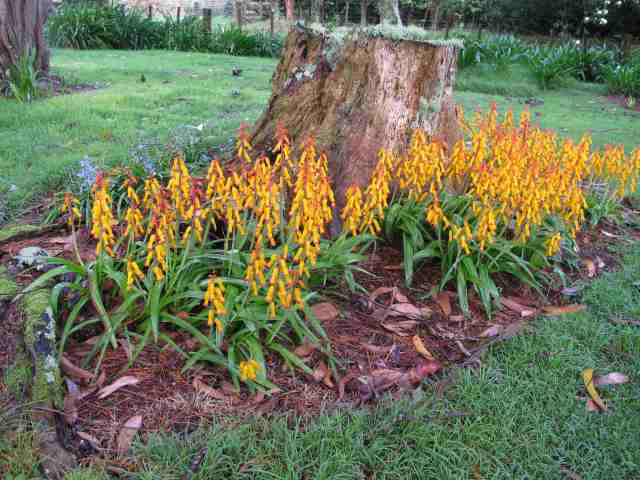
The lachenalias also star through spring. It is the boldest and the brightest that bloom first. Lachenalia aloides is the common form that is widely grown. Cheap and cheerful, might be the best description. Placement is everything when it comes to this bulb. I don’t like it as a garden plant but I think it is great on the margins and in wilder areas.
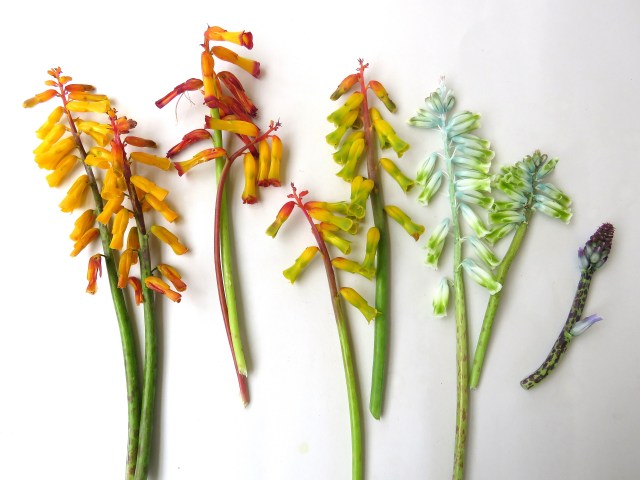
I am officially giving up on trying to understand the plant classification and nomenclature of lachenalias. Last time I looked, these were all forms of the species L. aloides. I even staged a photo to support my comment that a single species can be very variable. So we have straight aloides, quadricolor (already passing over – it is even earlier), tricolor, vanzyliae and glaucina which was barely opening a week ago. Now I look and I see they have been split. Glaucina is back with L. orchiodes, while quadricolor and vanzyliae seem to have been elevated to the status of being in species classes of their own and I have no idea where tricolor sits. They can remain a mystery for me.
Lachenalia glaucina
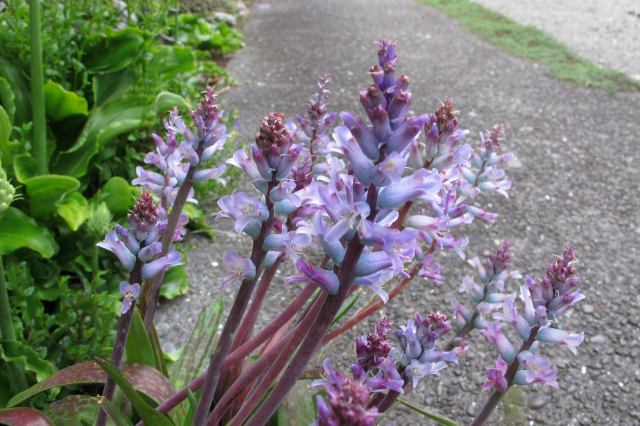
From a garden perspective, I always notice that it is the orange, yellow and red lachenalias that flower first (the yellow being Mark’s reflexa hybrid, the red we have is bulbifera). The most desirable so-called blues come later. I say so-called blues because that casual grouping takes in those with the faintest blue genes that are really shades of cream, pink and lilac as much as pure blue. We have gathered every one we could find over the years and by far the most reliable is the aforementioned L. glaucina.
And without writing a book on topic, I can only continue by listing bulbs that I spotted on a perfunctory wander around the rockery and areas where we have done informal swathes of different bulbs. We find the bulbs add depth and detail which we value highly.
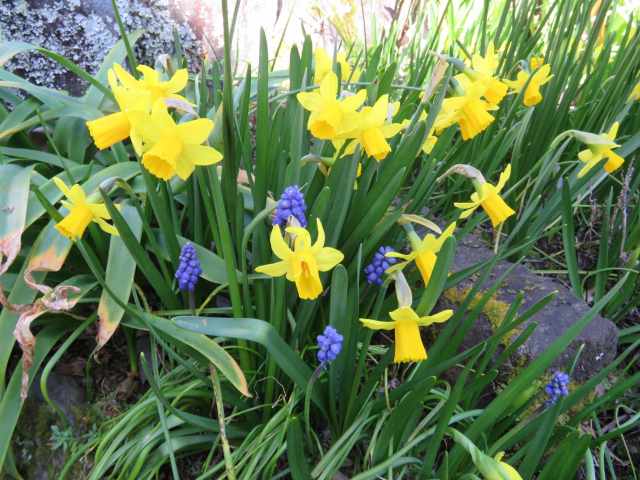
A touch of grape hyacinth is enough. Seen here with Narcissus Tete a Tete.
We are not too snooty about the common bulbs. While the snowdrops finished last month, the undervalued snowflakes (Leucojum vernum) flower on. We are thinning out both the grape hyacinths (muscari – foliage to flower ratio too high in our climate and spreads a bit too much) and bluebells (way too invasive) but not aiming for total eradication.
Once was dipidax, then onixotis but now, apparently a wurmbea
Seedling anemone
The blue anemones seed down and have quietly naturalised in the rockery without being a problem. I once planted a couple of bags of anemones and ranunculus and they all flowered the first year. From then on the ranunculus, the double anemones and all colours except blue quietly faded away but I like the simple blue and I like even more that they are self-maintaining. The Wurmbea stricta which we used to know as an onixotis and before that was a dipidax is another common bulb but one without a widely-used common name so most often greeted with words to the effect of “Is that what it’s called? My mother used to grow that – I never knew its name.” Dutch iris are another early spring option. I like my blue ones but I am not a particular fan of the family generally.
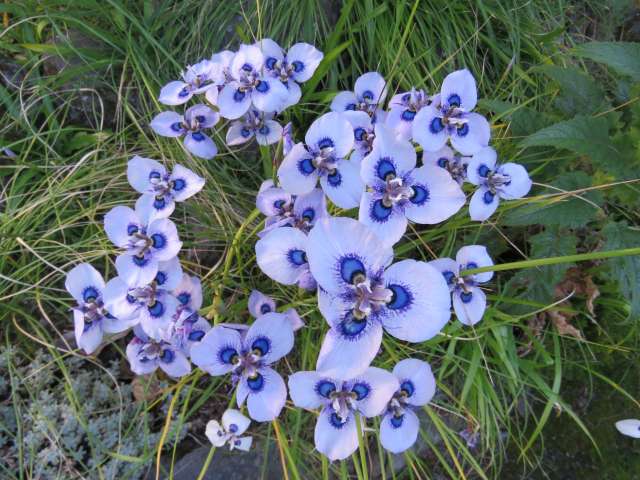
The blue moraea villosa are the most desirable but the white with blue eye are the most common
There is a large group of somewhat messy bulbs that are terrific in flower but their seasonal foliage is often dying, either just before they bloom or while they are in flower. So they are not nice, tidy, neat bulbs but they are generally showy. The Moraea villosa float like ethereal eyes of the peacock feather, moving in the breeze and they are a delight, even though I may feel irritation at their messy foliage in a few weeks’ time. The freesias (plain cream ones here), sparaxis, valotta, tritonia, Gladiolus tristis and babianas all fall into the same category and are flowering now. We grow them all, but more in the rockery for choicer ones and in meadow plantings for vigorous ones. Their foliage issues are less intrusive than in a tidy border planting.
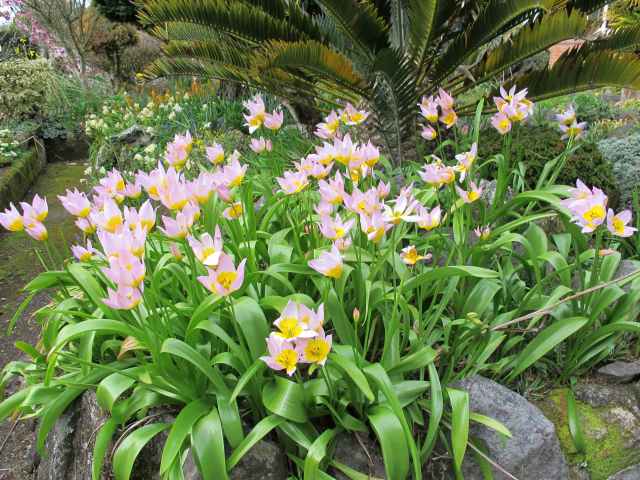
Unlike the Dutch hybrids, Tulipa saxatilis just keeps quietly increasing and returning to bloom every year
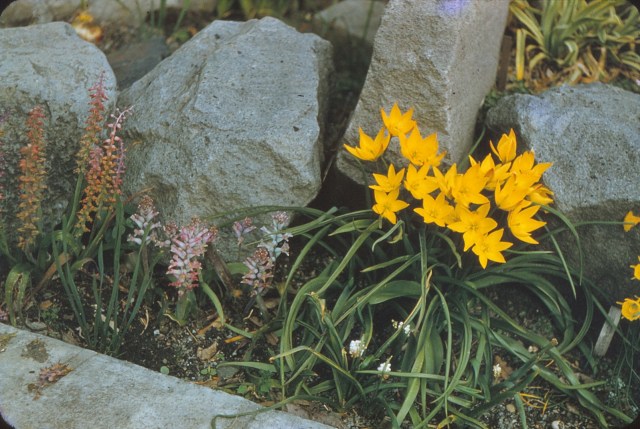
Tulips – we don’t grow the Dutch hybrids but we are enamoured with the Cretan species Tulipa saxatilis. And we have a dainty yellow species that may be a form of T. sylvestris, or it may not. Amongst Mark’s parents’ slides, there was a photo of it in the newly constructed rockery so around 1952 or so. Amusingly, seventy years on, we still have it but only in similar quantity to that in the early photo. It is clearly not going to naturalise and reproduce much here.
We know this is a very early photo because the rocks have not a skerrick of moss or lichen on them.
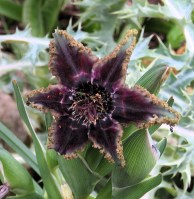
Ferraria crispa
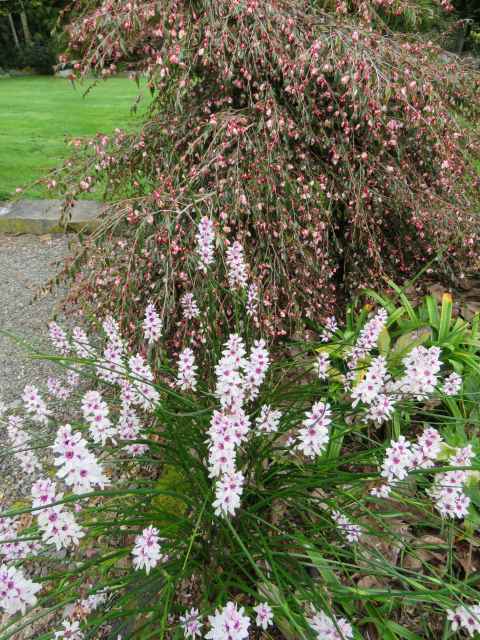
Then there is the Ferraria crispa, the starfish iris which is only worth the space if you are fascinated by oddities and freaks. Erythroniums, dog’s tooth violets which prefer colder, drier winters, are a seven to ten day wonder with us but charming and dainty for that time and no bother for the rest of the year. Veltheimias in pink and in cream are a mainstay for us in both sun and shade, the pleione orchids are coming into flower and Hippeastrum papilio has opened its first blooms – I could go on.
Why did I start with the month that is probably the busiest of the year in the varied world of bulbs? There will be more that I have missed. If I end up having to retire to a very small town garden, there will be no roses, lavenders or easy-care mondo grass. I am pretty sure I will be growing bulbs.
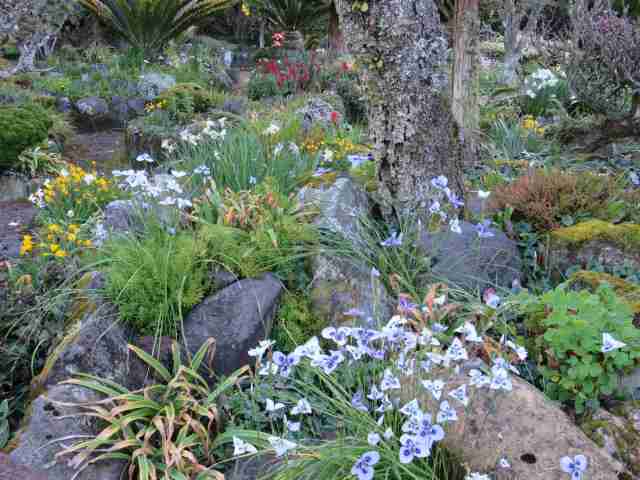
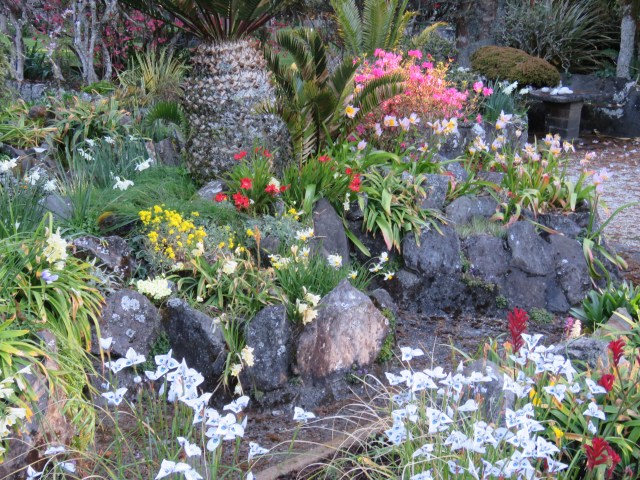
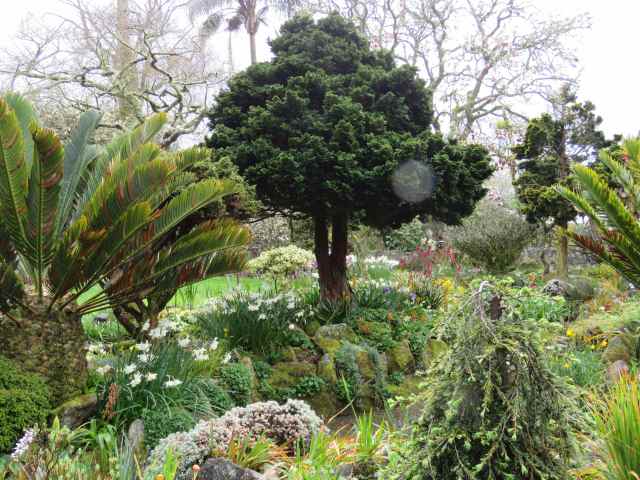
The rockery is at its busiest at this time of year
We don’t open the garden to many groups these days but agreed when we were approached to host a visit from “the last Camellia Nationals in their current format”. That is the national conference of the NZ Camellia Society. Competitive show blooms have long been a hallmark of the camellia world, the major focus of the annual conference but a range of garden visits are also included.
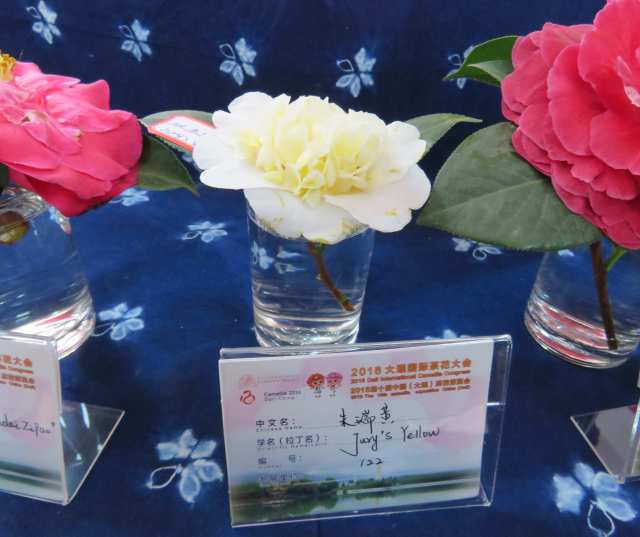
A little bit of Taranaki Jury on the honours table of the International Camellia Convention in Dali, China 2016
Mark’s father Felix and his Uncle Les Jury were giants in the camellia scene back in the 1960s and 1970s, earning international reputations and breeding camellias that have become known throughout the world. To this day, Les’s Camellia ‘Jury’s Yellow’ remains a market standard and Felix is probably best remembered for his camellias ‘Dreamboat’ and ‘Waterlily’.
Camellia ‘Waterlily’
Camellia ‘Dreamboat’
When Mark and I returned to Taranaki at the end of 1979, Les was elderly. But before he died in the early 1980s, he was particularly encouraging and generous with advice to Mark, who was taking his own first steps in plant breeding, starting with camellias. Felix didn’t die until 1997 so the camellia influence was strong.
Conferences past. I recently found some homemade posters – I am guessing Mimosa’s work – for a conference that was likely in the 1960s. The flowers have been cut out from magazines and glued on and, unless I am mistaken, the lettering is from Letraset and only oldies will remember the days before accessible printing, let alone photocopy machines!
It was to respect that family connection to camellias that we agreed to the visit last weekend. Times are changing and many horticultural groups are struggling to continue as members die off – literally – and younger generations are not signing up to replace them. That is why this was to be last national camellia show and conference in the current format. I have no idea what new format is planned.
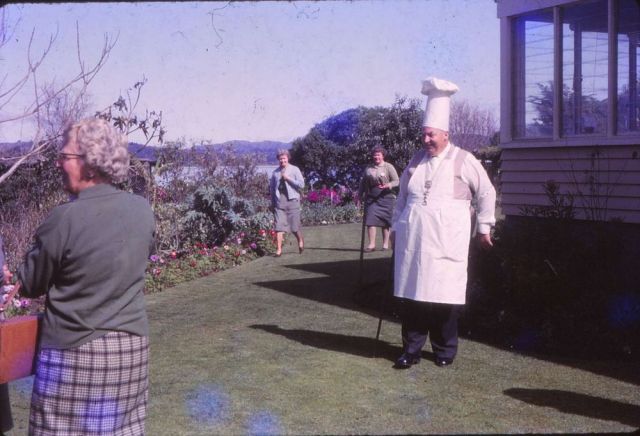
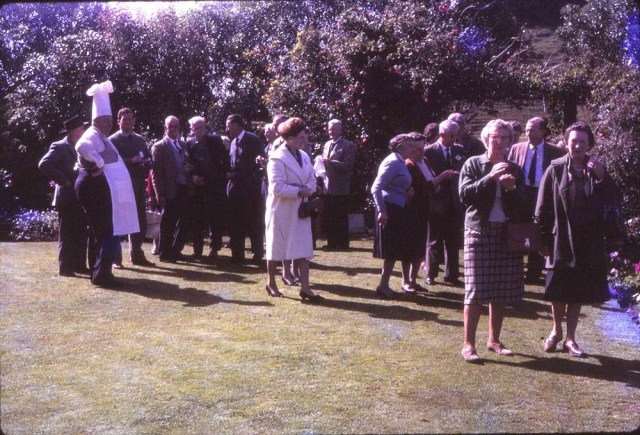
Camellia conferences in days of yore were a little larger and a little different. If the labelling on Mark’s parents’ slides was correct, this seems to be Whakatane 1964.
In times past, the camellia conference was huge. In the heady boom times through until the early 1990s, my recollection is that the conference tours around gardens involved six coaches and countless cars – several hundred people. It was bigger than the rhododendron conference which only required four coaches plus cars. Mark attended several conferences as his parents’ driver and was in awe at the scale of the event and the depth of expertise in the attendees. I went to one – I think it was Whakatane ‘82 and I can date it because I had our first-born with us and she was small. Even back then, Mark and I were a good decade or three younger than most of those who went. We continued to host conference visits here in the times since so last Sunday felt something like the end of an era. Conference attendance was down to 63, so one coach, a minibus and a couple of cars.
The group arrives last Sunday afternoon.
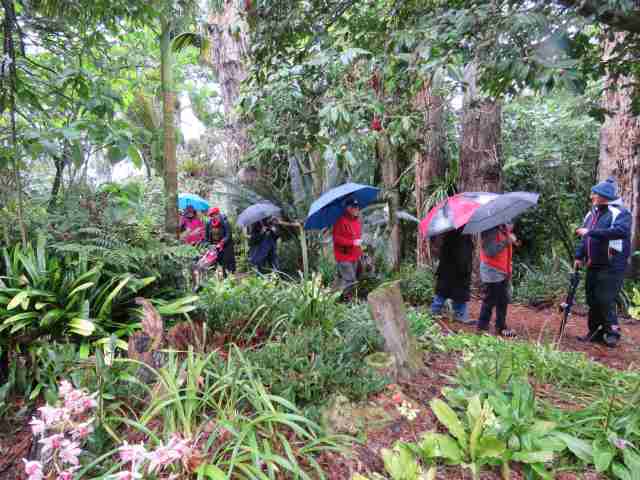
It rained but the camellia enthusiasts were very enthusiastic and appreciative
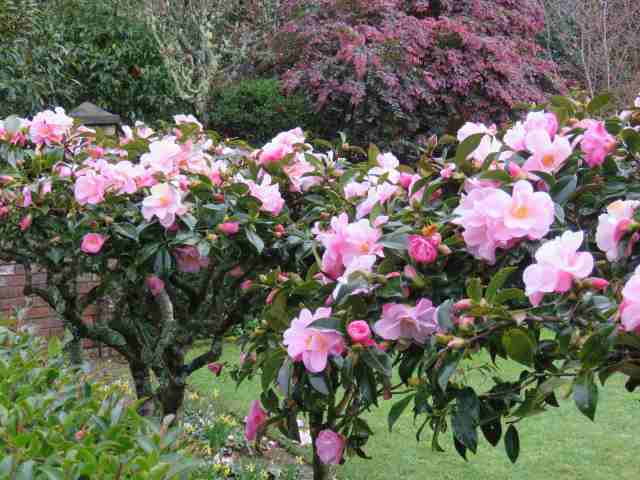
In earlier times, pretty much every camellia we grew put on a mass display of blooms. These days it is a rarer sight which makes this little row of Mark’s ‘Pearly Cascade’ more special. But even this would have had many more blooms in the days before petal blight.
Of course, camellias have changed over that time, too. Back in those days, camellias were ranked the second largest-selling product line. Roses were top. And the vast majority of camellias being produced were japonicas and hybrids. Camellia petal blight changed everything. The mass display of flowers all over the bush, the efforts Felix and Les both went to in creating varieties that were self-grooming (dropping spent blooms to avoid the need to pick over the plant), the perfection of formal blooms like ‘Dreamboat’, ‘Mimosa Jury’ or ‘Desire’, the purity of bushes with perfect white blooms, the quest for ever larger blooms – these are but distant memories. Petal blight has largely destroyed the displays that made camellias so loved. It made the Camellia Society shows problematic because the blooms no longer stood up to travel and display over several days. Picked as perfect, they too often became blotched with brown by the next morning and sludge the day after.
Camellia Mimosa Jury’
We still have hundreds of camellias here in our garden and right across our property. I set out to pick one off each bush where I could reach a flower and gave up after covering just a fraction of the garden. A few are named varieties but many are just seedlings from the breeding programme.
I think of camellias like the cast of a stage-show musical. In times gone by, the entire front row of the chorus and some significant soloists were camellias. Nowadays, they play a valuable but less acclaimed role, filling out the back rows of the chorus with a few of them getting to step forward to sing a few solo lines from time to time. They used to be grown primarily for their flowers. Now we value them more for their potential form – we clip and shape key specimens – as well as their obligingly resilient and healthy nature and their adaptability.
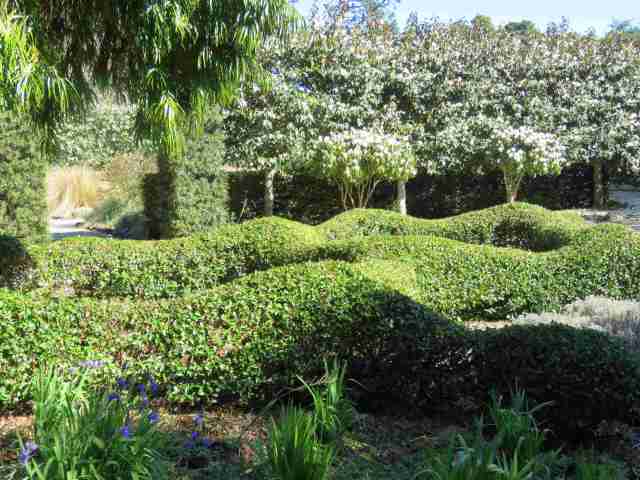
We use camellias differently now. The undulating hedge in the foreground is Camellia microphylla. The clipped hedge running across the middle of the photograph is Mark’s Camellia ‘Fairy Blush’. The two white topped lower plants in front of it are Camellia yuhsienensis.
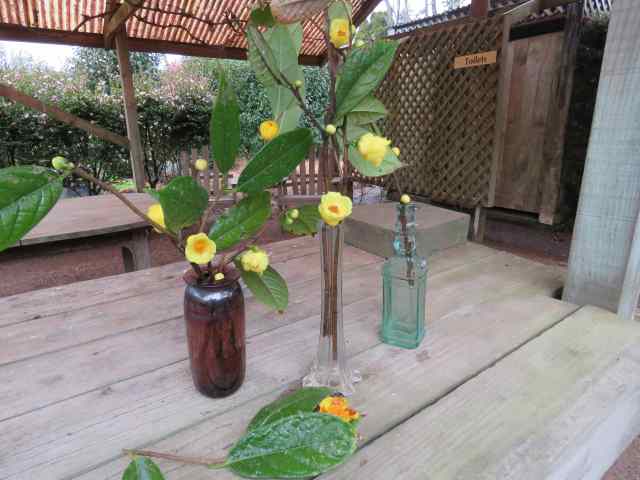
I set up a few sprays of Camellia nitidissima on the table by the visitor loos because I thought the visitors might not be accustomed to seeing them growing outdoors as garden plants – but nobody commented on them, to me at least. At the time when Les and Felix were breeding camellias, nobody in the west even knew about the yellow camellias in China and Vietnam. Les created ‘Jury’s Yellow’ from white camellias.
This train of thought came back to mind as I was sorting through the old slides of our garden dating back in its early days. We first came across the concept of freezing a garden in time when we encountered the Florence Charter being quoted twenty years ago, in the context of what are now referred to as the regional gardens here, particularly Tupare and Hollards.
I see the Florence Charter of 1981 built upon the earlier Venice Charter of 1964 and I can’t quite get my head past the glorious locations of these think-tank conferences on preserving historic monuments. Still, I doubt that the wise heads behind these charters were thinking about preserving gardens from the 1940s and 1950s. Only in colonial New Zealand do we think of 70 to 80 years warranting the descriptor of *historic*.
But how realistic is it to freeze a garden in time? For starters, it is probably limited to bulbs, herbaceous perennials or roses. Trees and shrubs grow. They can’t be lifted, divided, thinned, pruned and replanted in their original configuration. That rules out 99% of all gardens in this country; I cannot recall seeing any gardens here with no trees or shrubs in them.
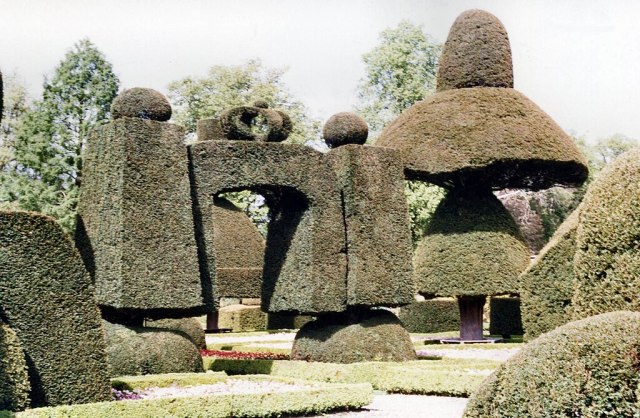
Topiary at Levens Hall by Peter Jeffery (via Wiki Commons)
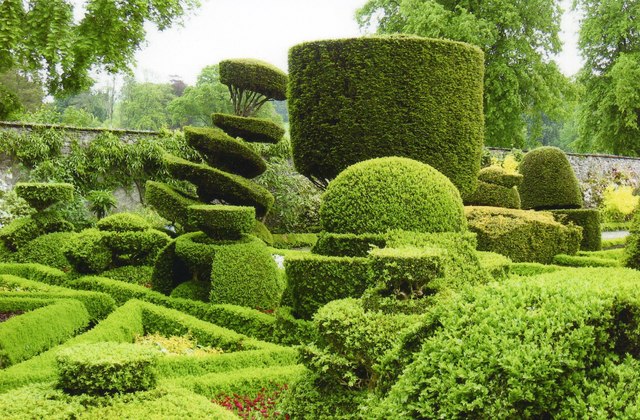
What about topiary, I hear somebody ask. Even they evolve over time. Covid robbed us of the opportunity to visit Levens Hall in the Lakes District of the UK. That garden dates back to 1690 and is claimed to be the oldest known topiary garden. Some of the yew topiaries could well be original but I doubt they look the same now as they did in 1700. Even topiary and bonsai grow, mature and evolve over time.
Topiary in the garden at Levens by Simon Palmer (via Wiki Commons). That unbalanced, leaning, cake-plate topiary is an example of serendipity over time, adding quirkiness that would not have been there at the start.
Roses and maybe some other small deciduous shrubs can be kept to the required size and shape. Besides, you could grow on replacement plants out the back somewhere and bring them in as instant substitution when needed.
Herbaceous perennials and bulbs can certainly be lifted, thinned and replanted in exactly the same configuration, although why you would want to do so eludes me.
But, and it is a big but, you can have a perennial, bulb or rose bed and dedicate your gardening life to keeping it static in display but make sure it is in the middle of open space which will stay open. As soon as a bed or border is encircled in hedging, other gardens, trees, orchard or anything else, the time-clock of change starts ticking. The micro-climate you started with will change over time as other plants grow and may no longer be hospitable at all to the initial plant selections.
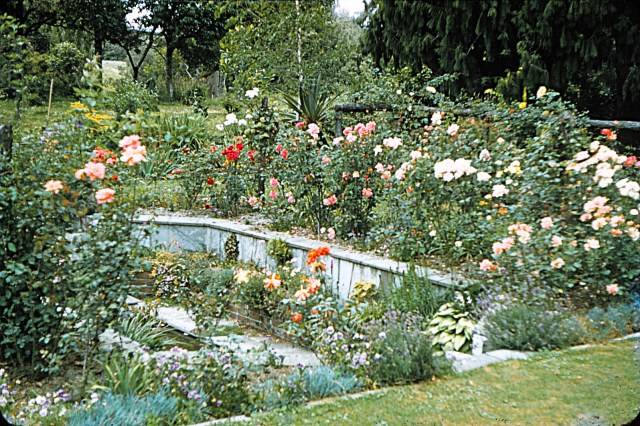
Mark’s mother’s rose garden in its heyday
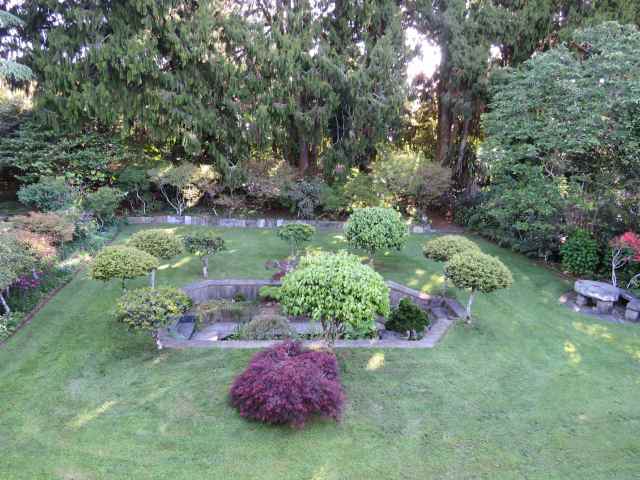
And how the area looks today. The line of rimu trees behind were planted in the 1870s and continue to grow with root systems spreading extensively.
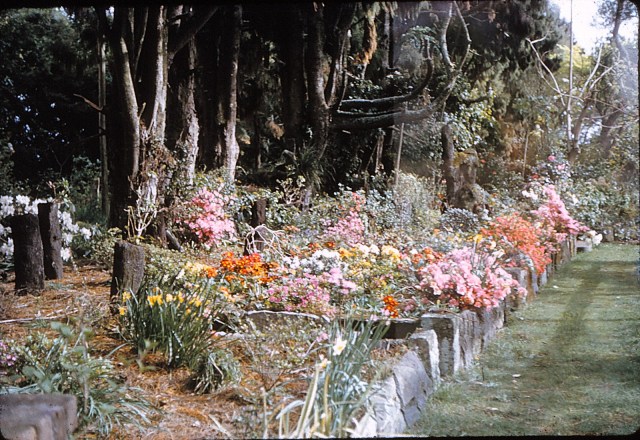
We worked this out when our best efforts failed entirely to restore the sunken garden to the glory days when Mimosa had it looking lush, abundant and flowery. In the decades since it was first planted, the rimu trees that bound it on one side have pretty much doubled in size and their fibrous root systems have spread throughout much of the area. The trees and shrubs Felix and Mimosa planted on two other sides have grown like Topsy and the garden in the middle has long since stopped being sunny and open; the area once suitable for roses is now semi-shaded, very sheltered and filled with roots from surrounding trees sucking up all the moisture and fertility. We changed tack entirely.
Freshly planted azaleas on the sunken garden side of the rimu trees, probably in the early to mid 1960s
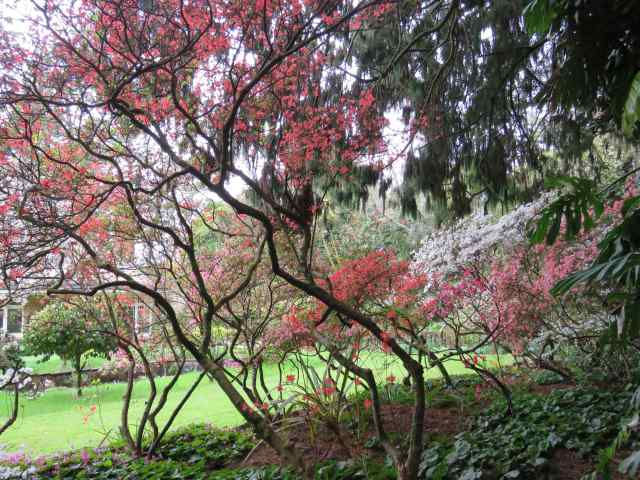
Looking back towards the sunken garden, these are the surviving azaleas from that original planting today. Now underplanted with Cyclamen coum and hederafolium as it is too shaded for the original narcissi.
All of this begs the question of why anyone would want to freeze a garden in time. Times change and with that, expectations and gardening values change. I was going to add in changing fashions, but long term gardens are about more than fickle fashion. The mark of good gardening, in my book, is the ability to adapt an existing garden, keeping it appropriate, relevant and in tune with current values while accommodating issues of changing microclimates and external conditions. Personally, I don’t see the value of trying to freeze even historic gardens to a particular point in their development.
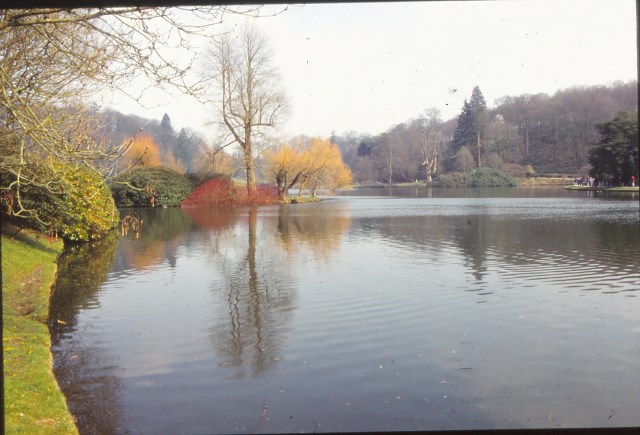
Stourhead, we think. Our memories are a little hazy now, given we visited in 1996.
Never have Mark and I forgotten our early visit to Stourhead in Wiltshire. The garden at Stourhead was created in the style of Capability Brown – sweeping landscapes and dearie me, is that a village located just where we want to put the lake? Move the peasants out now. So, a statement of wealth, power and privilege. Visiting in spring, the magnificent display of rhododendrons and azaleas delighted the modern hoi polloi amongst the vistas and the garden follies of past grandeur.
But there was a problem. Historically, the garden at Stourhead pre-dated the introduction of rhododendrons to the UK. The original lakeside plantings were, apparently, laurel and mass-planted laurel is never going to delight anybody, really. There was a purist, historical lobby group who wanted to pull out all the glorious rhododendrons and replant with laurels, in the interests of historical accuracy, you understand.
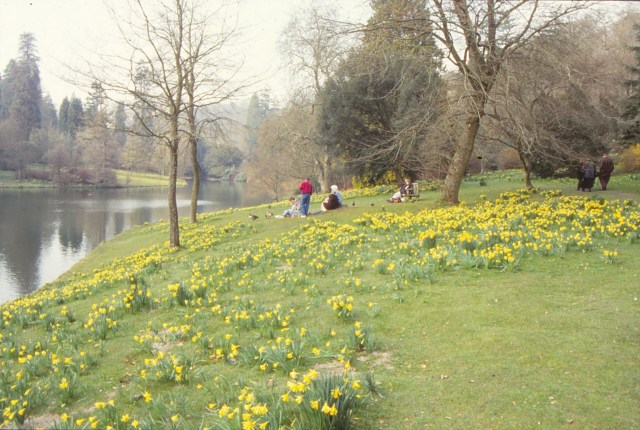
I admit we didn’t think to look closely enough back in 1994 to determine whether this host of golden daffodils were native narcissi species and not more recent hybrids.
I am assuming the historical purists did not win but we haven’t been back to see. It does illustrate the downside of picking an arbitrary time frame to freeze for the long term. You can do it with buildings and monuments but gardens? Gardens, by their very essence, change over time and we gardeners need to adapt to and enhance that change, not constantly try to wind the clock back.
Postscript: Theoretically, a rockery largely given over to bulbs and small perennials could be maintained as a static feature. It is clear that from the very start, Mark’s parents set out to plant in a mixed style.
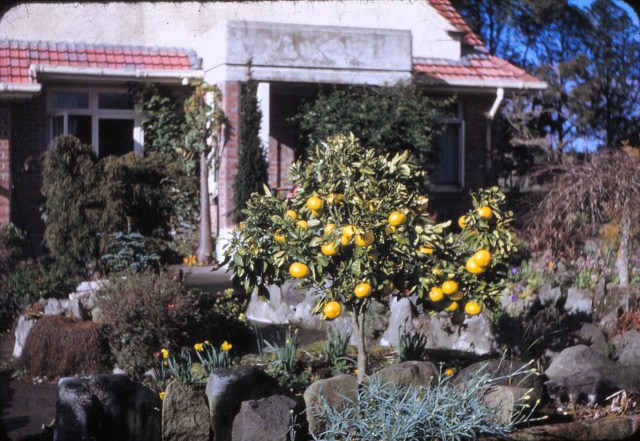
The house was built around 1949 and 1950 and the rockery must have been the first area of the garden to be created and then planted because this is as early as 1954 and many trees and shrubs are looking remarkably well established. That is a Wheeney Grapefruit which was moved out soon after.
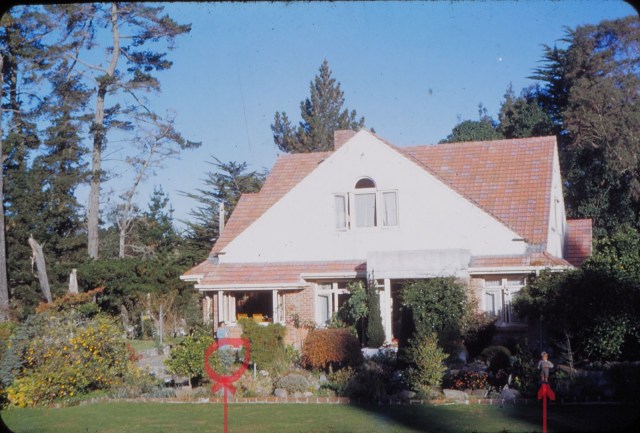
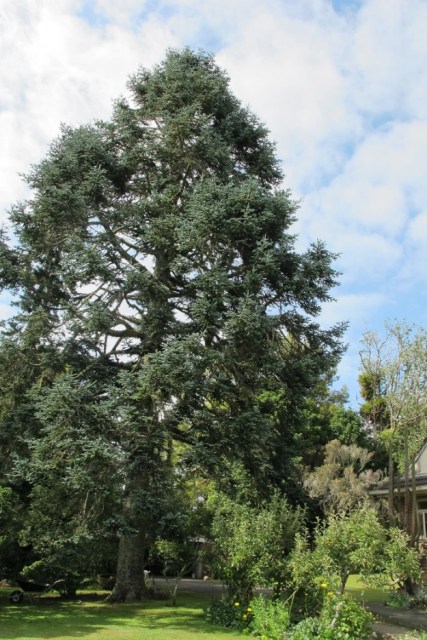
We can date this to 1954 accurately because that is wee Marky at the red arrow on the right. Mark’s mum is above the red arrow on the left but the circle is what I wanted to highlight. You won’t be able to see much on a small screen but the circle is around a very small blue conifer. It was Abies procera glauca and you can read it’s story here.
We felled it in 2019. It had been moved out of the rockery at some point in the later 1960s and by the time we dropped it for safety reasons, it looked like this.
The rockery is the the area where there has been the least change in structure and design. We have carried out a few running repairs but otherwise it is pretty much as constructed by Felix around 1951. The plant material, however, is something else. The turnover of plant material won’t be quite 100% but there is very, very little left that is original.
Freezing a garden in time seems a fruitless folly, really.











 Tikorangi The Jury Garden