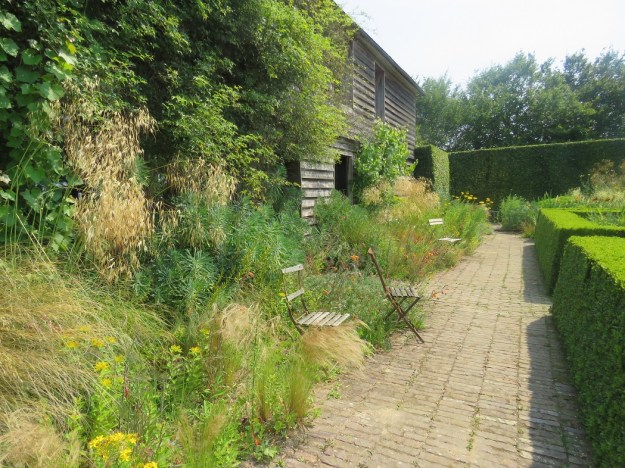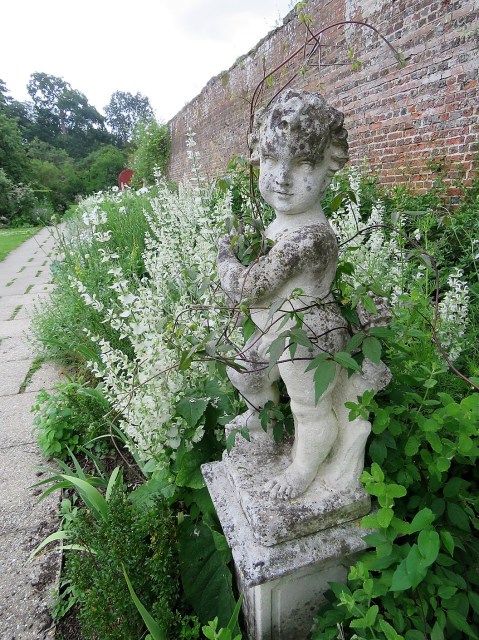
The white border at Parham
Parham was the only garden we went to on our recent trip without knowing anything about it in advance. As a result, while I have a fair number of photos and recollections, I lack an overview, a wider context. There is an interesting lesson for me there on future trips – we learn more if at least one of us does a bit of advance research on the destination. When we live so far away, making a second visit is unlikely so we need to short circuit the familiarisation step to have any hope of getting beneath the superficial.
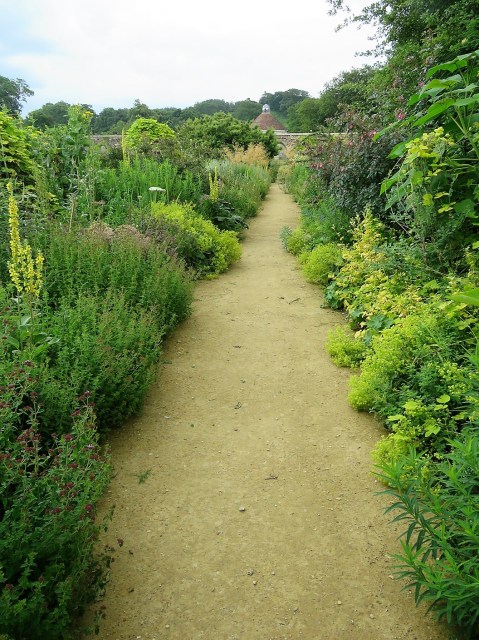
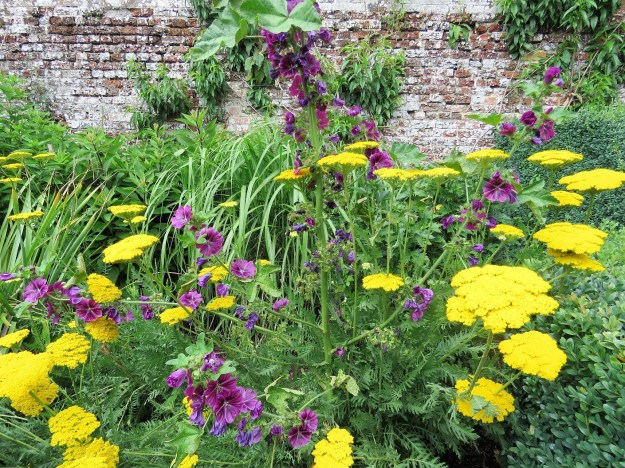
The yellow border at Parham
That is why I only offer this as ‘impressions of Parham’. Just for context, it is a private house, garden and estate in Sussex that opens to the public. They say house. We New Zealanders are more likely to describe it as a mansion. Or stately home, at least. Big, historic – Elizabethan in fact. That is the sixteenth century one, not last century’s one who is still with us. We did not tour the house. I did not even think to photograph it. Nor did we look at the estate, a 16th century deer park and working farm, or test the on-site café which serves locally sourced food including from the garden. I can report that the plant centre had some of the best displays I have seen in a garden centre and good plants on offer and that the gift shop was better than many I have visited and not exorbitantly priced. I bought myself a souvenir – a pretty milk jug with Redoute’s roses on it. I don’t even think we found the Pleasure Grounds. It was just the extensive walled gardens that we looked at. But, as you may gather, this is a multi-faceted operation which has to work hard to keep it financially viable and in private ownership.
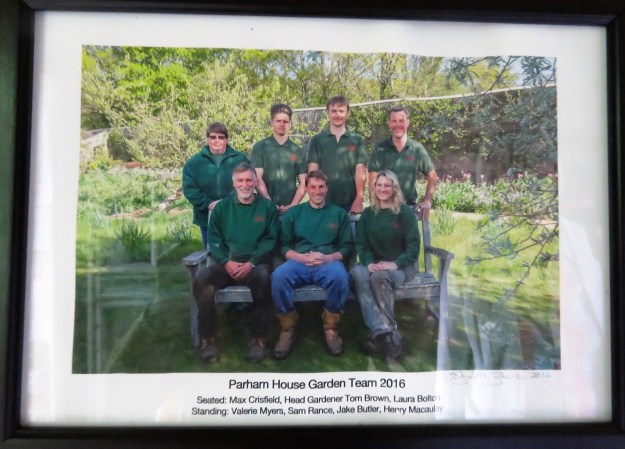 There was a team of seven hard working gardeners though I can’t tell you if they are all full time. We met the head gardener because he did his apprenticeship under the eye of our friend who took us there. Britain still has an enviable tradition of training professional gardeners. I have seen a few gardeners at work when we have been out touring, and I can tell you that these Parham ones were hard workers and focused on tasks to hand.
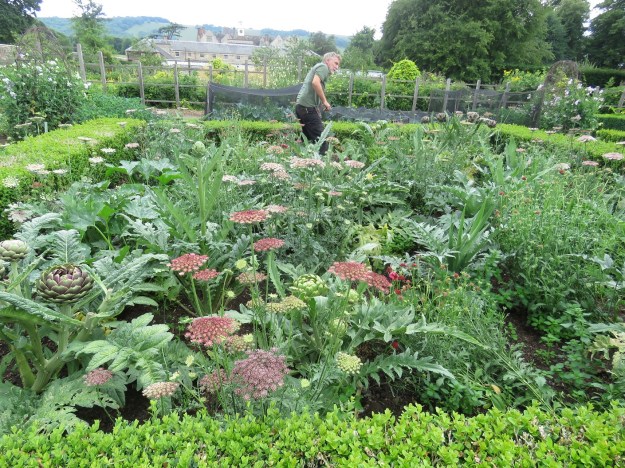 From memory, they are required to provide 30 buckets of blooms to the big house a week. That is a huge amount and they must be hard pressed in winter. But the production of both food and cutting flowers was impressive – highly productive, in fact. Also done without chemical sprays.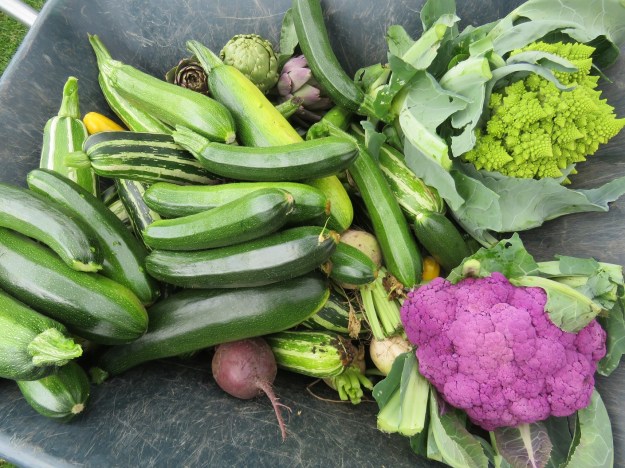


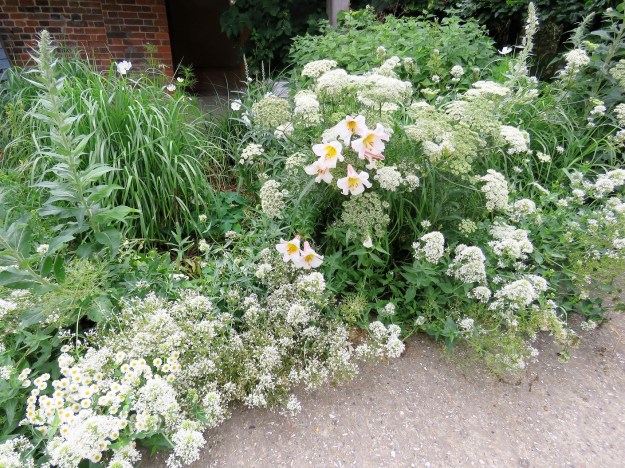
 The herbaceous borders were another modern take on classic design and techniques. The blue border was the most recent to have had a major makeover and it certainly looked glorious. I complimented the woman in blue whom I photographed strolling through the border, for her superb choice of toning colours. The yellow border was less flowery on the day but carefully composed and easy on the eye. The shorter white border was also at peak border perfection that the Brits can do so very well. If there was a red border, I missed it entirely but I do not think there was.
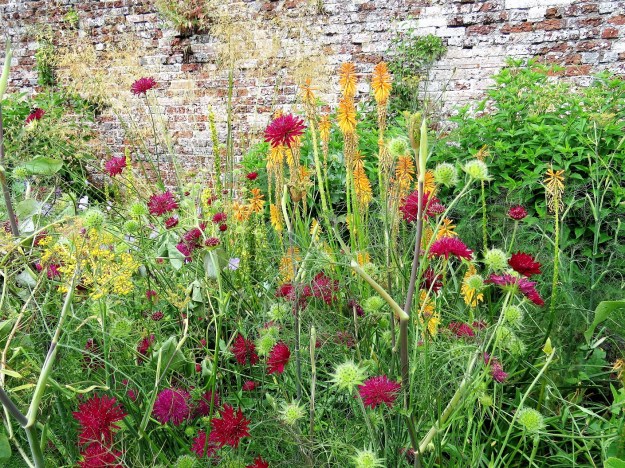
Along the back wall – for this is all contained in a walled area – were the hot, vibrant colours and combinations, many of which were designed to zing.
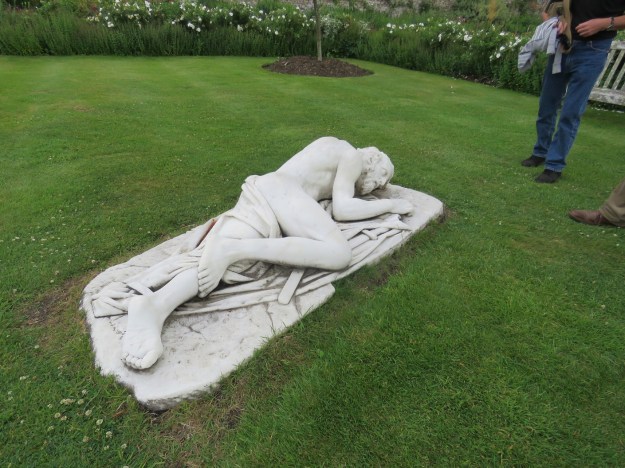
 Some of the statuary was… very white. Not necessarily to my taste. Some were more subtle than others. This was not. I am sure there will be somebody out there who can explain the significance of this figure and the inscription he is marking out with his finger.
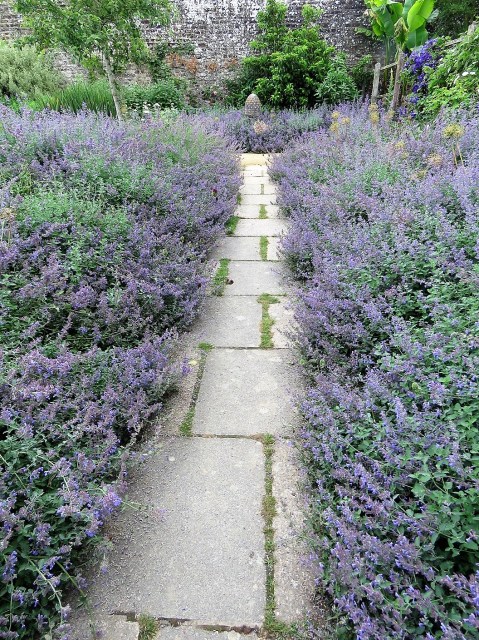
Railway tracks of blue nepeta that many of wish we could achieve in NZ but rarely succeed
What we saw of Parham’s gardens were predominantly herbaceous or productive and sometimes both at the same time. They were not flashy or even particularly innovative, but they were very good. It is an example of high level horticultural excellence. Presumably it is tourism, both domestic and international, that enables a private estate such as Parham to maintain this level of excellence.
If you want to see more photos and get more detail, I have matched again to an album on our Facebook page.

 The front garden was the first to be done and is a walled area. We have seen a number of large scale Oudolf plantings now. Bury Court is early Oudolf but, more interestingly, it is domestic and private in scale and design which makes it very different. The perennial plantings are still big, bold and bouffy but on a scale suited to this environment. I look at the photos and I see how much thought has gone into the combinations and juxtaposition of plants but when you are surrounded by them in person, it is more an experience of being enveloped by the vibrancy.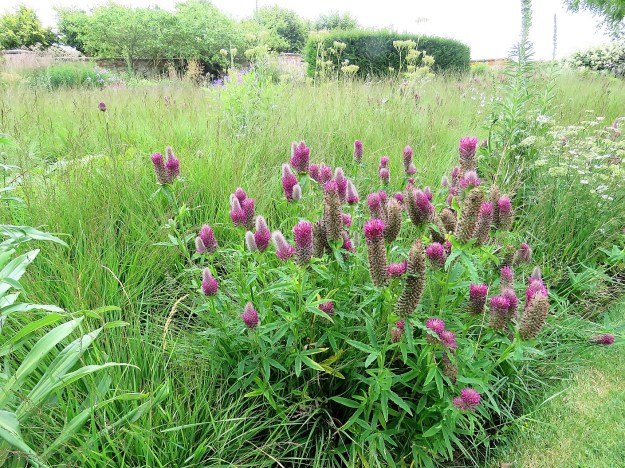
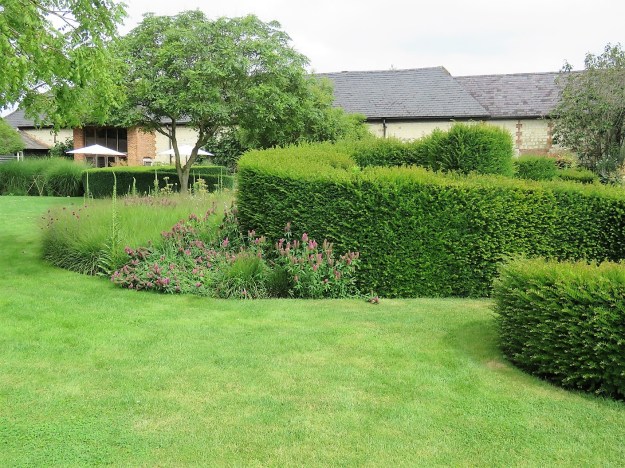
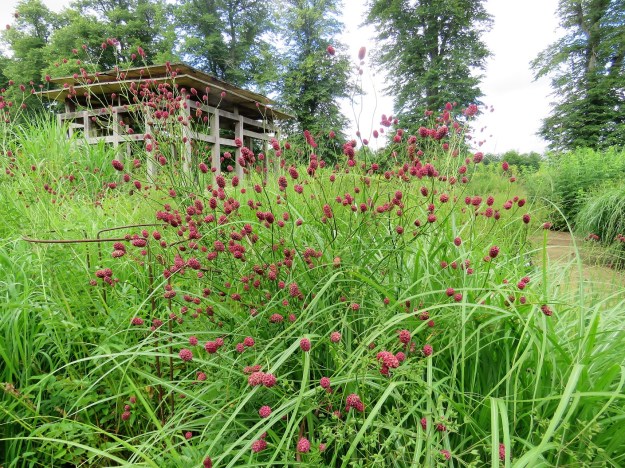
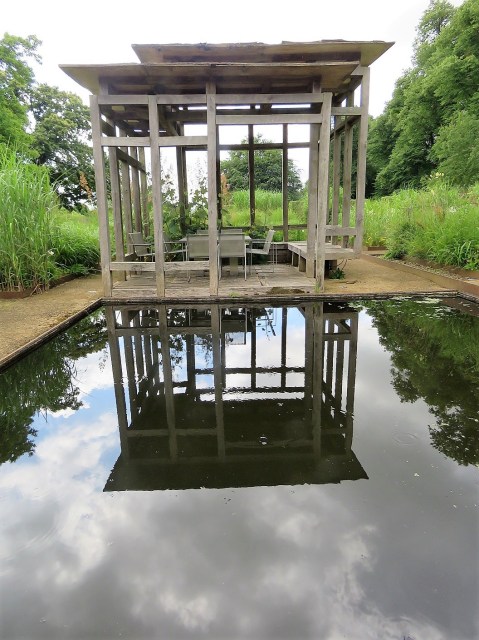
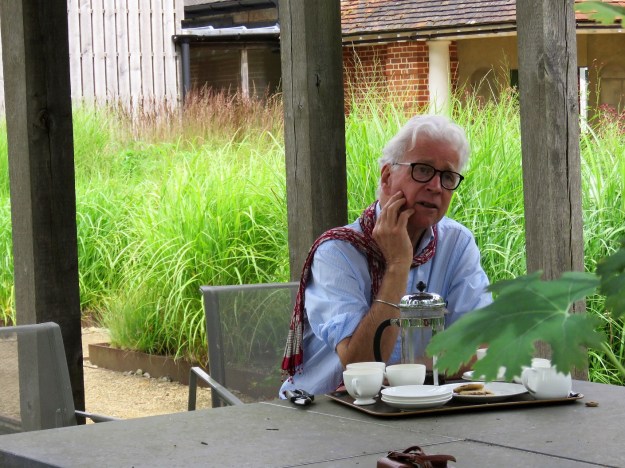
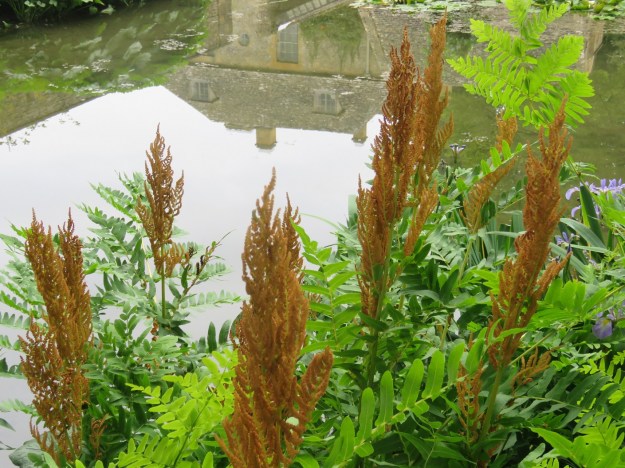
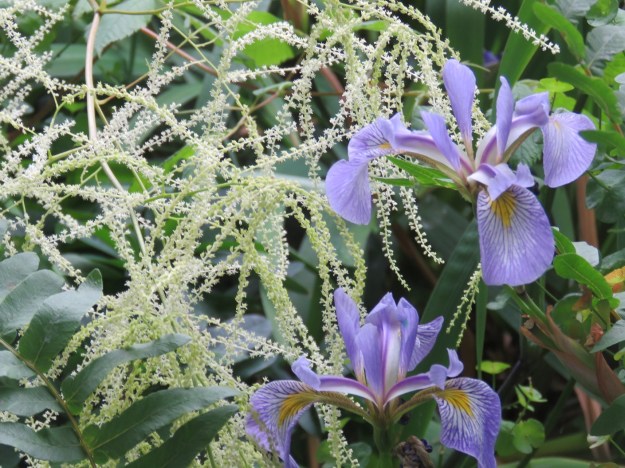 To set the scene, from memory the owners told us it is an acre in size. It is flat and Pearson took it back almost to a blank canvas. With the typical Cotswold two-storeyed cottage in the local golden stone being on the road side of the site, the body of the garden has four distinct sections, three of which feature water. The first is by a charming stream boundary and centres on a large elliptical pool with restrained plantings. The second is a formal garden built around a canal, with a dining area closest to the house. The third is the most spacious and contains a swimming pool. It was apparently the first garden Pearson had done that included a swimming pool and he was not keen. I can understand why. Pools are awfully difficult to integrate without turning it into the Miami look. But this pool was beautifully executed, though that is easier when you don’t have our laws requiring childproof fencing close in on all swimming pools.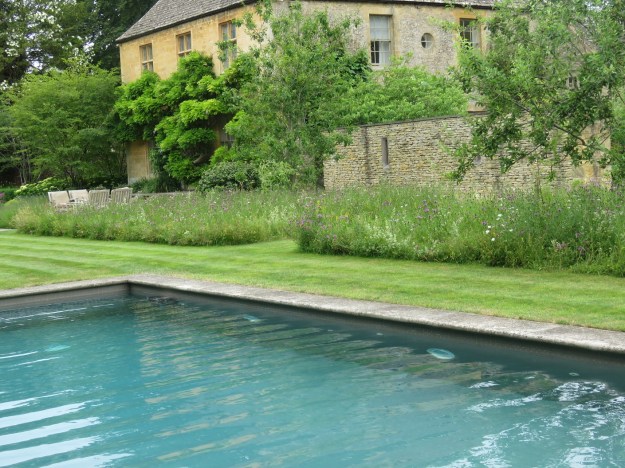
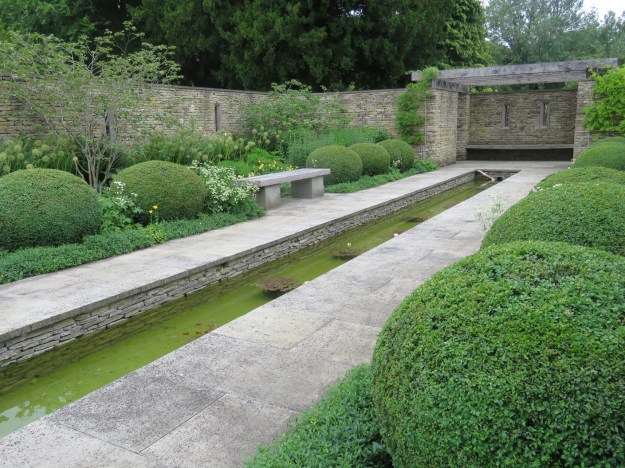
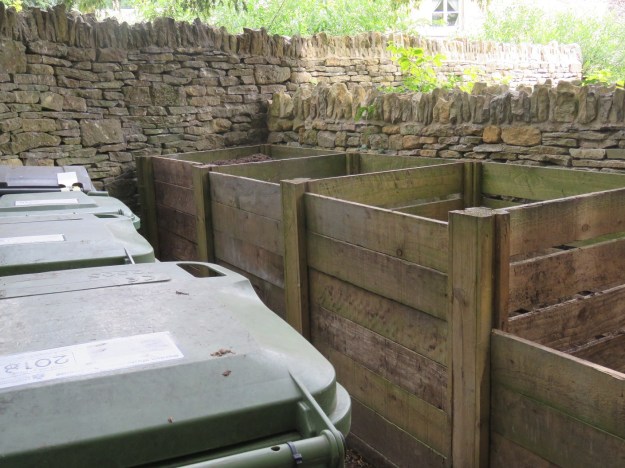
 What I call the ‘hidden infrastructure’ of the garden is well camouflaged to the point where it was not apparent at all. Again, attention to detail is paramount. There is no pond lining visible on the elliptical pool. I asked and the pool is made the old fashioned way, presumably with clay lining to remove the need for an unsightly pool liner. I did not spot a single skerrick of plastic anywhere in the garden. No cheap solar powered lights either. There were no visible hoses hanging about, no clumsy afterthoughts of garden edgings. The swimming pool filter was housed out of sight. The motorised pool cover was near to silent and the wiring was hidden. The compost bins and inevitable wheelie bins were discreetly housed. Everything had been thought of. We fall well short of that in our own garden but we admire the impressive attention to detail.





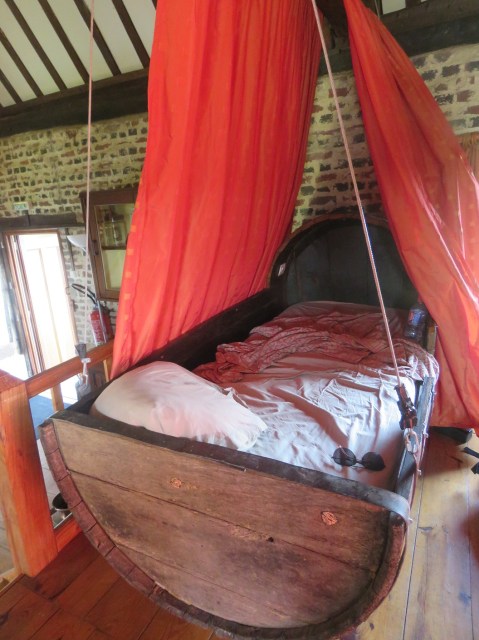 We stayed in another Air BnB place in Camembert – in this case a Norman barn that had been converted to a large apartment. Some of the conversion was a little curious but we did not electrocute ourselves and the opportunity to sleep in an adult-sized cradle created from a half cider barrel may never come my way again.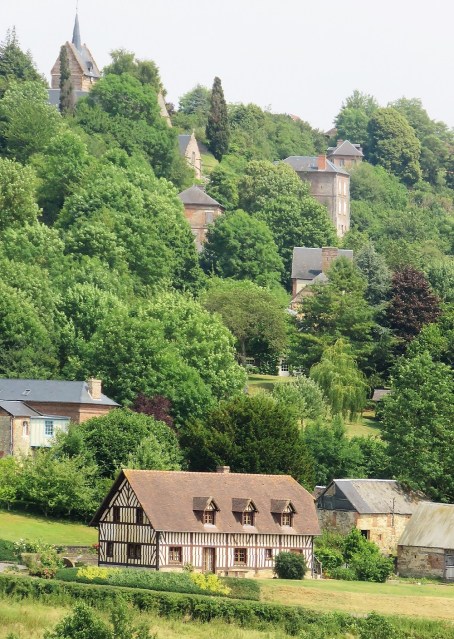

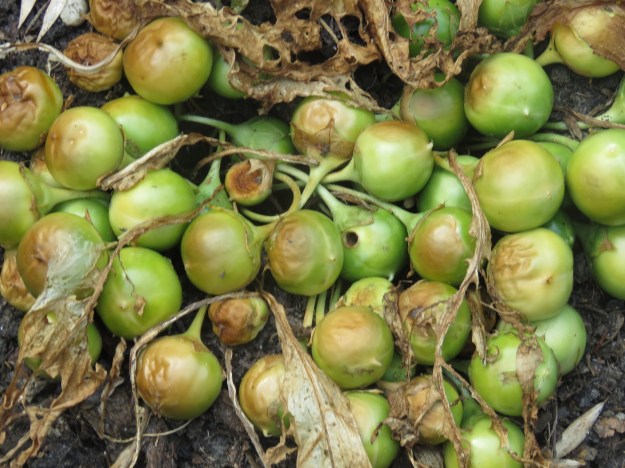 The fruit of the mandrake! Mandragora officinarum, to be botanical. This is not something one sees often. It is apparently the root that is harvested for whatever purpose one harvests mandrake, but the fruit are certainly eye-catching too. I think it was in the physic garden.