Tag Archives: Mark and Abbie Jury

Plant Collector: Syagrus romanzoffiana

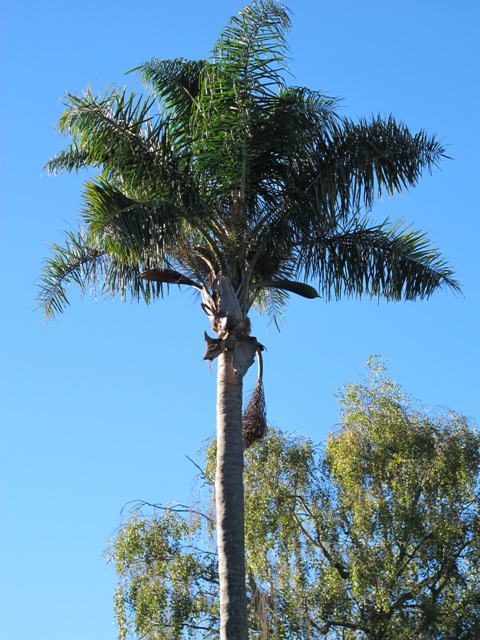
The towering Queen Palm, or Syagrus romanzoffiana growing in coastal Taranaki

The towering Queen Palm, or Syragus romanzoffiana growing in coastal Taranaki

I asked Mark how tall he thought our queen palms are. Mentally I was stacking 2 metre men on top of each other which is how I estimate tree heights. “About eighty feet,” Mark replied, “to the top of the crown.” I leave it in imperial feet because it sounds more impressive than 25 metres. They are tall, these handsome palms, and we have three of them. All were planted in the late 1950s by Felix Jury, from seed given to him by one of the Australian botanic gardens. Not that they are an Australian native. These are South American palms, coming from that mid band where Argentina, Brazil and Bolivia meet.

The single trunks are tall and slender and the impressive top knot houses an entire condominium of nesting birds. In spring time, there are often small, lightly feathered corpses at the base because fledglings are not going to survive a fall of that magnitude. It is mostly sparrows with the occasional starling. We often sit in a spot which looks out to one palm and the amount of comings and goings are prodigious.

I read advice on line that said: “the fronds die early and must be pruned to keep the tree visually pleasing”. No, we do not get the extension ladder out to groom our queen palms. Fronds do indeed die but they detach themselves in time and crash to the ground. As the sheaf of the frond is quite substantial, you don’t want special plants beneath and you certainly wouldn’t want one of these beside a building or near the car.

S. romanzoffiana is a suitable substitute for the common bangalow palm. While there are reported incidents of it escaping into the more tropical wilds of Australia, it has nowhere near the weed potential of the bangalow and we have never heard of it being a problem in NZ.

First published in the Waikato Times and reprinted here with their permission.

Garden lore

“Unless I’m missing out on something here, slug sex appears to be mightily different to human sex. The way slugs court is to circle each other for a while and produce a great big puddle of slime. Then, because they are hermaphrodite, they inject each other with sperm before slipping away to lay roughly three dozen eggs each.”

The Curious Gardener’s Almanac by Niall Edworthy, (2006). )

???????????????????????????????
Saving seed
If you are organised, you can save your own vegetable and flower seeds and save money but there are reasons why buying packets of seed can seem expensive. Saving seed is one of those jobs which is glibly recommended but takes some skill if you want to ensure success. Firstly and most importantly, save seed from the very best produce – not as an afterthought from a slow maturing or substandard specimen. If your crop is an F1 hybrid (and the only way to know that is from the original packet), seed will be inconsistent and patchy. You can stabilise a good seed strain over time but it will take a few generations. Sweet corn is often F1 (in other words it is the result of controlled pollination from two superior parents). Some tomatoes, cucurbits and cut flowers can also be F1s.

Clean the seed, label and date it. Pack it in paper and then store in a sealed plastic container with a sachet of silica gel or even rice, to absorb any surface moisture. So cool, dry, sealed, rodent-proof and mould-proof. The mice will find it if you leave it anywhere accessible. The fridge is a good place if your house partners accept your seed gathering ways.

Not all seed is dry seed. Some needs to kept on the damp side but not so wet that it rots. Generally these seeds have a fleshy coating (like belladonna seeds or cyclamen). It is often easiest to clean this seed and sow it immediately because it has a very short life span, especially if you allow it to dry out.

First published in the Waikato Times and reprinted here with their permission.

About the butterflies and the bees

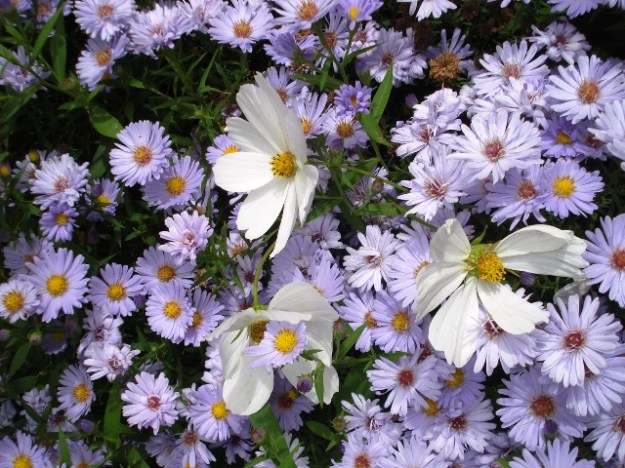
Single flowers like the white cosmos and semi doubles like the aster provide pollen and nectar

Single flowers like the white cosmos and semi doubles like the aster provide pollen and nectar

Were my Mark to have his life over again, he might equally choose to be a meteorologist or a lepidopterist instead of a plant breeder. But as he only has the one life, he is destined to remain merely a weather-watching butterfly enthusiast. It is butterflies this week.

As a country, we are a bit deficient in the butterfly stakes. Moths we have a-plenty and very beautiful many are but the jewel colours of butterflies are in short supply. I have even seen Mark, in a fan club of one, admire the fluttering of cabbage whites around the summer garden.

When he found a beautiful Blue Moon years ago, he became very excited and tried to make a home for it. I have only just looked it up and informed him that his Blue Moon was a male and could never have laid the eggs he hoped for. The females are modest brown but the male was gorgeous. We figured at the time that the Blue Moon had been blown over from Australia but I see they are now to be found in parts of this country so maybe they will turn up here to enrich our lives at some stage. Plant portulaca, though it needs to be the right one.

A stinging nettle turned up in a prominent spot of the veg garden this summer and we are pleased. It can stay and we may encourage a bigger patch of them to form because that is what is needed to bring in the admiral butterflies. We know next door but two had red admirals and was working on yellow admirals last year so we are optimistic. It is just a shame their host plant is so off-putting.
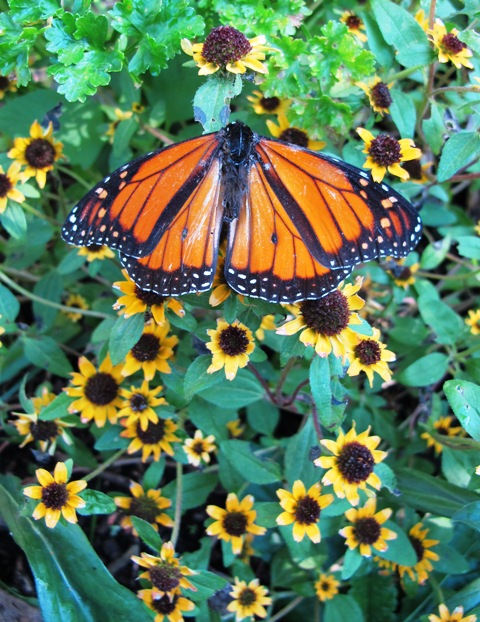
Monarchs, the most rewarding common butterfly on offer in this country

Monarchs, the most rewarding common butterfly on offer in this country

Essentially it is the monarchs which are the most rewarding of all and which have become part of our way of life here. The earlier obsession that saw Mark successionally sow swan plants by the kilometre (I am not exaggerating – I paced out his rows one summer) have passed. These days we have plants seeding down and naturalising with just a bit of topping up from fresh seed as required.
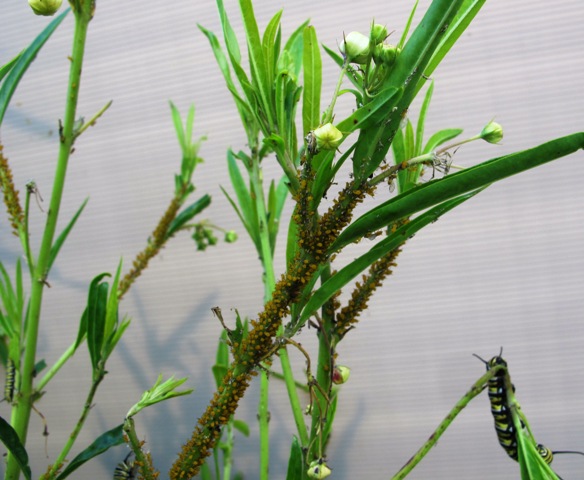
Nasty yellow aphids

Nasty yellow aphids

Nasty yellow aphids are an ongoing issue. They suck the sap from plants and can weaken them to the point of death. After trying various ways to control these critters, Mark is pleased to report that there is a spray that works. It kills the aphids without harming the caterpillars. Nature’s Way, a product from Yates. It is not organic, despite its reassuring name, but it is targeted and appears to be safe to use. Nature’s Way is a fatty based spray. In his capacity as my in-house technical advisor, he thinks that the organic canola oil-based Eco Spray from Tui should also work in a similar manner. Both sprays will need repeat applications every few weeks to achieve control. If you only have one plant and are vigilant, you can probably squash the aphids (digital control) but that is not practical on larger plantings or out of control infestations.

It is not the caterpillars that have exerted the greatest influence over our gardening here. Leaving swan plants to seed down in corners around the garden is the easy part. It is the next step – food for the butterflies.

The fashion for minimalist gardens (so last century now) which has morphed into the clean lines of prestigious modern landscaping using large swathes of the same plant in monochromatic monocultures, is one of the unfriendliest types of gardening as far as butterflies, bees and insects are concerned. Most insects need nectar and pollen and that means flowers with visible stamens. Green, sculpted gardens don’t do it.

If you follow the British garden media, you will have noticed a very strong drive to promote gardening which supports eco systems rather than imposing unfriendly garden styles on nature.
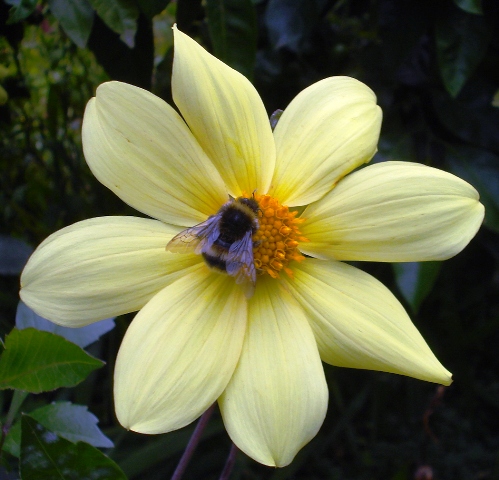
Single and semi double blooms offer the most to both bees and butterflies

Single and semi double blooms offer the most to both bees and butterflies

All this means flowers, particularly single and semi double flowers. A single flower form has one row of petals arrayed around a sunny centre of stamens which usually means pollen and nectar. A semi double has two rows of petals so looks to be a fuller flower but still has that life supporting centre. Full double flowers only have petals visible and are of very limited or no value at all to insects, including our butterflies and bees. This is not to say you should shun double flowers. You just need to make sure that you have a good representation of singles and semi doubles as well.

Generally, there is plenty in bloom during spring and early summer. We target flowers for summer, autumn and winter to keep the butterflies around. If you lack the food for them, they will just fly away. These days our vegetable patches are a major mix of flowers and produce. This tumble of plants may not appeal to ultra tidy gardeners, but our patch is full of bees and butterflies and many lesser appreciated but valuable insects. We are also factoring in the need for food for butterflies and bees in the ornamental gardens.

You know you are succeeding when you get monarch butterflies wintering over in your garden and when you have plenty of bees buzzing busily. Not only is it better for the balance within nature, it adds vitality to the garden.

First published in the Waikato Times and reprinted here with their permission.

Plant collector: Eryngium planum

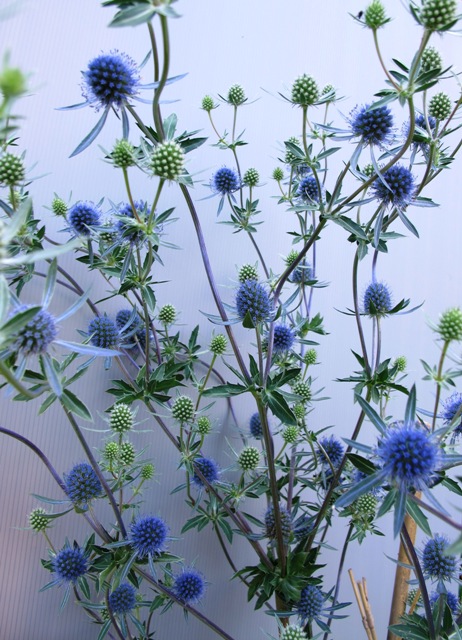
The hazy blue of Eryngium planum

The hazy blue of Eryngium planum

I thought it was going to be easy to write up eryngiums but it transpires that there are a whole lot of different ones from various habitats and climates. So I will confine my comments to the ones we are growing here. I love these ethereal thistle or teasel-like flowers in the prettiest hazy blue. We have had what I think is Eryngium variifolium in the rockery for a number of years. Despite its decidedly prickly habit and its location too close to the path, the flowers are always a summer delight. When I tried to move it back from the path, I found it had a phenomenally long and tough tap root so it defied my plans. That one has never set seed for us. Some eryngiums are propagated by autumn root cuttings so we plan to try that.

Eryngium planum is taller so needs staking in the garden. It flowers earlier in the season and grows easily from seed. We ordered it through Kings Seeds and this is the first summer we have had a good sized planting of it. I am hoping it will set seed because I think I can use lots of this plant in the summer garden. It doesn’t take up much space so can grow through other plants and the flowers last a long time. Both forms we have are perennials. E. variifolium disappears entirely in winter but neither of us can remember whether E. planum does too or whether it retains a smaller rosette of visible leaves.

Eryngiums belong to the Apiaceae family (with carrots!) not the thistle family. They are often referred to as sea holly but that should more correctly be ascribed to E. maritimum which we have seen growing wild on the coast of Cornwall.

First published in the Waikato Times and reprinted here with their permission.

Plant Collector: Solandra longiflora

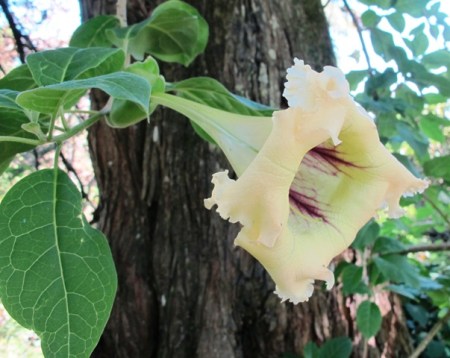
Solandra longiflora or the chalice vine

Solandra longiflora or the chalice vine

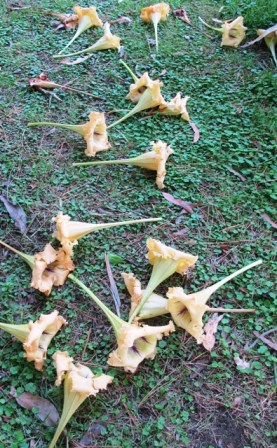
A carpet of spent trumpets

A carpet of spent trumpets

This is not a common plant at all in this country, where it has been identified as Solandra longiflora. All the solandras, of which there are around eight, appear to be variable species so not all longifloras will look the same as ours. However, they all share the common name of chalice vine on account of the large blooms that look like chalices. And they are strong climbers from the more tropical areas of the Americas, in the case of longiflora – the West Indies.

Ours has taken a fair number of years to get a good grip on the large tree we wanted it to grow up and also to produce more than just a few blooms. But this summer it is outdoing itself and we have an abundance of these large trumpets. They are an attractive amber honey colour with dark burgundy striping in the throat. At 25cm long and over 12cm across, there is quite a lot of flower.

The foliage is not exciting and bears some resemblance to woolly nightshade, daturas or brugmansias, this being because they all belong to the solanum family. It also shares some of the chemical compounds of the datura family but this is best left to the indigenous peoples who use it for a variety of purposes. Like datura, it is highly toxic and more likely to cause death in the wrong hands.

First published in the Waikato Times and reprinted here with their permission.