Tag Archives: Mark and Abbie Jury

Outdoor Classroom – how to sharpen garden tools

1) Every winter, the advice comes to sharpen and clean tools, but it rarely includes instructions on how sharpening should be done. There is no doubt that good tools with sharp cutting edges make gardening much easier. If you try it, you will believe it. Better quality tools hold a sharp edge longer.

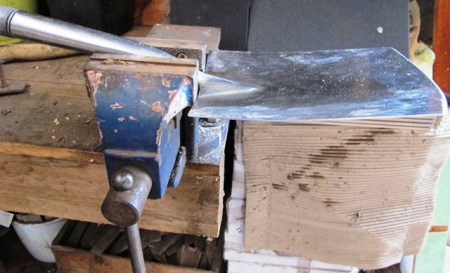
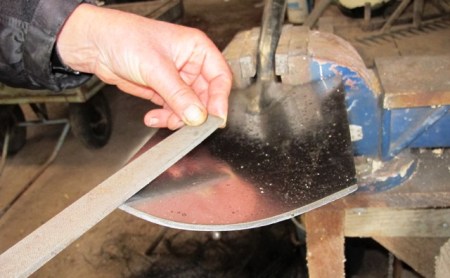
2) It helps to be able to hold larger tools firmly while sharpening and we prefer to do this in a simple workbench vice.

3) Only ever sharpen one side of a spade or push hoe – the side that faces upwards. With a push hoe, this keeps the blade flat to the ground with the cutting angle on the upper side. Spades cut better with one flat side and the upward or outward side bevelled and sharpened. We use a file to sharpen the blade. Home handypeople may go so far as to use an angle grinder but be careful not to overheat the garden tool or you will lose the temper (hardness) of the blade.

4) An oil stone is the best implement we know for sharpening secateurs and can be bought from a hardware store. Most secateurs are held together with a central bolt and nut. You have to unscrew this to take the blades completely apart. Some CRC or oil may help to loosen it. Do not lose the spring in the process.

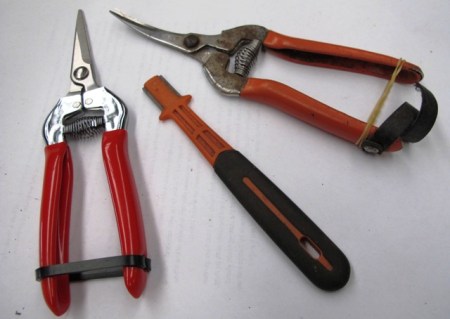
5) Wetting the stone with oil, use a gentle circular motion to sharpen one side of the blade. Never sharpen both sides of the blade or you will find it no longer cuts (it is the same with scissors). Cutting relies on a sharp bevelled edge meeting a completely flat surface so always sharpen the side of the blade that is already bevelled. Where you have secateurs like these with one blade incurved, this second blade shown on the table will need to sharpened on a round stone or with a round file because it will not sit flat to this type of stone.

6) A quick-fix sharpen for secateurs and scissors can be achieved with this handy little tool from garden retail outlets. It is also the only way we know of sharpening cheap secateurs held together by rivet, or the grape snips with upward curving blades. Run it along the angled edge of the cutting blade about six times. Remember to sharpen only the bevelled side of each blade. This tool is made by Bahco though there are other brands on the market.

A little bit of Tikorangi at Clarence House

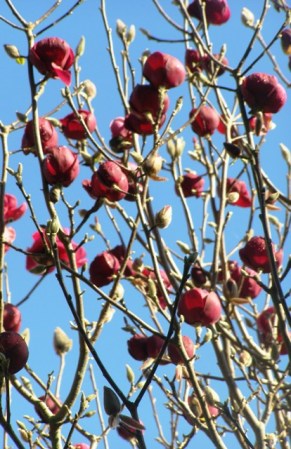
The promise of big fat buds on the magnolias just yesterday morning

The promise of big fat buds on the magnolias just yesterday morning

Latest posts: Friday 29 June, 2012

1) Snowdrop season has started!
2) Not perhaps for everybody. The exotica of a bilbergia in Plant Collector this week. (Hint: it is a bromeliad).
3) Grow it yourself – whacking great Oriental radishes.

It may take a little while for the Black Tulip at Clarence House to reach this scale of display

It may take a little while for the Black Tulip at Clarence House to reach this scale of display

Tikorangi Notes: Friday June 22, 2012
Without a doubt, the highlight of the week was when it was pointed out to us that the magnolia planted by Aung San Suu Kyi at Clarence House, the London home of the Prince of Wales and Duchess of Cornwall, was in fact none other than our very own Black Tulip. The story came via The Telegraph complete with short video of the Nobel peace laureate and Burmese Opposition leader scooping three spade loads of dirt around the tree. Black Tulip is adjacent to another magnolia planted by the Dalai Lama in 2008.

Magnolia Black Tulip was bred here at Tikorangi by Mark. Last year, the Queen herself was given a presentation of Black Tulip, though it looks as if the Clarence House specimen may be slightly larger.

We are honoured by this international recognition, though Mark would have preferred them to have planted his Magnolia Felix instead. It appears to be performing very well in the UK and the Royals’ gardens are large enough to take large flowered magnolias.

Tikorangi Notes: Friday 22 June, 2012

Latest posts: June 22, 2012
1) The garden identity crisis (or why you need to do quite big things around about year 15). My column from the Waikato Times this morning.
2) The sugar candy pink of Luculia gratissima Early Dawn on a winter’s day. Not my favourite luculia, perhaps. Plant Collector from the Waikato Times this morning.
3) The strawberry bed should be planted this weekend. Time is running out. From the Waikato Times this morning.
4) Much of what you may want to know about the early flowering camellias (plus more). From the latest edition of Weekend Gardener.
5) In the garden this fortnight. On actually getting around to digging and dividing instead of merely advising others to do it and getting rid of excess mondo grass – my garden diary from Weekend Gardener.
6) For absolute beginners – how to plant a tree. Outdoor Classroom has a second coming with our step by step guides.
7) Latest cookbook reviews – and why it may be better to keep local. In fact our NZ cookbooks are particularly good so it is a mystery to me as to why a NZ publishing house would want to import and release this utility series from Kyle Books in the UK.

A reasonably remarkable mid winter sight - the original R. macgregoriae aged 55 years!

A reasonably remarkable mid winter sight – the original R. macgregoriae aged 55 years!

A week of typical winter weather – random rain, torrential at times with thunder storms and just enough sun to remind us that our weather isn’t too bad, temperatures swinging from cold (like 10 degrees during the day) to a balmy 16 or 17. A typical mid winter’s week, really. I have at least started my major renovation of the rose garden. It is fun and not all gardening is fun. Wait for more – it is all part of learning to garden with perennials and finding a level we are happy with in terms of a modern look without resorting to mass planting and utilitiarian ground cover.

The snowdrops are opening here and that is a simple delight. But the flowering star this week is the vireya rhododendron, R. macgregoriae. This is the original plant that Felix Jury collected in what was just New Guinea in 1957. It is a particularly good form and gave the basis of a breeding programme here. But the astonishing thing, for anyone who knows vireyas, is that it is still thriving after 55 years. This is not a plant genus that is known for its longevity.

Outdoor Classroom (for absolute beginners): how to plant a tree

1) If you are planting into grass or paddock, remove the turf from the area first. The rule of thumb is to dig a hole at least twice the width of the root ball of the tree and a little deeper. Break up the clods of dirt thoroughly as you go, because you want friable, well cultivated soil so the tree can get its roots out easily. If water ponds at the bottom of the hole as you dig, look for another site. It will rot the roots. Keep the top soil to one pile and the subsoil and clay to another for when you refill the hole so the subsoil can go back in first.

2) If the plant is in a plastic bag, cut the bag off to avoid damage. Examine the roots. The fine roots are the most important ones. If there are strong roots wound round and round the outside, these need to be cut, because they will stay in a corkscrew shape and not spread out.

3) Often there is a mass of fine roots and the plant is difficult to get out of its pot or bag. Roughen up the outside of the rootball with your hands or make several shallow cuts down the sides. However, do not try and tease all the roots out to spread them. You are far more likely to cause damage than to do any good. As long as you plant into friable soil, the plant will get its roots out on its own. However, if the roots have grown into an envelope shape at the bottom of the planter bag, these can be trimmed off.

4) Getting the plant at the right level in the hole is extremely important. If it is too deep, you risk rotting the stem, too shallow and the roots will be exposed and the plant will dry out too easily. Measure with a stick and backfill the hole with compost and soil to get the level right.

5) Only stake the plant if it is necessary because of strong wind or instability. Trees grow better unstaked because the rocking movement in wind makes them form a strong tapered trunk. Staking can slow this process so never have a stake more than a third of the tree’s height. Put the stake in beside the plant before you refill the hole. Never drive a stake in close to the trunk. You are shearing off an entire section of roots.

6) Where soils are poor or heavy, layering in compost gives better soil texture. However, there is no point in adding extra fertiliser to the hole at this time of the year. Plants take up fertiliser when they are in growth so the time to feed is in spring and summer. Added in winter, it will leach out and disappear with the winter rains, giving no benefit.

7) Once the tree is in place, fill the hole with the original dirt which you have broken up to form a finely textured soil. Firm the plant and gently tread the surrounding soil but do not stomp heavily close to the stem or you risk tearing off the roots. A final layer of mulch will stop weed competition and protect the roots.

8) Where staking is necessary, always use a soft tie such as the stockinette shown here (available from garden centres) or old pantyhose. These do not cut into the bark of the tree. Cross the tie between the stake and the tree to reduce the bark rubbing on the stake. Make sure that the top tie is never more than one third the height of the tree.

Grow it yourself: strawberries

If you have been thinking of growing strawberries, do not delay. They should be planted immediately. As with most edible crops, they need full sun and plenty of rich, well dug soil to get them away to a good start. Good drainage is important. If you mound the soil, you get maximum exposure to the sun for the berries but you also hasten drying out over summer. Commercially, strawberries are usually grown in black plastic. This heats up the soil faster for early production and keeps the fruit clean by stopping splashing of mud. If you prefer not to use plastic, the traditional mulch is straw – hence the name of strawberries, perhaps? You may need to keep applying mulch as the season progresses.

Netted already - mostly because of our unwelcome resident rabbit.

Netted already – mostly because of our unwelcome resident rabbit.

Space plants at about 30cm, usually staggered in a double row. Garden centres will be selling reliable named varieties or you can take runners off your last year’s crop if you grew them. The runners are the plant’s way of increasing itself and good strong ones will be full of vim and vigour. Expect the biggest and the best berries in the first season (maybe even for Christmas dinner). If you keep the plants well fed, you will get more but smaller berries the following summer but it is not usually worth persisting with the same plants past the second season.

Plan from the start how you will cover your plants. If you don’t, the birds will beat you to every red fruit. We cover ours from the start to stop the birds from raking over the mulch and to foil the elusive resident rabbit from excavating the plants, using netting spread over cloche hoops.

If you are going to grow them in pots, they will need frequent watering and liquid feeding as soon as temperatures rise again.

First published in the Waikato Times and reproduced here with their permission.