Tag Archives: Mark and Abbie Jury

Tikorangi Notes: Friday 18 November, 2011

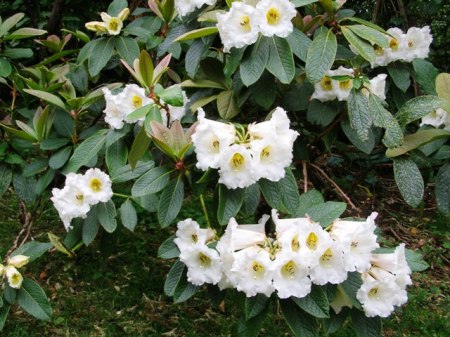
The fragrant nuttallii rhododendrons are late season bloomers here

The fragrant nuttallii rhododendrons are late season bloomers here

Latest Posts: Friday 18 November, 2011
1) Plant Collector – the showy Geranium madarense

2) Yet another NZ book best left on the booksellers’s shelves. I call it candyfloss gardening.

3) What’s in a name? Quite a bit, sometimes. Abbie’s column.

4) Grow Your Own – carrots this week

5) In the garden this fortnight

6) Future success predicted for Fairy Magnolia Blush – in Australia.

7) On the case with Grandma’s violets – a step by step guide on digging and dividing congested groundcover.

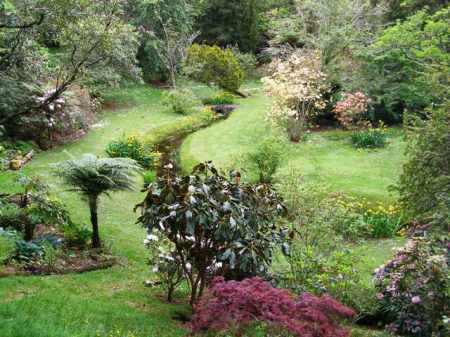
The area we refer to as "the park"

The area we refer to as "the park"

The two most admired areas of our garden are the rimu cathedral walk (“under the rimus” as we call it) and the informal park area in spring time. The park is somewhere over 4 acres in size with the upper waters of the Waiau Stream meandering through. We have deliberately kept the area quite open and informal, featuring specimen trees and an abundance of seasonal colour from magnolias, then prunus, rhododendrons, azaleas and other flowering shrubs. It is that very informality that seems to appeal to garden visitors. Only the very observant pick the detail which underpins such a casual appearance. Bulb meadows don’t just happen of their own accord, at least not in our climate. Nor do clear flowing streams stay that way without some intervention – our torrential rains see flood waters full of suspended silt on a regular basis. But it all seems worthwhile every spring when the park is in bloom and with our unseasonably cool season this year, that flowering has extended by weeks. The nuttallii rhododendrons are in full bloom now, as are the later season maddeniis.

Our garden remains open. If we are not around, we leave an honesty box out. However, plant sales have well and truly finished and we have taken to the end of retail like ducks to water. We would much rather be gardening.

I was, however, disconcerted by the garden visitors earlier this week – an older couple who came out of the garden, making the usual positive comments of how lovely it all was, when he came out with an extraordinary statement: “It must all be such a heavy burden for you.”

I think it said more about him than us!

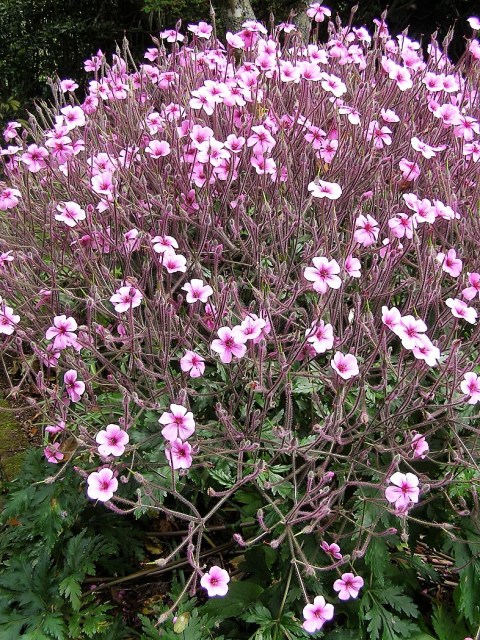
Plant Collector: Geranium maderense

Geranium maderense

There is nothing rare about Geranium maderense but it is certainly eye-catching if you have not seen it before. The only tricky part seems to be getting the first plant to grow. It then sets seed prolifically and it will continue coming up for years to come. I weed out most of them, leaving two or three to grow on to flowering size each season.

This is the largest of the geranium family and it is biennial. It doesn’t flower until its second year and then it puts on a huge show, sets seed and dies. By this point it is at least a metre high and a metre across so it does require space. Curiously, its lower leaves (which are large and attractive in their own right) become elbows resting on the ground to enable the plant to stand upright without support when flowering time arrives. It comes from the island of Madeira and to save you looking it up, this island group belong to Portugal and is located southwards to the west (or left) of North Africa. So this geranium comes from a hot, dry, maritime climate and is not particularly hardy to cold areas but it seems to be resilient in a range of soil conditions.

Elbows!

Apparently the Romans used to call Madeira the Purple Isles which seems appropriate given the most common form of G. maderense is in cerise to purple tones. There is a white form available. Terry Hatch from Joy Plants on the northern border of the Waikato gave us three plants of the white form but, alas, they failed to survive with us. This may be because we didn’t get around to planting them out quickly enough though others have told me they have tried and lost the common purple form too. If you are going to try growing G. maderense, go for a position which offers warmth, sun, good drainage and space.

First published in the Waikato Times and reproduced here with their permission.
Postscript: I have just been alerted to the existence of an endangered geranium in Hawaii which would almost certainly beat G. maderense on size. Geranium arboreum can reach up to 4 metres high, though it does not appear to be as showy in bloom as the second place-getter in the big geranium stakes.

Grow It Yourself – carrots

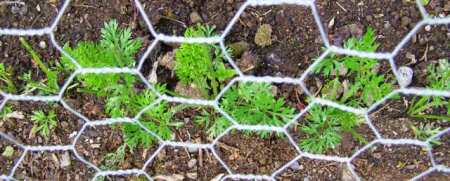
First time we have had to net in the carrots but Peter Rabbit paid a visit in the night and nearly put paid to a row of very expensive gourmet carrots

First time we have had to net in the carrots but Peter Rabbit paid a visit in the night and nearly put paid to a row of very expensive gourmet carrots

Generally, carrots sold in the supermarket are high quality, cheap and grown in New Zealand so the main reasons for growing at home are if you are aiming for self sufficiency, you want to be organic, you really like eating them at a juvenile stage or you want to try some of the less common varieties. They now come in purple, yellow, red and white as well as in a squat radish shape. As far as the traditional orange carrot goes, there are higher value crops to grow if space is tight in your garden. The critical aspect is soil preparation. Carrots do best in sandy or grainy soils so you need to make sure that yours is very well tilled and cultivated.

Carrot is direct sown from seed and that seed is extremely fine. We usually cover the row with a narrow strip of Novaroof to stop the seed from being washed out by heavy downpours. Once the seed is germinating, start thinning the crop and keep thinning it several times to get final spacings of 3 to 5cm. This allows each root space to grow.

It is usual to sow carrots in an area where you grew leafy vegetables before but don’t add more manure, compost or fertiliser. They certainly don’t want nitrogen which encourages leafy growth. Fresh animal manures can cause the roots to fork.

The main pest is carrot fly whose larvae chew holes in the carrots. We find early crops sown in September or October usually mature before the fly is on the wing. There are some carrot fly resistant strains. Other than that, we just cut out the larvae holes and trails because we prefer not to use insecticides in the vegetable garden though Diazinon is effective if you wish to try that. Crop rotation (growing them in a different area each year) also helps reduce the build up of pests.

The different carrots are available from Kings Seeds for New Zealand gardeners.

First published in the Waikato Times and reproduced here with their permission.
Tikorangi Notes: November 11, 2011

How curious is Hippeastrum papilio?

How curious is Hippeastrum papilio?

Latest Posts: 11/11/11

1) The exotica of Hippeastrum papilio in flower this week. To me it looks more like an orchid than a butterfly.

2) So you think you might like to open your garden to the public? Abbie’s column (based on 24 years of experience here).

3) Grow it yourself – parsley, a vegetable garden staple of underestimated value.

4) Cordyline Red Fountain receives high praise in Australia.

5) In the Garden this fortnight – the first of a new series written for the Weekend Gardener, detailing what we have been up to in our garden.

Tikorangi Notes: 11/11/11

Rhododendron Ivan D Wood

Rhododendron Ivan D Wood

With the end of our garden festival (formerly the Taranaki Rhododendron and Garden Festival but these days the equal mouthful of Powerco Taranaki Garden Spectacular), we woke up on Monday feeling like zombies. Ten days of standing on concrete and meeting and greeting of visitors takes its toll when the pressure comes off.

Dichelostemma Ida Maia

Dichelostemma Ida Maia

Our flowering remains late but no doubt the season will catch up soon. The curious Dichelostemma Ida Maia (formerly a brodiaea) has been attracting frequent comment and Rhododendron Ivan D Wood is justifying its place with its annual flowering – lovely colour range but the foliage is pretty unappealing for the remaining 50 weeks of the year. It wants to live in a colder climate than ours.

We are stripping out the retail area and are no longer selling plants, though the garden remains open. The plant sales list has been taken off this site until next September or early October. We will not be selling again until Labour Weekend next year when there will be a two week period of sales. We have just had enough of selling plants and would rather enjoy gardening and gardening conversations.

It was undeniably pleasing to see Gardening Australia name Cordyline Red Fountain amongst their top 20 plants in the last 20 years. Equally pleasing to see Fairy Magnolia Blush named amongst their top 10 recent picks for long term success.

So you want to open your garden to the public?

A welcome sight perhaps, carloads of garden visitors, but by no means a certainty

A welcome sight perhaps, carloads of garden visitors, but by no means a certainty

Spring in New Zealand sees the main flurry of garden visiting. If you have been out and about with friends recently and one is starting to make dangerous comments like: “My garden is as good as this one,” or “I have got one like that but mine is better,” maybe: “My standard Icebergs are more advanced than hers,” be proactive. It may be kinder to take your friend to Harvey Norman and persuade him or her to buy a new home appliance instead. Opening your garden to the public is a time consuming, expensive and demanding activity.

Many open garden circuits are of short duration with all proceeds going to charity. Clearly this motivation is entirely above reproach and we will just set it to one side as not being relevant to this discussion.

But too many garden openers are under the misapprehension that they can make money by opening. Experienced openers will tell you that in many cases it actually costs you money because you go to a great deal of time and expense preparing your garden, often buying expensive potted colour to plug gaps which you would otherwise have ignored. The bottom line is that there are too few garden visitors in this country to make it financially viable. To get more than just a few visitors, you need a brilliant location (preferably main road close to a population centre, right on a tourist route and featuring a castle), usually allied to an established reputation which takes years to build and a very good garden. Added attractions are advisable, whether they be a cafe, craft shop, plant sales or major events. If you go in for added attractions (which can certainly contribute a great deal to financial viability), don’t delude yourself into thinking that visitors are all coming to enjoy your garden. In reality your garden simply becomes a pleasant venue and many visitors come for the attractions, not to see your gardening efforts.

Don't expect the sort of visitor numbers Great Dixter gets

Don't expect the sort of visitor numbers Great Dixter gets

So what are the main reasons for opening besides charity? At its best, positive affirmation of one’s efforts. At its worst, ego. Garden openers’ egos can be a scary force to encounter and the whole exercise can turn a perfectly pleasant Dr Jekyll of a gardener into a Mr Hyde garden opener.

If you are contemplating opening your own garden, the first piece of advice I would offer is to go out and look closely at other people’s gardens – not critically but comparatively. You need to work out where your garden fits in and what you have to offer that is better, more skilled or more interesting than what is already out there.

The second step is to come home and look critically at your own garden, trying to assume the persona of an outsider looking for the first time. Over the years, we have met many gardeners who expect visitors to see their garden through the same eyes as they do. You know your own garden inside out. Often you envisage the potential when plants grow and fill out. The mistake is to think that the first time visitor will also see your dream. They won’t. They will see the reality on the day. You need to take off rose-tinted glasses to see that reality for yourself.

If you have children still at home, they won’t thank you. We always had two flat rules for the kids: no loud music and no loud arguments. But I do recall Second Daughter saying plaintively one busy week: “And you could tell visitors they don’t have to wave to me through the window when I am having breakfast.” That would the 11.30am weekend brunch when she was still in her dressing grown.

If you are determined to open, presentation becomes a key issue. Open gardens are finished and presented to a higher standard than your average home garden. All that lawns, hedges and edges stuff has to be done well and maintained at that standard. Established weeds are a no-no as are unsightly areas of wasteland. Visitor safety can be an issue, especially when the average age of garden visitors usually works out somewhere over 60 (which means a fair proportion will be decidedly elderly). Access to a toilet and safe parking are additional factors, as is the personal touch of meeting and greeting visitors. Opening your garden these days requires a whole lot more than just sticking out an icecream container and collecting the money.

That said, our experience of opening for many years is enormously positive. We can count on the fingers of one hand the attempts at plant theft over the years (the loss of the unripe seed on Mark’s Paris polyphylla was particularly galling). There is the odd person who tries to sneak in without paying but we have become pretty good at dealing with that (it is so embarrassing but it should be embarrassing to the guilty party, not the host). Only once have we ever caught an old biddy going through the house (shameless, she was!). The vast majority of garden visitors regard it as a privilege to be able to come into a private garden and behave accordingly. Though I should add that we are a more expensive garden at $10 for adults. The cheaper you are, the more riffraff you will attract.

In the end, it is enormously affirming to have garden visitors who really enjoy the environment you have created and who are unstinting in their expression of appreciation. In New Zealand, that has to be the main reason for opening. If you are thinking about it for any other reason, you may be better off going to try some retail therapy instead.

First published in the Waikato Times and reproduced here with their permission.