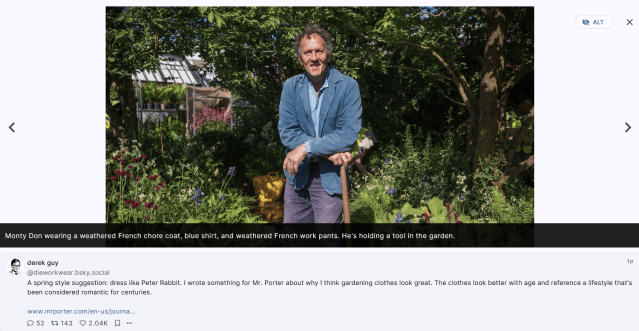
“Back in December 2005, Monty Don, the British horticulturalist and human Peter Rabbit, wrote a delightful little essay for The Guardian on how to dress as a gardener.” (Derek Guy, ‘Why We Dig Gardening Style’ Mr Porter, Fashion)
Writing my almost overdue post about March bulbs flowering now felt like getting blood from a stone and, as a writer and gardener with deadlines that are all self-imposed, I was delighted to be diverted in an unexpected quarter. Monty Don as a human Peter Rabbit, you say. Tell me more.
The alt text to the photo (the bit on the black background that is probably too small to read) says: ‘Monty Don wearing a weathered French chore coat, blue shirt, and weathered French work pants. He is holding a tool in the garden.’
The writer is a US – based master of sartorial elegance and expertise, Derek Guy. This is not a subject of great interest to me in the greater scheme of things but Derek Guy had come to my notice through Bluesky. Social media gets a bad rap these days when, at its best, it can open us up to new ways of looking at things. Having dabbled in and out of Guy’s posts, I have learned things I never knew about quality men’s tailoring and why the Spanish king – I think it is the one from Spain – always looks so beautifully attired while our PM, try as he might, is more like a sack of potatoes in a blue suit jacket without even a hint of Peter Rabbit’s charm. Social media makes my world bigger, as I say.
I was amused by this reply to the original post
Having perused these witty dissertations from both Guy and the Monty Don himself, I am forced to admit that we let the side down badly here. Mark manages the ‘rumpled corduroy trousers’ as long as I can continue to source this item of clothing. They are much scarcer than they were 50 years ago when I first had to shop for them, replaced, I guess, by the unpleasantly named ‘sweatpants’. But there our flirtation with classier garden-wear ends.
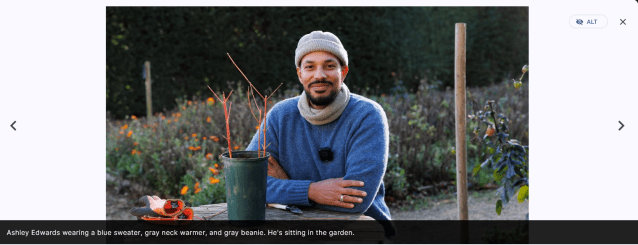
You can tell that Mr Guy is more focused on the clothes than the activity of gardening. His alt text reads: ‘Ashley Edwards wearing a blue sweater, gray neck warmer and gray beanie. He is sitting in the garden.’
I have noticed that English gardeners often adopt a higher standard of dress code. I think that is due to tradition and to the recognition of gardening as a higher level skill and a profession. We have to look to earlier generations where there was some crossover to those who gardened in the far-flung colonies.
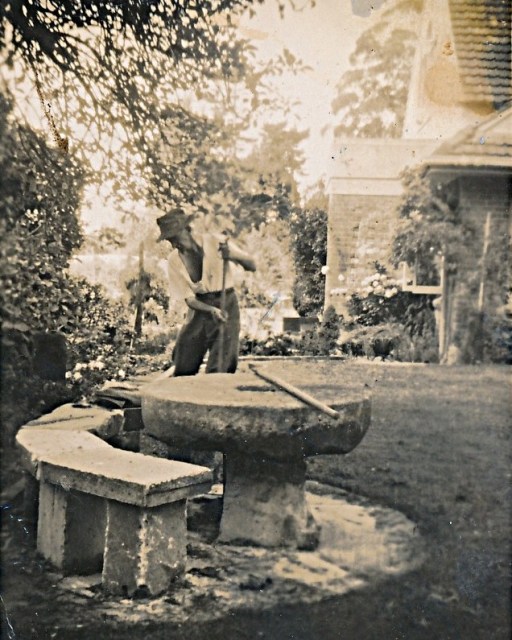
Felix’s garden attire did not change much down the decades beyond the colour of the shirt. Notice the hat. This will have been taken in the mid 1950s
Mark’s dad, Felix, always wore a tweed Trilby hat outdoors and his winter gardening attire included a wool tweed jacket. He always wore shirts – olive green for the garden – and woolen trousers. Very brown and green he was, more leprechaun than Peter Rabbit.
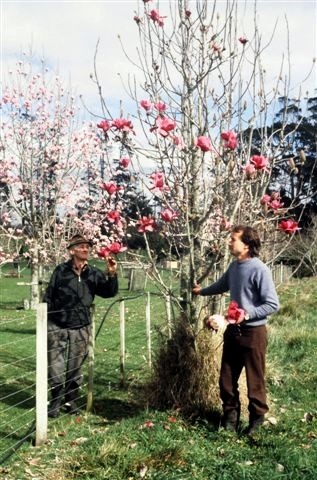
Mark and Felix looking at the original plant of Magnolia Vulcan in the early to mid 1980s. Notice Felix is still in a Trilby hat and woolen trousers. We put his final Trilby in the coffin with him when he died. But notice also, Mark in his rumpled brown corduroy trousers. Should he die before me, I may dress him in a pair of brown cords for his final journey.
Fortunately, women have escaped the scrutiny of both Guy and Don. There is a certain genre of English lady gardeners, photographed tending their gardens while clad in pastoral themed, artful ‘peasant style’ dresses. In my mind, I associate them with growing the dahlias that are so in vogue these days but that may just have been a photo I saw which made me wonder if these charmingly attired women ever did any digging or kneeling in their gardens.
My rule of thumb is that if the clothing is old, comfortable, has pockets, is easily washed and dried and is suited to the weather, it can be considered gardening clothing. Upon occasion, I ask myself, “Would I be embarrassed if an unexpected visitor turned up and saw me wearing this?” If the answer is yes, it is usually a sign that it is time to consign that item to the dustbin of landfill. That is as far as sartorial garden attire goes here. But I do feel a little pang that we have failed dismally to establish any reputation at all for our garden clothes.
The third Guy illustration’s alt text reads ‘Alfie Nickerson in a bright yellow zip-up jacket and blue shorts, along with beaten brown Blundstones. They are carrying flowers and a dog.’ I had to google Alfie Nickerson and I, for one, welcome the new generation of gardeners with their modern style.
I sign off without photo but can offer the alt text: ‘Abbie Jury is wearing a bottle green, stretch cotton, sleeveless dress with deep pockets from the defunct label of Ezibuy and battered woollen Allbird lace-up shoes in beige.’
I said in last week’s post that I would return to Waltham Place and Knepp Castle, along with ‘rewilding’. Both are visited in episode 4 of Monty Don’s British Gardens series.
Waltham Place first because we were fortunate to talk our way into seeing it in person in 2014. It was certainly challenging and interesting and continues to be food for thought a decade later. I have written about it here, but without photographs because one condition of entry was that we not take photographs. Did we like it? Not particularly. We prefer prettier gardens with more focus on plant interest but that was irrelevant then and remains so now.
This is my one and only photo from Waltham Place – taken when we parked the car before our pleasant host specified that the owners did not want photos taken by visitors.
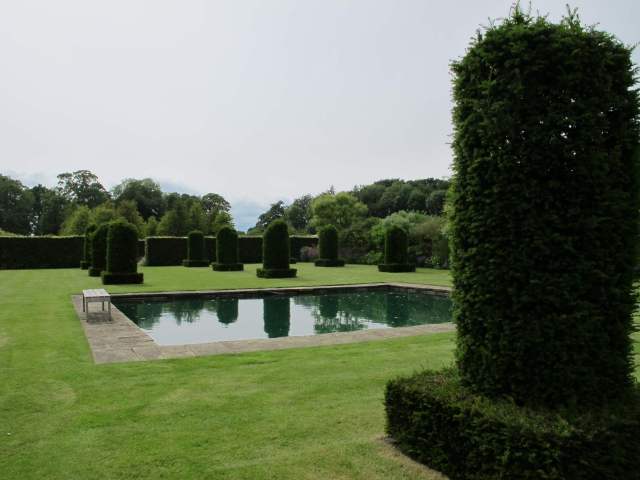
In retrospect, I think it may sit as a side adjunct to the whole genre of conceptual gardens. In a pure form, conceptual gardens are where design, space and integrated art installations – the last being of a symbolic, architectural, intellectual-bordering-on-esoteric nature – take precedence over more traditional garden values. Think Little Sparta or Plaz Metaxu To some extent, I think Belgian designers Jacques and Peter Wirtz belong here too. They are landscape architects and their speciality is treating outdoor space as architecture where form and space are the most important aspects. We have never sought these gardens out because our interests take us in other directions.
Why would I put Waltham Place into this wider genre? Because the concept and philosophy that underpins the garden is arguably more important than what you see. It seemed very much an intellectual exercise. Planted around 2000, it utilised all the existing elements of a traditional, English, Arts and Crafts garden (huge brick pergola, walled garden, gazebo on stilts, ponds, graceful manor house etc) but the plantings are on the wild side with a very light hand indeed on maintenance. The designer was Dutchman, Henk Gerritsen and it adheres closely to the philosophy of his muse from an earlier generation, Mien Ruys: “a wild planting in a strong design”. Dare I say it – the strong design element at Waltham Place means that it photographs and films rather better than the actual experience of visiting in person.
Gerritsen died at a relatively young age in 2007. Had he lived longer, I think it would have been interesting to see how his style evolved further over time because he was a philosopher with a passion for wildflowers as much as a landscape architect. Waltham Place was certainly cutting edge at the start of the new millenium.
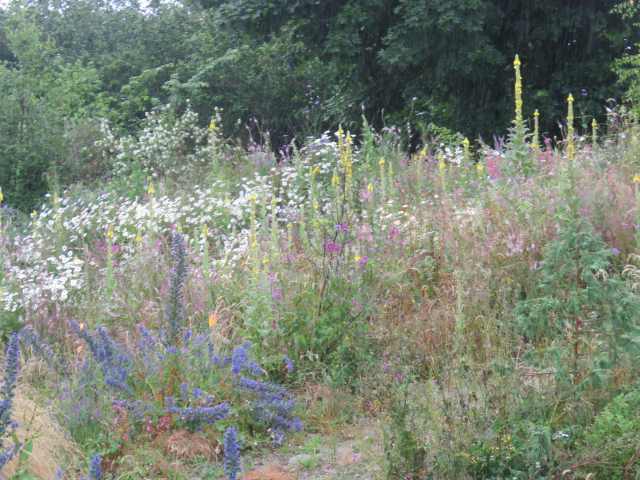
Neither Waltham Place nor Knepp Castle, but a wild-ish scene that charmed me on the day.
Knepp Castle, in the same episode, is very recent – just a few years old, in fact. I haven’t been there but it appears to be the new cutting edge, arousing strong opinions. I have heard it praised to the sky but also savaged as a travesty of a traditional, walled garden.
Walled gardens are not uncommon in Britain. Often encompassing areas that are measured in acres and a lasting monument to brickies of old, they were originally sheltered kitchen gardens, orchards and picking gardens so productive and utilitarian. These days, they are widely repurposed as ornamental gardens. It is quite a leap to change them from being a productive garden in times past to being purely ornamental as at Scampston Hall. Is it such a big leap to then heavily modify the contour and soil to make a naturalistic garden?
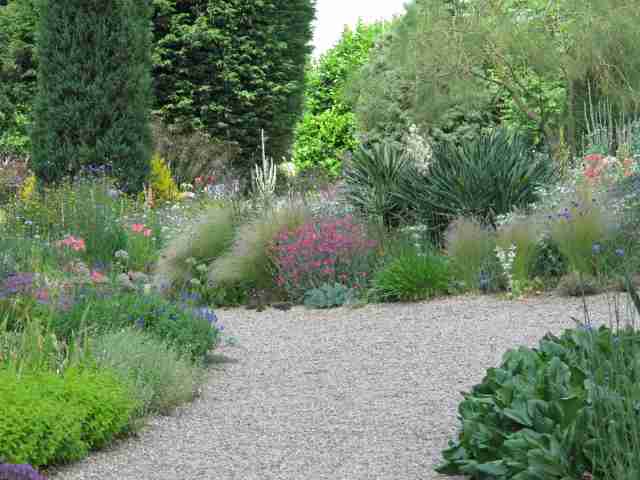
Not Knepp Castle – I have no photos of that location. This is Wildside in the rain and there seem to be strong parallels, albeit on very different budgets.
I was going to say that, to me, Knepp Castle looks like having its roots in Beth Chatto’s dry garden from the 1960s with strong elements of James Hitchmough’s Missouri meadow at Wisley from the mid 2000s, meeting Tom Stuart-Smith’s expansive perennial terraces, some modern European gardens and generous lashings of what Keith Wiley has created at Wildside – but all combined in a project started in 2020. I looked up their website and indeed the designers involved included Stuart-Smith and Hitchmough as well as Jekka McVicar and Mick Crawley whom I had not heard of but is apparently an emeritus professor of plant ecology at Imperial College in London. That is quite the team.
I am with Monty Don. I hesitate use the words rewilding, or even restorative gardening at Knepp Castle, but I love the naturalistic look and the underpinning principles of gardening in cooperation with Nature, not by iron-fisted, human control. But you have to intervene all the time, as the owner said, or it will just be taken over by weeds. My reservations – and, it seems, Monty’s – are about semantics not principles or indeed the end result which is a lovely example of modern naturalism in gardening, rich in plant interest.
To me, rewilding and restoration are more akin to what we know in this country as ‘riparian planting’***. Or maybe planting an area in eco-sourced natives or shutting up an existing area of native plants and then assiduously weeding out invading plants of exotic origin. That is not gardening.
What is being referred to as rewilding or restorative gardening in Britain is what we describe as naturalistic gardening, sometimes veering into wild gardening. Same principles, different words.
I don’t think there is a big difference between what we call our Wild North Garden here and what the Knepp Castle folk call ‘rewilding’
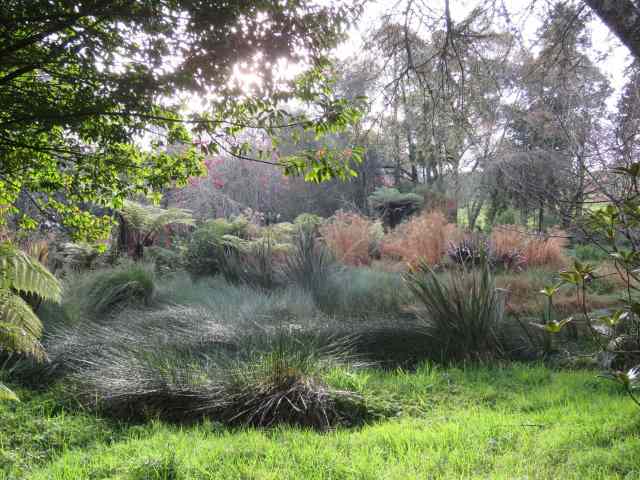
Naturalistic, maybe modern, here at Tikorangi but not what we would describe as rewilding.
It seems to me that the controversial aspect of Knepp Castle lies mostly in the repurposing of a walled garden to carry out this experiment in naturalism. I have only seen it in episode 4 of Monty Don’s British gardens but I have watched that segment three times. I much preferred it to the walled garden (I think in episode 3) which had been planted out in wide rows of perennials as a nod to its more traditional food producing days. That one had all the romance and panache of production nursery stock beds in our eyes (retired nursery people here) with none of the skills and delights of plant combinations, let alone any actual merit in design.
***Riparian planting is being strongly promoted by our regional councils, mandatory in some situations. It is fencing off and planting the banks of waterways, generally in native plants, with the aim of preventing farmland runoff contaminating rivers and streams. In quaint rural parlance, I understand the measure of a waterway that should – or must – be fenced and planted is that it be ‘wider than a stride and deeper than a Redband’. Redband is the brand of gumboots most often worn in farming communities. That is probably what most people in this country would see as rewilding.
Our Wild North Garden again. I liked the layers from this angle.
“What do you think the ingredients of a typical English or British garden are?”
“That is an interesting one. I would say hedges, borders, grass, (something inaudible to a NZ ear) and enough manicuring in some parts that it looks cared for. I think it is that mix of formality, the manicured elements and the wilder, more romantic parts that make the British garden especially British.”
Monty Don in conversation with Chris Crowder, head gardener at Levens Hall in episode two of the TV series ‘British Gardens’.
“Yesss!” I said out loud and went back and replayed it. Not just British gardens – that is a pretty accurate description of how we personally garden in Aotearoa NZ. I would qualify that we don’t do topiary here so much as some heavy clipping but it serves the same end of giving definition and form in the garden. And I would add a high level of plant interest which is another feature of British gardens (and very much so in our own garden). It is perhaps an understandable omission on Chris Crowder’s part, given that he manages a garden that dates back to 1690 (!) and is famed for its topiary.
In brief, Monty Don’s summary of the essence of British gardening seemed to come down to a few key points.
Gregarth Hall, the home and garden of Arabella Lennox-Boyd, was not featured in the TV series. To us, it is a fine example of the quintessential British garden of the late twentieth century built around some splendid architecture from earlier generations.
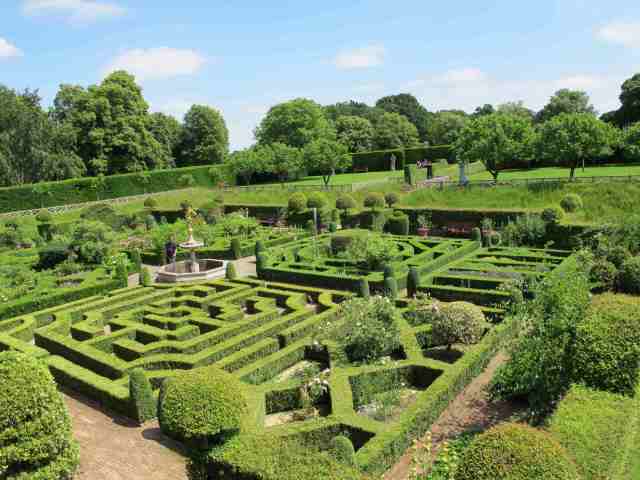
Gresgarth incorporated topiary.
Firstly that British gardening is deeply rooted in eighteenth century landscape design (think Capability Brown and his peers designing grand landscapes for the rich and powerful) and that, to this day, a high value is placed on that long history. Many British gardens have wonderful, historic architecture features – be they massive walls from old walled gardens, ruins, follies, pretty manor houses or even castles.
Those early funders also supported plant hunters combing the world for new plants which were welcomed with delight back in their homeland in a rarified pursuit of competition and one-upmanship. To this day, British gardening is a celebration of the ability to grow a huge range of different plants collected from around the globe and plant range is a defining feature. I remember quipping after my first trip to Italy – a magnolia conference tour – that they basically gardened with the same ten plants but that is not true of British gardens, or indeed New Zealand ones.
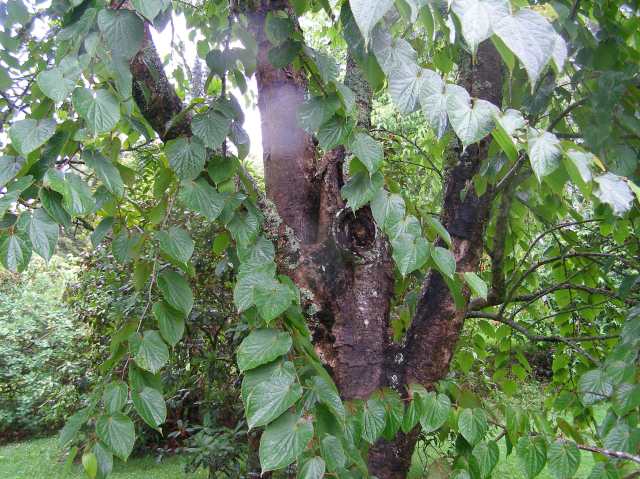
British botanists kept up the tradition of plant collecting. The Tetracentron sinensis in our park dates back to Frank Kingdon-Ward who financed some of his expeditions by subscription. Felix Jury paid in advance to receive seed back in the 1950s. We could have done without the rhus but the tetracentron is a fine tree.
Secondly, climate. In global terms, Britain generally enjoys a moderately temperate climate and there is no doubt that it is easier to garden in a climate without extremes. I don’t think their climate is quite as good as some of the people in the programme asserted but I would say that, as a New Zealander.
Thirdly, Monty Don talked about his homeland as a place where people ‘learn the language from an early age’. I think it is a bit more complex than that. What I see is a place where gardening has been both professionalised and institutionalised over a long period of time, which has given leadership and placed a value on it which is often lacking in other countries. Gardening, not just the broader notion of horticulture, is a respected profession. There is an established career path and high-quality training. Added to that, there is considerable support from institutions like Kew, The Royal Horticulture Society with their major gardens and in the media. BBC Gardeners’ World has been running since 1968 on primetime television, for goodness sake, and still has a loyal following. There is quite the collection of other TV garden programmes, both good and execrable, and garden celebrities who are actually celebrated, as opposed to just being recognisable. The vast majority of domestic gardening is done by amateurs but there is institutional knowledge to underpin much of that, and a strongly educative side.
In this country we haven’t had a proper TV garden programme for over two decades. That is despite census data regularly showing that gardening is one of the most popular leisure pursuits. I have long figured that nobody in the TV programme commissioning area has understood this simple fact, nor have they seen past the dated formula of instant garden makeovers.
Britain is a densely populated country with much more restricted personal space. This means that large numbers of people want to get out and about in their leisure time. With gardening so embedded in the national psyche, that often includes garden visiting and the level of visitor numbers supports both public and private gardens.
Hatfield House – again not in the Monty Don series – but an example of the style emulated by some aspirational NZ gardeners.
In Aotearoa NZ, we have taken on some of the same gardening values, although our colonial interpretation of British garden design is more Arts and Crafts (garden rooms) than 17th century pastoral landscape. With our benign climate, we certainly place a high value on growing a wide range of plants and having an attractive home garden – albeit quite a few want it to be both attractive and low maintenance. With a small population and overall low density of housing, the majority of people have private outdoor space. So yes, we do garden a lot. But overall, we lack that professional and institutional backbone of British gardening.
Great Dixter, the garden of the late Christopher Lloyd, is given credit for its significant contribution to gardening directions in recent decades in Britain.
Similarly, Beth Chatto is accorded a major place in the history of British gardening. She was pioneering sustainability long before we were even aware of climate change.
It was interesting to hear discussion on the impacts of climate change threaded throughout all the episodes. Many gardeners and Don himself referenced it as they discussed the gardens and future considerations. All I can say is that I am not seeing that sort of discussion in this country where the prevailing views seem to be either a loud ‘harrumph’ of denial or, at best, issues of climate change are pushed out to the margins as not being a relevant issue at a personal or local level. We have not normalised it as a factor in planning for the immediate – or even distant – future. We may be in for a shock as we continue to treat extreme weather events as one-offs rather than part of a larger pattern which is set to get considerably more extreme in a shorter space of time than originally thought.
Allotments – this one in suburban London. It is not from the TV programme but Mark and I often wandered allotments on our travels. These have a long history and are basically areas divided into small plots which are leased to individuals at a low annual rent, predominantly – but not exclusively – to grow food on a non-commercial basis. Their continued popularity is testament to the drive to grow gardens even in densely populated areas where people do not have personal space around their home.
Facebook showed me a post by Gardens Illustrated on one of our most favourite gardens, Wildside and I read the comments. “Lovely series but it would be nice to see some ‘normal’ gardens”. Reader, what is a ‘normal garden’? The series gave considerable attention to both the wonderful British phenomenon of allotments as well as community gardens, alongside a potted history of the evolution of gardening down the past 450 years, touching on the most innovative recent developments.
I suspect a ‘normal garden’ equals ‘a garden like mine’ to that Facebook commenter.
“Rewilding” will have to wait. I will return to Knepp Castle and Waltham Place and the questions they raise in the future.
When we saw advance publicity on Monty Don’s new ‘British Gardens’ TV series, we wondered how long we would have to wait to see it here. We are old, you see, so it took our younger gardener Zach to alert us to the fact that it is readily available online. We watched it on You Tube (just go to their home page and type in Monty Don) but it is probably available on other streaming services too. It is worth watching.
We visited Upton Grey Manor in 2009. Featured in episode 4, it has been meticulously restored by the owner to its original Gertude Jekyll plan and is now kept frozen tin time.
Love him or not, Monty Don knows his stuff and this is not just a happy jaunt around various gardens – sixty of them, I believe, in an attempt to define what characterises British gardens. That comes to about twelve gardens per hour of TV time so some are once over lightly but Monty’s thoughtful commentary and analysis is what knits it all together. I imagine there is fierce debate over his selection of gardens in UK gardening communities but all I want to say on that is that out of sixty gardens, there were only two that made us raise our eyebrows and wonder at their inclusion.
We have a great deal of respect for the English gardening tradition. The standards set there are high, due in no small part to the fact that gardening and working with plants is a respected profession with high skill levels. I did a cursory trawl through the memory banks and photo files and was a bit surprised to find that on our trips, we have seen more than seventy gardens in Britain, both great and small, so we are not inexperienced. We had been to quite a number that Monty Don included in his five part series which added to our viewing interest.
Scampston Hall (episode 2) gets extensive coverage. The Oudolf planting of perennials was the best of it to our eyes when we visited in 2014.
Still at Scampston. *Conceptual gardens* are not my cup of tea but we all like different things and there are a few examples of the genre covered in the series.
He started in the north, in Scotland and Northumberland which is an area that is unfamiliar to us. The only times I have been to Scotland were before I started gardening. But the gardens in the far north with low winter light levels and exposed to North Sea storms are very different to our gardening experience. Starting a garden there might be akin to starting a garden on Chatham Island – not for the faint-hearted.
Tom Stuart Smith’s planting at Trentham Gardens which are not included in the series, although Tom Stuart Smith is.
Episode two was somewhat poignant for us. In the north of England with a foray over to Northern Ireland, it was more familiar territory. We had another trip planned in 2020 which had to be cancelled due to Covid and that included some of the gardens in this episode – Lowther Castle, Levens Hall, Nigel Dunnett’s private garden and Chatsworth. I wish we had managed to get to see them in person but there comes a point in life when realism means accepting things that will not happen after all. Other highlights of this episode include a local competitive gooseberry show – British eccentricity at its very best – and landscape architect Tom Stuart-Smith talking with Monty Don at Chatsworth. When I had Chatsworth on our list of places to visit, it was primarily to see the area designed and executed by Dan Pearson. I didn’t even know that there were major new borders that are the work of Tom Stuart Smith so that would have been a bonus.
Bressingham in episode 3 is credited with pioneering island beds. Also, maybe, the origin of what we refer to as ‘kiwi hosepipe style’ here, in a case of what might be renaming by cultural appropriation.
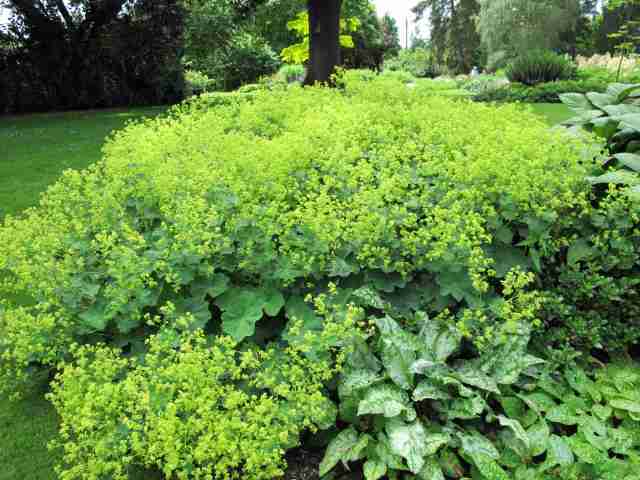
Bressingham had the best Alchemilla mollis I have seen. It never looks quite like that here.
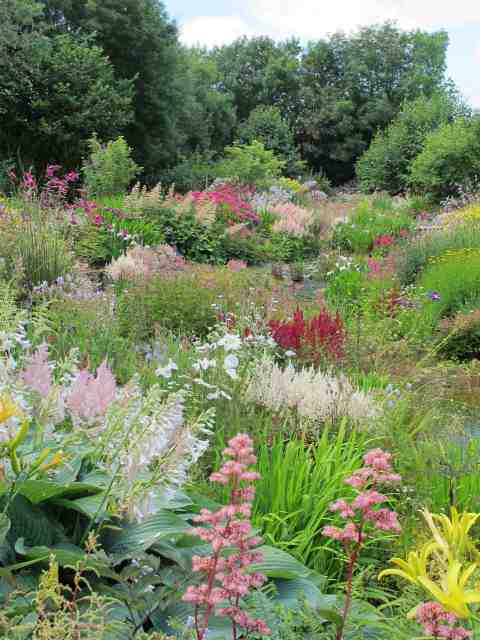
Episode three covers the area from Wales to Norfolk, four is in London and the Home Counties and five is in south. There were quite a few gardens we had been to and we were waiting with anticipation for Monty Don’s visit to Wildside, one of our most favourite gardens of all. The interview between Don and Keith Wiley was fine, as were Don’s interpretative comments. The timing of the visit was not. Wildside is predominantly perennials full of flowers, colour and interesting plant combinations but on screen it just looked, well, green. Mark’s comment was “Could they have picked a time to visit when there was less colour in the garden?”
Wildside without the flowers is not quite the same.
There is enough meat in this series to make us want to view it a second time. I think I am coming to a slightly different conclusion as to what sets British gardening apart but that will have to wait until after the second viewing. Also thoughts on what the Brits are calling ‘rewilding’, what makes a garden film or photograph well as opposed to being in the garden in person and how much they are talking about the impact of climate change which many people are resolutely ignoring in this country.
I am still wondering about the gooseberry show where the top award went to the heaviest gooseberry. What I want to know is how they guarded against cheating. Is it possible to increase the weight of one’s show gooseberry by nefarious means, maybe injecting the fruit with additional water just before tabling it at the show? This may remain one of life’s little mysteries.
Mark coined a new word for our gardening lexicon – to monty, a verb meaning to fluff around in one’s own garden with more pleasure than urgency. I do a lot of montying.
British gardeners will recognise instantly that this is a tribute to Monty Don, the lead presenter of BBC’s long-running Gardeners’ World. Sure we are watching the 2013 series on NZ television (Choice TV, Fridays at 10pm) but eventually we may catch up? Unlikely. It took us a while to warm to Monty who is quintessentially British. We felt very sorry for poor Toby Buckland, the previous lead host, when he was axed. Toby had earned our respect with the depth of his knowledge and his ability to convey sound information in an unhurried manner. But it appears he lacked the class craved by the audience and, we must admit, the episode involving peeing on your compost heap may have been a step too far. Now we have settled into the groove of watching Monty who so clearly enjoys pottering around in his own garden called Longmeadow, and he is backed up by very capable and knowledgeable co-presenters from around the country. It is light years ahead of any home-grown gardening programmes here. Sure vegetable growing features, but so does aspirational, higher level gardening that is concerned with aesthetics, the environment, interesting plants and design. And Monty is a dedicated organic gardener.
While there is a great deal of critiquing that goes on about Gardeners’ World in the UK and on social media, I just think the Brits do not know how lucky they are. The running commentary on each programme (the 2015 series has just finished) often appears on my Twitter feed under #shoutyhalfhour. It was here I picked up the very funny series of tweets about Monty’s recent attire. My prize for the best tweet went to @milominder: “Monty Don wardrobe update: nonchalant actor in relaxed interval mode at a production of The Three Musketeers”. Monty’s dog Nigel is also a huge hit.
But the viewer who tweeted: “I like Monty Don but with my small garden most items from his vast plot just do not translate. Time for a change?” should consider moving to New Zealand where our only TV gardening is aimed at the lowest common denominator, pretty much lacking in anything of interest to more experienced gardeners.
In fact, I could suggest that we have the Tui Garden infomercial vs the Yates Garden infomercial. How many of the sponsors’ products can be worked into each short segment? The focus morphs into an exercise where the selling of branded product to a gullible public with deep purses takes precedence over fostering good gardening.
I don’t blame the presenters at all. I have met both Lynda Hallinan and Tony Murrell and have a great deal of respect for them. Both are genuinely keen, knowledgeable, experienced and professional. I would love to see them given the freedom to generate quality content that goes beyond that most basic level and using the sponsors’ branded products.
I blame the producers who have kowtowed to horticultural supply merchants, apparently with unsophisticated marketing staff who think endless repetition of the company name and hawking of often unnecessary product will increase their sales and profile. It makes me flick the channel switch to escape.
Tui is arguably the worst of the two. Kiwi Living on Friday evening on TV1 is quite an engaging lifestyle programme. The fashion makeovers, food and architecture sections are interesting. So too is the interior design, even if it is not to my personal taste. The continuity scenes with the hosts, sitting chatting on the couches, are not too embarrassing or forced. And then there is the Tui Gardening Infomercial, masquerading as the garden segment. In case you miss the Tui product when it is mentioned, it is also flashed up on the screen for you to see. So too with the Yates products on the Get Growing Roadshow, but they also work on prominent product placement in the filming and they have a wider portfolio of sponsors to serve.
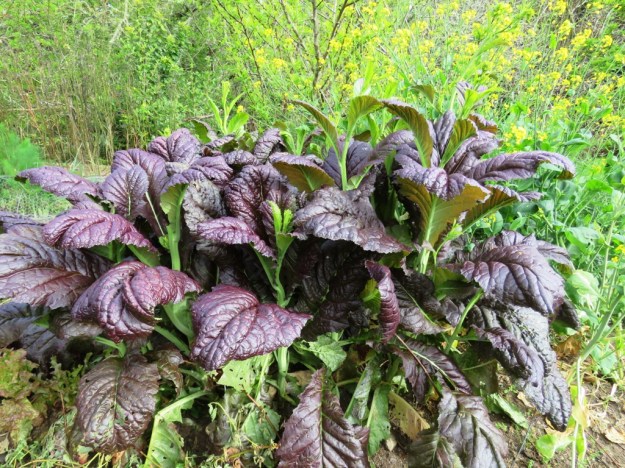
Mustard, in lieu of kale here
We gardeners deserve better and these presenters could certainly give us better if the shackles of the sponsors were loosened. There are folk who garden outside Auckland, who are not absolute beginners under the age of 40 and who do not wish to grow tomatoes, basil or kale.
You don’t see Monty Don and his team of highly professional presenters forever promoting the sponsors’ products. I like the gentle pace of BBC Gardeners’ World. It suits my montyesque gardening style.









 Tikorangi The Jury Garden