Tag Archives: naturalistic gardening

Pushing the boundaries

I said in last week’s post that I would return to Waltham Place and Knepp Castle, along with ‘rewilding’. Both are visited in episode 4 of Monty Don’s British Gardens series.

Waltham Place first because we were fortunate to talk our way into seeing it in person in 2014. It was certainly challenging and interesting and continues to be food for thought a decade later. I have written about it here, but without photographs because one condition of entry was that we not take photographs. Did we like it? Not particularly. We prefer prettier gardens with more focus on plant interest but that was irrelevant then and remains so now.
This is my one and only photo from Waltham Place – taken when we parked the car before our pleasant host specified that the owners did not want photos taken by visitors.

In retrospect, I think it may sit as a side adjunct to the whole genre of conceptual gardens. In a pure form, conceptual gardens are where design, space and integrated art installations – the last being of a symbolic, architectural, intellectual-bordering-on-esoteric nature – take precedence over more traditional garden values. Think Little Sparta or Plaz Metaxu To some extent, I think Belgian designers Jacques and Peter Wirtz belong here too. They are landscape architects and their speciality is treating outdoor space as architecture where form and space are the most important aspects. We have never sought these gardens out because our interests take us in other directions.

Why would I put Waltham Place into this wider genre? Because the concept and philosophy that underpins the garden is arguably more important than what you see. It seemed very much an intellectual exercise.  Planted around 2000, it utilised all the existing elements of a traditional, English, Arts and Crafts garden (huge brick pergola, walled garden, gazebo on stilts, ponds, graceful manor house etc) but the plantings are on the wild side with a very light hand indeed on maintenance. The designer was Dutchman, Henk Gerritsen and it adheres closely to the philosophy of his muse from an earlier generation, Mien Ruys: “a wild planting in a strong design”. Dare I say it – the strong design element at Waltham Place means that it photographs and films rather better than the actual experience of visiting in person.

Gerritsen died at a relatively young age in 2007. Had he lived longer, I think it would have been interesting to see how his style evolved further over time because he was a philosopher with a passion for wildflowers as much as a landscape architect.  Waltham Place was certainly cutting edge at the start of the new millenium.
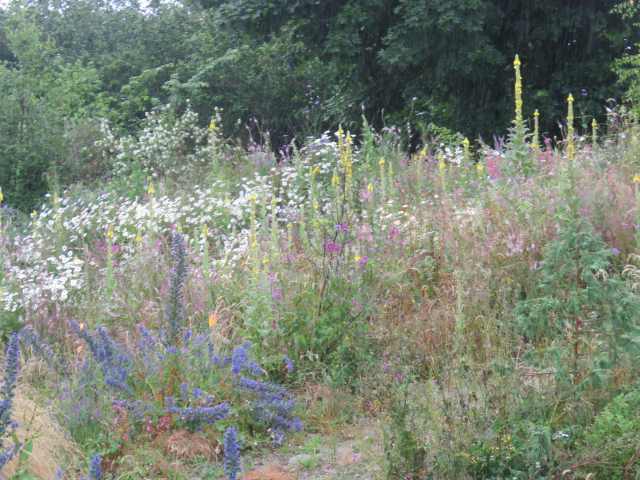
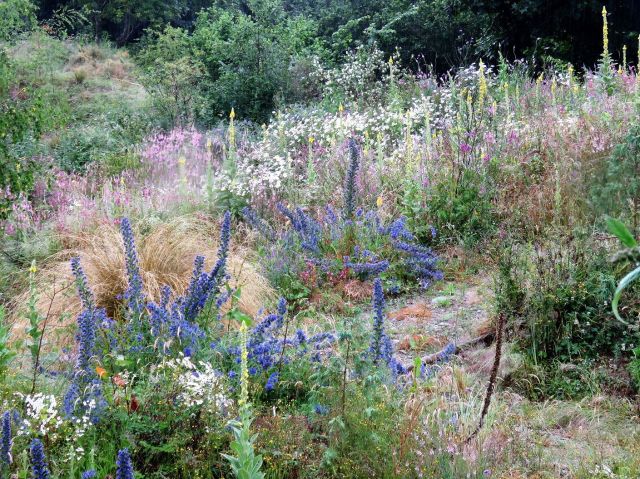
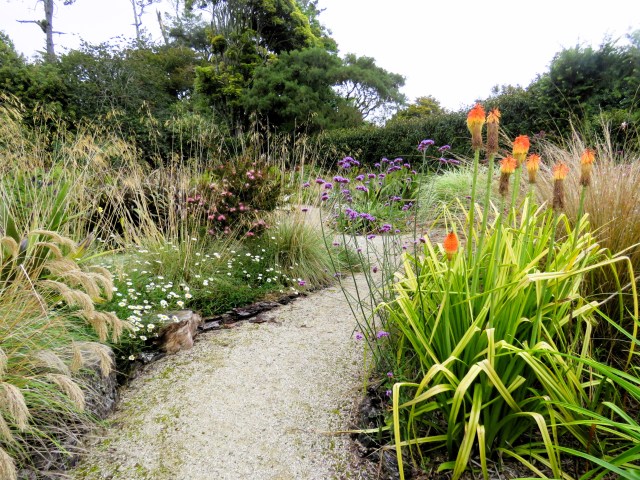
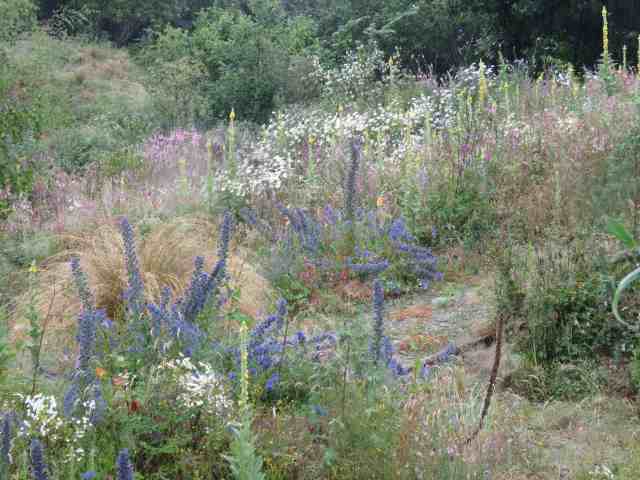
Neither Waltham Place nor Knepp Castle, but a wild-ish scene that charmed me on the day.

Knepp Castle, in the same episode, is very recent – just a few years old, in fact. I haven’t been there but it appears to be the new cutting edge, arousing strong opinions. I have heard it praised to the sky but also savaged as a travesty of a traditional, walled garden.

Walled gardens are not uncommon in Britain. Often encompassing areas that are measured in acres and a lasting monument to brickies of old, they were originally sheltered kitchen gardens, orchards and picking gardens so productive and utilitarian. These days, they are widely repurposed as ornamental gardens. It is quite a leap to change them from being a productive garden in times past to being purely ornamental as at Scampston Hall. Is it such a big leap to then heavily modify the contour and soil to make a naturalistic garden?
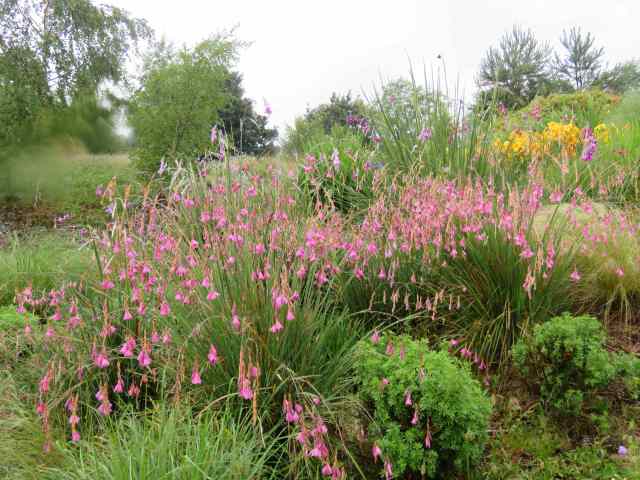
Not Knepp Castle – I have no photos of that location. This is Wildside in the rain and there seem to be strong parallels, albeit on very different budgets.

I was going to say that, to me, Knepp Castle looks like having its roots in Beth Chatto’s dry garden from the 1960s with strong elements of James Hitchmough’s Missouri meadow at Wisley from the mid 2000s, meeting Tom Stuart-Smith’s expansive perennial terraces, some modern European gardens and generous lashings of what Keith Wiley has created at Wildside – but all combined in a project started in 2020. I looked up their website and indeed the designers involved included Stuart-Smith and Hitchmough as well as Jekka McVicar and Mick Crawley whom I had not heard of but is apparently an emeritus professor of plant ecology at Imperial College in London. That is quite the team.

I am with Monty Don. I hesitate use the words rewilding, or even restorative gardening at Knepp Castle, but I love the naturalistic look and the underpinning principles of gardening in cooperation with Nature, not by iron-fisted, human control. But you have to intervene all the time, as the owner said, or it will just be taken over by weeds. My reservations – and, it seems, Monty’s – are about semantics not principles or indeed the end result which is a lovely example of modern naturalism in gardening, rich in plant interest.

To me, rewilding and restoration are more akin to what we know in this country as ‘riparian planting’***. Or maybe planting an area in eco-sourced natives or shutting up an existing area of native plants and then assiduously weeding out invading plants of exotic origin. That is not gardening.

What is being referred to as rewilding or restorative gardening in Britain is what we describe as naturalistic gardening, sometimes veering into wild gardening. Same principles, different words.
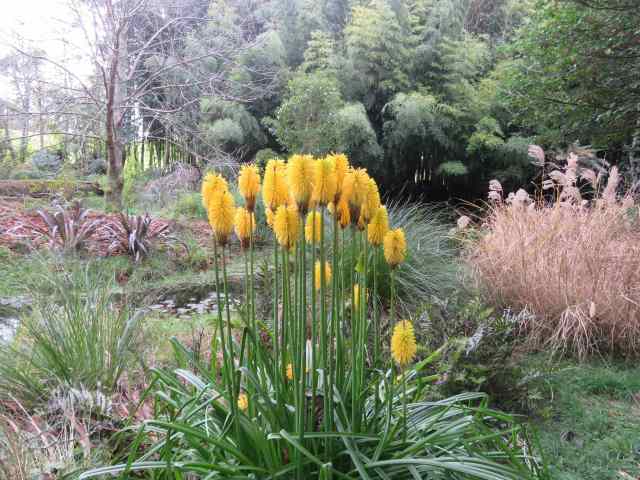
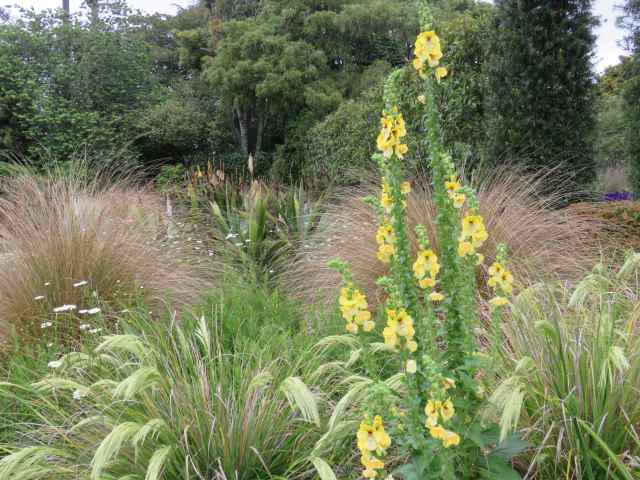
I don’t think there is a big difference between what we call our Wild North Garden here and what the Knepp Castle folk call ‘rewilding’
Naturalistic, maybe modern, here at Tikorangi but not what we would describe as rewilding.

It seems to me that the controversial aspect of Knepp Castle lies mostly in the repurposing of a walled garden to carry out this experiment in naturalism. I have only seen it in episode 4 of Monty Don’s British gardens but I have watched that segment three times. I much preferred it to the walled garden (I think in episode 3) which had been planted out in wide rows of perennials as a nod to its more traditional food producing days. That one had all the romance and panache of production nursery stock beds in our eyes (retired nursery people here) with none of the skills and delights of plant combinations, let alone any actual merit in design.

I would put Knepp Castle on my visiting list, were I planning another trip to Britain, even though I struggle with the idea of thinking like a beaver or a wild boar when it comes to garden maintenance.

***Riparian planting is being strongly promoted by our regional councils, mandatory in some situations. It is fencing off and planting the banks of waterways, generally in native plants, with the aim of preventing farmland runoff contaminating rivers and streams. In quaint rural parlance, I understand the measure of a waterway that should – or must – be fenced and planted is that it be ‘wider than a stride and deeper than a Redband’. Redband is the brand of gumboots most often worn in farming communities. That is probably what most people in this country would see as rewilding.
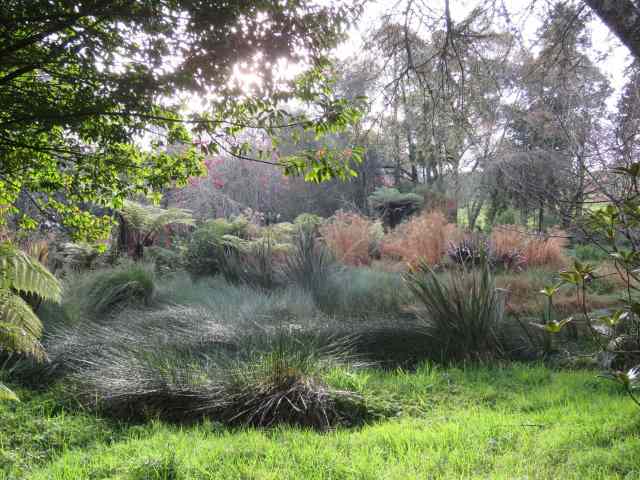
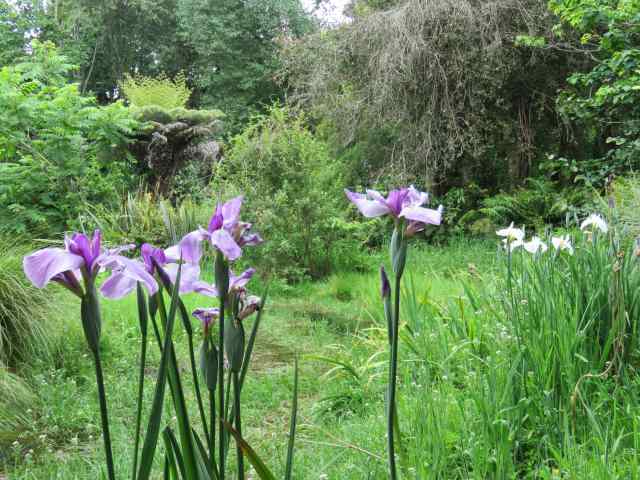
Our Wild North Garden again. I liked the layers from this angle.

The marriage of sustainable gardening with biodiversity

Our Wild North Garden – an experiment in a much looser style of gardening

Following on from yesterday’s post considering sustainability in gardens, a new book out of the UK take the issues of sustainability and reducing negative environmental impacts to a far more holistic view. I admit I have not yet read ‘Pastoral Gardens’ by Clare Foster with photographs by Andrew Montgomery. I am not sure it is in this country yet. I am working from the interview with her on Dig Delve, the site of Dan Pearson – an English garden designer whose work we greatly admire.

I am not sure that the term ‘pastoral gardens’ will ever catch on in this country. While the word ‘pastoral’ is evocative in England with its connotations of bucolic nostalgia, here it is more likely to be associated with ‘pasture’ which immediately summons up the mental image of intensive dairy farming. I prefer the term the ‘New Naturalism’ or even our shorthand of ‘wild gardening’.

Nigel Dunnet’s garden at the Barbican is included in the book but I hesitate over the inclusion of this Central London garden under the descriptor of a ‘pastoral garden’. It is a wonderful example, however, of a naturalistic-styled garden in a challenging environment.

What comes through very strongly in the interview, and presumably the book, is the embrace of gardening styles that work with Nature, that prioritise biodiversity and garden practices that enhance the natural environment. It is still gardening and still focused on aesthetics, but not at the cost of damaging the environment. The author won me with this quote:

“Another uniting factor for all these gardens is their need to be gardened. So many people think that wildlife-friendly gardens are relaxed, neglected spaces, that can be left to their own devices. This is certainly not the case with the gardens we showcase in this book. The role of the gardener is almost more important than ever in overseeing, managing and editing each planting scheme, ensuring that diversity is maintained, rather than one or two species taking over.”

We saw this deterioration happen over time in in the Missouri Meadow Garden at Wisley where a dominant aster had swamped out large parts of the meadow.The role of the gardeners had fallen well short on maintaining this area and I assume it had to do with the fact it needed to be monitored and maintained in a very different way to more traditional perennial plantings and they had yet to learn those skills.

Wildside, Keith Wiley’s garden in Devon, was a revelation to us in terms of complex biodiversity and still stands in our memory as one of the most exciting gardens we have visited. It is not in the book, though.

I think the author is dancing on a pin head when she attempts to differentiate current trends in naturalistic gardening from the earlier work by Irish gardener, William Robinson of Gravetye Manor in the 1880s and the more recent New Perennials movement. I may be doing her an injustice but I think she is saying that ‘pastoral gardens’ are basically the new naturalism but sitting on the higher moral ground of biodiversity. I see the difference as more linguistic. The term biodiversity is an amalgam of biological & diversity and was first coined in 1968 but didn’t enter common usage until the 1980s. Robinson didn’t have the same language to draw on but that doesn’t mean that his gardening in harmony with nature is any less for that. The loss of biodiversity, the impact of climate change and questioning of many current garden norms which run counter to the natural environment combine to give considerable urgency to the matter, but it is not necessarily new.

We grow good hostas without needing to lay slug bait or add fertiliser

We have never done any scientific study to determine the changes to our immediate garden environment when we consciously switched to more sustainable practices. That would, I am guessing, involve analysing small sections across the property, maybe 10cm squares, maybe metre squares, starting before we changed our practices and then at various points along the way. Counting the number of different insects, fungi, bacteria, animals, plant species and analysing the soil profile could prove the case. We rely on anecdotal evidence. We never use slug bait but our hostas are largely clean and lush which would suggest that we have a very healthy bird population which keeps the slugs and snails in check and indeed, we see a great deal of bird activity all the time here. But we have never taken a census of the bird population or done any comparisons. Observation tells us that it is a healthier environment but that is not scientific proof so I am somewhat cautious about making sweeping environmental claims for how we garden.

When we changed the management of the grass in our park to go with a Taranaki version of a meadow, we were not at all sure how others would react. It was even more the case when we opened the Wild North Garden which is several steps further on the naturalistic, wild gardening spectrum. When you open your garden to the public, you also open yourself to being judged. It was heartening to see an overwhelmingly positive response. It may be that the visitors who dismissed it as lazy or unkempt were too polite to say so but if that is the case, they didn’t question us or express their dislike. Most visitors visibly breathed out, relaxed and often responded to the casual environment with emotion rather than detached observation. These days, we don’t open any longer so we don’t feel at all sensitive to judgement of our garden but I have thought about it recently. In a country which places a high value on immaculate maintenance and overall tidiness in open gardens, why did visitors respond so positively to large areas which were anything but?

A marked contrast between the house gardens and the looser management in the park and the wild garden
Our Wild North Garden again

I think it is likely the contrast in our garden. We always maintain the house gardens – the area of close to two acres on the flat around the house which includes the summer gardens, the rockery, the Rimu Walk and the Avenue Gardens – to a weed-free, tidy state with areas that are quite sharply defined. The switch to the loose style of the park and the Wild North is very different and it is that contrast that makes it appear by design, not laissez faire management.

A Dan Pearson designed garden in the Cotswolds that we were lucky to visit. Formalised blocks of meadow beneath apple trees on the edge of of an otherwise tightly maintained garden.

There is a lesson there that can be applied to those gardening on a smaller scale. The juxtaposition of some formality and form with more naturalistic, wilder plantings can pull it all together. It is what Dan Pearson does really well, if you scroll through to the photos of the garden he designed and planted at Little Dartmouth Farm. You can start small. We have experimented with letting our front lawn grow and flower over summer but giving it form by mowing a double width around the edge and paths on our main walking tracks across the lawn. It is not an option if your priority is an immaculate monoculture of a lawn that resembles a green velvet sward but we long ago abandoned that approach as a crime against nature.

I would suggest that if you are starting this particular journey and struggling to reconcile it with the traditional values of tidiness and visibly tight maintenance,  you may find it easier if you keep the gardens closest to the house in a controlled, tidy state but start loosening that iron grip as you move further away. It creates a transition that seems to make sense to the logical parts of our brains.

It is fine to start small; it is recognising the need to change many of the ways we garden that is the very first step.  Clare Foster’s book promises to show just how successful it can be to take a much more expansive view and to integrate concerns about sustainability, biodiversity and the longer term environment alongside placing a high value on aesthetics.

When I have written about working with Nature rather than gardening by controlling Nature, about gardens that sit within the landscape rather than on the land, about gardens that are immersive and not just pictorial,  I think they are just variations on the topic that Clare Foster has grouped under her term of pastoral gardens. It is the same ground that I traversed with Australian gardener, Michael McCoy and it comes through repeatedly in his social media posts.

No matter the words and terms we use, I think we are all singing from the same song sheet and it is reassuring to find that the directions we have chosen in our little corner of Tikorangi are part of a wider international trend of questioning how we garden, what we value and how we can garden more positively to support an environment that gets more degraded and threatened every day.

Soft-edged romanticism at Wildside in an area on the margins of more intensively gardened areas

For New Zealand readers: I went to order the book on line but blenched when it was going to cost as much for postage as the book. I can cope with £55 for the book but £54.95 for postage was an additional cost I will need to ponder further.

Seamless transitions – doing away with garden edgings

Beth Chatto’s dry garden in the UK was a revelation for us and, to this day, we see it as a major influence in the whole shift of direction with the New Perennials or New Naturalism movement that is more commonly attributed to Piet Oudolf.

Beth Chatto’s dry garden

Beth Chatto was planting on an old riverbed in an extremely low rainfall area and she wanted a garden that did not rely on any irrigation at all. Clearly this bears no relationship to our conditions. We never irrigate because we don’t have to; we never suffer from low rainfall. But it is the absence of garden edgings I want to draw attention to.

I don’t for one minute think that they have to do as much maintenance on their perennials in these testing conditions in Beth Chatto’s garden. We would be digging through that mulch and bringing up the soil from below all year round.

Garden edgings are basically about containing the garden and giving definition. To do away with them altogether completely changes the look and makes it far more natural in appearance – albeit while not being natural at all. I really like the look and debated about it when we were putting in the Court Garden but decided not to for practical reasons.

The Chatto garden again

It came back to mind recently, firstly with the visit of Australian, Michael McCoy and then looking at some of Penny Zino’s photographs of her summer gardens in North Canterbury. I don’t have permission to use their photos here  but you can find them both on Facebook where they post photos able to be viewed by anyone or go to their own sites – https://www.flaxmeregarden.co.nz/gallery for Penny Zino and https://thegardenist.com.au/ for Michael McCoy. I am not an Instagram user but Michael is active on that forum too as @michaelmccoyongardens. If you browse their photos, you will find examples of these seamless transitions – paths meandering through plantings in the Chatto style and very charming it is, to my eyes at least.

We used a fine, cream coloured grit that compacts well throughout the summer gardens

All of us appear to have chosen the same path surface in fine, cream grit and that, in itself, gives definition and lightness. Our grit is 50% crushed limestone and 50% crushed shell, bought from a local supplier of gravels and rocks. Beth Chatto used a mulch around the plants that is the same colour as the path grit but pebble-sized so it looks the same at first glance but it is in fact easier to rake to the side when digging is required. I didn’t notice that at the time but it is clear in my photo records. Not having seen their gardens except in photos, I don’t know whether Zino and McCoy have also carpeted their entire area in the same as mulch or whether they just allow the paths to peter out into leaf litter and soil as it goes further into the plantings.

I chose to go with an edging in the Court Garden for reasons that were entirely related to ease of maintenance but we chose an informal edge in lengths of pine bark from on site

It made me reflect on why it is not a practical option for us and why I decided against it. There are several reasons – climate, the presence of large trees, plant selection and maintenance. I think it is a dry garden technique and we are anything but. If the path surface extends through the garden as mulch, it looks best if there isn’t a whole lot of leaf litter and debris on the surface. With the number of large trees we have and being in a windy climate, we have falling leaves and debris all year round. Keeping the cream-coloured paths clear is a big enough job for us, without having to leaf rake or blow all the garden surface too.

Added to that, in our soft climate, we have rampant growth and managing perennials means constant cutting back, digging and dividing, restricting and deadheading to prevent too many self-sown seedlings. Plant selection becomes critical if you want that seamless look because every time you dig a plant, you disturb the mulch and make a mess. When set in cream grit mulch, it would be easier from the start to choose plants that grow from a central stem – lavender, euphorbias, roses, and salvias come to mind. Plants that form rosettes or spread beneath the ground – like perennial lobelias, alstromerias, asters, echinaceas, rudbeckias – all need regular attention to restrict spread or to keep healthy by dividing. I want to grow all these, too.
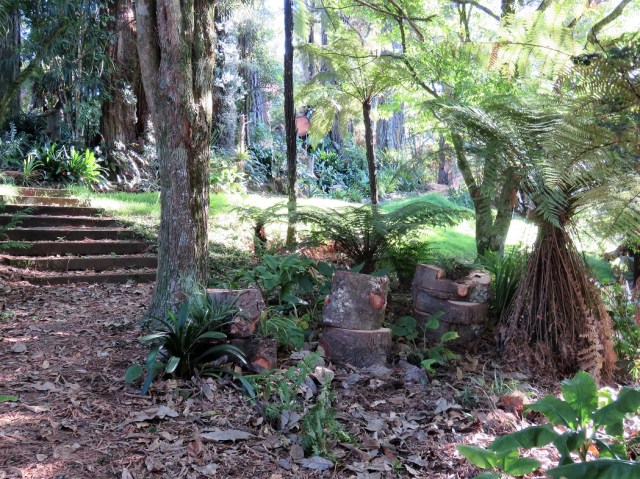
It is why we favour composted wood chip mulch. It is easy to top up at the end, cheap to use and, when weathered and composted, it just adds natural humus to the soil. It is best to source a woodchip that isn’t too coarse. Some mulching machines make a big chunky chip which takes much longer to weather and is not attractive to my eyes. Our friendly, local arborist (he lives up our road) provides a good grade of chip which soon becomes anonymous in appearance.  When I cut back or deadhead, I often snip the pieces to smaller sizes and leave them in situ to break down naturally. If I had decorative mulch, I couldn’t do that. 

Ralph tones in particularly well with the grassland

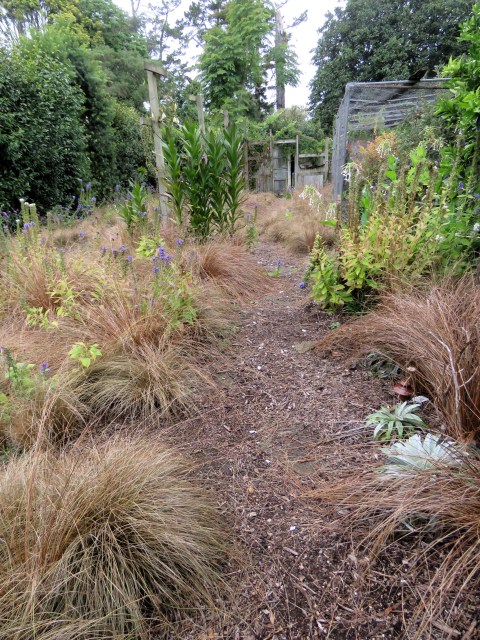
Our compromise was to go for that seamless look and meandering paths in the area we now loosely refer to as ‘the grassland’. It is a transitional filler space, primarily using just two native brown grasses, Carex buchananii and Carex coman’s ‘Bronze’ along with a fair swag of interlopers (‘volunteers’ as we call plants that just arrive of their own accord), residual survivors from its earlier uses and bulbs I have added for seasonal interest. So, a limited plant palette overall and most of the maintenance is pulling out seedlings (particularly of the carex) and a bit of occasional grooming of the grasses. It is not carpeted in cream grit but in woodchip – paths and mulch. It is a lower-key look that lacks the contrast and lightness given by the cream grit but it is a long-term, sustainable option in our conditions.

Seamless in woodchip

What makes a garden? The wild garden debate.

‘Wild’ gardening may be all the rage in the UK these days but it is not a discussion that we are rushing into with any enthusiasm in Aotearoa New Zealand. Maybe we are a bit sensitive in this country to the status of weeds, given that so many of our biological time bombs are garden escapes. Or maybe not. There is a possibility that the majority of homeowners in this country still prefer a neatly maintained section with tidy borders, sharp lines and an immaculate lawn.

We call this our ‘Wild North Garden’ but it would not pass the test of a wild garden in more purist circles

Whatever the case, I found this article interesting. We will gloss over the fact it is in The Telegraph, a UK publication of somewhat questionable political affiliations; it does seem to have some good gardening pieces. I will park Alan Titchmarsh to one side because I think he is a spokesperson for a past generation of gardeners. It was Monty Don’s comments that interested me because some of us are familiar with his garden through BBC’s Gardeners’ World and I would have described much of his garden as being ‘naturalistic’ in style, verging on ‘wild gardening’ at times. It seems that ‘wild gardening’ in the UK is a great deal wilder than I had thought.
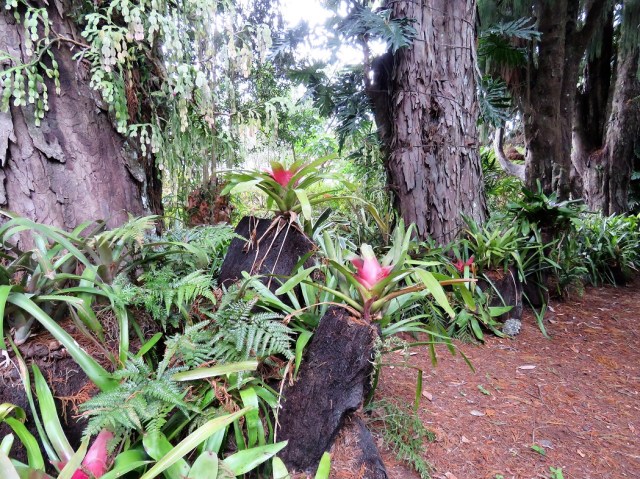
“It is as though a so-called ‘wild’ garden that mimics natural conditions is somehow worthier and more moral than one in which mankind’s creative skills are more obviously played out.

“This is puritanical nonsense.  If you want a truly wild garden then simply walk away. Leave any patch of ground completely untouched by human hand and it will happily become whatever it wants to be.

“The result might be beautiful and richly satisfying as well as very good for wildlife of all kinds, but it will not be a garden.”.

Monty Don in The Telegraph
This was the first deliberately wild or naturalistic garden I had seen, in Marlborough back in 2008. While looking very natural, the whole area had been recontoured and replanted, using native plants of the area. I loved it and how it sat in its wild landscape, even though it was not pretty and contained no elements traditionally associated with gardens. At the time, I wondered if it was a garden or a landscape; now I am happy to describe it as a garden.

I think he makes a useful distinction. I see he has been on this topic for a while. The best in show title at Chelsea Flower Show last year was won by a so-called wild garden created by two people who describe themselves as “passionate ecological restorationists”, rather than gardeners. I can’t read the whole article about Monty Don questioning whether their display was actually a garden at all because I am not willing to sign up to The Telegraph, even though they offer the first month free. I have my own standards when it comes to media. Ecological restoration is a different kettle of fish, to my mind. It involves eco-sourcing plant material (limiting plants to those sourced from local plant populations), keeping to native plants only with a purist vision of returning land to how we think it may have been in earlier times, usually prior to European settlement. Aesthetics are not a factor when it comes to ecological restoration, although the end result may well be visually pleasing to some.

Yes, we do ‘garden’ this area, but differently to other areas.

Of course, many of our weeds in this country are native wildflowers in the UK so rewilding with those may have a prettier result without being tainted by the connotations of rampant, invasive pest plants. We are a bit thin on pretty- flowered, native perennials and annuals in this country, although we have a wealth of beautiful flowering trees and shrubs and some splendid grasses.

Our personal take on wild gardening here at Tikorangi would not meet the purity test. Not by a long shot. We started the Wild North Garden with a mix of both native plants and exotics and have continued with that. We still carry out weed control. We have to in our conditions or it would deteriorate into a weedy mess in a single season. But we don’t remove every weed as we attempt to in the more tightly managed areas of the garden.

Wild gardening is NOT a case of shutting up an area and letting Nature take over, as some assume. It is not an excuse for lazy gardening. It is a different way of managing an area, a lighter hand, way less emphasis on tight control and instead viewing an area through different eyes with different expectations.  
Simple solutions, not man-made focal points

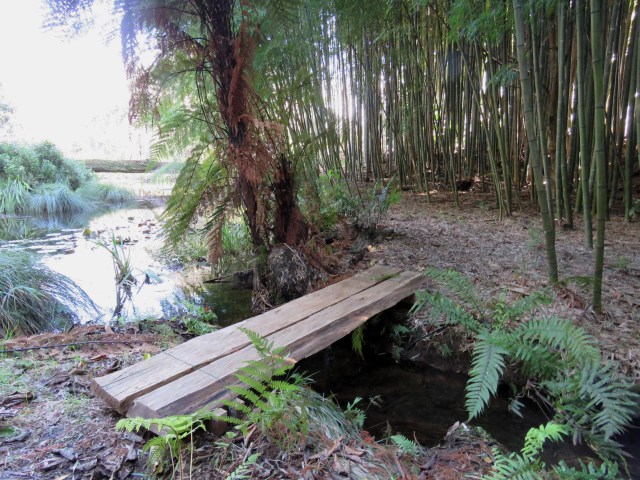
We have shunned contrived ‘focal points’ and garden features that are clearly made by human hands. The simple bridges and a couple of bench seats are the only man-made structures although, in reality, the whole area has been reshaped, re-formed and planted by human hands. We do a lot of lifting and limbing to get view shafts and a sense of distance in the area. There are no defined borders or garden beds but we continue to add plants that we think can blend in, add interest, compete with competition from other plants and survive with minimal maintenance. There is no deadheading, seasonal cutting back or staking. Management of the area – which our property title tells me is close to 4 acres or a hectare – is light-handed but manage it we do.
We do a lot of lifting and limbing of trees and shrubs to create view shafts and vistas while keeping a more natural feel.

That is what we are calling wild gardening. At a personal level, when I am leading people through the garden, I always finish up in the Wild North Garden and as I walk down the hillside to enter it, I can feel myself breathing out and relaxing. I find I talk less and more quietly. It feels different to every other area of the garden and very, very different to the more tightly maintained, detailed areas. I love that different feel.

Regenerating native vegetation on a roadside bank just north of the Tongaporutu Bridge. it was beautiful enough in the morning light to make me stop the car to look but it is not a garden.

I am with Monty Don, though. I think, by definition, a garden requires a human vision, a sense of aesthetics and human hands in its creation and ongoing management. Nature can be very beautiful and natural environments can nourish the human spirit or even take one’s breath away; Nature can establish and support an extensive ecosystem if given the opportunity. But that does not make it a garden. Wild gardening or naturalistic gardening is a human attempt to find the meeting ground between a garden and the natural environment that also fulfils a purely human aesthetic.  

This is from one of our most favourite gardens ever – Wildside in North Devon. Most of Keith Wiley’s remarkable garden is anything but wild – it is highly detailed naturalistic plantings. This was a new area he was just starting to expand into and it had that loose, soft feeling that I associate with wild gardens.

Go back

Your message has been sent

Warning
Warning
Warning
Warning

In partnership with Nature

Mark counted more than sixty rings in the cut trunk so the abies must have been planted around 1960

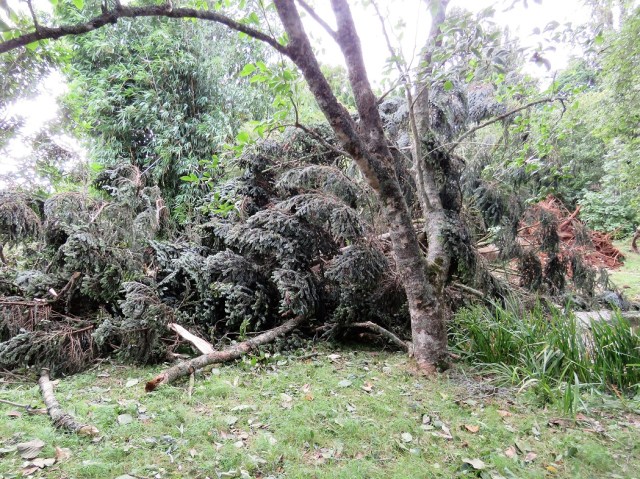
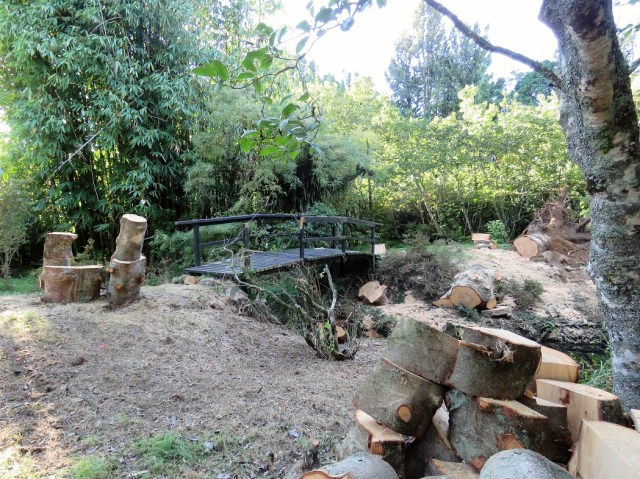
The clean-up from Cyclone Dovi is continuing here at a cracking pace. Zach started on the large, fallen abies in the park and has almost finished it. We were relieved to find that damage to the bridge beneath is minimal. A few more centimetres to one side and it could have wiped out most of the bridge. This would have been a problem for us, had it twisted the metal chassis beneath the bridge timbers.

Wisteria Blue Sapphire on the bridge has been hammered but will recover, the azalea has been extensively damaged but should also recover and Magnolia Lotus on the right lost some branches as the abies fell but the bridge just had railings broken.

Because it is right at the bottom of the park, dealing with the debris is an issue. Mark was not interested in the timber for firewood. We burned the Abies procera we dropped a few years ago but it proved to be a very light timber and we have better options. Access issues mean it isn’t practical to offer the wood to people who are less picky about their firewood and we don’t want to haul the whole lot out with our baby tractor, so creativity is required.

We debated about hiring an industrial-grade mulcher to deal with all the branches and foliage but decided in the end to burn it nearby. It leaves a dead patch in the grass but that can be resown and will disappear in a year or so. It is less work than having to disperse a mountain of wood chip in an area where we don’t need mulch.

But what to do with the lengths of trunk that can’t be left where the tree fell across the stream?

I like the shape of this fallen pine tree that perched itself up on its side branches like some freeform crocodile or giant lizard. It is decaying so it will drop at some point but that is fine.

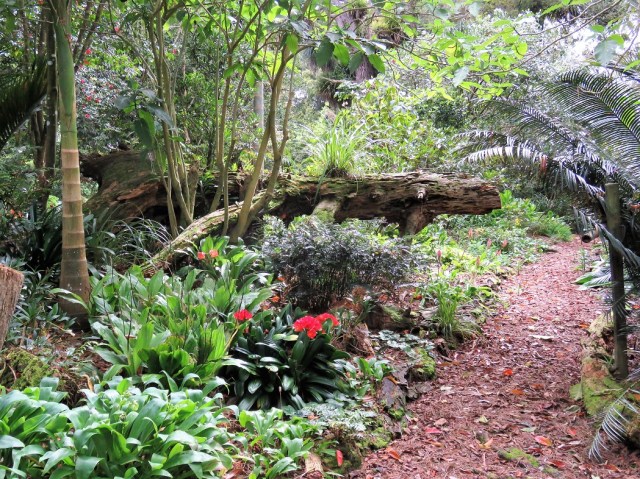
We re-use a lot of fallen material here. Suitable thinner lengths of branches are sometimes used to edge garden beds and borders where appropriate. Where we can, we clean up fallen trees, reducing them just to the main trunk and then garden around them. Over time, they rot down and start to disintegrate but that is part of the long-term cycle.

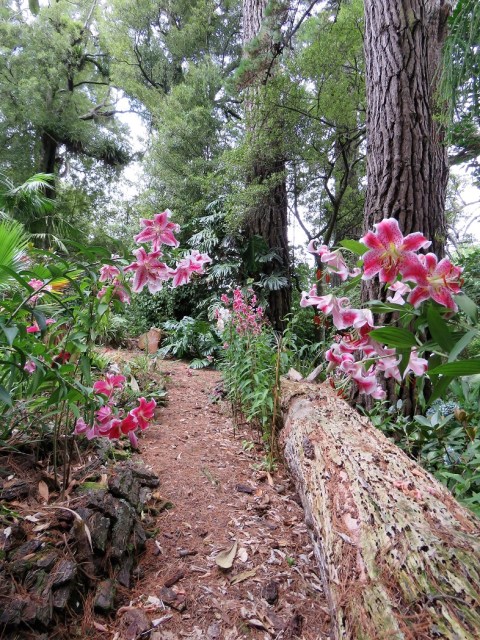
This was a substantial length of pine tree that fell and then rolled into a most convenient position on the edge of a path.

Where this is not an option, we will cut the trunks to manageable lengths, take out what we want for firewood and place the rest. Other gardens may have sculptures and installations that are clearly made by human hands; we have casual installations of wood, sometimes as stumperies and sometimes just as low-key placements.

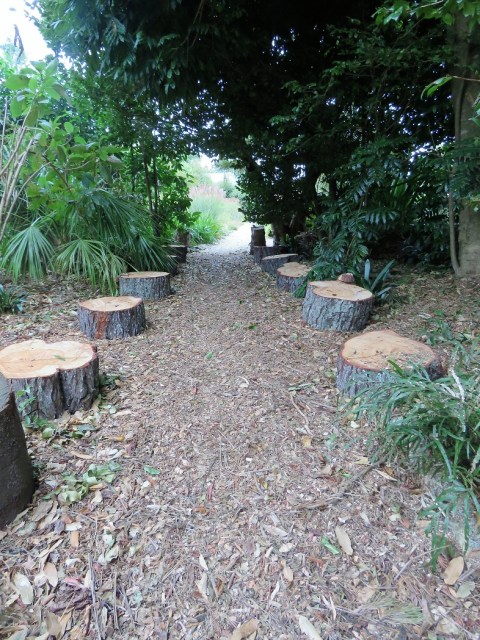
Defining the path with pine tree sections

We have already placed the pine lengths from the Avenue Gardens that were surplus to firewood replacements. At least some of the abies is destined for another use – giving height and structure to a rather casual area of planting. This is an area that has no name yet, where the Avenue Gardens transition down the hill to the park – I wrote about it once on blurring the transition from well-tended gardens to more laissez-faire outer reaches. We may have to come up with some shorthand name rather than referring to it as ‘the bit beside the steps coming down from the Avenue Gardens to the Mangletia insignis”.

Stacking lengths of abies to use in a different area

This is Mark’s vision. Neither Zach nor I can grasp yet what he has in mind, although Zach has carted abies lengths to this area in preparation. Zach and I are pretty good on placing individual bits as punctuation marks in the garden but not on creating entire structures. We will both watch and learn as it happens. I have every confidence in Mark’s skills in this endeavour

Felix used ponga logs and stumps to create his section of what we now call the Rimu Avenue

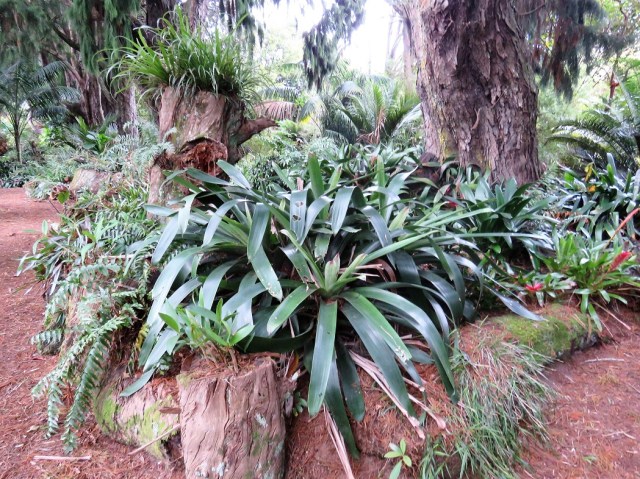
Our feature Rimu Avenue is essentially a stumpery, created as a pragmatic solution to enable plants to grow in dry shade where the enormous trees above are sucking all the goodness and moisture from the ground beneath. They are a naturalistic, raised bed solution. The oldest section was created in the 1950s by Mark’s dad, Felix and he used ponga logs and stumps (NZ tree ferns, for overseas readers). These are remarkably durable – still serving their purpose after 70 years.

Mark used whatever timber he had to hand when he doubled the length of the Rimu Avenue to give both structure and raised beds

When Mark doubled the length of the Rimu Avenue 20 years ago, he was disinclined to go out to the bush to harvest ponga so he used what we had to hand – a bit of ponga but mostly lengths of trees that have fallen here.

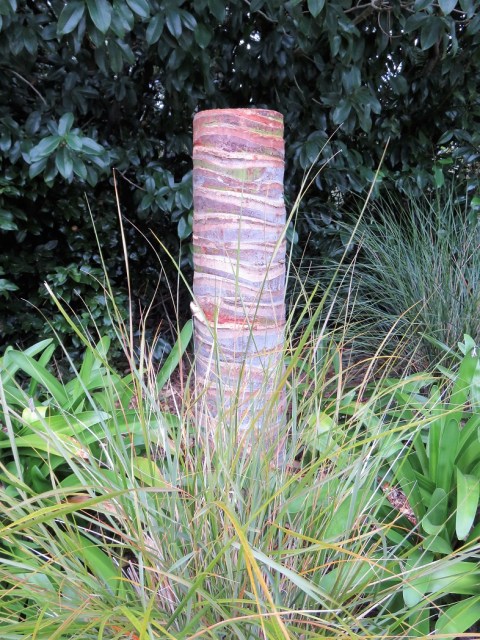
A simple feature. It will only last a few years because it is just a section of banglow palm trunk but it will decay gracefully

Somewhat unintentionally, our labour saving strategies are creating a theme throughout the entire garden – the re-use of fallen timber to create focal points, casual structure and different environments for plants as well as stowing lengths of fallen or felled trees in a way we find aesthetically and environmentally pleasing. It has been happening here for years. Cyclone Dovi has just accelerated it.

It all decays over time but don’t we all?

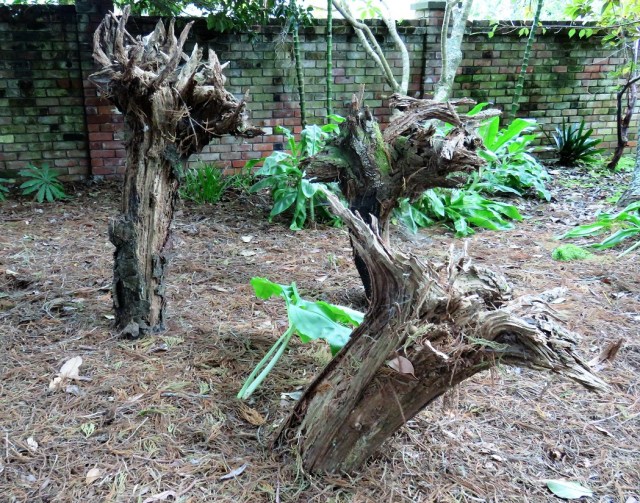
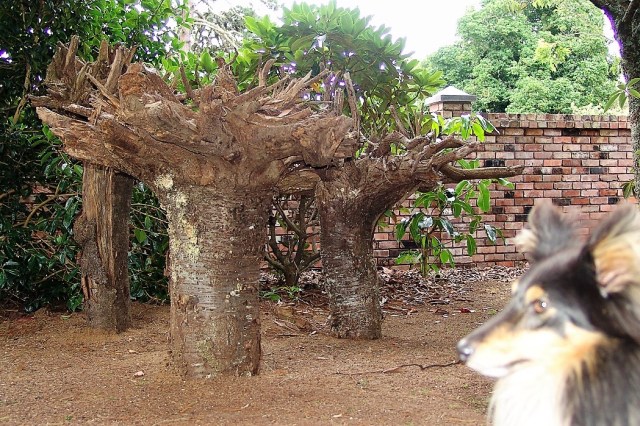
I see the date on this photo is 2004, probably very soon after Mark asked Lloyd to bury the upturned plum tree stumps to make a natural feature
In 2022 – today in fact – those stumps are getting ever smaller and less of a feature but that is part of Nature doing what Nature does.