Tag Archives: New Zealand gardening

Plant Collector: disa orchids

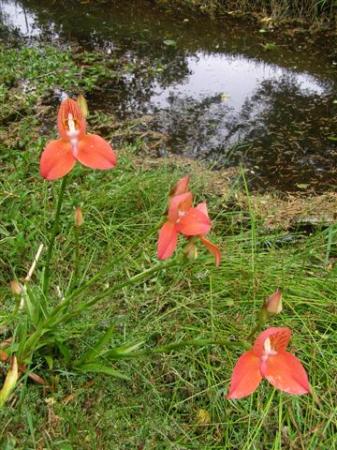
Working to naturalise disa orchids by our stream

Working to naturalise disa orchids by our stream

It was a bit of a mission earlier this week to find anything looking good after Sunday night’s fierce storm but the disa orchids held up well. Trying to get these delights naturalised on the margins of the stream which runs through our park is a recent venture. It is far too soon to decide that it is a success because this is their first season so all we can say is so far, so good. If we still have some and they are gently increasing in five years time, we will hail it as a success.

Of all the plant families in the world, orchids are by far the most complex. The sub group of disas alone has about 170 separate species and that does not take into account multitudinous hybrids. Mark is not trying to get to grips with the detail. He just accepts gratefully what local orchid expert and friend, George Fuller, gives him to try out. As far as we know, it was the dainty little Disa tripetaloides which gave us white flowers earlier in the season and these larger red ones in flower now are from the more common D. uniflora. It is the natural habitat of the disa orchids which caught our attention. They occur in damp conditions on the margins of streams and waterfalls, predominantly in South Africa. That is why we hoped they could be naturalised on the margins of the stream where they are a great deal more exotic than the thuggish yellow Primula helodoxa. You need a situation where you can control floodwaters however, as we do with a weir and a flood channel, or our frequent torrential downpours will scour out marginal plantings.

If Wikipedia is correct, the tuberous root of the disa orchid is used to manufacture maltodextrins, used in artificial sweeteners. How curious is that? Mark is a bit concerned at the absence of the Mountain Pride Butterfly here, that being the natural pollinator for D. uniflora in South Africa. We are not at all sure that our monarch butterflies, which we have in abundance, are up to taking on additional duties in this respect.

In the Garden this week: January 28, 2011

• A point of clarification from last week: if you want to try water retention crystals (Saturaid, Crystal Rain or similar) on a dry lawn, you must rake them in, not just leave them scattered on top. Otherwise you will just hoover them all up with the lawnmower.

• If you read the article on the food pages of our local paper last Tuesday about pine nuts, you may be interested to know that they are easy enough to grow here. Pinus pinea, the Italian stone pine, is the most common variety though there are other species suitable for seed (pine nut) production. However, and it is a big however, as soon as it comes to harvesting the seeds and peeling off the outer coating of each seed, you will realise why they are relatively expensive in the supermarket. You are more likely to decide that they are actually extremely cheap to buy instead.

• If you needed an extra reason to get motivated to plant a winter vegetable garden, the Australian floods may be it. Vegetables are tipped for hefty price rises this year – it is all a matter of supply and demand. So start digging. If you are working on grassed areas skim off the top layer of turf and stack it to one side to rot down. Or, if you are not determined to be organic, spray with glyphosate (formerly known as Round Up) which will also kill off most of the perennial weeds (but not clover). Current evidence is that glyphosate is safe to use when applied according to directions. It has been around for many years now so there has been time to discover lingering ill effects or contraindications.

Last weekend's rain means it is safe to return to planting out herbaceous material

Last weekend's rain means it is safe to return to planting out herbaceous material

• With the heavy rain last weekend and more forecast, we have resumed planting but only of herbaceous material, not woody trees and shrubs which will get stressed when we next dry out again. Herbaceous material is quicker to establish itself and to get its roots out and it responds much faster to watering if necessary. I have been digging, dividing and replanting an enormous clump of Ligularia reniformis (the tractor seat one) – but cautiously. It is within reach of a hose just in case.

• If your potatoes are showing signs of blight (dark brown wet patches on the leaves), you have to be in really early with a fungicide spray to stop it. If the foliage is already collapsing, it is too late. Dig the potatoes immediately and you may save some of the crop. Delay and the blight will also infect the potato tubers. You have to remove all the diseased foliage and tubers to try and stop the fungus from remaining. Either burn the affected plants, put them out in the rubbish or hot compost them. Don’t just throw them in a heap or cold compost them. It is this blight (Phytophthora infestans) that caused the Irish potato famines.

• On the grounds that a few phone calls asking the same question may indicate a landslide of curiosity out amongst the readership, I found the rolling compost maker shown in Outdoor Classroom last week at Mitre 10 Mega in New Plymouth. This is not to say that other outlets do not also have it in stock – I did not look further.