Tag Archives: outdoor furniture

My unlikely global study of outdoor furniture made from polyester resin ends in the face of corporate takeover

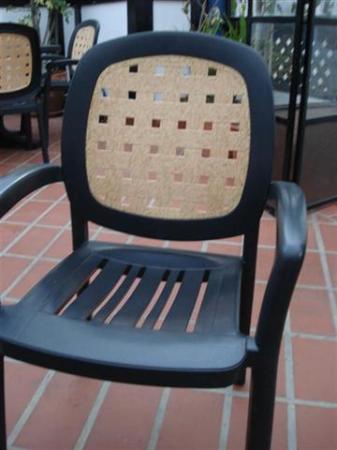
The raffia or rattan look

The raffia or rattan look

I admit my fascination with polyester resin garden furniture may place me in a small minority. My global study, superficial as it is, may make it an even smaller club. I hasten to add that this curiosity is entirely academic, or is that esoteric? I have never owned a piece of polyester resin furniture in my life and indeed have actively shunned it on aesthetic grounds but this does not stop it being a source of great amusement.

Polyester resin furniture is that cheap, plastic type which hit our stores well over a decade ago. Being low priced and functional, it pretty much took the bottom end of the market by storm as New Zealanders embraced the concept of al fresco living. In those early days, it came in three colours – white, dark green, and for those with slightly higher social aspirations, sophisticated sage green. That was it. I didn’t think about it much until we did a trip to Vietnam about eight years ago. In place of their traditional bamboo and cane furniture, there were the same polyester resin chairs and tables but not in our aforementioned colours. No, the Vietnamese ones came only in French blue and burgundy. Suddenly it dawned on me that this was a global phenomenon and somewhere, maybe, there was a little man in an office who decided which country was to get what colours. Without wishing to overstate my desultory interest, I started to take more notice. On the Sunshine Coast of Australia, polyester resin furniture was all white and cream. On the Greek islands, it seemed to come in old gold and white. Each country visited over recent years appeared to have only two, sometimes three different colours but all in the same design. So it was both a revelation and a terrible disappointment when I pursued this entirely random study in Spain and Portugal recently.
Marbelette or marbeline

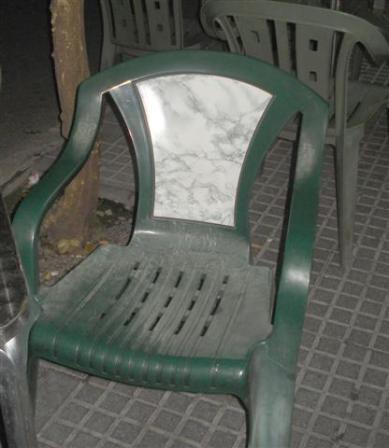
Marbelette or marbeline

The revelation was the emerging sophistication. First there was the ubiquitous resin chair (in Cordoba, for those of a pedantic disposition) which came with inset mock marble seat backs. I was entranced, though I felt they should have been Italian in origin. A marbleine finish, a friend suggested, though I thought perhaps marblette. Undeniably naff, but then so is most polyester resin furniture. Is poly resin in a swirly marble design worse than the plain, unadorned poly resin?

Then there were the poly resin chairs of a cut out design which attempted to look like the white aluminium furniture forever branded with the name Enderslea which was in itself an attempt to reproduce the expensive, antique wrought or cast iron furniture we associate with the French provincial look.

I burst out laughing when I came across the poly resin furniture in a Portugese restaurant which emulated the woven raffia look. By this stage my travelling companion, who had started out somewhat incredulous at my fascination, was entering into the spirit of the quest and arranging the furniture for my photographs. Indeed, we even found some more upmarket poly resin chairs in a roadside bar in Seville. These were in a stylish and sophisticated charcoal and a square design. These, I thought, I could actually live with in my own garden but only if necessary.
The global corporate takeover

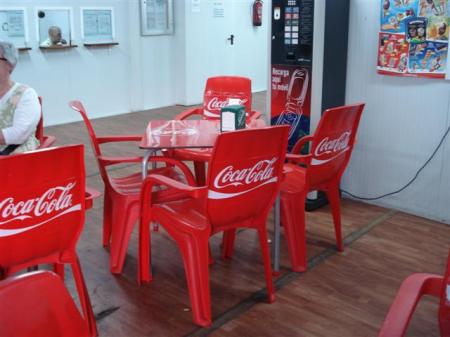
The global corporate takeover

But sadly, dear Reader, it dawned on me that my sociological study of this global phenomenon was showing too much variation for me to keep with my theory of the little man in an office determining distribution and colour. Not only that, but the true horror of globalisation and corporate sponsorship will see the end of regional diversity sooner rather later. Yes, folks, corporates like Coca Cola and Amstel have seen the possibilities of this ubiquitous furniture as cheap advertising billboards. National differences in colour are set to disappear in the face of the corporate red of Coca Cola or the Amstel colours.

Scientist daughter mentioned in passing that the production of poly resin is highly likely to be extremely unfriendly to the environment, that it is an amalgam of some real nasties and the cheaper the product is sold, the more likely it is to be produced in a country with poor environmental controls over its industry. You could argue that you shun poly resin furniture on green principles but then I always worry about how many little Indonesian orang-utan babies have been made homeless orphans by the continued harvest of Asian hardwoods so I am not sure that the bulk of outdoor wooden furniture is any more environmentally friendly. It is so very difficult to buy ethical and sustainable outdoor furniture these days, don’t you think?

The Enderslea look

The Enderslea look

The final word on this furniture came in a little garden we visited in Cornwall. The modest little afternoon tea set-up had camouflaged poly resin furniture. The tables (are they sometimes octagonal?) had pieces of hand-painted ply on top while the legs were encircled in bamboo stakes cut to size and tied together with jute. As I recall the chairs were draped in fabric and cushions. It seemed such a lot of effort to go to in order to mask the humble origins beneath but maybe she regretted the impulse which had seen her buy this cheap and practical outdoor furniture.

Almost acceptable styling

Dining al fresco – furniture options

Getting my eye in for outdoor furniture options

I see that summer officially starts on Tuesday but our thoughts turned to the first of the summer wines a few weeks ago. That is to say that I floated the idea of some new outdoor furniture for us to sit in greater comfort with glass in hand. My Mark is a man of many talents but shopping is not one of them. When it comes to larger purchases, I have to do the legwork in advance, narrow it down to a preferred option plus a back up position and then psyche us both up for a joint shopping expedition. So I have been getting my eye in on current options, both in shops and on line.

Wooden furniture largely falls into two camps: Indonesian teak and kwila (hardwoods) or Cape Cod style which is more commonly made in tanalised pine and often painted. We have an existing teak table and eight chairs which are fine but I have another use for them and I want more comfort. I have a twinge of conscience each time I look at the current furniture. I suspect an orang-utan may have been made homeless in order to supply the timber for my patio furniture. Back about eight to ten years ago when we bought it, sustainable logging was not a key selling point. Now it is a huge issue and every purveyor of Indonesian hardwood outdoor furniture from the cheapest to the considerably more upmarket outlets claims that their source is sustainably managed. Call me a cynic, but I wonder if in fact all these offshore buyers were not booked in for consecutive days to visit the one and same model plantation with the claim that it is a fine example of wonderful environmental management and their furniture is being made exclusively from timber milled from this location. The bottom line is that Indonesia’s hard wood forests are disappearing at a completely alarming rate and the timber is going somewhere. It may be optimistic to think that they are not going to supply the decking and outdoor furniture for wealthy Western al fresco living. It is more likely that sustainable logging in heartland Indonesia means cutting out the hardwood forest to replant in high yield palms.

I won’t be buying more furniture made from Indonesian hardwoods at this stage. If you have some (and who hasn’t), you may like to try extending its life by painting it with a mix of about half raw linseed oil and half turpentine. If the mix is a little thick, add more turps. The proportions are not critical. The turps helps the mix get absorbed readily and stops the timber from being sticky. Sadly, I must warn that you can’t put it in a huffer bottle and spray it on (I tried but the mix is too viscous) so you need to brush it or apply it with a rag. It will wreck the brush and if you use a rag, be cautious what you do with it afterwards because it can combust. However it is a great deal cheaper and just as effective as expensive wood preservers sold for the same purpose, though it will darken the wood.

The Cape Cod furniture is allegedly in the American style (fairly loosely speaking, I suspect) favoured on that peninsular of Massachusetts. Personally I think the common style of chair looks as if it were designed for the human equivalent of Jack Russell dogs – long in the upper leg (deep seats) but extremely short in the lower leg (close to the ground) and with a sharply angled back to the chair which looks really bad for posture. They are quite cute to look at in that picket fence sort of genre and it appears to be fashionable to have them painted in alarming garish colours, rather than in gently weathering timber but at least they are made from ethical timber.

Next is that tubular aluminium and nylon look. At its best, it is very stylish in its contemporary appearance with clean lines and it is probably very practical. At its worst, it just looks utility and cheap – and there are very cheap options from some outlets. It is not for me but if I lived in a penthouse apartment with lots of shiny stainless steel and, perspex panels and glass, I would probably feel it was entirely appropriate to the environment but I would only want the more upmarket quality of this style.

So to the French provincial look (sometimes Italian), marketed these days as shabby chic. It is usually cast iron, sometimes wrought iron and I admit I love the look. When we bought our old wooden suite, what I would really have adored was the French provincial dining table and eight chairs which was a mere $6000 close to a decade ago. It wasn’t overly comfortable, it couldn’t accommodate a sun umbrella and it certainly wasn’t practical (the heavy chairs would have been difficult to push in and out on our imperfect, outdoor surface) but it was stylish. These days the price has dropped (the quality too) and alas shabby chic has come to mean chipped paintwork in pastel colours peppered with rust. I don’t want chipped paintwork and rust and I do want comfort. Shabby chic is founded on the real McCoy – weathered by time and of undeniable quality. Repro shabby chic does not do it for me.

Finally we come to the option of African colonial which is outdoor wicker. Proper wicker is a wonderfully organic and aesthetically pleasing material (though it can descend from chic to plain shabby alarmingly quickly) but it is designed for a very dry climate. So what is on offer here is made from synthetic materials. I was surprised to find that if you buy good quality, the guarantee runs to five years which is a lot longer than I expected. African colonial probably takes the prize for all round comfort – clearly the gin drinking representatives of HM Government in that continent knew a thing or two about comfort.
We have yet to make our decision but certainly my forays on the topic have highlighted three points:

1) Like most things in life, you get the quality you pay for.
2) The really, really, really stylish options are found on the internet and are divine but out of our league altogether. I may even rather have the new car I could buy with the money instead.
3) Bringing your outdoor furniture under cover at the end of summer greatly extends the life expectancy of same.

I did not see any of the polyester resin furniture that I have maligned over a period of many years. Maybe it has gone – I wish. I will not even deign to comment on the naff swinging love seats under their own little awnings which look like a floral surrey with a fringe on top. But I would comment that the cantilevered umbrellas that are for sale everywhere this year are desirable. We haven’t owned one yet but we have used one and they completely eliminate the intrusive presence of an umbrella pole in the middle of everything. We are looking forward to being well set up shortly for the summer wines.