Tag Archives: perennial plantings

Rhythm and repetition

The borders springing into fresh growth afer their winter hiatus

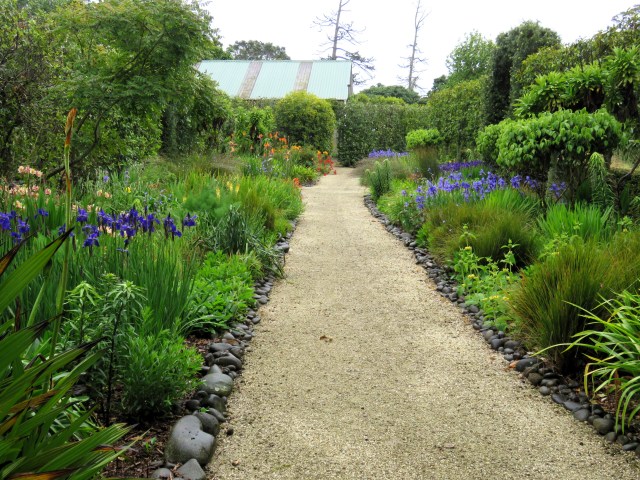
Oh my, but the summer borders are looking pretty. From being fairly empty and dull a few weeks ago, they have sprung back into life. When I planted them back in 2016, I remember muttering words like ‘rhythm’ and ‘echo’ as I was placing plants, with English designer, Dan Pearson, firmly at the front of my mind. I see I once recorded that I was working with about 120 different plant varieties in that area, starting with a blank canvas, so placing plants to achieve some continuity of rhythm was important in avoiding a mishmash. It is only this spring that I looked at it and thought, ‘yes, that continuity makes sense’.
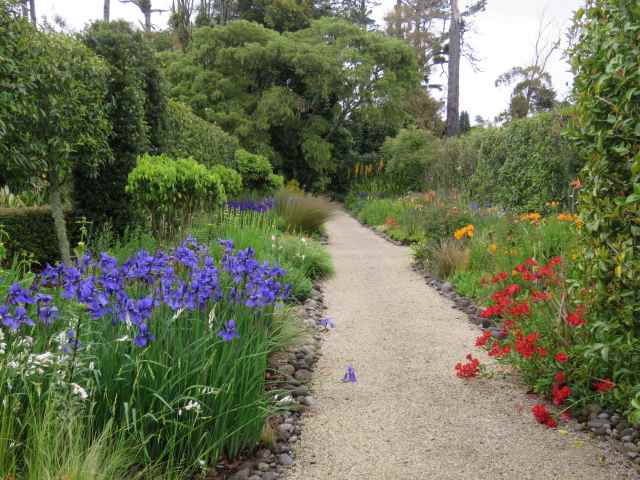
Looking back from the other end
I have highlighted in blue the patches of blue – I counted ten all up

It is the repetition of a colour, not so much the same plant, that made the whole visually pleasing. At this time of the year, it is patches and threads of blue down the length that lifts my heart. Later in summer, it will be more about orange and yellow with splashes of purple leading the eye down the full length.

Strelitzia bring the blue, orange and red together in a single, very odd bloom. When those flowers die, they always remind me of a horse’s head.

Years ago – at least twenty years, maybe longer – the oft-repeated mantra of planting was to unify a garden by repeating plants throughout. I see in 2012, I wrote a piece querying this common wisdom and asking whether in fact that repetition just makes a garden downright dull. If you are using renga renga lilies (Arthropodium cirratum),  or even clivias, then yes, it will look dull and repetitious. It is not that simple.

If you are going to use a lot of just one single plant variety repeated or threaded through a larger area, it needs to be very carefully chosen, not just what is cheap, available and easy to grow. It needs to be bold and strong enough in its own right to work visually and not just when it is in flower. I have seen it done with euphorbia which has good foliage, reasonable form and flowers that can smack you in the eyeballs. It is not my choice because I find the acid yellow a bit too strident and that is a matter of personal taste. But it can indeed keep a big perennial planting knitted together as a cohesive whole.

Not our garden. This is English designer, Tom Suart-Smith’s exquisite terrace at Mount St John in Yorkshire using clipped buxus mounds repeated through exuberant perennials.

I have seen tightly clipped shrubs used amongst perennials – usually tightly clipped buxus mounds and that can work well – better scattered randomly in my eyes than placed with mathematical precision. We have used the lesser-known Camellia yuhsienensis down one side of the borders – but only five of them. I clip and shape them but not to a uniform shape – more to keep them to a certain size and they give some winter interest when there is not much happening at ground level.
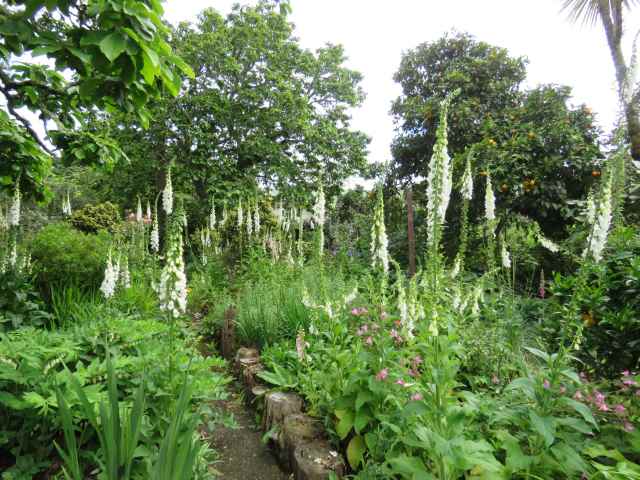
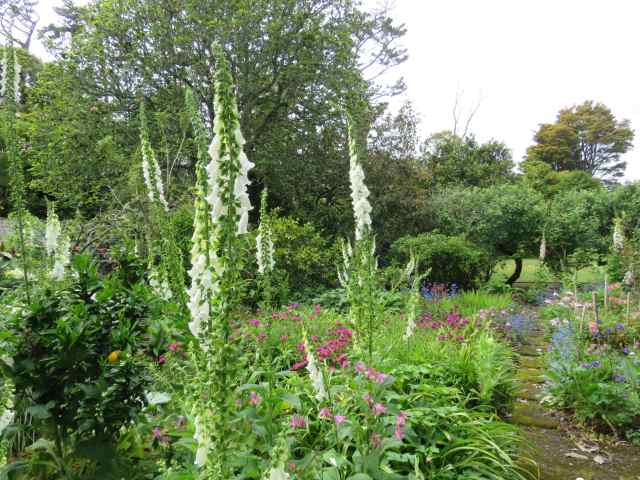
White foxgloves giving some stature and unity to the very loose plantings in the Iolanthe garden here

At this time of the year, it is the over-the-top white foxgloves that keep the loosely ordered chaos of our Iolanthe garden working visually. They are thugs, more perennial than biennial in those conditions and some are towering clumps over two metres tall, all in pure white. I need to thin them (‘edit’ them in modern parlance) because we are getting too many but those tall spires randomly spread through the area hold it all together visually. I admit the foxgloves are serendipity, not forward planning.

We watched an old documentary on the UK’s royal gardens earlier this week, and King Charles’ plant choice was tall delphiniums which are equally seasonal, a whole more work and arguably classier than my white foxgloves. He had them as the bold statement plant in many areas at Highgrove.

Iris sibirica ‘Caesar’ Brother’ in the foreground and Iris sibirica ‘Blue Moon” at the top of the photo

It is the repetition of colour that is working in our twin borders and that comes down more to rhythm than simply repeating the same plant. True, it is the bold blocks of Iris sibirica that give the mass of blue at this time of the year but they not the same variety of that iris and there are also blue bearded iris in flower and plenty of the dainty blue Orthrosanthus multiflorus, which is an Australian native that looks like a blue flowered libertia.

Orthrosanthus multiflorus is a very handy little plant

If your garden is very small, then you treat the area as a whole and picking one bold plant to thread through can certainly hold it all together visually. In a larger garden, it can make it all look the same if you insist on repeating the same plant on a much larger canvas. It is a lot more interesting to ring the changes and create different atmospheres in different areas. You can also achieve unity by repetition of form, not necessarily the same plant.

The orthrosanthus – apparently known as the morning iris – sits gently amongst the daintiest kniphofia, fennel foliage and alstromeria, adding to the thread of blue that holds the overall display together at this time of year.

Or you can do it by colour and that is what is giving me joy. I did plan it, though in my mind and not on paper, so it is not by chance or good fortune. It is even more pleasing to see a plan coming together and for me, it is about rhythm and harmony, rather than controlled repetition.
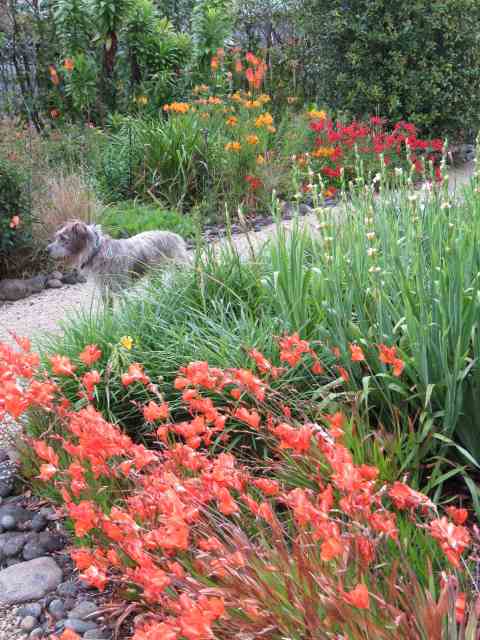
Not just blue – here we have orange tritonia echoing across the path to kniphofia and alstromerias. With Raplh, as per usual

Stripes, hedges and gardening on the flat

Striped gardening a la Monet (photo: Michal Osmenda via Wiki Commons)

Striped gardening a la Monet (photo: Michal Osmenda via Wiki Commons)

There I was last week, railing against the fad for edging plants everywhere and referencing planting in stripes. We watched a programme which we had recorded on Monet’s famous garden at Giverny. There was his striking central allée and it was planted in long stripes! But beautiful, complex stripes created with painterly style and panache.

I have yet to visit Giverny and I may have trouble motivating Mark to accompany me. Being a New Zealander, he has an abhorrence of crowds and that particular garden is renowned for packing ‘em in. That said, good friends of ours went last year, not expecting to be overly impressed, but they were blown away by it so if we are in that part of the world (an hour or so north of Paris), we will probably go. And admire planting in stripes.

It is probably no surprise that a Frenchman would go with formalised planting. The genre of parterres (regimented planting of colour on formal terraces) is closely identified with the French nobility of old. It was primarily designed to be viewed from upper windows and is essentially using flowering plants as a tool to paint patterns in stylised form, such as we see on fabrics.

Monet used more of a mix and match of colours to get the beguiling complexity we associate with Impressionist art, but if you look at the composition around that central allée, it is still geometric.

The danger is that if you over simplify it, you are more likely to end up with bedding plants arrayed in the style of the old fashioned traffic island or floral clock.

Next up came a programme we had of BBC Gardener’s World where lead presenter, Monty Don, was walking down one of the paths in his garden and lo! There was another garden in distinctive stripes. It was all dead straight. Very tall hedges either side, a middle layer of matched small bushes planted in long stripes inside, edged by buxus with a narrow path between the matched borders. There is something engaging in the simplicity of such a scene, but it is still really like a house hallway outdoors – an access way which you want to lead to somewhere more open and spacious at either end.

David Hobb's garden in Canterbury

David Hobb’s garden in Canterbury

It started a conversation here about creating a garden on a dead flat site with no established trees or structure. That is apparently what Monty Don did and he went with masses of clipped hedges to give form. I saw the same strategy in large Christchurch gardens on the flat. These hedges gave both structure and protection from Canterbury’s winds which can howl across the plains.

Mobile hedge-trimming platform from Trotts Garden in Canterbury

Mobile hedge-trimming platform from Trotts Garden in Canterbury

Ever practical gardeners, we could see difficulties in the longer term. In order to get good structure, you need to let the hedges grow tall – around the 4 metre mark in large spaces. Formal hedges need trimming at least once a year, more often if you want clean crisp lines. If you get the mechanical hedge trimming contractors in, you have to keep a vehicle path width down either side of the hedge. If you do it yourself, you need mobile scaffolding, a good eye and the determination to get it right. It is not a path we would choose to go down ourselves. There are more fun things to do in the garden than endless hedge trimming. These may not be gardens to grow old in, unless you can afford the labour to carry out the trimming.

The alternative in large flat gardens is to plant good long term trees with sufficient space to grow to reach their potential. They can give the structure and form in the long term and as long as you choose well, they are not going to need anywhere near the regular maintenance of the formal hedge.

Next, on the long, wet weekend, we reviewed yet another of the gardening programmes we had saved. This time it was the UK’s longstanding and vastly experienced garden presenter, Alan Titchmarsh (a refreshingly unpretentious Yorkshireman) with his Love Your Garden series. One episode showed a simply astounding, verdant, lush forest on a very traditional, flat, rear section.

If you have ever seen British suburbia, the British equivalent of our traditional quarter acre section is a narrow plot which is the width of the semi detached or terraced house (in other words, two rooms wide if you are lucky) with a small front area and a longer rear area. This was one of those. I think Alan Titchmarsh said it was 30 metres long but it can’t have been more than 8 metres wide, if that.

The gardening owner had taken this long, thin rectangle and entirely disguised it. The main device was a zigzag wall structure running diagonally across the yard which had then been planted heavily. The foliage hid the wall but that structure turned a blank, open canvas into a much more complex design with different conditions in which to grow plants. Against the odds, there were hidden areas to be discovered and the garden was not visible at any point in its entirety (except, presumably from an upstairs window).

You can take a dead flat, unprepossessing piece of ground and turn it into something surprising and deceptive if you have flair. But then you can take planting in stripes and turn it into something special as well, if you are another Claude Monet.

First published in the Waikato Times and reprinted here with their permission.