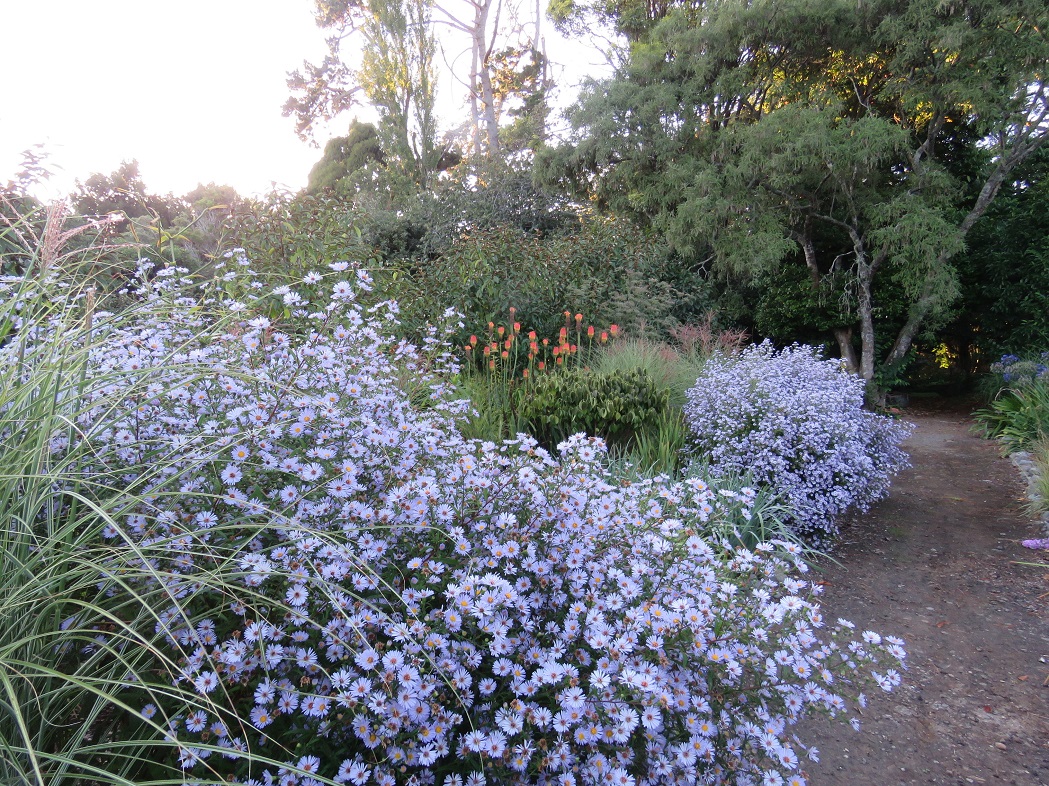
I don’t know its name. I am guessing it is a species.
Remember this pretty aster I showed in March? I loved its profusion and lightness. So did the bees and butterflies love it. But I was worried that it was too large and too dominant immediately by the path so set out to reduce its bulk and spread. That was illuminating. The initial divisions that I had planted were now so dense I had to cut them into squares to get them out but that was fine. What worried me was how far and how fast it was s p r e a d I n g. It had probably colonised its way out about a metre all around by sending out long runners below ground. The runners will put up a small rosette of leaves maybe every 20cm but they keep running and they are certainly aren’t going to let the roots of other plants deter them. Nor indeed were the stone edging or compacted path a deterrent.

That is about two years of growth in the pink tub and on the path and just from one patch.
By the time I came to the second clump, I decided on total elimination and that turned into quite a major operation. The first clump, I just tried to reduce and thin somewhat but I am pretty sure I may have to carry out more drastic action next year.
I am trying some in a confined drum and will see how that works. It is such a lovely plant in leaf and flower that I want to keep some of it but I really don’t want it invading large areas. Come to think of it, it may be the same aster that took over the Missouri Meadow at Wisley, choking out most of the other plants.
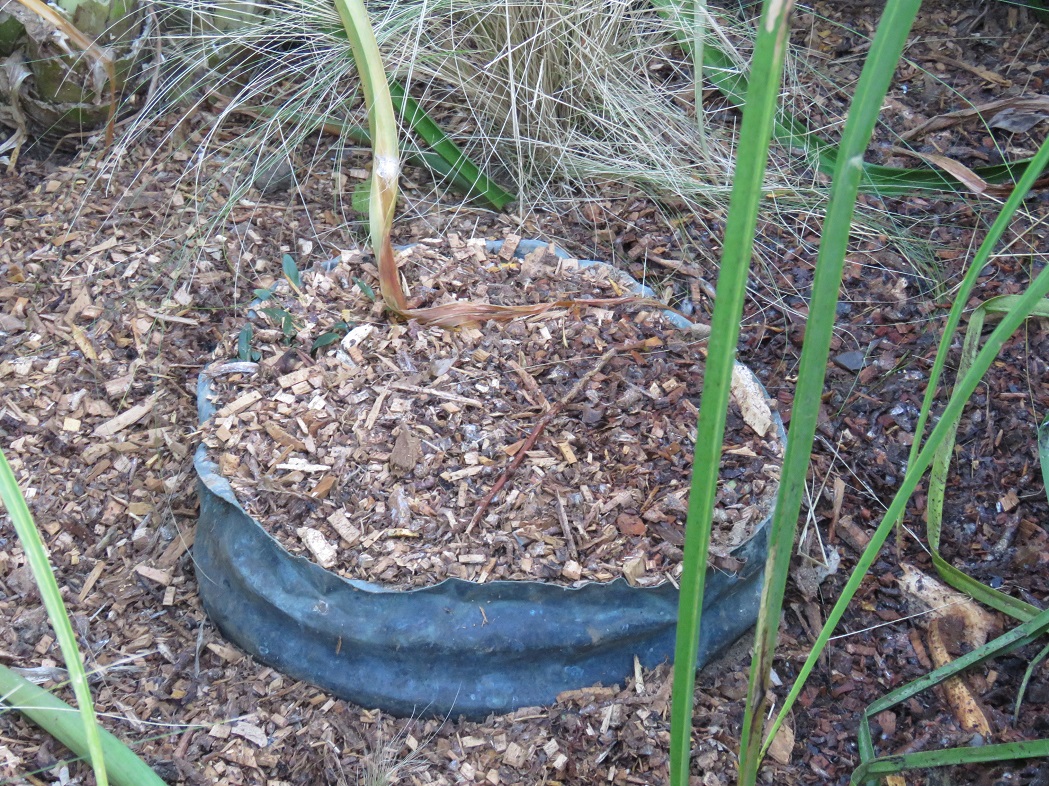
We inherited several old tanks with holes in the bottom that I am now using to contain plants that look dangerous
We are extremely cautious about invasive plants in our garden. Make that our country, not just our own garden, because garden escapes of invasive plants are a major problem in the wild. I like to shock overseas gardeners by telling them that it is actually illegal to grow the giant gunnera where we are in Taranaki. It became a noxious weed on the coastal cliff tops near Opunake where eradication was such a huge issue it was banned altogether. Our soft, warm-temperate climate makes plants which may be called ‘vigorous’ or ‘strong growing’ in harsher climates downright invasive pests here. And it is not just gunneras. Agapanthus, flag iris, campanulata cherries, the bangalow palm (Archontophenix cunninghamiana) , erigeron daisy, pampas grass, perennial sweet peas, Fuchsia boliviana – our country is littered with plants that are a great deal more prized overseas but either discouraged, banned from sale or banned entirely in some areas here.
My gardening friend from Christchurch, Robyn Kilty recommended Calamgrostis ‘Overdam’ as a possible alternative to C. ‘Karl Foerster’ which had become dangerously strong growing here. I looked it up and found I can indeed buy it but the description from one producer included the terrifying words ‘may be invasive’. Make that ‘will be invasive’ in our conditions. Where Robyn gardens in Christchurch, such plants are not a problem with their cold winters and hot dry summers which restrict growth. There is no such brake on their growth here.
Some plants invade by seeding too freely. To some extent, that can be controlled by dead heading if the plants are lower growers. We dead head most of our agapanthus here and I dead head the likes of crocosmias. Or choosing sterile varieties can eliminate the seeding problems, especially when it comes to trees.
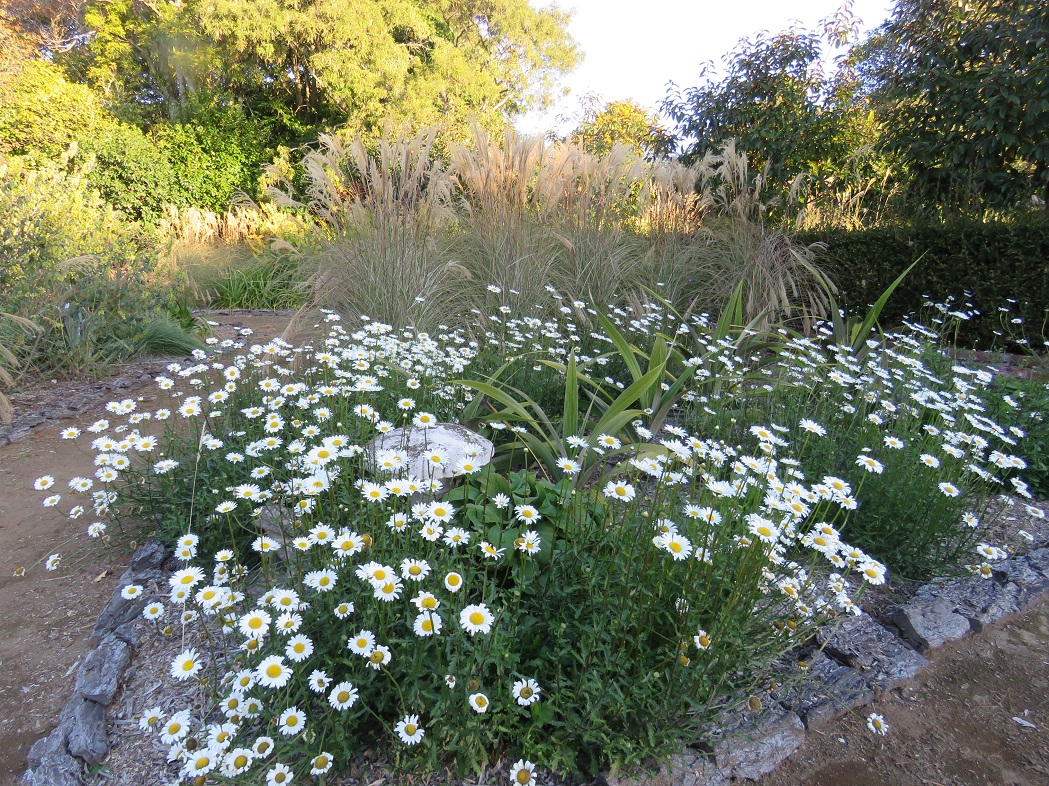
This white daisy – name unknown – is vigorous without being invasive. If cut back hard, it flowers a second and even third time which is very obliging of it.
Some plants invade by putting out runners along the ground which then make roots. Wisteria are a prime example of this and believe me, you do not want to plant wisteria unless you are willing to restrict them and prune them at least once a year. Somebody once told me that the largest plant in the world is a wisteria which has layered its way along. I have no idea if that is true but I wouldn’t be surprised.
And some plants, like the aster (and indeed the calamgrostis) invade by determinedly spreading their roots below the ground. They are way more problematic though you can resort to spraying with herbicide if you use it. The underground spreaders tend to be very strong indeed, choking out the competition and getting their roots intertwined with anything in their way.
I have kept six plants of Calamagrostis ‘Karl Foerster’ to see if I can contain them by root pruning them once a year with a sharp spade. I think I discarded 18 of them and digging those out was a major effort, I tell you, after only one year in the ground. I had to barrow in quite a few loads of soil to fill the holes that were left.
Mark is going to try some of the aster down in the park meadow where the competition from other plants is greater and the area is mown twice a year so that may curb the rampant growth. If it doesn’t, he will have to reach for the herbicide.
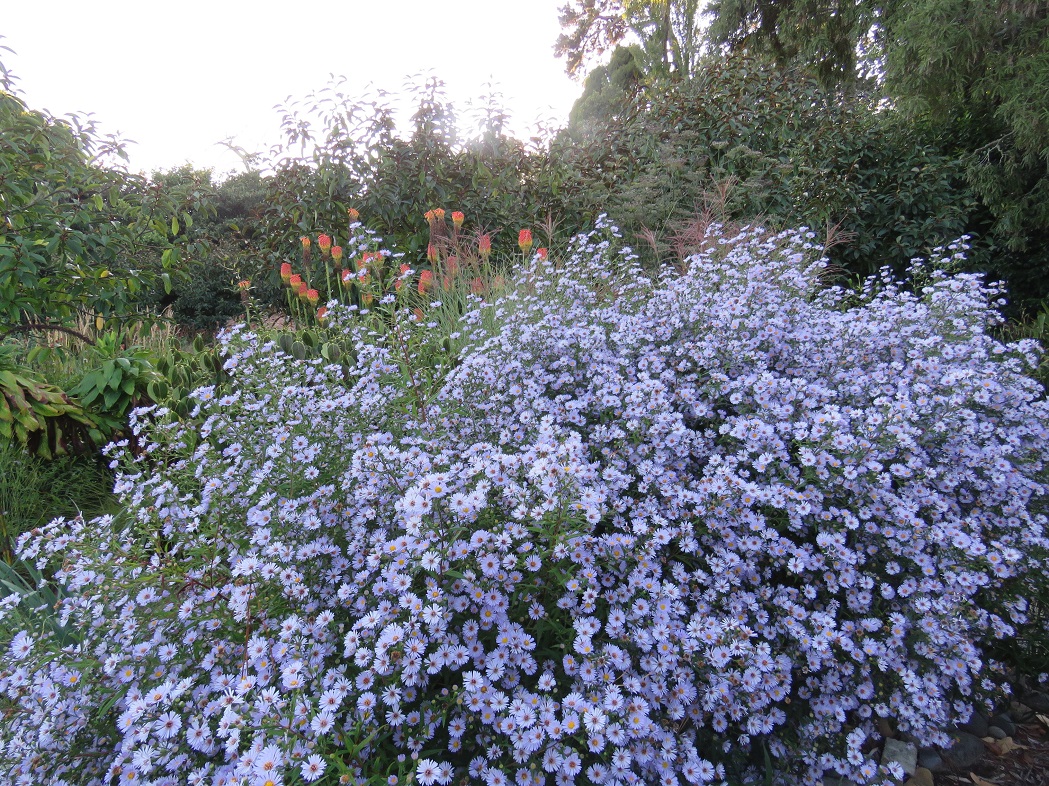
A profusion of aster that looked as though it had the potential to turn into a takeover by aster

 Tikorangi The Jury Garden