The need for a Christmas tree became pressing. I admit that when none of the children get home for Christmas, I tend to skip that festive accoutrement. Our three all live overseas these days. But with two of them making it back this year, one with partner and daughter who was a baby last time I saw her in May but is now very much a small child, there was clearly a need for a decorated tree.
Family tradition decrees that said Christmas tree can not be a) purchased or b) a fake tinsel affair. It must be harvested or repurposed from home. This has led to considerable variation in size and type down the years.

In the warmer parts of Aotearoa New Zealand, the pohutukawa (Metrosideros excelsa) is firmly established as the iconic ‘New Zealand Christmas tree’ but it does not lend itself to cutting to bring indoors. It is an outdoor tree. Being one of the few trees that will grow right on the coast, even on crumbling, eroding land, tolerating both wind and salt spray, it is widely grown as a street tree, on golf courses, as shelter belts and generally all round the place. Its flowering season may be short but it always comes in the lead-up to Christmas.
Pinus radiata is the main choice for Christmas trees here – quick-growing, expendable, suitable foliage and the Christmas pine scent. Christmas tree farms supply them as dense, clipped pyramids but wild collected specimens or just branches are generally more sparse. Mark has been known to wire in extra pieces to fill out bare spaces. It used to be a time-honoured tradition that families would head out to the country to harvest a tree or branch from the roadside but I am not sure that still goes on since tree farms made better specimens easily available, albeit at a price. That practice of wild collection had the potential to go wrong, of course.
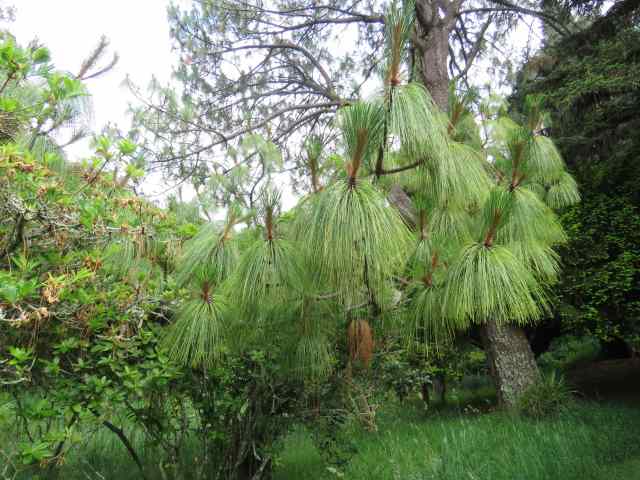
We lacked even a wilding pine to harvest this year. What could we use? The first plan was to retrieve some of the huge branch of Pinus montezumae which has split but not yet fully snapped off the tree in our park. I could see it would be messy and we would have to be creative in wiring in extra pieces because it is sparse when viewed close-up. But I felt sure a collective effort would see us equal to the task.
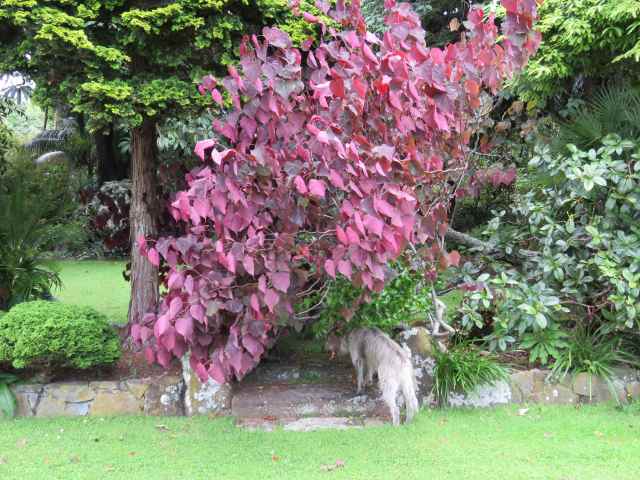
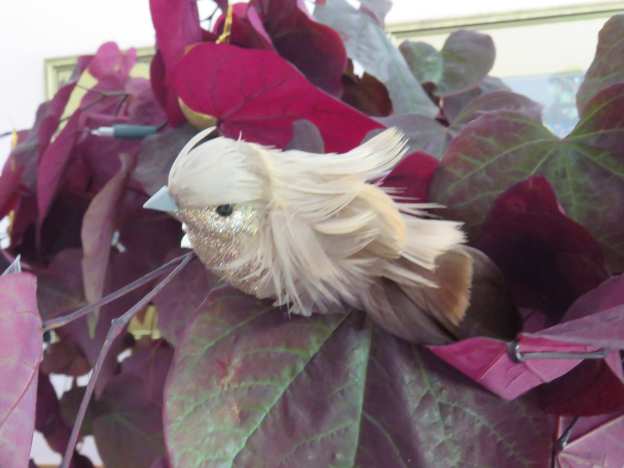
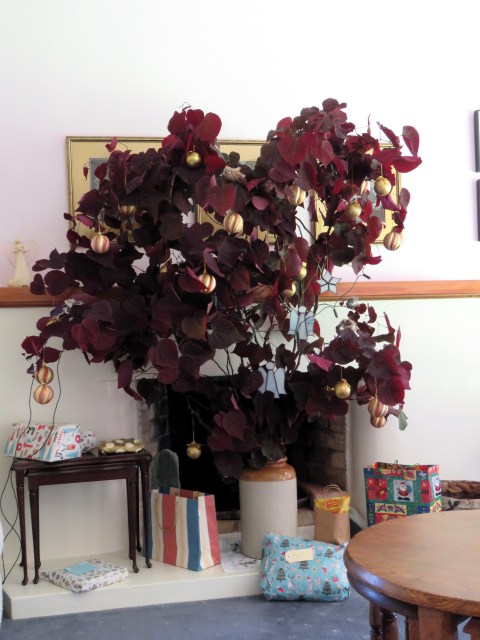
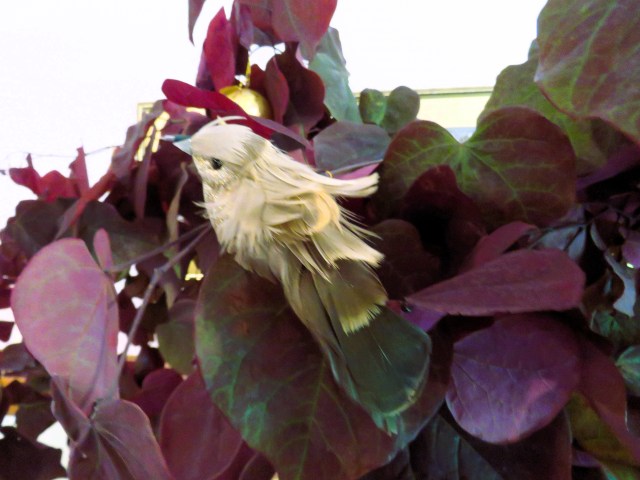
Then the Cercis ‘Forest Pansy’ fell over. It seems to have root problems and it hadn’t even been windy when we noticed it down. It seemed more manageable than the Montezuma Pine although Mark doubted its capacity to take up enough water to keep it alive when cut off. So far, so good. It only has to last another three days so I think it will make it. It is nicely colour-toned to our pink sitting room; it cost nothing either in dollar terms or in environmental impact. It is just not your traditional Christmas tree. I had to bypass all the small decorations because of the big foliage so the decorative aspects are… restrained, shall I say? Golden balls, feather birds and my glass decorations I made back in the days when I was a moderately competent leadlighter and copper foiler and the remaining Christmas lights.

Lloyd and Zach took 90% of the foliage and branches off the remaining cercis and propped it back up. Only time will tell if it can recover.
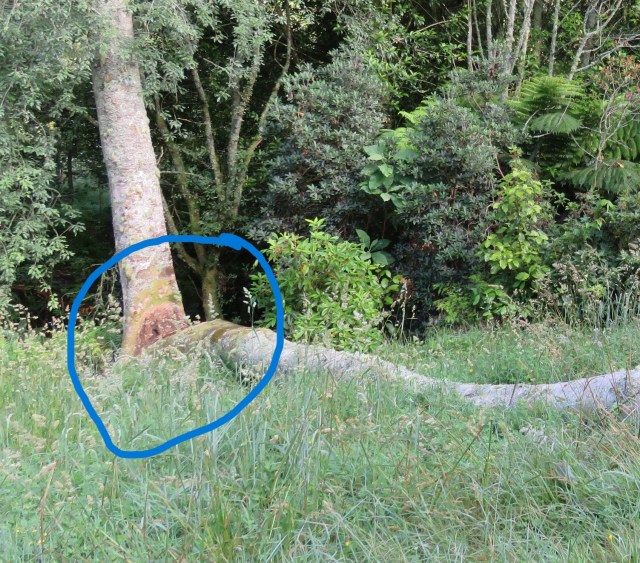
Despite the fact that we have had settled, calm weather recently, we have had more than the cercis and the Montezuma branch fall. I include the tree of heaven (Ailanthus altissima) which lost a trunk last weekend. It is a quick growing tree and something of a weed so it is no loss. But you can see how a trunk split out at the base and it is a good example of why trees should be kept to a single leader from the very start.
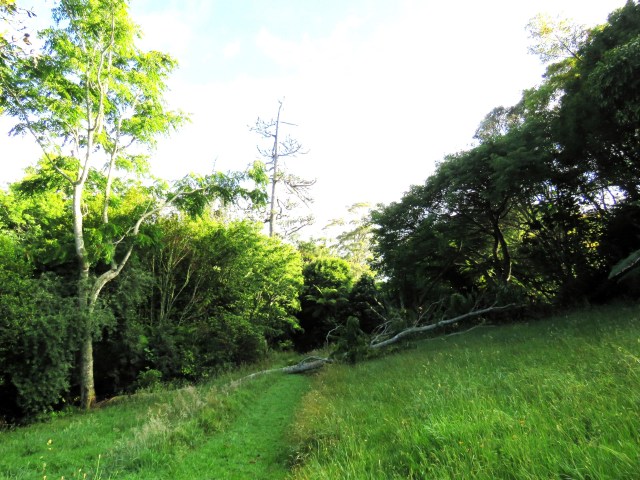
The wood is too soft and light to be of any use. Lloyd has cut it into manageable lengths and at some stage soon, Zach will create one of his natural compositions in a wooded areas where they can stand as random uprights and start the process of rotting down to return to the soil.

May you and those close to you find happiness and congeniality in the festive season. Here, in Aotearoa with our summer Christmas, the country has already started the big shut down when some people at least can breathe out, indulge too much, relax and take time out as much of the country closes down for the next few weeks.


 Tikorangi The Jury Garden